

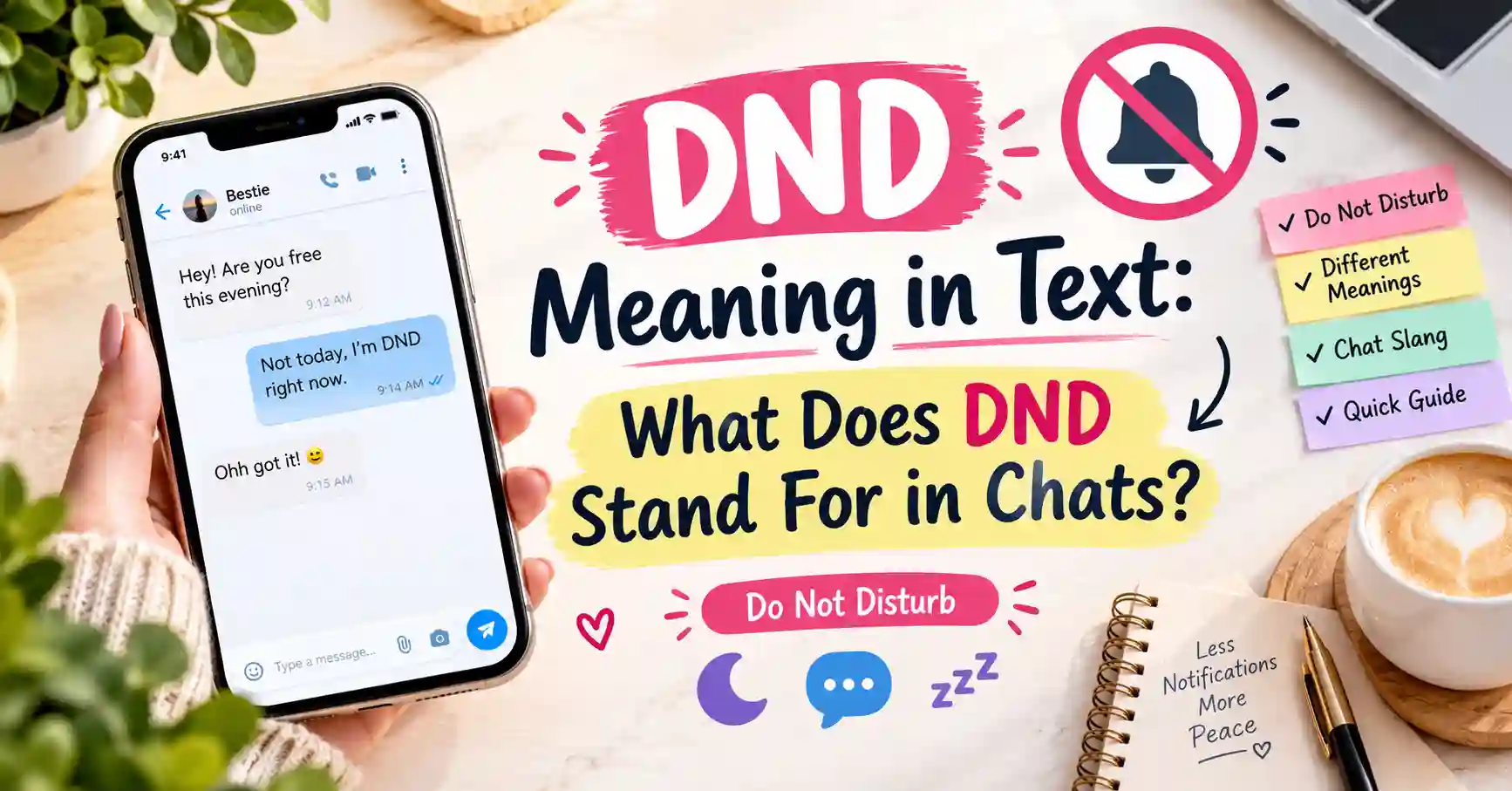
You get a message that says “I’m on DND.” What does it mean? Is the person angry? Are they busy? Are they ignoring you?
Don’t worry. The DND meaning in texts is simple. DND stands for “Do Not Disturb.” People use it to say, “Please don’t contact me right now.”
In this guide, you will learn where DND came from and how people use it in chats. You will see how it works on different apps and what the other meanings are. You will also learn how to reply the right way. Let’s start with the basics of the DND meaning in text.
What Is the DND Meaning in Text?
DND stands for Do Not Disturb. It is a short way to say you are unavailable. You want no calls, no alerts, and no interruptions.
You can use it in two ways.
1. As a message.
You type it yourself.
- “Going into a meeting. DND until 3.”
- “DND tonight. Exam tomorrow.”
- “On DND. Text me later.”
2. As a phone or app setting.
You switch it on, and your device goes quiet. No sounds. No buzzing.
Both uses mean the same thing. The person needs peace and focus. It is not rude. It is a boundary.
Here is the quick answer for anyone in a hurry:
- Full form: Do Not Disturb
- DND meaning in text: “I’m busy. Please don’t message or call.”
- Tone: Neutral and polite
- Common places: Text messages, WhatsApp, Discord, Slack, Teams, phone settings
Where Did “Do Not Disturb” Come From?
The phrase is much older than smartphones. Hotels used it first. For decades, hotels have hung “Do Not Disturb” signs on room doors. The sign tells staff to stay out. Guests want to sleep, rest, or work in peace.
Offices borrowed the idea next. People put signs on doors. Some hung them on cubicle walls. The message was always the same: “I’m focused. Please wait.”
Then technology took over. Landline phones and early mobile phones added silent modes. Instant messengers followed. Programs like Skype and MSN let users show a status. One of those statuses was “Do Not Disturb.”
Later, smartphones made DND a standard feature. Today almost every phone has it. Almost every chat app has a version of it too.
So the idea grew from a hotel door sign into a digital habit. The goal never changed. It is a quick way to protect your time.
How People Use the DND Meaning in Text Messages and Chats
In daily chats, DND is a quick status update. It saves time. You don’t need a long explanation.
Common Examples
Here are real-life ways people use it:
- At work: “In a client call. DND for an hour.”
- Studying: “DND mode on. Finals this week.”
- Sleeping: “Heading to bed. DND till morning.”
- Traveling: “On a flight. DND until I land.”
- Personal time: “Need some alone time. DND today.”
- Gaming or streaming: “Live on stream. DND please.”
Why It Works
DND works because it is short. Three letters say a lot. They also set a clear limit without sounding harsh.
Compare these two messages:
- “Stop texting me. I’m busy.”
- “I’m on DND for a bit. I’ll reply later.”
The second one is much friendlier. It tells the other person you will return. It does not push them away. That is why the DND meaning in text is seen as polite, not cold.
Capital Letters or Lowercase?
Both are fine. You will see “DND,” “dnd,” and “DnD.” Most people use capitals for the status. Lowercase feels more casual. The meaning stays the same.
DND Meaning in Text on Different Apps and Devices
DND is not one single feature. Each app handles it a little differently. Here is how it works on the most popular platforms.
DND on iPhone
Apple used to call it “Do Not Disturb.” In newer versions of iOS, it became part of Focus. Focus lets you create modes, such as Work, Sleep, or Personal. Do Not Disturb is still one of them.
When you turn it on:
- Calls and alerts go silent.
- You can allow certain people to get through.
- Some contacts can see that your notifications are silenced in Messages.
DND on Android
Android phones have a “Do Not Disturb” setting too. The exact menu name can change by brand. Samsung, Google Pixel, and Xiaomi all look slightly different.
With it, you can:
- Silence calls, messages, and app alerts.
- Set a daily schedule, such as 10 PM to 7 AM.
- Allow calls from starred contacts.
- Let repeat callers through, in case of an emergency.
DND on Discord
Discord shows a red circle for Do Not Disturb. When you pick this status, you won’t get desktop notifications. Your friends see the red icon. They know you are busy.
Gamers use it often. It helps during matches, streams, or work hours.
DND on Slack
Slack has a “Pause notifications” feature that works like DND. You can pause alerts for 30 minutes, an hour, or longer. You can also set a daily schedule. Teammates can still send you a message. They just won’t ping you right away. Slack also lets people choose to notify you anyway if something is urgent.
DND on Microsoft Teams
Teams has a status called Do not disturb. It shows a red icon. Most notifications are silenced. You can allow a priority list of people to break through.
DND on WhatsApp
Here is a common point of confusion. WhatsApp does not have a built-in DND status. You can’t mark yourself as “Do Not Disturb” inside the app.
Instead, people do three things:
- Turn on DND on their phone, which silences WhatsApp alerts.
- Mute individual chats or groups.
- Type “DND” in a message or in their About section.
So if someone writes “DND” on WhatsApp, it is a manual note. It is not an official setting.
DND vs. Other Status Terms
People often mix DND up with other settings. They are not the same. This table shows the differences.
| Term | What It Means | Do You Get Alerts? |
| DND | You want zero interruptions | No (or very few) |
| Busy | You are occupied, but may reply | Often yes |
| Away | You stepped away from your device | Usually yes |
| Silent mode | Sound is off | You may still see alerts |
| Airplane mode | All wireless signals are off | No calls or data |
| Offline/Invisible | You hide your status | Varies |
The Key Difference
Silent mode only stops the sound. Your screen may still light up. DND is stronger. It blocks the sound, the vibration, and often the visual alert.
Airplane mode is stronger still. It cuts the connection completely. DND keeps you online. You just aren’t bothered.
Other Meanings of DND in Text You Should Know
Context matters. In some chats, the DND meaning in text is not “Do Not Disturb.” Here are the other uses.
Dungeons & Dragons (D&D, DnD)
This is the biggest alternative. D&D is a famous tabletop role-playing game. Players create characters. They go on quests. A “Dungeon Master” guides the story.
Fans often type it as “DnD” or “DND.” Look at these examples:
- “Are you free for DND on Friday?”
- “Our DnD group needs one more player.”
- “I’m making a new DND character.”
If the chat is about games, friends, or hobbies, the person likely means the game.
Department of National Defence
In Canada, “DND” is a common short form for the Department of National Defence. You will see it in news and official papers. It rarely appears in casual texting.
How to Tell the Difference
Ask yourself these questions:
- Who is sending it? A gamer friend probably means the game.
- What is the topic? Plans and hobbies point to Dungeons & Dragons.
- What is the status? A red icon or a “busy” note points to Do Not Disturb.
- Is there a time? “DND till 5” means Do Not Disturb.
When in doubt, just ask. A quick “DND as in Do Not Disturb, or Dungeons & Dragons?” clears it up.
How to Reply When You See the DND Meaning in Text
Good manners matter here. A person who says DND has asked for space. Respect it.
Do This
- Wait. Give them time. Don’t send repeated messages.
- Keep it short. If you must text, be brief.
- Say it’s not urgent. Add “no rush” so they feel no pressure.
- Check back later. Reach out after their stated time.
A Few Sample Replies
- “No problem. Talk later!”
- “Got it. Ping me when you’re free.”
- “Good luck with the meeting!”
- “Sleep well. We’ll chat tomorrow.”
Don’t Do This
- Don’t spam them with messages.
- Don’t call again and again.
- Don’t take it personally.
- Don’t assume they are upset.
What About Real Emergencies?
Sometimes you truly can’t wait. In that case, use the emergency options. Many phones let repeat callers through. If you call twice within a few minutes, the second call may ring. You can also text first: “Urgent. Please call me.”
Use this only for real problems. Don’t abuse it.
How to Use DND the Right Way
DND is a useful tool. But it works best when you use it well. Follow these tips.
1. Tell People in Advance
Don’t just vanish. Send a quick note. “DND from 2 to 4 for deep work.” People then know when you’ll return.
2. Give a Time Limit
A time limit lowers worry. “DND till 6 PM” is better than a silent disappearance.
3. Set a Schedule
Use the automatic schedule on your phone. Turn it on at night. Turn it off in the morning. You won’t need to remember.
4. Create a VIP List
Allow certain people through. Family, a boss, or a school is a good start. Then a true emergency can still reach you.
5. Turn It Off When Done
Many people forget this step. They leave DND on all day. Then they miss important calls. Check your settings often.
6. Pair It With a Goal
Use DND for a reason. Study. Write. Exercise. Rest. The feature is only helpful if you use the quiet time well.
Pros and Cons of Using DND
Like any tool, DND has good and bad sides.
Pros
- Better focus. Fewer alerts mean fewer distractions.
- Better sleep. Night pings no longer wake you.
- Less stress. You control when you respond.
- Clear boundaries. People learn your limits.
- Higher productivity. Deep work becomes easier.
Cons
- Missed messages. You may miss something important.
- Missed calls. Emergencies can slip through.
- Misunderstandings. Friends may think you are ignoring them.
- Delayed replies. Teams may wait longer for your input.
The Balance
The answer is not to avoid DND. The answer is to use it wisely. Set a schedule. Make a VIP list. Tell people what is happening. Then the pros far outweigh the cons.
Common Mistakes People Make With DND
Even simple tools get misused. Watch out for these errors.
- Leaving it on forever. You miss calls you needed.
- Not telling anyone. People think you are ignoring them.
- Blocking all contacts. Family emergencies get lost.
- Confusing it with silent mode. The two settings behave differently.
- Using it to avoid hard talks. DND is for rest, not for dodging.
- Forgetting app settings. Some apps ignore your phone’s DND unless you allow it.
Fix these, and DND becomes a real help.
The Future of DND and Digital Boundaries
We live in a world of constant alerts. Phones buzz all day. Work chats never stop. People now speak openly about digital wellbeing.
Because of this, DND is growing smarter. Modern devices already offer:
- Smart schedules that adjust to your routine.
- Focus modes tied to work, sleep, or study.
- Auto-replies that tell senders you are busy.
- App-based rules that silence only certain apps.
Expect more of this in the years ahead. Phones will likely learn your habits better. They may switch DND on without being asked. Workplaces are also paying more attention to the right to disconnect. Many companies now encourage staff to protect their off-hours.
The message is clear. Boundaries are becoming normal. Saying “DND” is no longer rude. It is healthy.
Conclusion
Now you know the DND meaning in text. It stands for Do Not Disturb. It means a person is busy and wants no interruptions for now.
Here are the key takeaways:
- The DND meaning in text is “Do Not Disturb.” It works as a typed message and as a phone setting.
- The idea came from hotel door signs.
- Apps like Discord, Teams, and Slack have their own versions.
- WhatsApp has no official DND status. People type it or mute chats.
- DND is different from silent mode, busy, and airplane mode.
- In gaming chats, DND often means Dungeons & Dragons.
- The best reply is simple. Wait, stay polite, and follow up later.
- Use DND with a schedule, a VIP list, and a clear time limit.
Understanding what DND stands for in chats helps you avoid confusion. It also helps you set your own limits with confidence. The next time you see “DND,” you will know what to do. Respect the pause. Then reconnect when the time is right.
Frequently Asked Questions (FAQs)
1. What does DND mean in text messages?
The DND meaning in text messages is “Do Not Disturb.” The sender is busy and doesn’t want calls or messages for a while. They will usually reply later.
2. Is DND rude?
No. DND is a polite way to set a boundary. It is not rude, especially when you add a time or reason. For example: “DND till 5. In a meeting.”
3. What is the difference between DND and silent mode?
Silent mode only turns off the sound. Your screen may still light up with alerts. DND blocks sounds, vibrations, and often visual alerts as well. It can also use schedules and allow certain contacts through.
4. Does DND block calls and messages?
DND does not block them. It silences the alerts. Calls and messages still arrive. You can see them later. You can also allow chosen contacts or repeat callers to get through.
5. Can the other person see that I’m on DND?
It depends on the app. On Discord and Teams, your status shows a red icon. On some phones, certain contacts may see a notice that your notifications are silenced.
6. Does the DND meaning in text change in gaming chats?
Yes. In gaming and hobby groups, DND usually means Dungeons & Dragons. It is often written as “DnD.” Check the context. If people talk about characters, quests, or game night, it refers to the game.
