
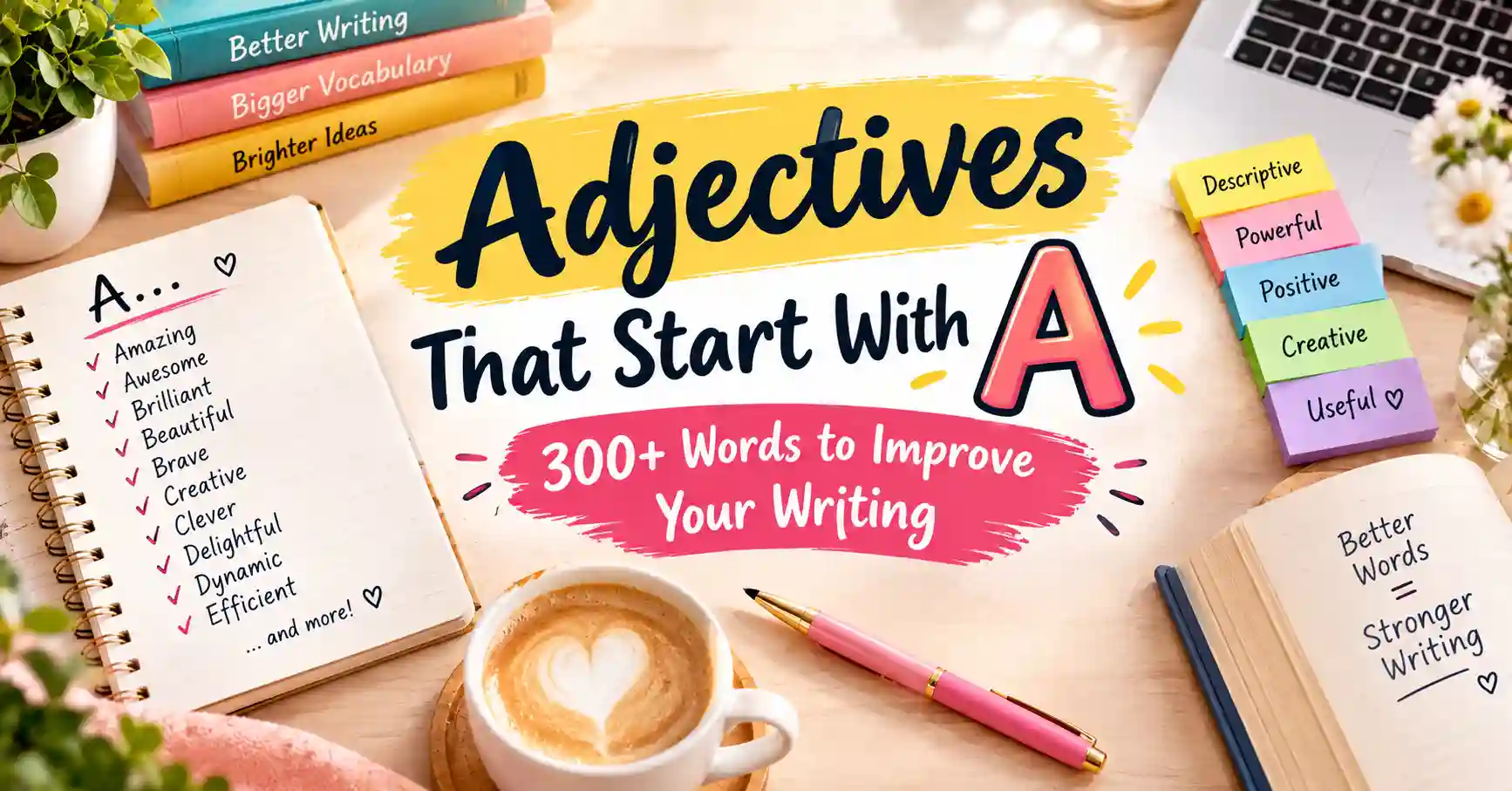
Do you ever search for the perfect word and come up empty? You are not alone. Many writers get stuck on the same few words. A strong list of adjectives that start with A can fix that fast.
This guide gives you more than 300 adjectives that start with A. Each group has a clear purpose. You will see meanings, example sentences, synonyms, and antonyms. You will also learn grammar rules, common mistakes, and easy memory tricks.
Why does this matter? Adjectives add color to your words. They make your essays sharper and your stories richer. They also help you speak with more confidence.
Whether you are a student, a teacher, or a writer, this vocabulary list will help. Read it once. Save it. Come back to it often.
What Are Adjectives?
Before we explore the full list, let us review the basics. An adjective is a word that describes a noun or a pronoun. It tells us more about a person, place, thing, or idea. Adjectives answer questions like “What kind?” “Which one?” and “How many?” They are small words with big power.
Simple definition: An adjective describes or gives more detail about a noun.
Here are a few examples:
- The amazing view took my breath away.
- She wore an auburn scarf.
- We met an adventurous traveler.
- The ancient castle stood on a hill.
- He gave an accurate answer.
A rich adjective vocabulary improves your writing and speaking in three ways. First, it makes your meaning clear. “A good day” is vague. “An amazing day” paints a picture. Second, it saves words. One precise adjective can replace a long phrase. Third, it makes you sound confident. People trust speakers who choose exact words.
Learning adjectives by letter is a smart method. It gives you a small, clear target. Today, that target is the letter A.
The Complete List: Adjectives That Start With A
This is the heart of the guide. Below, you will find adjectives that start with A in clear groups. Each group has its own purpose. You can browse by tone, by topic, or by level. Every word is a real adjective. No word is repeated anywhere in the list. Start with the group that fits your need today.
Positive Adjectives That Start With A
Positive adjectives praise, admire, or express approval. They are perfect for reviews, compliments, speeches, and cheerful stories. Using them well makes your writing warm and persuasive. The table below shows the top 20 positive words with meanings and examples. A longer list follows it.
| Word | Meaning | Example Sentence |
| able | having the skill or power to do something | She is able to solve hard puzzles fast. |
| abundant | present in large amounts | The valley has abundant fresh water. |
| accurate | correct and free from errors | His report was clear and accurate. |
| adaptable | quick to adjust to new conditions | An adaptable worker learns new tools fast. |
| admirable | deserving respect | Her honesty is admirable. |
| adorable | very cute and lovable | The adorable puppy wagged its tail. |
| adventurous | willing to try new things | We took an adventurous trip through the hills. |
| affectionate | showing warm love | My cat is gentle and affectionate. |
| agile | able to move quickly and easily | The agile dancer leaped across the stage. |
| alert | watchful and ready | Stay alert when you cross the road. |
| amazing | causing great wonder | The view from the top was amazing. |
| ambitious | eager to reach big goals | He is an ambitious young chef. |
| amusing | funny and entertaining | The clown told an amusing story. |
| appealing | attractive or interesting | The menu has many appealing dishes. |
| artistic | having creative skill | She has an artistic eye for color. |
| astute | clever and quick to see the truth | An astute buyer checks every detail. |
| attentive | paying close attention | The attentive waiter refilled our glasses. |
| authentic | real and genuine | We ate authentic Italian pasta. |
| awesome | extremely good or impressive | The concert was awesome. |
| ardent | full of strong feeling | He is an ardent fan of chess. |
More positive adjectives: accomplished, adept, adroit, affable, agreeable, alluring, altruistic, amiable, angelic, animated, appreciative, aspiring, assured, astonishing, astounding, athletic, attractive, auspicious, avid, aglow, ample, articulate, aesthetic, authoritative.
Pick one or two from this list for each paragraph you write. Too many positive words in a row can sound fake. Balance is the key.
Negative Adjectives That Start With A
Negative adjectives show dislike, danger, or disappointment. Writers use them to build tension, describe villains, or give honest criticism. They add contrast to a text. Use them with care, because strong words can hurt. The table gives 12 common examples with meanings and sentences.
| Word | Meaning | Example Sentence |
| abrasive | harsh and rude in manner | His abrasive tone upset the team. |
| abrupt | sudden and unexpected | The meeting came to an abrupt end. |
| absurd | silly and not sensible | It is absurd to wear a coat in July. |
| aggressive | ready to attack or argue | The aggressive dog barked at everyone. |
| aloof | distant and unfriendly | She stayed aloof at the party. |
| angry | feeling strong displeasure | He was angry about the delay. |
| annoying | causing irritation | The buzzing noise was annoying. |
| anxious | worried or nervous | I felt anxious before the exam. |
| arrogant | too proud of oneself | The arrogant player ignored his coach. |
| awful | very bad | The soup tasted awful. |
| awkward | clumsy or uncomfortable | There was an awkward silence. |
| apathetic | showing no interest | Many voters felt apathetic. |
More negative adjectives: abhorrent, abominable, abysmal, acrimonious, aggravating, agitated, alarming, alienated, amiss, anguished, annoyed, appalling, ashamed, atrocious, austere, argumentative, antagonistic, aimless, afraid, agonizing, antisocial, arduous, avaricious, abusive, adversarial, apprehensive, abnormal, alarmed, ailing.
Notice the range. “Annoying” is mild. “Abominable” is very strong. Match the strength of the word to the strength of the feeling.
Neutral or Descriptive Adjectives That Start With A
Neutral adjectives do not praise or criticize. They simply describe facts like age, size, color, or condition. They form the backbone of clear writing. News reports, science notes, and instructions all rely on them. Here are eight key words with examples, followed by a longer list.
| Word | Meaning | Example Sentence |
| abstract | existing as an idea, not a thing | Freedom is an abstract idea. |
| active | busy or full of action | He leads an active life. |
| ancient | very old | We visited an ancient temple. |
| annual | happening once a year | The annual fair starts in June. |
| automatic | working on its own | The door has an automatic sensor. |
| available | ready to use or reach | Is this seat available? |
| average | typical or of the usual level | The average height here is five feet six. |
| anonymous | with no name given | An anonymous donor paid the bill. |
More neutral adjectives: academic, actual, additional, adjacent, administrative, adult, advanced, aerial, alphabetical, alternative, amber, apparent, applicable, approximate, aquatic, arctic, asleep, atomic, audible, awake, azure, acoustic, aerodynamic, agricultural, airborne, alike, alone, ancestral, angular, antique, arboreal, architectural, armed, ashen, asymmetrical, atmospheric, auditory, autumnal, avian, aromatic.
These words are the “plain clothes” of English. Use them when you want facts, not feelings.
Adjectives That Start With A to Describe People
People are complex, so we need many words to describe them. This group covers personality, appearance, and emotions. Each sub-list below has fresh words that do not appear above. Use them in character sketches, profiles, recommendation letters, and everyday chat.
Personality: assertive, analytical, audacious, amicable, apologetic, approachable, artful, ascetic.
Appearance: auburn, aquiline, aged, ageless, androgynous, arresting, aristocratic, alabaster.
Emotions: amused, amazed, aghast, appalled, astonished, ambivalent, aggrieved, affronted, abashed, adoring, awestruck.
Try pairing one personality word with one appearance word. For example: “an approachable woman with auburn hair.” It instantly feels like a real person.
Adjectives That Start With A to Describe Places, Things, and Situations
Not every noun is a person. Places, objects, and events need good adjectives too. This group helps you describe a landscape, a product, or a tricky moment. Each word is new to this guide. They work well in travel writing, product copy, and reports.
Places: alpine, arid, airy, abandoned, accessible, affluent, agrarian.
Things: antiquated, absorbent, adhesive, alkaline, acidic, acrid, adjustable, airtight, antibacterial, artificial, automated.
Situations: acute, adverse, ambiguous, appropriate, accidental, arbitrary, advantageous, acceptable, adequate, absolute, alleged, apt.
Match the word to the noun. You can call a room “airy” but not a rule. You can call a rule “arbitrary” but not a valley.
Technical and Academic Adjectives That Start With A
Students and professionals meet special adjectives in science, math, and school subjects. These words are exact. They help you sound precise in lab reports, essays, and exams. Learn a few at a time, and link each one to the subject where you will use it.
aerobic, anaerobic, anatomical, algebraic, analog, antiseptic, amphibious, astronomical, aeronautical, alphanumeric, allergic, archaeological, algorithmic, arithmetic, automotive, astral.
A quick tip: many of these end in -ic or -al. That ending often signals “related to” a subject.
Uncommon or Advanced Adjectives That Start With A
Advanced adjectives make your writing stand out. They are rare, exact, and often elegant. Use them sparingly. One or two in an essay can impress. Too many can confuse your reader. Study the twelve words below, then browse the longer list.
| Word | Meaning |
| abstruse | hard to understand |
| acerbic | sharp and bitter in tone |
| acquiescent | quietly agreeing |
| adamant | unwilling to change your mind |
| anachronistic | belonging to the wrong time |
| anomalous | unusual or not normal |
| apocryphal | of doubtful truth |
| arcane | known by only a few people |
| assiduous | careful and hard-working |
| asinine | very foolish |
| avuncular | kind and friendly, like an uncle |
| axiomatic | obviously true |
More advanced adjectives: amorphous, analogous, antediluvian, apolitical, astringent, asymptotic, atavistic, august, autonomous, abstemious, accursed, adamantine, adventitious, allegorical, ambrosial, amenable, amoral, anodyne, aphoristic, apoplectic, apposite, archaic, arrant, ascendant, attenuated, aureate.
Always check the meaning twice before using a rare word. A wrong choice is worse than a simple one.
Simple Adjectives That Start With A for Beginners
Beginners need friendly words they can use right away. This group has short, common adjectives. Many start with the letter “a” as a small prefix. Learn them first. They will carry you through daily speech and basic writing.
alive, aware, ajar, afloat, ablaze, afire, aflame, afoot, agape, agog, akin, alight, askew, astir, adrift, aching, arty, artsy.
Many of these sit after a verb, as in “The baby is asleep.” We will explain this later in the fun facts.
Adjectives by Type
Adjectives come in several types. Knowing the types helps you use each word in the right place. Some start with A, and some do not. In this section, we use real examples from the A-list. We also point out the types that have no A-words at all. That honesty will save you time when you study.
Descriptive Adjectives
Descriptive adjectives are the largest group. They describe quality, size, shape, color, or condition. Almost every word in the lists above belongs here. Words like ancient, amber, airy, and adorable are all descriptive. They answer the question “What is it like?”
Example: “The airy room had amber curtains.”
Comparative and Superlative Adjectives
Comparative adjectives compare two things. Superlative adjectives compare three or more. Most short words add -er and -est. Longer words use more and most. For example, angry becomes angrier and angriest. Amazing becomes more amazing and most amazing. A full table appears in the grammar section below.
Possessive and Demonstrative Adjectives
Possessive adjectives show ownership: my, your, his, her, its, our, their. Demonstrative adjectives point to things: this, that, these, those. No word in either group starts with A. That is normal. Still, you will use them daily beside A-words, as in “my amazing friend” or “that ancient tower.”
Quantitative Adjectives
Quantitative adjectives tell us how much or how many. From our list, ample, abundant, and adequate fit this role. In traditional grammar, small words like all, any, and another are also called quantitative adjectives. Many modern books label them determiners. Either way, they work the same in a sentence.
Example: “We have ample time and abundant snacks.”
Compound Adjectives
Compound adjectives join two or more words, often with a hyphen. They pack a lot of meaning into one phrase. They are popular in news, ads, and fiction. Here are 16 that start with A:
able-bodied, absent-minded, above-average, action-packed, age-old, air-conditioned, all-inclusive, all-natural, all-powerful, all-purpose, all-time, ankle-deep, anti-aging, apple-green, award-winning, awe-inspiring.
Use a hyphen when the compound comes before a noun. Write “an award-winning film,” but “the film is award-winning” is often left open after the noun.
Proper Adjectives
Proper adjectives come from names of places or people. They always start with a capital letter. They are useful for describing origin, culture, or language. Here are 16 that begin with A:
African, Afghan, Albanian, Algerian, American, Andean, Argentine, Armenian, Asian, Australian, Austrian, Arabic, Alaskan, Athenian, Arthurian, Aristotelian.
Example: “She cooked an Afghan dish with Asian spices.”
Participial Adjectives
Participial adjectives come from verbs. They end in -ing or -ed. They are very common and very useful. Here are 14 that start with A:
abiding, absorbing, acclaimed, accustomed, admiring, anticipated, appointed, assorted, assumed, attached, authorized, awaited, abridged, accepted.
Example: “The acclaimed author signed an abridged edition.”
How to Use These Adjectives Correctly
Knowing many words is only half the job. You must also place them well and avoid common slips. This section covers the key grammar rules. It includes word order, comparisons, frequent errors, and confusing word pairs. Read each part slowly. A few small habits can make your English sound far more natural.
Adjective Word Order
When you use more than one adjective before a noun, English follows a natural order. Native speakers use it without thinking. Learners must study it. The usual order is: opinion, size, age, shape, color, origin, material, purpose. Break the order, and the phrase sounds odd.
Here are three examples with A-words:
- an amazing little old stone house (opinion, size, age, material)
- two adorable small brown puppies (opinion, size, color)
- an awesome new red sports car (opinion, age, color, purpose)
Opinion words, like amazing and awesome, almost always come first.
Comparative and Superlative Forms
Comparing things is a daily task. Short adjectives usually take -er and -est. Longer ones take more and most. Words ending in -y change the y to i. Some words allow both forms. Study this table of ten key words.
| Adjective | Comparative | Superlative |
| angry | angrier | angriest |
| airy | airier | airiest |
| able | abler (or more able) | ablest (or most able) |
| ample | ampler | amplest |
| ancient | more ancient | most ancient |
| awful | more awful | most awful |
| amazing | more amazing | most amazing |
| anxious | more anxious | most anxious |
| adorable | more adorable | most adorable |
| awkward | more awkward | most awkward |
When in doubt, use more and most for words with three or more syllables.
Common Mistakes and How to Avoid Them
Even strong learners repeat the same errors. Spotting them is the first step to fixing them. Below are six common mistakes with simple corrections. Check your own writing against this list.
- Wrong article. ❌ “a awful day” → ✅ “an awful day.” Use an before a vowel sound.
- Double comparison. ❌ “more angrier” → ✅ “angrier.”
- Using afraid or asleep before a noun. ❌ “an afraid child” → ✅ “a frightened child” or “The child is afraid.”
- Adjective instead of adverb. ❌ “He spoke angry.” → ✅ “He spoke angrily.”
- Mixing -ed and -ing. ❌ “I am annoying by the noise.” → ✅ “I am annoyed by the noise.”
- Wrong preposition. ❌ “afraid from spiders” → ✅ “afraid of spiders.”
Also remember that adjectives never take a plural s. Say “the angry kids,” not “the angries kids.”
Commonly Confused Words
Some adjectives look or sound alike but mean different things. Mixing them up can change your message. Learn these six pairs. Each one includes a short explanation to keep them straight.
| Pair | Difference |
| adverse / averse | Adverse means harmful or unfavorable (“adverse weather”). Averse means strongly opposed (“averse to risk”). |
| alternate / alternative | Alternate means every other or taking turns. Alternative means another option. |
| amoral / immoral | Amoral means having no sense of right and wrong. Immoral means knowing the rules and breaking them. |
| ascetic / aesthetic | Ascetic means living very simply. Aesthetic relates to beauty. |
| aural / oral | Aural relates to hearing. Oral relates to the mouth or speech. |
| apathetic / empathetic | Apathetic means not caring. Empathetic means sharing another person’s feelings. |
Say the pairs aloud a few times. The sound difference will help the meaning stick.
Synonyms and Antonyms
A single idea can wear many words. Synonyms are words with similar meaning. Antonyms are words with opposite meaning. Knowing both gives you range. It stops you from repeating the same word again and again. The table below shows 16 key adjectives that start with A, along with synonyms and antonyms.
| Word | Synonyms | Antonyms |
| able | capable, skilled | unable, incapable |
| abundant | plentiful, ample | scarce, sparse |
| accurate | precise, exact | inaccurate, wrong |
| admirable | praiseworthy, commendable | shameful, contemptible |
| aggressive | hostile, forceful | gentle, passive |
| ancient | old, archaic | modern, recent |
| angry | furious, irate | calm, pleased |
| anxious | worried, uneasy | calm, relaxed |
| arrogant | conceited, haughty | humble, modest |
| awful | terrible, dreadful | wonderful, pleasant |
| alert | watchful, vigilant | drowsy, inattentive |
| absurd | ridiculous, silly | sensible, rational |
| active | energetic, lively | idle, inactive |
| adequate | sufficient, enough | inadequate, insufficient |
| authentic | genuine, real | fake, counterfeit |
| awkward | clumsy, uneasy | graceful, smooth |
Synonyms are not perfect twins. Each one has its own tone. “Angry” is plain. “Irate” is formal and strong. “Furious” is intense. Choose by asking three questions. How strong is the feeling? How formal is the setting? Who is the reader? A text to a friend can say “annoyed.” A legal letter might say “aggrieved.” Matching tone to context is the mark of a skilled writer.
Practical Use Cases
Words are tools, and tools work best in the right setting. Below you will see how adjectives that start with A fit into five real-life situations. Each part includes short examples you can copy, adapt, and make your own. Choose the setting that matches your goals today.
Essays and Academic Writing
Academic writing needs clear, exact, and balanced language. Choose adjectives that show analysis, not just opinion. Words like analytical, ambiguous, accurate, and adequate fit well. Avoid slang. Keep your tone calm and formal.
- The study offers an accurate account of annual rainfall.
- Her argument is ambiguous in two key places.
- An analytical approach reveals the arbitrary nature of the rule.
Storytelling and Creative Writing
Stories live on images. Good adjectives help readers see, hear, and feel the scene. Pick words that set mood. Abandoned, arid, and ashen create gloom. Amber, airy, and aglow create warmth. Show, do not just tell.
- An abandoned cabin stood at the edge of the arid plain.
- Her amber eyes were alert and ageless.
- The lantern left the room aglow and aromatic with pine.
Resumes and Professional Writing
Employers scan fast. Use adjectives that prove value, and back them with facts. Words like adaptable, accomplished, articulate, and analytical are strong choices. Avoid empty praise. Pair each adjective with real results.
- Adaptable project manager with an ambitious growth record.
- Articulate communicator who stays alert under pressure.
- Accomplished analyst known for accurate reporting.
Social Media Captions
Captions are short, so every word counts. Cheerful adjectives work best. Keep it light, fun, and real. One bold adjective can make a post feel alive. Match your words to the photo and the mood.
- Golden hour, amazing friends, and an adventurous heart.
- Autumn mood: aglow, at ease, and always up for coffee.
- Awesome day, authentic smiles.
Everyday Conversation
In daily talk, simple words win. Short adjectives sound natural and friendly. You do not need rare words here. Choose ones people understand right away. A few well-placed A-words can make small talk more lively.
- That movie was amazing!
- I am a bit anxious about the test.
- Are you available on Friday?
Fun Facts and Learning Tips
Learning words should feel fun, not heavy. The best learners are curious. They ask where a word came from, how it changed, and how to remember it. This section gives you stories, tricks, and habits that make adjectives stick. You will find fun facts, memory aids, word histories, daily practice ideas, and a short quiz to test yourself. Take your time and enjoy it.
Fun Facts About These Adjectives
Words have secret lives. Some were once praise and now mean the opposite. Others carry old sailing terms or ancient myths. Here are six facts about adjectives that start with A. They show how living and surprising English can be.
- Awful once meant “full of awe.” In its early days, it described things that inspired deep respect. Over time, its meaning slid toward “terrible.”
- Artificial used to be a compliment. It comes from a Latin word linked to art and craft. Something artificial was made with skill. Today it often suggests “fake.”
- Many A-adjectives sit after the verb. Words like asleep, awake, afraid, alone, alike, alive, and aware usually come after verbs such as be or feel. The “a-” often comes from an old English word meaning “on.” So asleep once meant “on sleep,” and alive meant “on life.”
- August has two sounds and two meanings. The month is pronounced AW-gust. The adjective is aw-GUST, and it means grand and dignified. Both trace back to the Roman ruler Augustus.
- Adamant and diamond are cousins. Both come from a Greek word for “unconquerable.” That is why an adamant person is as hard as a diamond about their opinion.
- Antediluvian means “before the Flood.” It comes from Latin and refers to the great flood in old stories. Today people use it as a joke for something extremely old-fashioned.
Memory Tricks and Mnemonics
Memory works best when words connect to pictures, sounds, or stories. Here are five simple techniques. Each one uses real words from the lists. Try the one that suits you, and invent your own versions.
- Silly sound pictures. For abundant, picture “a bun” and “dant.” Imagine a mountain of buns. Abundant means plenty.
- Mini stories. For adamant, imagine “Adam the ant” refusing to move from his leaf. He is adamant.
- Prefix families. The prefix ab- often means “away.” Think of abnormal (away from normal), abrupt (broken off), and abstract (drawn away). One rule unlocks many words.
- Alliteration chains. Say a phrase with the same starting sound: “an amiable, adventurous artist.” The rhythm helps you recall each word.
- Opposite pairs. Learn words in twos: ancient/modern, arrogant/humble, abundant/scarce. Your brain remembers contrast well.
Word Origins and History
Every word has a family tree. Looking at the roots can make meanings clear and memorable. Here are six words with their languages of origin and how their meanings changed. These stories make dry vocabulary feel alive.
- Absurd comes from Latin absurdus, meaning “out of tune.” A sour musical note became a symbol for anything senseless.
- Alert comes from an Italian phrase meaning “on the watch.” Soldiers on a lookout were “alert.”
- Aloof is linked to an old sailing phrase. Many dictionaries connect it to a Dutch word for “windward.” Keeping aloof meant steering away from danger. Now it describes a cool, distant person.
- Ancient comes through Old French from Late Latin, meaning “from before.” It has kept that sense for centuries.
- Arbitrary comes from Latin arbiter, a judge. It first meant “decided by a judge.” Now it means “based on whim, not reason.”
- Awesome comes from awe, which has Old Norse roots. It first meant “inspiring awe.” In the 20th century,y it became slang for “great.”
Daily Practice Tips
Small habits beat big bursts. Ten minutes a day will do more than one long weekend session. Choose habits you can keep. Here are six that work well for learners at every level.
- Read every day. Pick articles, stories, or blogs you enjoy. Underline any new adjective. Seeing a word in context fixes its meaning.
- Keep a word journal. Each night, write three sentences using three new adjectives. Writing makes you think about meaning and spelling.
- Use flashcards. Put the word on one side and the meaning plus a sentence on the other. Review them with spaced repetition. Look at hard cards more often.
- Speak out loud. Say your new words in real talk. Record yourself and listen back. Speaking turns passive knowledge into active skill.
- Play an “A-day” game. For one day, try to describe everything with an A-word. Your coffee is aromatic. Your desk is adjustable. It is silly, and it works.
- Review weekly. Every Sunday, scan your journal. Circle words you forgot. Reuse them during the next week.
Mini Practice Quiz
Time to test yourself. These ten questions cover meaning, spelling, grammar, and usage. Try them without looking back. Then check the answer key to see how you did. Do not worry about mistakes. Each one shows you what to review.
- The desert is hot and ______. (arid / amiable)
- I was ______ by the magic show. (amazing / amazed)
- Choose the correct article: ______ awful day. (a / an)
- Abundant means: (a) rare (b) plentiful (c) angry
- Her ______ manner made her seem cold. (aloof / adorable)
- Choose the antonym of ancient: (a) modern (b) aged (c) antique
- Choose the correct form: Tom is ______ than Sam. (angrier / more angry)
- Which sentence is correct? (a) The asleep baby is cute. (b) The baby is asleep.
- Adamant means: (a) unwilling to change your mind (b) very sleepy (c) quick to laugh
- The weather turned ______ and the match ended. (adverse / averse)
Answer Key
- arid. It means very dry.
- amazed. Use -ed for how you feel.
- an. Awful starts with a vowel sound.
- (b) plentiful.
- aloof. It means distant.
- (a) modern.
- angrier. Short words ending in -y take -er.
- (b) Asleep sits after the verb.
- (a) unwilling to change your mind.
- adverse. It means unfavorable. Averse means opposed.
Score 9 or 10? Excellent. Score 6 to 8? Good, review the weak spots. Below 6? Re-read the lists and try again tomorrow.
Frequently Asked Questions
Readers often ask the same questions when they study this topic. This FAQ section answers seven of the most common ones in clear, short replies. Use it as a quick refresher. If your question is not here, check the matching section above for more detail and examples.
What are adjectives that start with A?
Adjectives that start with A are describing words that begin with the letter A. Examples include amazing, ancient, angry, active, and adorable. They describe people, places, things, and ideas. Some are simple, like alive. Others are advanced, like abstruse. This guide lists more than 300 of them, with meanings and examples.
What are some positive adjectives that start with A?
Popular positive options include amazing, admirable, adorable, adventurous, affectionate, agile, ambitious, appealing, and awesome. They are great for praise, reviews, and cheerful writing. For a more formal tone, try accomplished, astute, articulate, or altruistic. Choose the word that fits the strength of your praise.
What are good adjectives that start with A to describe a person?
For personality, try amicable, assertive, analytical, approachable, or ambitious. For looks, try attractive, auburn, athletic, or arresting. Pick words that show a real trait, not just a general good or bad.
What are some negative adjectives that start with A?
Common negative choices are angry, annoying, arrogant, awful, awkward, aggressive, and abrasive. Stronger ones include abhorrent, abominable, and atrocious. Use them with care. Match the strength of the word to the situation. “Annoying” fits a noisy neighbor. “Atrocious” fits a serious wrong.
What are some uncommon adjectives that start with A?
Rare but useful options include abstruse, acerbic, anachronistic, arcane, assiduous, avuncular, and axiomatic. They add precision and style to essays and stories. Use one or two at a time. Always check the meaning first, because a rare word used wrongly can confuse your reader.
What adjectives that start with A describe feelings?
Try anxious, amused, angry, ashamed, astonished, affectionate, ambivalent, and apprehensive. Notice that many end in -ed. These describe how a person feels. Words ending in -ing, like annoying or amazing, describe what causes the feeling. Keep this rule in mind to avoid mix-ups.
How can I learn adjectives that start with A quickly?
Learn in small groups of five words. Write a sentence for each one. Use flashcards and review them daily with spaced repetition. Group words by theme, like feelings or places. Say the words aloud and use them in real talk. Short, steady practice beats long, rare study sessions.
Conclusion
Strong writing starts with strong word choice. Now you have more than 300 adjectives that start with A. You saw them sorted by tone, topic, type, and level. You learned how to order them, compare them, and avoid common errors.
Here are the key takeaways. Use positive words to praise and negative words to warn. Use neutral words for facts. Place opinion adjectives first. Watch out for confusing pairs like adverse and averse. Choose synonyms by tone and context.
Now it is your turn. Pick five new adjectives that start with A today. Write one sentence for each. Say them out loud. Save this guide for later, and share it with a friend who loves words. Small steps build a large vocabulary.
