

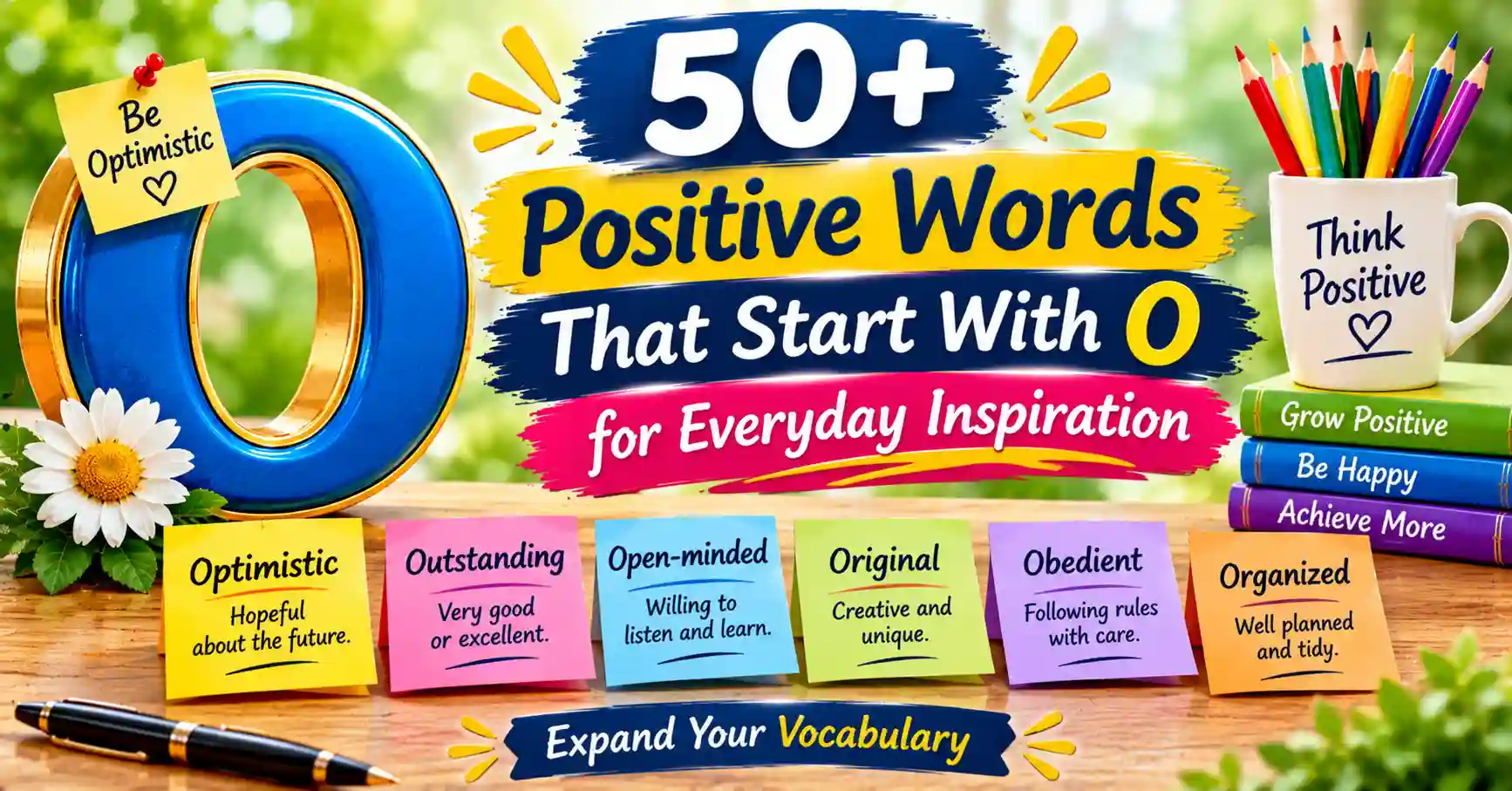
One warm word can open a whole day. Say “that was okay,” and the moment passes. Say “that was outstanding,” and it lingers. This guide gives you a full list of positive words that start with O, with clear meanings and easy examples.
O is a round and open letter. It also gives us lively words like overjoyed, outgoing, and outstanding.
One honest note first. O has fewer clearly positive words than most letters. We left out words whose tone shifts with context, such as obedient, opulent, and overwhelming.
In this guide, you will learn:
- all 54 positive words, labeled by part of speech
- meanings and examples for the top 20 words
- words sorted by emotion, person, and strength
- how to praise with care and avoid empty flattery
- origins, memory tricks, and a ten-question quiz
Positive vocabulary helps you speak with warmth and write with energy. Let’s begin.
What Are Positive Words?
Positive words carry a kind, happy, or helpful meaning. They lift the mood of a sentence. Positive words that start with O are easy to spot and fun to learn. This section gives a simple definition, five examples, and a look at tone.
A positive word makes people feel good, hopeful, or valued. It praises, encourages, or describes something pleasant.
Here are five examples:
- Optimistic (adjective): “She stayed optimistic all week.”
- Opportunity (noun): “This job is a great opportunity.”
- Overcome (verb): “He worked hard to overcome his fear.”
- Openly (adverb): “They talked openly and kindly.”
- Originality (noun): “Her originality delighted the judges.”
Every word has two layers. The first is denotation. This is the plain dictionary meaning. The second is connotation. This is the feeling that rides along with the word.
Take outgoing and loud. Both describe someone easy to notice. But outgoing feels friendly. Loud feels tiring. The facts are close, but the feelings are far apart.
Positive words improve communication. Listeners relax when your tone is warm. They stay open and listen longer.
They improve relationships. Kind words show care. People remember how you made them feel.
They improve writing. Warm words give your sentences energy. Readers enjoy every line.
Complete List of Positive Words That Start With O
This is the heart of the guide. Here you will find every positive O word we trust, sorted by type. Each list is alphabetical. We start with a table of the twenty most useful words. Then we cover the other adjectives, nouns, verbs, and adverbs. No word appears twice in these main lists.
Top 20 Positive Words That Start With O
O is a smaller letter, so we give you the twenty most useful words, not forty. You will hear them at home, at school, and at work. Each one has a part of speech, a short meaning, and an example. Learn these first. They form the base for the rest. The news overjoyed us three words from this table. Use one each day this week.
Positive Adjectives That Start With O
Adjectives describe people, places, and things. They add color and feeling to your sentences. The words below are the other positive O adjectives. None of them are in the top 20 table. Use them to make your praise fresh and exact.
- on-point – exactly right and sharp (informal)
- one-of-a-kind – unique and special
- open-hearted – warm and generous
- openhanded – giving freely
- opportune – happening at a helpful time
- optimum – the best possible
- organized – neat and well planned
- out-of-the-box – creative and fresh
- out-of-this-world – amazing (informal)
- outperforming – doing better than expected
Choose adjectives that fit your noun. “Open-hearted” suits a person. “Opportune” suits a moment.
Positive Nouns That Start With O
Nouns name people, ideas, and things. Positive nouns let you thank, praise, and celebrate. They also help you name good feelings. The words below are the other positive O nouns. They work well in notes, speeches, and journals.
- ode – a poem of praise
- offering – a gift given with care
- oneness – the feeling of being united
- oomph – lively energy (informal)
- orator – a skilled public speaker
- originator – a person who starts something good
- outpouring – a flood of love or support
- outreach – effort to help others
- overcomer – a person who beats a hard challenge
Nouns work well in thank-you notes. Try “Your outreach meant the world to us.”
Positive Verbs That Start With O
Verbs are action words. Positive verbs show kindness in motion. They show what good things people do. O has only six more positive verbs, so we list the real ones and add no filler. All are new to the lists above.
- oblige – to do a kind favor
- organize – to arrange things well
- outdo – to do better than before
- outperform – to do better than expected
- outshine – to shine more brightly than others
- overjoy – to make someone extremely happy
Try one in a sentence: “Good friends oblige each other without being asked.”
Positive Adverbs That Start With O
Adverbs tell us how something happens. A positive adverb adds a warm tone to the action. It can turn a plain sentence into a joyful one. O has nine, and all are new to the lists above. Use one adverb per sentence, so it never feels heavy.
- obligingly – in a helpful way
- observantly – with sharp, kind attention
- open-heartedly – with a warm, open spirit
- openhandedly – in a freely giving way
- openly – honestly and without hiding
- opportunely – at just the right time
- optimally – in the best possible way
- optimistically – with hope
- outstandingly – in an excellent way
Pair an adverb with a verb that needs it. “She spoke openly” works better than “She spoke very honestly.”
Uncommon or Advanced Positive Words
A few positive O words are rare or formal. They are not used in daily talk. But they add polish to speeches and essays. Learn a few of these gems. They are re-listed from above, with fuller notes. Use one per page, so your writing stays natural.
| Word | Part of speech | Meaning | Example |
| ode | noun | a poem of praise | She wrote an ode to her teacher. |
| openhanded | adjective | giving freely | He was openhanded with his time. |
| opportune | adjective | happening at a helpful time | Her call came at an opportune moment. |
| optimum | adjective | the best possible | We chose the optimum route. |
| orator | noun | a skilled public speaker | The orator moved the whole hall. |
| originator | noun | a person who starts something good | She is the originator of the club. |
| outpouring | noun | a flood of love or support | We felt an outpouring of kindness. |
| outshine | verb | to shine more brightly | Her kindness will outshine any gift. |
Save these words for special moments. Say them aloud before you use them in writing.
Simple Positive Words for Beginners and Kids
Young learners need short, friendly words. These words are easy to say. They also build a happy habit of speech. Parents and teachers can use them in daily praise. Positive words for kids should feel natural, not forced. All are re-listed from above.
- offer (verb) – “I offer to share my snack.”
- open (adjective) – “Keep an open mind.”
- optimist (noun) – “My brother is an optimist.”
- original (adjective) – “That is an original drawing.”
- outgoing (adjective) – “She is outgoing and kind.”
- overjoyed (adjective) – “I was overjoyed to see you.”
Say one of these words to a child today. Notice the smile.
Positive Words by Theme and Emotion
Positive words that start with O fit many moods. This section groups the same 54 words by emotion. O is a smaller letter, so some groups have fewer than eight words. We list only real ones. Some words fit more than one theme. That is why a few appear twice.
Positive Words for Happiness and Joy
Joy is a light, lifting feeling. The right word can catch it perfectly. Some words are quiet. Others are loud and bright. These O words help you describe happiness from a small smile to a big party.
- oomph (noun) – lively energy
- optimism (noun) – hope for good outcomes
- optimistic (adjective) – hopeful about the future
- out-of-this-world (adjective) – amazing
- outpouring (noun) – a flood of love
- ovation (noun) – loud, warm applause
- overjoy (verb) – to make extremely happy
- overjoyed (adjective) – extremely happy
Positive Words for Love and Affection
Love shows up in many forms. It can be warm, deep, or playful. I have lovely words for family, friends, and partners. These words help you say “you matter to me.” Use them in cards, letters, and quiet moments.
- obliging (adjective) – helpful and kind
- offer (verb) – to give freely
- offering (noun) – a gift given with care
- oneness (noun) – the feeling of being united
- open-hearted (adjective) – warm and generous
- open-heartedly (adverb) – with a warm spirit
- openhanded (adjective) – giving freely
- openhandedly (adverb) – in a giving way
- openness (noun) – honest, welcoming spirit
Positive Words for Success and Achievement
Success deserves strong words. Whether you win a race or finish a project, language helps you celebrate. These O words describe wins, great work, and big goals. They suit sports, business, school, and personal growth. Use them to honor hard work.
- on-point (adjective) – exactly right and sharp
- opportunity (noun) – a good chance
- optimal (adjective) – the best possible
- optimize (verb) – to make the best of something
- optimum (adjective) – the best possible
- organized (adjective) – neat and well planned
- originator (noun) – a person who starts something good
- outdo (verb) – to do better than before
- outperform (verb) – to do better than expected
- outperforming (adjective) – doing better than expected
- outshine (verb) – to shine more brightly
- outstanding (adjective) – excellent
- outstandingly (adverb) – in an excellent way
- ovation (noun) – loud, warm applause
- overcome (verb) – to beat a hard challenge
Positive Words for Kindness and Compassion
Kindness is care in action. It is a gentle hand and a warm word. These O words honor people who give, help, and listen. They are perfect for thank-you notes and tributes. Use them to say “your goodness has been seen.”
- oblige (verb) – to do a kind favor
- obliging (adjective) – helpful and kind
- obligingly (adverb) – in a helpful way
- offer (verb) – to give freely
- offering (noun) – a gift given with care
- open-hearted (adjective) – warm and generous
- openhanded (adjective) – giving freely
- outpouring (noun) – a flood of love or support
- outreach (noun) – effort to help others
Positive Words for Strength and Courage
Strength is not only about muscles. It is also about heart and spirit. I have only a few words here, and we say so honestly. They honor people who face hard days and rise again.
- originator (noun) – a person with the courage to start
- outdo (verb) – to beat your own best
- outperform (verb) – to rise above expectations
- overcome (verb) – to beat a hard challenge
- overcomer (noun) – a person who beats a hard challenge
Positive Words for Peace and Calm
Peace is a deep, quiet kind of joy. It helps us rest and reset. O has a handful of calm words. They are perfect for mindfulness notes and soft affirmations. Say them slowly. Let your shoulders drop.
- oasis (noun) – a calm, welcome spot
- oneness (noun) – the feeling of being united
- open-minded (adjective) – willing to hear new ideas
- openness (noun) – honest, welcoming spirit
- organized (adjective) – neat and well planned
Positive Words for Gratitude and Appreciation
Gratitude turns what we have into enough. It also strengthens bonds with others.OneO has a small set of words to help you thank someone with feeling. They work in journals, speeches, and notes.
- ode (noun) – a poem of praise
- oblige (verb) – to do a kind favor
- obligingly (adverb) – in a helpful way
- offering (noun) – a gift given with care
- outpouring (noun) – a flood of love or support
- ovation (noun) – loud, warm applause
Positive Words for Hope and Optimism
Hope is the belief that good things can happen. It gives us strength on hard days. O is an excellent letter for this theme. These words shine a light forward. Use them when you or a friend need a lift.
- open (adjective) – ready for new things
- opportune (adjective) – happening at a helpful time
- opportunely (adverb) – at just the right time
- opportunity (noun) – a good chance
- optimism (noun) – hope for good outcomes
- optimist (noun) – a person who expects good things
- optimistic (adjective) – hopeful about the future
- optimistically (adverb) – with hope
- overcome (verb) – to beat a hard challenge
Positive Words for Intelligence and Creativity
Smart minds and creative hearts deserve fine words. These O words praise clear thinking and fresh ideas. They suit classrooms, studios, and offices. Use them to give credit where it is due. Be specific about what impressed you.
- observant (adjective) – quick to notice good details
- observantly (adverb) – with sharp, keen attention
- one-of-a-kind (adjective) – unique and special
- optimize (verb) – to make the best of something
- orator (noun) – a skilled public speaker
- organize (verb) – to arrange things well
- original (adjective) – fresh and new
- originality (noun) – the quality of being new
- originator (noun) – a person who starts something good
- out-of-the-box (adjective) – creative and fresh
Notice that original and optimistic fit many themes. These flexible words are great to learn first.
Positive Words to Describe People
People are complex and wonderful. A good word can capture a spirit in an instant. This section gives 10 words for different roles and relationships. Each list comes with short example phrases. Use them with accuracy and warmth.
Positive Words to Describe Personality and Character
Character is who someone is when no one is watching. Good words here show respect. They name the traits we admire most. Use these O words in references, speeches, and heartfelt notes. Pair them with a short example for more power.
- observant – “an observant listener”
- obliging – “an obliging neighbor”
- open-hearted – “an open-hearted friend”
- open-minded – “an open-minded thinker”
- optimistic – “an optimistic spirit”
- organized – “an organized planner”
- original – “an original mind”
- outgoing – “an outgoing host”
Positive Words to Describe a Friend, Partner, or Family Member
The people closest to us deserve our best words. A heartfelt phrase can make someone feel truly seen. These O words work in cards, toasts, and quiet chats. Use them to show love in a way that feels personal and real.
- obliging – “a loving, obliging partner”
- offering – “your kindness is an offering”
- one-of-a-kind – “my one-of-a-kind sister”
- open-hearted – “an open-hearted mother”
- openhanded – “an openhanded uncle”
- optimist – “my favorite optimist”
- overcomer – “my dad, an overcomer”
Positive Words for Describing a Boss, Teacher, or Colleague
Work and school life run on respect. Praise for a boss, teacher, or coworker builds trust. Use these O words in reviews, thank-you emails, and farewell notes. Keep your praise specific and sincere. It will mean far more.
- obliging – “an obliging colleague”
- observant – “an observant manager”
- open-minded – “an open-minded teacher”
- orator – “a gifted orator”
- organized – “an organized director”
- originator – “the originator of our best program”
- outperforming – “an outperforming team lead”
- outstanding – “an outstanding mentor”
Positive Words for Describing Children
Children grow best with warm, true praise. The right word shapes how a child sees themselves. These O words celebrate energy, kindness, and curiosity. Praise effort and character, not only results. A child will remember your words for years.
- obliging – “an obliging helper”
- observant – “an observant little scientist”
- oomph – “a child with oomph”
- optimistic – “an optimistic boy”
- original – “an original storyteller”
- outgoing – “an outgoing girl”
- overjoyed – “an overjoyed toddler”
Positive Words for Describing Appearance and Style
Compliments on looks can be sweet and kind. The best ones feel warm, not shallow. O has few words here, so we list the real ones. Use them with care and respect.
- on-point – “an on-point outfit” (informal)
- one-of-a-kind – “a one-of-a-kind style”
- original – “an original look”
- out-of-this-world – “an out-of-this-world dress” (informal)
- outstanding – “an outstanding design”
Positive Words by Word Length and Intensity
Words come in many sizes and strengths. Short words hit fast. Long words feel grand. Soft words comfort. Strong words inspire. This section sorts positive O words by length and by strength. O has almost no short positive words, and we say so.
Short, Medium, and Long Positive O Words
Word length changes rhythm. Short words are punchy and clear. Long words sound rich and formal. An honest note: only two positive O words have three or four letters. So that group is small.
Short (3–4 letters): ode, open
Medium (5–7 letters): oasis, offer, oomph, outdo, orator, oblige, optimal, optimum, oneness, ovation, overjoy
Long (8+ letters): observant, obliging, openness, optimism, optimistic, opportunity, organized, original, originality, outgoing, outstanding, overcome
Mix lengths in your writing. A short word after a long one gives your sentence a nice beat.
Gentle, Strong, and Powerful Positive Words
Not every positive word has the same force. “Open” is soft. “Out-of-this-world” is huge. Matching intensity to the moment makes your praise believable. Use gentle words for small wins. Save powerful words for rare, special things.
| Level | Adjectives | Nouns | Verbs |
| 1 – Gentle | open, organized | offering, openness | offer |
| 2 – Warm | obliging, outgoing | optimism, outreach | oblige |
| 3 – Strong | outstanding, overjoyed | ovation, originality | outperform |
| 4 – Powerful | one-of-a-kind, out-of-this-world | outpouring, overcomer | overcome |
Read down each column. Notice how the feeling grows. Choose the level that matches the moment.
Spelling Patterns and Word Roots for the Letter O
Spelling gets easier when you see patterns. Many O words share beginnings, endings, and roots. This section shows the most useful word parts. It also covers tricky spots in positive O words. Learn them once, and you can spell many new words with confidence.
Common Prefixes, Suffixes, and Roots
Word parts are like building blocks. Once you know them, whole word families make sense. Latin roots and the prefixes out- and over- give us many positive O words. Below are the most useful patterns. Learn them once and spot them everywhere.
| Pattern | Meaning | Examples |
| opt- | best or choose | optimal, optimism, optimist, optimistic, optimize, optimum |
| orig- | beginning | original, originality, originator |
| out- | beyond or better | outdo, outgoing, outperform, outreach, outshine, outstanding |
| over- | above or too much | overcome, overcomer, overjoy, overjoyed |
| ob-/opp- | toward | oblige, obliging, observant, opportune, opportunity |
| -ness | state of | openness, oneness |
| -ity | state or quality | originality, opportunity |
| -ly | in a way | openly, obligingly, optimally |
| -ize / -ise | to make | optimize, organize |
Roots tell great stories too:
- opt- (Latin “best”): optimal, optimism, optimum
- orig- (Latin “to rise”): original, originality, originator
- liga- (Latin “to bind”): oblige, obliging
When you see opt-, think “best.” That one clue unlocks a whole family.
Tricky Spellings, Silent Letters, and Pronunciation Notes
Some O words look easy but trip people up. A few have double letters. Others have odd stress. Learn the trouble spots below. A quick check will keep your writing clean and your speech confident.
- opportunity: double p. Say “op-er-TOO-nuh-tee.” Many people write opportunity by mistake.
- original: it ends in -al. Many people write orginal by mistake.
- optimistic: it has -mist- in the middle.
- observant: it ends in -ant, not -ent.
- outstanding: it is out-standing. Both words keep their letters.
- oasis: say “oh-AY-sis.” The plural is oases.
- oomph: say “oomf.” It is informal.
- ovation: say “oh-VAY-shun.”
- organize: British spelling can be organise.
- open-hearted: it is often written with a hyphen. Openhearted is also common.
Say each tricky word aloud three times. Then write it once from memory.
How to Use Positive Words Correctly
Great words need great timing. A word that fits one moment can feel odd in another. This section shows how to match words to settings. It also covers avoiding clichés, giving real compliments, and fixing common mistakes. Small choices make praise sound honest and warm. It also solves the a or an question.
Choosing the Right Word for the Situation
Context matters. Casual talk uses relaxed words. Formal writing uses polished ones. The same idea can be said both ways. Read the table below for six easy swaps. Ask yourself who is listening before you choose. Note that most O words take an.
| Casual | Formal |
| “That was awesome!” | “That was outstanding.” |
| “She’s super positive.” | “She is remarkably optimistic.” |
| “He’s easy to talk to.” | “He is open-minded.” |
| “Thanks for pitching in.” | “Thank you for being so obliging.” |
| “That idea is wild!” | “That idea is highly original.” |
| “You nailed it.” | “Your work was on-point.” |
Match your word to your audience. A warm, simple word never fails.
Avoiding Overuse, Clichés, and Insincere Praise
Too much praise can feel fake. Vague words like “outstanding” lose power when repeated. People notice when praise has no detail. Instead, name what you saw. Real praise is specific, short, and honest.
| Vague | Better |
| “You’re outstanding!” | “Your outstanding report saved us two days.” |
| “You’re an optimist.” | “Your optimism kept the team calm last week.” |
| “Original idea.” | “Your original layout makes the page easy to read.” |
| “So organized.” | “Your organized notes made the meeting short.” |
Say less, but say it truly. One honest line beats ten empty ones.
Giving Specific Compliments and Constructive Positive Feedback
A specific compliment shows you paid attention. It also helps the person repeat what worked. Constructive feedback can be kind too. Start with a strength. Then offer one clear step forward. Here are six examples you can use today.
- “Your observant questions helped the shy student speak.”
- “You were open-minded about the feedback, and it showed.”
- “Your original summary made the talk easy to follow.”
- “That was an obliging act, and the team noticed.”
- “Your report has an optimal structure. Let’s polish the final chart.”
- “You organize the team with calm and kindness. Thank you.”
Common Mistakes and Corrections
Even strong writers slip on word forms and word choices. The table below shows seven common errors with simple fixes. Study it once. You will avoid the same slips for good.
| Wrong | Right | Why |
| “a optimist” | “an optimist” | Optimist starts with a vowel sound. |
| “an one-of-a-kind gift” | “a one-of-a-kind gift” | One starts with a “w” sound. |
| “oppurtunity” | “opportunity” | The spelling is opportunity. |
| “orginal idea” | “original idea” | Keep the i in original. |
| “He spoke optimistic.” | “He spoke optimistically.” | Use an adverb to describe a verb. |
| “I am optimist.” | “I am an optimist.” | A singular noun needs an article. |
| “I am overjoy.” | “I am overjoyed.” | Use -ed to describe a feeling. |
Commonly Confused Positive Words
Some words look or sound alike but mean different things. Mixing them up can change your message. The pairs below are worth learning. Each one has a short note and an example. Keep this table nearby when you write.
| Pair | Difference | Example |
| optimal/optimum | adjective use / often a noun or adjective; both mean “best” | “Choose the optimal plan. Find the optimum.” |
| optimist/optician | a hopeful person / a person who makes glasses | “An optimist visited the optician.” |
| obliging/obligatory | helpful and kind / required | “An obliging host. An obligatory form.” |
| outstanding/outstanding | excellent / still unpaid | “Outstanding work. An outstanding bill.” |
| ode / owed | a poem of praise/money that is due | “She wrote an ode. He owed her ten dollars.” |
| open-minded/open-ended | willing to hear new ideas / without a fixed answer | “An open-minded teacher asked an open-ended question.” |
Optician, obligatory, and owed are not on our positive lists. They sit here only as partner words. Notice that outstanding has two senses, so context decides.
Synonyms and Antonyms
Synonyms are words with close meanings. Antonyms are words with opposite meanings. Knowing both sharpens your vocabulary fast. The table below pairs sixteen key positive O words with matches and opposites. Use it to avoid repeating yourself and to see each word more clearly.
| Word | Synonyms | Antonyms |
| obliging | helpful, accommodating | uncooperative |
| observant | alert, watchful | oblivious |
| open | honest, frank | closed |
| open-minded | receptive, flexible | narrow-minded |
| openhanded | generous, giving | stingy |
| opportune | timely, well-timed | untimely |
| optimal | best, ideal | worst |
| optimism | hope, confidence | pessimism |
| optimist | hopeful person | pessimist |
| optimistic | hopeful, upbeat | pessimistic |
| organized | orderly, tidy | chaotic |
| original | fresh, new | copied |
| outgoing | friendly, sociable | withdrawn |
| outstanding | excellent, superb | ordinary |
| overcome | beat, conquer | surrender |
| overjoyed | thrilled, delighted | miserable |
Synonyms are close, but they are not twins. Each one has its own tone. Obliging feels warm and plain, while accommodating feels formal. Outgoing feels friendly, while gregarious feels more social.
Think about intensity too. Open is gentle. Outstanding is strong. One-of-a-kind is stronger. Using a huge word for a small thing can sound false.
Finally, think about context. Optimal suits plans and methods. Optimistic suits people. When unsure, pick the simpler word. Clear praise always wins.
Practical Use Cases
Words matter most when you use them. This section shows how positive words that start with O work in real life. You will see examples for talking, writing, and sharing. Each use has three samples. Copy them, change them, and make them your own.
Compliments and Daily Conversation
Small talk is full of chances to be kind. A short, warm word can brighten a stranger’s day. Keep compliments natural and true. Aim for one sincere line each day. Here are three easy samples.
- “You are so open and easy to talk to.”
- “That was an obliging thing to do.”
- “Your optimism cheers everyone up.”
Affirmations and Self-Talk
How you speak to yourself matters. Kind self-talk builds calm and confidence. Positive affirmations work best when they are short and believable. Say them aloud in the morning. Here are three to try.
- “I am open to good things today.”
- “I can overcome this step by step.”
- “I am an optimist, and I welcome opportunity.”
Essays and Academic Writing
Academic writing needs clear, precise words. Positive O words can add tone without losing accuracy. Use them to describe findings, ideas, and sources. Keep your claims honest and well supported. Here are three samples.
- “The study offers an original view of early reading.”
- “The authors take an open-minded approach to the data.”
- “Her model may optimize classroom habits.”
Resumes, Cover Letters, and Performance Reviews
Work documents need strong, honest language. Positive words show your value, or the value of your team. Back each word with a clear example. These samples show the style. Replace the details with your own facts.
- “Organized planner who met every quarterly goal.”
- “Outstanding communicator who earns trust quickly.”
- “Originator of a new program that helped ten new hires.”
Social Media Captions and Bios
Captions are short, so every word counts. Positive O words add warmth and rhythm. They also help your posts feel hopeful. Keep your tone real. Followers can tell when words are forced. Here are three ideas.
- “Open hearts, open skies.”
- “Optimistic mornings, outstanding coffee.”
- “One-of-a-kind days with my favorite people.”
Greeting Cards and Messages
Cards carry feelings. A well-chosen word makes your message feel personal. I have a few lovely words for birthdays, thank-yous, and new starts. Pick one that fits the person. Then add a short, true detail. Here are three samples.
- “May your birthday be joyful and bright.”
- “Thank you for your obliging heart.”
- “Wishing you opportunity and outstanding days in your new job.”
Motivational Speaking and Storytelling
Speakers and storytellers need words that move people. Short, strong O words hit the heart and stick in memory. Use them in openings and closings. Say them with pauses. Here are three lines to inspire your next talk.
- “Be open enough to begin.”
- “Optimism turns small chances into big opportunities.”
- “Every overcomer was once a beginner.”
The Power of Positive Language
Positive words that start with O are more than pretty sounds. They shape how we think, speak, and connect. This section explains how positive language works, using only well-known ideas. It also shows how to build a growth mindset and how to reframe negative phrases.
How Positive Words Affect Mood and Relationships
Positive psychology offers a helpful idea. It is called the broaden-and-build theory, linked to the researcher Barbara Fredrickson. It suggests that positive emotions can widen our thinking. Over time, this can help us build skills and strong relationships.
Words are one way we create these feelings. A warm word can ease tension in a conversation. A kind tone often invites a kind reply.
Specific praise also helps learning. When people hear what they did well, they can repeat it.
Gratitude habits, such as writing down what you appreciate, are widely studied. Many people find them helpful for mood. The effects vary from person to person.
Positive language is not magic. It does not fix every problem. But it can make hard days a little lighter. It can also make good days feel richer.
Positive Words for Building a Growth Mindset
A growth mindset is the belief that skills can improve with effort. Psychologist Carol Dweck made this idea famous. Language plays a role. Words that stress effort and progress support this view. These O words can help.
- open: “I stay open to feedback.”
- opportunity: “Every mistake is an opportunity.”
- optimize: “I optimize my habits, one step at a time.”
- organize: “I organize my practice each week.”
- outdo: “I try to outdo my own best.”
- overcome: “I can overcome hard things with effort.”
- optimistic: “I am optimistic about my progress.”
- original: “I find my own original way.”
How to Turn Negative Phrases into Positive Ones
Reframing means changing how you say a thought. It does not hide the truth. It focuses on what can be done next. The table below shows ten swaps. Try them in your own words.
| Negative | Positive |
| “I’m not good at this.” | “I’m still learning, and I can overcome this.” |
| “This is a problem.” | “This is an opportunity to find a fresh solution.” |
| “Don’t be nervous.” | “Stay open. You are prepared.” |
| “That idea is bad.” | “Let’s find a more original version.” |
| “I failed.” | “I gained a lesson, and I will try again.” |
| “You’re always late.” | “I’d be grateful if we could start on time.” |
| “It’s too hard.” | “It’s a big goal, and I will optimize my plan.” |
| “Stop being negative.” | “Let’s look at this optimistically.” |
| “You never listen.” | “I’d love for us to talk openly.” |
| “Your work is sloppy.” | “Your work has a good base. Let’s organize the details.” |
Fun Facts and Learning Tips
Learning is easier when it is fun. Positive O words have rich stories behind them. Some have changed meaning over time. Some came from Latin, Greek, or old Roman customs. This section shares fun facts, memory tricks, word origins, daily habits, and a quiz. Each part helps you remember more positive words that start with O and use them with joy.
Fun Facts About the Letter O and Its Positive Words
Words carry hidden stories. The six facts below show how letters and meanings shift over time. Some words began in a very different place. They also make great conversation starters. Share one with a friend today.
- O began as an eye. It traces back to the Phoenician letter ayin, which meant “eye.” The round shape looks like an eye. The Greeks later split it into omicron, “small O,” and omega, “big O.”
- O is one of the steadiest shapes. Its round form has changed very little across thousands of years. Few letters have stayed so close to their ancient look.
- “Ovation” began as a Roman honor. In ancient Rome, an ovation was a lesser triumph given to a returning general. The word is linked to Latin ovare, “to rejoice.” Today it means loud, warm applause.
- “Outstanding” is made of two plain words. It literally means “standing out.” Something excellent stands out from the rest. But it can also mean “unpaid,” as in an outstanding bill.
- “Opportunity” is often linked to a harbor. It is often traced to Latin ob portum, “toward the port.” A good wind blowing toward the port was a lucky chance. The story is popular, though details are debated.
- “Oomph” is a young word. It is an American slang word from the early 1900s. Its exact origin is uncertain. It names that spark of lively energy.
Memory Tricks and Mnemonics
Memory tricks make new words stick. The brain loves patterns, pictures, and sounds. Try the five methods below. Each uses real words from this guide. Mix and match to find your favorite.
- Alliteration chains. Say “open, optimistic, outstanding” three times. The shared sound locks the words together.
- Opt means best. Link optimal, optimism, and optimum. Each one points to “the best.”
- Picture links. See a green spot in a desert for oasis. See a standing crowd for ovation.
- The -ed and -ing rule. Say “-ed is how I feel. -ing is what causes it.” I am overjoyed. The news is overjoying.
- Mini rhymes. Say “Open minds find optimal ways.” It is silly, and it works.
Word Origins and History
Every word has a past. Knowing where a word came from deepens its meaning and helps you remember it. Here are six positive O words with their languages of origin and how their meanings changed.
- Optimism comes from French optimisme, from Latin optimum, “the best.” It was tied to a philosophy that this is the best possible world. Today it simply means hope for good outcomes.
- Original comes from Latin originalis, from origo, “beginning.” It first meant “from the start.” Later it came to mean fresh and new.
- Oblige comes from Latin obligare, “to bind.” It first meant to bind by duty. Later it came to mean to do a kind favor.
- Orator comes from Latin orare, “to speak.” It has long named a skilled public speaker.
- Ode comes from Greek oide, “song.” It first named a song or sung poem. Now it names a poem of praise.
- Organize comes from Medieval Latin organizare, from Latin organum, “tool” or “instrument.” It first meant to furnish with parts. Later it came to mean to arrange well.
Daily Practice Tips
Habits beat cramming. A few minutes a day can add many words each month. With only 54 words, you can learn the whole list in a month. These six habits are simple and joyful. Pick two to start. Add more as they feel natural.
- Gratitude journaling. Each night, write one thing you are thankful for. Use one O word, like offering or opportunity. This links new words to real feelings.
- Daily affirmations. Say one short affirmation each morning. Try “I am open to good things today.” Repeating the words helps them stick.
- Word of the day. Pick one O word each morning. Use it in a text, a note, or a chat. Using a word three times makes it yours.
- One specific compliment a day. Praise someone using a new O word. Name exactly what you liked. This builds both vocabulary and kindness.
- Flashcards. Write the word on one side and the meaning on the other. Review for five minutes. Short, spaced practice works well.
- O hunting. While reading, spot positive O words. Jot them down. You will start to notice them everywhere.
Mini Practice Quiz
Testing yourself locks in what you learned. This quiz has ten questions. It mixes fill-in-the-blank, best-word, part-of-speech, and matching tasks. Try it without peeking. Then check the answer key.
Fill in the blank. Word bank: optimism, obliging, oasis.
- Her ______ lifted the whole team.
- An ______ neighbor carried my bags.
- The garden was an ______ of calm.
Choose the best word.
- “I am ______ about the future.” (a) optimistic (b) optimism
- “She spoke ______.” (a) open (b) openly
Identify the part of speech.
- What part of speech is overcome in “She will overcome her fear”?
- What part of speech is optimistically in “He smiled optimistically”?
Match the meaning.
- Match each word: 1. ode 2. orator 3. ovation.
(a) loud, warm applause (b) a poem of praise (c) a skilled public speaker - Match each word: 1. outreach 2. oneness 3. oomph
(a) lively energy (b) effort to help others (c) the feeling of being united
Choose the noun.
- Which word is a noun? (a) opportunity (b) opportune
Answer key:
- optimism
- obliging
- oasis
- (a) optimistic
- (b) openly
- verb
- adverb
- 1–b, 2–c, 3–a
- 1–b, 2–c, 3–a
- (a) opportunity
FAQs
People often ask the same questions about positive O words. This section answers the most common ones in short, clear replies. Use them for quick study, classroom use, or fast reference. Each answer points you back to the lists above for more detail.
What are some positive words that start with O?
Some of the most popular are optimistic, outstanding, open, original, outgoing, overjoyed, opportunity, and optimism. Others include oasis, ovation, overcome, and obliging. These words are easy to use in daily talk. They also work well in writing, cards, and speeches. Each one adds warmth to a sentence.
What are positive adjectives that start with O?
Positive adjectives that start with O include open, open-minded, open-hearted, optimistic, optimal, original, outgoing, outstanding, overjoyed, and observant. Rarer ones include opportune and openhanded. Adjectives describe people, places, and things. Pick the one that fits your noun, and your sentence will feel more vivid.
What are positive words that start with O to describe a person?
Good choices include open-hearted, open-minded, optimistic, outgoing, observant, obliging, original, and organized. For a special touch, try one-of-a-kind or openhanded. Match the word to what you truly see in the person. Add a short example, such as “an obliging neighbor,” to make the praise feel real.
What are positive O words for kids?
Kids do well with short, friendly words. Try open, offer, optimist, original, outgoing, and overjoyed. These are easy to say and spell. Use them to praise effort and kindness, such as “You were so kind to offer your toy.” Simple words build confidence.
Are there 100 positive words that start with O?
No. O has fewer clearly positive words than most letters. We found 54. Lists with 100 or more usually add neutral, negative, or invented words. This guide keeps to real, positive words only. That is why it lists 54 and says so honestly.
What are positive verbs and adverbs that start with O?
Positive verbs include overcome, offer, optimize, organize, oblige, outdo, outperform, outshine, and overjoy. Positive adverbs include openly, optimistically, obligingly, observantly, outstandingly, and optimally. Use them to show good actions and warm manners, such as “She openly thanked him.”
Do you use “a” or “an” before positive O words?
Use an before almost every O word, because O starts with a vowel sound: an optimist, an opportunity, an original idea. The exceptions are one-of-a-kind and oneness, which start with a “w” sound, so we say “a one-of-a-kind gift.” The rule follows sound, not spelling.
Conclusion
Words are small, but they carry big power. In this guide, you explored 54 positive words that start with O. You learned their meanings, parts of speech, and best uses. You also saw how roots, tone, and context shape each word.
Remember the key points. O has fewer positive words than most letters, so every one counts. Pick specific words over vague ones. Match the word to the moment. Say an optimist, but a one-of-a-kind gift. Practice a little each day.
Now it is your turn. Choose one positive O word today. Say it, write it, or give it to someone. Be open. Be optimistic. Offer a little joy with your words, and watch what opens.
