

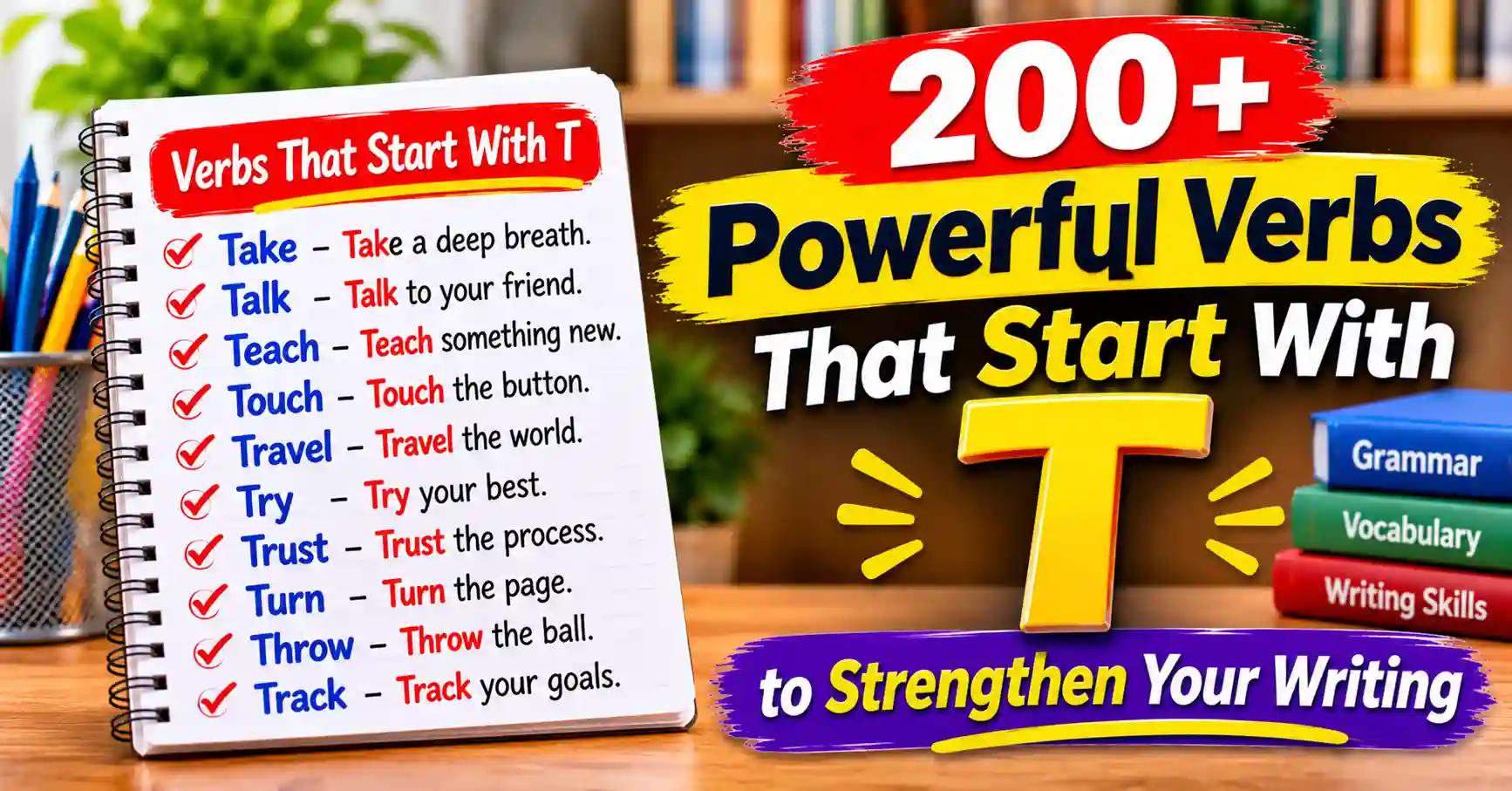
Take, think, tell, and try. The letter T opens some of the strongest verbs in English. This guide covers verbs that start with T, and there are plenty: more than 200 real ones, each checked for spelling and form. You will find common words, powerful words, action words, and a few rare gems.
Each group is easy to scan. You will see meanings and example sentences for the most common verbs. You will also see verb forms, tenses, spelling rules, and the prepositions that follow each verb. There are fun facts, memory tricks, and a short quiz too.
Why does this matter? Verbs drive every sentence. A strong verb makes writing clear and lively. It makes speech sharper. It also helps in school, at work, and in word games.
Read it once. Then come back and practice. Small steps build a large vocabulary. Let’s begin.
What Are Verbs?
Verbs are the action and state words of language. They tell us what someone does, what happens, or what something is. Almost every sentence needs one. Let’s look at a simple definition, five quick examples, and the three jobs verbs do in a sentence.
A verb is a word that shows an action, an event, or a state of being.
Here are five examples that all start with T:
- She teaches math at a local school.
- The children tiptoe past the sleeping baby.
- Rain taps on the window.
- We travel by train every summer.
- He thanked the team for their help.
Verbs do three main jobs:
- Action verbs show what someone does: tap, throw, tie.
- State verbs show a condition: tend, trust, tolerate.
- Helping verbs work with other verbs. No helping verb starts with T.
A rich verb vocabulary makes writing stronger. “Trudge” is more vivid than “walk slowly.” “Transform” is more exact than “change a lot.” Strong verbs also let you drop extra adverbs.
Now let’s explore verbs that start with T, one group at a time.
Complete List of Verbs That Start With T
This is the full word bank. It holds more than 200 real verbs that begin with T, all in their base form. The words are sorted by use, so you can browse by topic. Every list runs in alphabetical order. The first table gives meanings and examples. Later groups appear as clean lists you can scan fast.
Common Verbs Starting With T
Common verbs are the everyday words you use all the time. You hear them at home, at school, and at work. The forty words below are the best place to begin. Read each meaning. Then say the example sentence out loud once to lock it in.
| Verb | Meaning | Example |
| tackle | to deal with a problem | We must tackle the issue. |
| tailor | to make or adapt for a purpose | She tailors lessons to each child. |
| take | to get hold of or carry | Take an umbrella. |
| talk | to speak | We talk every day. |
| tap | to hit lightly | He tapped the door. |
| target | to aim at | The ad targets teenagers. |
| taste | to sense flavor | Taste the soup. |
| teach | to share knowledge | She teaches math. |
| tear | to rip | Do not tear the page. |
| tell | to say or inform | Tell me the truth. |
| tend | to care for, or to be likely to | He tends the garden. |
| test | to check by trying | Test the brakes. |
| thank | to show gratitude | Thank your host. |
| think | to use the mind | Think before you speak. |
| throw | to send through the air | Throw the ball. |
| tidy | to make neat | Tidy your room. |
| tie | to fasten with a knot | Tie your shoes. |
| tighten | to make tight | Tighten the screw. |
| time | to measure the duration of | Time the race. |
| tip | to give extra money, or to tilt | We tipped the waiter. |
| tire | to become or make weary | Long walks tire me. |
| touch | to feel with the hand | Do not touch the paint. |
| tour | to travel around a place | They toured Italy. |
| trace | to follow or copy lines | Trace the outline. |
| track | to follow the path of | Track your parcel. |
| trade | to exchange | They trade stamps. |
| train | to teach skills | Coaches train athletes. |
| transfer | to move from one place to another | Transfer the files. |
| transform | to change completely | Art transforms lives. |
| translate | to change into another language | She translates novels. |
| travel | to go from place to place | We travel by train. |
| treat | to behave toward, or to give medical care | Treat others kindly. |
| trim | to cut neatly | Trim the hedge. |
| trip | to stumble | He tripped on the step. |
| trust | to rely on | I trust you. |
| try | to attempt | Try again. |
| tune | to adjust a sound | He tuned the guitar. |
| turn | to rotate or change direction | Turn left. |
| twist | to wind or bend | Twist the cap. |
| type | to write on a keyboard | She types fast. |
Start with ten verbs. Write one sentence for each. Then add ten more.
Action Verbs (Physical Actions)
Action verbs show things you can see someone do. They describe pulling, covering, fastening, and hitting. These verbs make stories and instructions clear and lively. The twenty verbs below are not in the top list. Notice how many describe working with the hands.
- tack – to fasten with a small nail
- tamp – to pack down firmly
- tan – to turn skin brown, or to make leather
- tape – to stick with tape
- tar – to cover with tar
- tattoo – to mark skin with ink
- teeter – to sway unsteadily
- thatch – to cover a roof with straw
- thread – to pass a string through
- thump – to hit with a dull sound
- thwack – to hit sharply
- tile – to cover with tiles
- till – to prepare soil for crops
- toast – to brown with heat
- toe – to touch with the toe
- tow – to pull behind
- tuck – to fold in
- tug – to pull hard
- tumble – to fall roughly
- tweak – to pinch or adjust slightly
Pick an action verb when you want the reader to see the movement.
Verbs of Communication
Communication verbs show speaking, writing, asking, and explaining. They help you say exactly how someone shares ideas. A precise verb can replace a weak phrase like “said in a mean way.” The eighteen verbs below are not in the top list. Use them in essays, speeches, and reports.
- tabulate – to arrange in a table
- tattle – to tell on someone
- taunt – to tease cruelly
- tease – to make fun of playfully
- telegraph – to send by telegraph, or to signal
- telephone – to call
- televise – to broadcast on television
- term – to call by a name
- testify – to give evidence
- text – to send a text message
- title – to give a name to
- tout – to praise loudly in order to sell
- transcribe – to write out
- transmit – to send
- trill – to sing with quick notes
- trumpet – to announce loudly
- tweet – to post on social media, or to chirp
- twitter – to chirp
Choose “tease” for playful fun and “taunt” for unkind mockery.
Verbs of Thinking and Emotion
These verbs show what happens inside the mind and heart. They describe fear, wonder, doubt, and desire. They make characters feel real. The eighteen verbs below are not in the top list. Many are strong, so pick the one that fits the size of the feeling.
- tantalize – to tease with something out of reach
- tempt – to attract toward something wrong
- terrify – to frighten greatly
- terrorize – to scare with threats
- theorize – to form ideas
- thirst – to long for
- thrill – to excite
- tickle – to amuse
- titillate – to excite lightly
- tolerate – to put up with
- torment – to cause suffering
- torture – to cause great pain
- transcend – to rise above
- traumatize – to cause deep distress
- treasure – to value highly
- tremble – to shake with fear
- trifle – to treat as unimportant
- trouble – to worry
Match the strength of the verb to the feeling. “Trouble” is mild, and “terrify” is fierce.
Verbs of Movement
Movement verbs show walking, crossing, and rolling. They give a story speed, direction, and mood. Some describe slow steps, and others describe sudden rushes. The eighteen verbs below are not in the top list. They cover a wide range of motion.
- tail – to follow closely
- taxi – to move slowly on a runway
- teem – to swarm with moving things
- tiptoe – to walk on your toes
- toboggan – to ride a sled
- toddle – to walk with small steps
- totter – to walk unsteadily
- traipse – to walk wearily
- tramp – to walk heavily
- trample – to tread on
- traverse – to cross
- tread – to walk on
- trek – to travel a long way
- troop – to move in a group
- trot – to move at a quick pace
- trudge – to walk with heavy steps
- trundle – to roll slowly
- tunnel – to dig through
Use “tiptoe” for quiet movement and “trudge” for tired, heavy steps.
Verbs for Work, School, and Daily Life
These verbs appear in offices, classrooms, and homes. They describe counting, charging, ending, and teaching. They are useful in emails, reports, and resumes. The twenty verbs below are not in the top list. Learn the ones you meet most often first.
- table – to put forward or to postpone (the meaning differs by region)
- tally – to count
- tax – to charge a tax
- telecommute – to work from home by computer
- telework – to work remotely
- tenant – to occupy as a tenant
- tender – to offer formally
- terminate – to end
- thresh – to separate grain
- tithe – to give a tenth
- toil – to work hard
- total – to add up
- trademark – to register as a trademark
- transact – to carry out business
- transition – to change from one state to another
- trial – to test
- troubleshoot – to find and fix problems
- tutor – to teach one-to-one
- typecast – to assign the same kind of role
- typeset – to arrange type for printing
Pick “troubleshoot” for fixing problems and “terminate” for formal endings.
Positive Verbs
Positive verbs lift, grow, and bring people together. They describe care, success, and thanks. They are perfect for speeches, goals, and thank-you notes. Some words below repeat from earlier lists on purpose, because they fit more than one group. Use them to give your writing warmth and energy.
- teach – to share knowledge
- tend – to care for
- thank – to show gratitude
- thrill – to excite with joy
- thrive – to grow and do well
- tickle – to amuse
- tidy – to make neat
- toast – to honor with a drink
- trailblaze – to lead the way
- transcend – to rise above
- transform – to change for the better
- treasure – to value highly
- treat – to care for
- triumph – to win
- trust – to rely on
- turbocharge – to boost
Choose “thrive” for healthy growth and “triumph” for a win.
Negative Verbs
Negative verbs show harm, deceit, and trouble. They describe spoiling things, breaking rules, and hurting people. Use them with care, because they carry a strong tone. They are useful in news writing and stories with conflict. Five words below also appear in earlier lists.
- taint – to spoil with a bad influence
- tamper – to interfere with or harm
- tangle – to twist into a knot
- tarnish – to dull or damage
- taunt – to tease cruelly
- terrorize – to scare with threats
- thrash – to beat or defeat badly
- threaten – to warn of harm
- thwart – to block
- toady – to flatter to gain favor
- torment – to cause suffering
- torture – to cause great pain
- traduce – to slander
- trample – to tread on
- trash – to wreck or criticize harshly
- trespass – to enter without permission
- trick – to deceive
- tyrannize – to rule cruelly
Match the strength of the verb to the situation. “Tangle” is mild, and “torture” is severe.
Uncommon or Advanced Verbs
Rare verbs make your writing stand out. Use them in small doses. One advanced verb per paragraph is plenty. Too many can confuse a reader. The eighteen verbs below are strong, precise, and often found in books and speeches. Check each in a dictionary before you use it.
- tarry – to linger
- temporize – to delay to avoid a decision
- tessellate – to fit shapes together without gaps
- tether – to tie with a rope
- tinge – to add a slight color
- tipple – to drink alcohol in small amounts, often
- titter – to giggle
- tonsure – to shave part of the head
- torpedo – to destroy with a torpedo, or to ruin
- trammel – to hinder
- transfix – to hold motionless
- transgress – to break a rule
- transmute – to change into another form
- transpire – to happen, or to become known
- trounce – to defeat heavily
- truncate – to cut short
- twiddle – to fiddle with
- typify – to be a typical example of
Try “truncate” for a formal way to say “cut short.”
Simple Verbs for Beginners and Kids
If you are just starting, begin here. These ten verbs are short, common, and easy to say. Children love them, and so do new English learners. They repeat from the top list on purpose, because the simplest verbs are often the most useful. Make a sentence for each.
- take, talk, tap, tell, throw
- tidy, tie, touch, try, turn
Act each verb out with a friend. Then say a sentence for each one.
Verbs by Word Length
Sorting verbs by length helps in spelling, games, and puzzles. Short verbs are easy to learn. Long verbs need chunking. This section groups T verbs by how many letters they have. Some words repeat from earlier lists, and some are new. Use these groups to build your word-game skills.
3-Letter Verbs
Three-letter verbs are the building blocks of English. They are quick to spell and easy to remember. They are also gold in Scrabble and crossword grids. English has eighteen common verbs of this length that start with T. Learn them first.
tag, tan, tap, tar, tax, tee, tie, tin, tip, toe, tog, tot, tow, toy, try, tub, tug, tut
“Tut” means to make a clicking sound of disapproval, and “tee” appears in “tee off.”
4-Letter Verbs
Four-letter verbs are the sweet spot for many games. They give you enough letters to build a plan, but they stay easy to hold in memory. The twenty verbs below cover fastening, cleaning, and fixing. Say each one and picture it in your mind.
tail, tame, tank, task, tear, tent, test, tint, toil, toll, tone, tool, tote, tour, trap, trek, trot, tuck, tune, twin
“Tote” means to carry, and “twin” can mean to pair two cities or places.
5-Letter Verbs
Five-letter verbs are popular in word puzzles. They are long enough to be tricky and short enough to guess. The twenty verbs below range from “taint” to “twist.” They are great for Wordle fans and for anyone who loves a quick brain game.
taint, tally, tease, tempt, tense, thank, thump, tithe, toast, torch, towel, tower, trace, trail, tread, trick, troll, truss, twirl, twist
Many of these start with “tr” or “th.” That pattern helps in Wordle.
6-Letter Verbs
Six-letter verbs begin to show patterns like double letters and clear endings. They are useful in essays and stories. The twenty verbs below cover care, travel, and trouble. Break each one into two small chunks when you learn it. “Tack-le” and “tum-ble” are easy.
tackle, tailor, tamper, tangle, target, tattoo, temper, tender, thrive, tinker, tinkle, toddle, topple, totter, toughen, tousle, travel, trifle, tumble, tussle
Split long verbs into chunks. Your memory will thank you.
7+ Letter Verbs
Longer verbs add weight and detail to writing. They often come from Latin and Greek. Learn them by their parts, such as a prefix, a root, and an ending. The twenty verbs below range from seven to sixteen letters. Use them when you want your writing to sound precise.
tabulate, tantalize, telecast, tenderize, terminate, thicken, thunder, tolerate, tranquilize, transfigure, transliterate, transmogrify, transplant, transport, transubstantiate, triangulate, trivialize, troubleshoot, typewrite, tyrannize
Long verbs feel hard at first. With practice, they become easy.
Verbs by Type
Verbs come in several types. Each type tells us something about how a verb works in a sentence. Some show actions, and some show states. Some need an object, and some do not. Knowing the types helps you build correct sentences. Let’s explore six key types with T examples.
Action and Stative Verbs
Action verbs show things someone does. Stative verbs show a state, such as a feeling, a belief, or a condition. Stative verbs are rarely used in continuous tenses. Some verbs, like “taste,” can act as both. The lists below show the difference.
- Action: tap, throw, tie, toss, trot, tug
- Stative: tend, tolerate, treasure, trust
We say “She is throwing the ball,” but we do not usually say “She is trusting the plan right now.”
Transitive and Intransitive Verbs
Transitive verbs need an object to complete their meaning. Intransitive verbs do not. Many verbs can be both, depending on the sentence. Checking for an object helps you choose the right structure and the right preposition.
- Transitive: tackle, tame, teach, thank, tie, translate
- Intransitive: teem, tremble, thrive, tumble, twinkle
- Both: talk, tear, travel, turn, type
“She taught the class” needs an object. “The plants thrived” does not.
Regular and Irregular Verbs
Regular verbs add “-ed” for the past tense and past participle. Irregular verbs change in other ways. Most T verbs are regular. A small but important group is irregular, and the most common are “take,” “teach,” “tear,” “tell,” “think,” and “throw.” Learn these well, because they are used every day.
- Regular: talk, thank, travel, treat, trust, try
- Irregular: take (took, taken), teach (taught), tell (told), think (thought), throw (threw, thrown)
The full irregular list, with all forms, appears in the next section.
Auxiliary (Helping) and Modal Verbs
Auxiliary verbs help other verbs form tenses, questions, and negatives. Modal verbs show ability, permission, possibility, or necessity. Examples in English include “have,” “do,” “can,” and “must.” No auxiliary or modal verb in standard English starts with T, so this group is empty for this letter.
Use helping verbs from other letters with T verbs. For example: “She has taught for ten years,” “They will travel soon,” and “He can type fast.”
Linking Verbs
Linking verbs connect a subject to a description, as in “She is tired” or “He seems happy.” Two linking verbs start with T: “turn” and “taste.” They do not show action here. They link the subject to a state or quality.
- turn – “The milk turned sour.” “The leaves turn red in fall.”
- taste – “The soup tastes great.” “This tea tastes bitter.”
Check the test: if you can replace the verb with “be” or “become,” it is probably linking.
Phrasal Verbs With T
Phrasal verbs combine a verb with a small word like “up,” “out,” or “off.” They often have meanings that are different from the verb alone. Many are informal and very common in speech. The table below lists twenty phrasal verbs that start with T.
| Phrasal verb | Meaning | Example |
| take after | to resemble a relative | She takes after her mother. |
| take apart | to separate into pieces | He took the clock apart. |
| take back | to return, or to withdraw words | I take back what I said. |
| take in | to understand, or to absorb | I could not take it all in. |
| take off | to leave the ground, or to remove | The plane took off. |
| take on | to accept a task | She took on a new project. |
| take out | to remove, or to invite out | He took out the trash. |
| take over | to gain control | A new team took over. |
| take up | to start a hobby | He took up chess. |
| talk back | to answer rudely | Do not talk back. |
| talk over | to discuss | Let us talk it over. |
| team up | to join to work together | They teamed up on the project. |
| tear down | to destroy a building | Workers tore down the old shed. |
| tell apart | to see the difference between | I cannot tell the twins apart. |
| think over | to consider carefully | Think it over. |
| throw away | to discard | Throw away the old milk. |
| tidy up | to make neat | Tidy up your desk. |
| tie up | to fasten, or to occupy | The meeting tied up my morning. |
| try out | to test | Try out the new app. |
| turn down | to refuse, or to lower | She turned down the offer. |
Learn phrasal verbs as whole units. Their meanings are often not clear from the parts.
Verb Forms and Tenses
Every verb has several forms. Knowing them lets you build all the tenses. This section shows how verbs that start with T change in the past, the participle, and the third person. You will also see the spelling rules, the irregular verbs, and a full tense guide with examples.
Verb Forms Table
This table shows the five forms of twenty-four T verbs. The base form is the dictionary form. The past simple and past participle are usually the same for regular verbs. Study the pattern, then cover the other columns and test yourself.
| Base | Past simple | Past participle | Present participle | Third-person singular |
| tackle | tackled | tackled | tackling | tackles |
| tag | tagged | tagged | tagging | tags |
| tap | tapped | tapped | tapping | taps |
| target | targeted | targeted | targeting | targets |
| taste | tasted | tasted | tasting | tastes |
| tax | taxed | taxed | taxing | taxes |
| thank | thanked | thanked | thanking | thanks |
| tidy | tidied | tidied | tidying | tidies |
| tie | tied | tied | tying | ties |
| tip | tipped | tipped | tipping | tips |
| tire | tired | tired | tiring | tires |
| touch | touched | touched | touching | touches |
| trade | traded | traded | trading | trades |
| train | trained | trained | training | trains |
| transfer | transferred | transferred | transferring | transfers |
| translate | translated | translated | translating | translates |
| travel | traveled (US) or travelled (UK) | traveled or travelled | traveling or travelling | travels |
| treat | treated | treated | treating | treats |
| trim | trimmed | trimmed | trimming | trims |
| trot | trotted | trotted | trotting | trots |
| trust | trusted | trusted | trusting | trusts |
| try | tried | tried | trying | tries |
| tune | tuned | tuned | tuning | tunes |
| type | typed | typed | typing | types |
Notice that “tag,” “tap,” “tip,” “trim,” and “trot” double their last letter. The rules below explain why.
Irregular Verbs Starting With T
Irregular verbs do not follow the “-ed” pattern. T has some of the most common irregular verbs in English. Learn the table below, and you will avoid the most common verb errors. Notice how “telecast” and “typeset” never change.
| Base | Past simple | Past participle | Present participle | Third-person singular |
| take | took | taken | taking | takes |
| teach | taught | taught | teaching | teaches |
| tear | tore | torn | tearing | tears |
| telecast | telecast | telecast | telecasting | telecasts |
| tell | told | told | telling | tells |
| think | thought | thought | thinking | thinks |
| throw | threw | thrown | throwing | throws |
| thrust | thrust | thrust | thrusting | thrusts |
| tread | trod | trodden (or trod) | treading | treads |
| troubleshoot | troubleshot | troubleshot | troubleshooting | troubleshoots |
| typeset | typeset | typeset | typesetting | typesets |
| typewrite | typewrote | typewritten | typewriting | typewrites |
Say “She taught me” and “She has taught me.” Never say “teached.”
Spelling Rules for -ing, -ed, and -s
Adding endings follows a few simple rules. Drop a silent “e” before “-ing.” Double a final consonant when the last syllable is short and stressed. Change “y” to “i” after a consonant. Add “-es” after certain sounds. The table shows each rule with two examples.
| Rule | Example |
| Drop silent “e” before -ing and keep it before -s | tire → tiring, tires |
| Just add -d when the verb ends in “e” | tune → tuned |
| Double a final consonant after a short, stressed vowel | tap → tapping; trim → trimmed; tug → tugged; transfer → transferred |
| Do not double if the last syllable is unstressed | target → targeted; tailor → tailored |
| Change “y” to “ied” after a consonant | try → tried; tidy → tidied; terrify → terrified |
| Keep “y” after a vowel | toy → toyed; stay-type verbs do not change |
| Change “ie” to “y” before -ing | tie → tying |
| Add “-es” after s, x, z, ch, sh | toss → tosses; tax → taxes; teach → teaches; touch → touches |
Check the stress of the last syllable before you double a letter. This one rule prevents most errors.
Verb Tenses Explained
Tenses show when an action happens. Simple tenses show habits and facts. Continuous tenses show actions in progress. Perfect tenses link two times. The table below gives the form and two examples for each of eight common tenses, using T verbs.
| Tense | Form | Example 1 | Example 2 |
| Present simple | base / base + s | She teaches music. | They travel often. |
| Present continuous | am/is/are + -ing | He is typing a report. | We are tidying the house. |
| Past simple | -ed / irregular | We took the early train. | She thanked the cook. |
| Past continuous | was/were + -ing | I was thinking about you. | They were trading cards. |
| Future simple | will + base | I will tell you tomorrow. | They will translate the letter. |
| Present perfect | has/have + past participle | She has taught for ten years. | We have tried that route. |
| Past perfect | had + past participle | He had thrown the ball before the whistle. | They had traveled far. |
| Future perfect | will have + past participle | By June, she will have trained 20 nurses. | By noon, we will have typed the report. |
Use present simple for habits, past simple for finished events, and perfect tenses to link time periods.
Spelling Patterns and Prefixes for the Letter T
Spelling gets easier when you see patterns. T begins many verbs, and each pattern hints at a meaning. This section shows common prefixes, endings, and tricky spots. Use it as a map when you study verbs that start with T. A short list of patterns can unlock dozens of words.
Common Prefixes and Letter Combinations
Prefixes are small word parts added to the front of a word. They change or shape the meaning. The biggest T prefix is “trans-,” which means “across” or “beyond.” Another useful one is “tele-,” which means “far.” The list below shows each pattern with examples.
- trans- (across, beyond): transcend, transfer, transform, translate, transmit, transplant, transport
- tele- (far): telecast, telegraph, telephone, televise, telecommute
- tri- (three): triangulate
- th- (a common blend): thank, think, thrive, throw, thwart
- tr- (a common blend): trace, trade, train, tread, treat, trim, trip
Spot the prefix first. Then the rest of the word is easier to read.
Common Verb Suffixes
Suffixes are word parts added to the end. Some endings turn nouns and adjectives into verbs. The most common are “-ize,” “-ify,” “-ate,” and “-en.” Knowing them helps you spot verbs and build new ones. The examples below all start with T.
- -ize (to make or do): tantalize, terrorize, theorize, tranquilize, traumatize, trivialize, tyrannize
- -ify (to make): terrify, testify, transmogrify, typify
- -ate (to act on): tabulate, terminate, titillate, tolerate, triangulate, truncate
- -en (to make or become): thicken, tighten, toughen
Spelling can vary. “Tranquilize” is also spelled “tranquillize” in British English.
Tricky Spellings, Silent Letters, and Pronunciation
T verbs hide a few traps. Some change pronunciation with the meaning. Learn the patterns below, and you will avoid many common errors in speech and writing.
- Silent “l”: talk says “tawk.”
- Silent “b”: thumb, as in “thumb a ride,” says “thum.”
- Voiced “th”: teethe says “teeth” with the soft “th,” like “breathe.”
- Same spelling, two sounds: tear (to rip) rhymes with “bear.” Tear (to cry) is a noun that rhymes with “ear.”
- Spelling variants: traveled (US) is travelled in British English. Totaled (US) is totalled in British English.
- Often misspelled: transferred (double “r”), tying (not “tieing”), and tranquilize.
Notice that “tying” changes “ie” to “y.” Say “tie, tying” as a pair.
How to Use These Verbs Correctly
Knowing a verb is not enough. You must use it with the right subject, tense, and preposition. This section covers the rules that matter most. You will see agreement, tense choice, verb and preposition pairs, common mistakes, and confusing pairs. Practice with the verbs that start with T that you like best.
Subject-Verb Agreement
A verb must match its subject. Singular subjects take a verb with “-s” in the present tense. Plural subjects take the base form. A few subjects need extra care, such as “everyone,” “neither,” and group nouns. Read each example, and notice how the verb changes.
- The teacher teaches the class. (singular)
- The teachers teach the class. (plural)
- Everyone tries hard. (“Everyone” is singular.)
- Neither of them tells the truth. (“Neither” is singular.)
- The team trains every morning. (a group acting as one)
Choosing the Correct Tense
The right tense depends on when the action happens and how it connects to now. Use present simple for habits, past simple for finished events, continuous for actions in progress, and perfect for links between times. Here are five examples with the verb “take.”
- I take the bus every day. (habit)
- I took the bus yesterday. (finished past)
- I am taking the bus now. (in progress)
- I have taken the bus all week. (a past action with a present result)
- I will take the bus tomorrow. (future)
Verbs Followed by Prepositions
Many verbs need a specific preposition. Using the wrong one is a common error. Learn each verb and its preposition as a pair. The eight examples below all use T verbs. Say each sentence aloud once.
- tamper with: Do not tamper with the lock.
- thank for: I thank you for your help.
- think about: She thinks about her future.
- trust in: We trust in your judgment.
- translate into: He translates novels into Spanish.
- turn into: The caterpillar turned into a butterfly.
- threaten with: The storm threatened us with floods.
- tend to: He tends to arrive early.
Common Mistakes and How to Avoid Them
Everyone makes mistakes. The key is to spot them early. Most errors with T verbs come from irregular forms and agreement. Here are six that learners make often. Each has a quick fix. Read them twice, then check your next piece of writing.
- Wrong: “She teached me.” Right: “She taught me.”
- Wrong: “I thinked about it.” Right: “I thought about it.”
- Wrong: “He telled me.” Right: “He told me.”
- Wrong: “They throwed the ball.” Right: “They threw the ball.”
- Wrong: “She have took the book.” Right: “She has taken the book.”
- Wrong: “He talk to me daily.” Right: “He talks to me daily.”
Commonly Confused Verbs
Some verbs look or sound alike, or share a meaning that is hard to separate. Mixing them up can change your message. Here are six pairs worth learning. Study the difference, then try each verb in a sentence of your own. Soon the right choice will feel natural.
- take / bring: Take means to carry away from the speaker. Bring means to carry toward the speaker.
- tell / say: Tell needs a person: “tell her.” Say needs words: “say hello.”
- teach / learn: Teach means to give knowledge. Learn means to get it.
- transfer / transform: Transfer means to move. Transform means to change.
- trace / track: Trace means to follow lines or copy them. Track means to follow a trail or progress.
- tow / toe: Tow means to pull behind. Toe means to touch with the toe, as in “toe the line.”
Synonyms and Antonyms
Synonyms are verbs with similar meaning. Antonyms are verbs with opposite meaning. Learning both doubles your word power. You avoid repeating yourself, and you gain a feel for shades of meaning. The table below covers eighteen key T verbs. It is a handy tool for any learner.
| Verb | Synonyms | Antonyms |
| tackle | confront, handle | avoid, dodge |
| take | grab, seize | give, return |
| talk | speak, chat | listen, stay silent |
| teach | instruct, train | learn, study |
| tell | inform, say | conceal, hide |
| tend | care for, look after | neglect, ignore |
| thrive | flourish, prosper | fail, decline |
| throw | toss, hurl | catch, hold |
| tidy | neaten, arrange | clutter, mess up |
| tighten | taut, fasten | loosen, slacken |
| tolerate | bear, accept | reject, forbid |
| transform | change, convert | preserve, keep |
| trim | cut, clip | grow, extend |
| trust | rely on, believe | distrust, doubt |
| try | attempt, test | give up, quit |
| turn | rotate, spin | stay, hold still |
| thank | show gratitude | blame, ignore |
| tear | rip, split | mend, join |
Choosing between synonyms is about tone, strength, and context. “Try” and “attempt” both mean to make an effort. But “try” is everyday and warm, while “attempt” is formal and sounds serious. “Toss” is light, while “hurl” is fierce. “Tell” is plain, while “inform” is formal. Think about who is reading and how strong the action should be. A formal report may need “terminate,” while a chat may only need “end.” Match the verb to the person, and your meaning will land well. When in doubt, choose the simpler verb and add one detail.
Practical Use Cases
Verbs matter most when you use them. This section shows where T verbs fit in real life. You will see ideas for school, stories, work, social media, daily talk, and word games. Each setting has its own tone. Match your verb choice to that tone, and your message will land well.
Essays and Academic Writing
Academic writing needs precise, formal verbs. Choose verbs that are clear and measured. Avoid slang and phrasal verbs where a single verb will do. Verbs like “test,” “theorize,” and “transform” suit essays and reports.
- The study tests three teaching methods.
- Scientists theorize about the origin of the moon.
- New tools transform how people learn.
Storytelling and Creative Writing
Stories need vivid action and mood. Strong verbs let you show events instead of telling them. Verbs like “tiptoe,” “tremble,” and “thunder” paint pictures. Pick the verb that matches the mood you want.
- She tiptoed down the dark hall.
- His hands trembled as he opened the letter.
- Thunder rolled while the horses trampled the mud.
Resumes and Professional Writing
Resumes need strong action verbs in the past tense. Start each bullet with a verb, and follow it with a number or result. Verbs like “trained,” “transformed,” and “tripled” add weight. Claims without proof feel empty to hiring managers.
- Trained 25 new staff in customer service.
- Transformed an old filing system into a digital one.
- Tripled monthly sales in one year.
- Tracked budgets across five departments.
- Troubleshot network issues and cut downtime by 40%.
Social Media Captions
Captions are short and catchy. A single strong verb can make a post pop. Choose fun, light verbs, often in the command form. Keep your tone warm and natural. Short captions often win more attention than long ones.
- Take the long way home 🌅
- Try something new today.
- Treasure the small moments.
Everyday Conversation
In daily talk, simple verbs win. Use common verbs that sound warm and clear. “Talk,” “take,” and “thank” are perfect. They help you share plans fast. You do not need fancy words to sound smart. Clear speech always sounds good.
- “Let’s talk after lunch.”
- “Please take a seat.”
- “I want to thank you.”
Word Games (Scrabble, Wordle, Crosswords)
Word games reward a big verb bank. T is worth one point in English Scrabble, and it is a common tile, with six in a full set. Short T verbs fit tight crossword grids. Five-letter verbs like “track” and “trade” suit Wordle-style guessing. Practice with the length lists above to build speed.
- Try the Scrabble plays tug, tow, or tie to use a tight spot.
- Guess tease, train, or treat as a five-letter starter.
- For a crossword clue “Pull behind,” think tow.
Fun Facts and Learning Tips
Learning words should be fun. Stories stick better than lists. In this section, you will find surprising facts, memory tricks, word histories, daily habits, and a quiz. Take your time here. Try one idea at a time. Soon, verbs that start with T will feel like old friends, and your vocabulary will grow with every page you read.
Fun Facts About the Letter T and Its Verbs
The letter T has an old, colorful story. Its verbs hide ancient roots, odd histories, and famous names. These six facts show how alive English can be. Share a few with friends. They make great conversation starters, and they help words stay in your memory.
- T began as a “mark.” The Phoenician letter taw meant “mark” or “sign.” It looked like a cross. The Greeks turned it into tau (Τ), and Latin into T.
- “Tell” once meant “count.” It came from Old English tellan, “to count.” We still see that meaning in “bank teller” and “tell the votes.”
- “Travel” began as hard work. It came from Old French travail, meaning “toil” or “suffering.” Long trips were once so hard that the words for “work” and “journey” were the same.
- “Tantalize” comes from a Greek myth. King Tantalus was punished by standing in water beneath fruit he could never reach. His name gave English a verb for teasing with something out of reach.
- “Tease” once meant “pull apart wool.” It came from Old English tæsan, “to pluck or pull.” Workers teased wool fibers before spinning. Later, the word came to mean “to annoy playfully.”
- “Toast” began with bread. People once dropped spiced toasted bread into drinks. Later, “to toast” meant to drink in honor of someone, as if the person added flavor to the drink.
Memory Tricks and Mnemonics
Memory tricks turn hard words into easy ones. Your brain loves pictures, sounds, and stories. Use the five tricks below. Each one has an example from our list. Try making your own too. Personal tricks work best because they connect to things you already know.
- Took and taken: Say “take, took, taken.” All three start with T. They are easy to chant.
- Teach and learn: A teacher teaches, and a student learns. Picture a T for the teacher at the front.
- Tell and say: “Tell” needs a person, like “tell her.” “Say” needs words, like “say hello.”
- Transferred has two r’s: Say “trans-FER-red.” The stress falls on the last syllable, so the “r” doubles.
- Trace and track: Trace is for lines, like tracing paper. Track is for trails, like a train track.
Word Origins and History
Word origins explain why meanings feel the way they do. Here are five T verbs and where they came from. Notice how many started with a simple, physical idea. Seeing the root often unlocks the meaning. It also helps you guess new verbs.
- Torture: From Latin tortura, “a twisting.” It moved from “twisting” to “causing great pain.”
- Tolerate: From Latin tolerare, “to bear.” It moved from “carrying a load” to “putting up with.”
- Translate: From Latin translatus, “carried across.” It moved from “carrying across” to “carrying meaning across languages.”
- Transpire: From Latin words meaning “to breathe across or out.” It first described vapor leaving a surface. Later it came to mean “to become known” and then “to happen.”
- Target: From Old French targe, “a small shield.” It moved from “shield” to “the mark you aim at.”
Daily Practice Tips
Small habits beat big plans. Ten minutes a day can change your vocabulary in a month. Pick two or three of the habits below. Stay steady, and progress will come. Regular practice matters far more than long, rare study sessions.
- Read and underline. Pick articles, stories, or recipes. Underline any T verb you meet. Look up the ones you do not know.
- Write three tenses a day. Choose one new T verb. Write one sentence each in the past, present, and future. This builds form and tense skill together.
- Use flashcards. Put the base form on one side and the past and past participle forms on the other. Short, frequent reviews are best.
- Speak in patterns. Say “I take it, I took it, I have taken it.” Repeat with a new verb each day. Hearing yourself helps memory.
- Build a resume verb list. Collect strong T verbs like “trained,” “transformed,” and “tripled.” Use one in each job bullet.
- Play word games. Try Scrabble, Wordle, or crosswords with a friend. Games make practice fun and fast.
Mini Practice Quiz
Quizzes show what you know. They also show what to review. Try these ten questions without peeking. Write your answers on paper. Then check the answer key. Be kind to yourself. Every mistake is a step forward, and every correct answer proves your hard work is paying off.
- What is the past simple of “teach”? (taught / teached)
- What is the past participle of “take”? (took / taken)
- Fill in the blank: “I ___ him yesterday.” (tell / told)
- What is the -ing form of “tie”? (tieing / tying)
- What is the third-person singular of “try”? (trys / tries)
- What is the past participle of “tear”? (tore / torn)
- Which sentence uses a linking verb? (“The milk turned sour.” / “She turned the page.”)
- What is the past simple of “trim”? (trimed / trimmed)
- What is the past simple of “transfer”? (transfered / transferred)
- What does “thwart” mean? (to block / to help)
Answer Key
- taught – “Teach” is irregular.
- taken – The past simple is “took.”
- told – “Tell” is irregular.
- tying – Change “ie” to “y” before “-ing.”
- tries – Change “y” to “ies” after a consonant.
- torn – The past simple is “tore.”
- “The milk turned sour.” – “Turned” links the milk to a state.
- trimmed – Double the “m” after a short, stressed vowel.
- transferred – The stress falls on the last syllable, so the “r” doubles.
- to block – It means to stop someone’s plan.
Frequently Asked Questions
Learners often ask the same smart questions. This section answers the most common ones. Each answer is short and clear. Use them as quick reminders when you study or write. If you still have a question after reading, test the verbs in your own sentences and see how they sound.
What are verbs that start with T?
Verbs that start with T include take, talk, teach, tell, think, throw, travel, and try. They show actions, states, and events. English has many of them, because prefixes like “trans-” and endings like “-ize” build so many verbs. This guide lists more than 200, with meanings, forms, tenses, and examples.
What are some action verbs that start with T?
Popular action verbs include tap, throw, tie, tug, tow, toss, trot, and trample. They describe things you can see someone do. “Tackle,” “tighten,” and “thread” are good for hands-on tasks. Choose an action verb when you want the reader to picture the movement clearly.
What are strong verbs that start with T for a resume?
Strong resume verbs include trained, transformed, tripled, tracked, tested, translated, tailored, and tackled. Use the past tense for past jobs. Pair each verb with a number or result, such as “Trained 25 new staff.” A strong verb plus proof shows impact better than a general claim.
What is the longest verb that starts with T?
Among real verbs, “transubstantiate” is one of the longest, with 16 letters. It means to change one substance into another, and it has a religious use. Other long ones include “transliterate” and “troubleshoot.” Long verbs are easier if you split them into chunks, such as “trans-sub-stan-ti-ate.”
What are easy verbs that start with T for kids?
Good beginner choices are take, talk, tap, tell, throw, tidy, tie, touch, try, and turn. They are short and easy to say. Each one names something a child can act out. Pair each verb with a gesture, and ask the child to make a simple sentence in the present and past tense.
What are the irregular verbs that start with T?
The most common are take (took, taken), teach (taught), tear (tore, torn), tell (told), think (thought), and throw (threw, thrown). Others include tread (trod, trodden), thrust (thrust), and troubleshoot (troubleshot). Most other T verbs are regular and simply add “-ed.”
What linking verbs start with T?
Two linking verbs start with T: “turn” and “taste.” They connect the subject to a state or quality, as in “The milk turned sour” and “The soup tastes great.” They are also action verbs in other uses, as in “She turned the page.” Check whether you can replace the verb with “become” or “be.”
Conclusion
You learned what verbs are and how they work. You explored verbs that start with T: more than 200 of them, sorted by use, length, and type.
Here are the key takeaways. Start with the simple verbs. Learn the past forms as you go. Watch for the irregular verbs, especially take, teach, tell, think, and throw. Use strong verbs to make writing clear and lively.
Vocabulary grows through use, not just reading. So take action today. Pick five T verbs from this page. Write one sentence for each in two tenses. Save this article for later. Share it with a friend who loves words. Keep practicing, and your writing will shine.
