

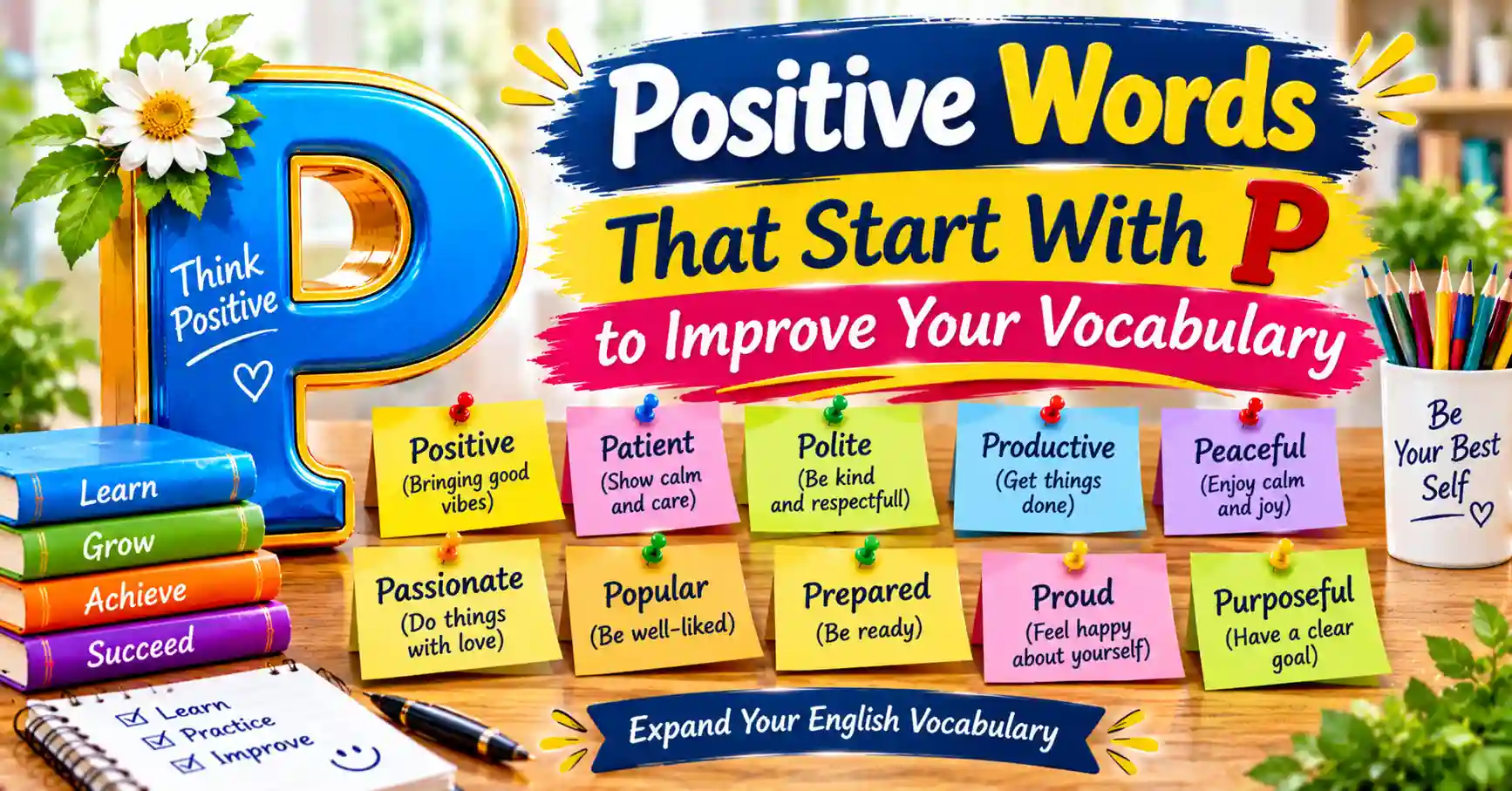
Peace, passion, patience, and promise. The letter P is full of warm, uplifting words. This guide shares more than 140 positive words that start with P. Each one has a clearly uplifting meaning. We checked every word, and we left out any word that is neutral or only positive in some settings.
P has a few words short of 150 that are truly positive. So we list every real one we found, and we add nothing weak. You will see meanings, parts of speech, and example sentences. You will also find themes, people words, spelling tips, and a short quiz.
Why does this matter? Positive words shape how people feel when they read or hear you. They make praise clear.
Read it once. Then come back and practice. Small steps build a large vocabulary. Let’s begin.
What Are Positive Words?
Positive words lift the mood of a sentence. They praise, comfort, and encourage. Learning them helps you speak with warmth and write with care. Let’s look at a simple definition, five quick examples, and the idea of tone behind every word.
A positive word is a word with an uplifting meaning or feeling. It makes people feel valued, hopeful, or glad.
Here are five examples that all start with P:
- We sat by a peaceful lake at dawn.
- She is a patient teacher who never rushes you.
- The garden was picturesque in spring.
- His perseverance carried him to the finish line.
- That was a phenomenal performance.
Every word has two layers. The first is its denotation, which is its dictionary meaning. The second is its connotation, which is the feeling around it. “Plump” and “pleasingly round” may describe the same shape, but the second feels kinder.
Positive words improve communication because they set a warm tone. They strengthen relationships because people feel seen and valued. They help writing too, since they add color and clear feeling.
Now let’s explore positive words that start with P, one group at a time.
Complete List of Positive Words That Start With P
This is the full word bank. It holds 145 positive words that begin with P, and each one has a clearly warm meaning. Every word carries its part of speech. Lists run in alphabetical order. The first table gives meanings and examples.
Top 40 Positive Words Starting With P
These forty words are the best place to begin. They are common, clear, and useful in daily life. Each row shows the word, its part of speech, a short meaning, and an example sentence. Read a few aloud, then try them in your own sentences.
| Word | Part of speech | Meaning | Example |
| pal | noun | a close, friendly companion | She is my pal. |
| paradise | noun | a place of perfect happiness | The beach felt like paradise. |
| passion | noun | strong, warm enthusiasm | He plays with passion. |
| passionate | adjective | full of strong, warm feeling | She is passionate about art. |
| patience | noun | calm waiting and kindness | Patience helps us learn. |
| patient | adjective | calm and tolerant | A patient teacher guided us. |
| peace | noun | calmness and harmony | We wished for peace. |
| peaceful | adjective | calm and quiet | We found a peaceful lake. |
| perfect | adjective | complete and without fault | It was a perfect day. |
| perfection | noun | the state of being flawless | The cake was baked to perfection. |
| perseverance | noun | steady effort despite hardship | Perseverance won the race. |
| phenomenal | adjective | remarkable and wonderful | It was a phenomenal show. |
| picturesque | adjective | lovely like a painting | We visited a picturesque village. |
| pioneer | noun | one who leads the way | She was a pioneer in medicine. |
| playful | adjective | full of fun | A playful puppy greeted us. |
| pleasant | adjective | enjoyable and nice | It was a pleasant surprise. |
| pleasure | noun | deep enjoyment | It was a pleasure to meet you. |
| plentiful | adjective | available in great amounts | Fruit is plentiful here. |
| plenty | noun | more than enough | There is plenty of food. |
| plucky | adjective | brave and spirited | A plucky young climber won. |
| polished | adjective | refined and elegant | She gave a polished speech. |
| polite | adjective | respectful and well-mannered | He gave a polite reply. |
| politeness | noun | respectful good manners | Politeness costs nothing. |
| positive | adjective | hopeful and constructive | Stay positive. |
| positivity | noun | a hopeful, upbeat outlook | Her positivity is contagious. |
| powerful | adjective | strong and effective | It was a powerful speech. |
| precious | adjective | very valuable and loved | These are precious memories. |
| pretty | adjective | pleasing to look at | The garden is pretty. |
| priceless | adjective | too valuable to measure | Your smile is priceless. |
| prize | noun | a reward for achievement | She won first prize. |
| prodigy | noun | a young person of great talent | He is a piano prodigy. |
| productive | adjective | achieving a lot | It was a productive day. |
| progress | noun | forward movement and growth | She made great progress. |
| promise | noun | hope of future good | The young player shows promise. |
| promising | adjective | likely to succeed | It was a promising start. |
| prosperity | noun | success and well-being | We wish you prosperity. |
| prosperous | adjective | thriving and successful | It is a prosperous town. |
| pure | adjective | clean and free of faults | She felt pure joy. |
| purpose | noun | a meaningful aim | Her work has purpose. |
| purposeful | adjective | determined and meaningful | He leads a purposeful life. |
Start with ten words. Write one sentence for each. Then add ten more.
Positive Adjectives
Adjectives describe people, places, and things. Positive adjectives add warmth to every description. They work well in compliments, reviews, and kind notes. The thirty-one words below are not in the top list. Notice how many end in “-ful,” “-ous,” and “-ive.”
- pacific (adj.) – peaceful (formal)
- palatial (adj.) – grand like a palace
- peaceable (adj.) – peaceful and friendly
- peachy (adj.) – fine and pleasant (informal)
- peerless (adj.) – without an equal
- peppy (adj.) – full of lively energy
- perceptive (adj.) – quick to notice
- perky (adj.) – cheerful and lively
- persevering (adj.) – steady despite difficulty
- philanthropic (adj.) – generous toward others
- pioneering (adj.) – leading the way
- placid (adj.) – calm and gentle
- pleased (adj.) – happy and satisfied
- pleasing (adj.) – giving delight
- pleasurable (adj.) – enjoyable
- plenteous (adj.) – abundant (formal)
- plush (adj.) – rich and comfortable
- poised (adj.) – calm and graceful
- praiseworthy (adj.) – deserving praise
- preeminent (adj.) – above all others
- prestigious (adj.) – highly respected
- principled (adj.) – guided by good values
- pristine (adj.) – fresh and spotless
- prized (adj.) – greatly valued
- proactive (adj.) – acting early to do good
- proficient (adj.) – skilled
- profitable (adj.) – bringing gain
- prolific (adj.) – producing much
- provident (adj.) – wisely prepared
- prudent (adj.) – wise and careful
- pulchritudinous (adj.) – strikingly beautiful
Pick the adjective that matches what you truly admire. Specific words feel more sincere.
Positive Nouns
Nouns name people, things, and ideas. Positive nouns name qualities we value, such as calm, skill, and generosity. They work well in speeches, cards, and goals. The twenty-eight nouns below are not in the top list. Many end in “-ness,” “-ship,” or “-ity.”
- panache (n.) – stylish flair
- paragon (n.) – a perfect example
- partnership (n.) – a cooperative bond
- pathfinder (n.) – one who finds a new way
- peacefulness (n.) – a state of calm
- peacekeeper (n.) – one who protects peace
- peacemaker (n.) – one who ends conflict
- pep (n.) – lively energy
- perceptiveness (n.) – sharp insight
- perk (n.) – a pleasant extra benefit
- philanthropist (n.) – a generous giver
- philanthropy (n.) – generous giving
- pinnacle (n.) – the highest point
- pizzazz (n.) – lively style
- playfulness (n.) – a light, fun spirit
- playmate (n.) – a friend to play with
- pleasantness (n.) – a pleasing quality
- pluck (n.) – courage and spirit
- poise (n.) – calm grace
- powerhouse (n.) – a person of great energy
- preeminence (n.) – top rank
- prestige (n.) – high respect
- productivity (n.) – the ability to achieve much
- proficiency (n.) – real skill
- protector (n.) – one who keeps others safe
- providence (n.) – wise care and foresight
- prowess (n.) – great skill
- purity (n.) – cleanness and goodness
Use nouns to name what you value. “Peacemaker” says more than “helper.”
Positive Verbs
Verbs show action. Positive verbs describe actions that lift, heal, and grow. They work well in goals, reviews, and speeches. P has ten clearly positive verbs. Each one shows kindness, courage, or growth in action. Choose them to give your sentences a warm, active feel.
- pacify (v.) – to calm gently
- pamper (v.) – to treat with loving care
- pardon (v.) – to forgive
- persevere (v.) – to keep trying
- please (v.) – to give delight
- praise (v.) – to express warm approval
- prevail (v.) – to win through
- prosper (v.) – to thrive
- protect (v.) – to keep safe
- purify (v.) – to make clean
Try “I want to persevere” instead of “I want to continue.”
Positive Adverbs
Adverbs describe how an action is done. Positive adverbs add kindness and beauty to the action. They often end in “-ly.” P has many of them, because many positive adjectives turn easily into adverbs. The twenty-four words below show how.
- passionately (adv.) – with warm feeling
- patiently (adv.) – with calm tolerance
- peaceably (adv.) – in a peaceful way
- peacefully (adv.) – in calm quiet
- perceptively (adv.) – with sharp insight
- perfectly (adv.) – flawlessly
- placidly (adv.) – calmly and gently
- playfully (adv.) – in a fun way
- pleasantly (adv.) – in an agreeable way
- pleasingly (adv.) – in a delightful way
- pleasurably (adv.) – enjoyably
- plentifully (adv.) – abundantly
- pluckily (adv.) – bravely
- politely (adv.) – respectfully
- positively (adv.) – with hope
- powerfully (adv.) – with strength
- preeminently (adv.) – above all others
- productively (adv.) – effectively
- proficiently (adv.) – skillfully
- promisingly (adv.) – with signs of success
- propitiously (adv.) – in a favorable way
- providently (adv.) – with wise planning
- prudently (adv.) – carefully and wisely
- purposefully (adv.) – with clear aim
Add an adverb to give a plain verb more feeling. “She listened patiently” paints a picture.
Uncommon or Advanced Positive Words
Rare words make your writing stand out. Use them in small doses. One advanced word per paragraph is plenty. Too many can confuse a reader. The twelve words below are strong and precise. Learn two or three at a time, and check each in a dictionary before you use it.
- paean (n.) – a song of praise
- panegyric (n.) – a speech of high praise
- paradisiacal (adj.) – like paradise
- perspicacious (adj.) – sharp and insightful
- perspicacity (n.) – keen insight
- plaudit (n.) – an expression of praise
- plenitude (n.) – rich fullness
- polymath (n.) – an expert in many fields
- prescient (adj.) – wise about the future
- propitious (adj.) – favorable
- puissant (adj.) – powerful (old-fashioned)
- pulchritude (n.) – great beauty
Try “a propitious start” for a start that feels full of good signs.
Simple Positive Words for Beginners and Kids
If you are just starting, begin here. These eight words are short, bright, and easy to say. Children love them, and so do new English learners. They repeat from the top list on purpose, because the simplest words are often the most useful. Make a sentence for each.
- pal (n.)
- peace (n.)
- peaceful (adj.)
- perfect (adj.)
- playful (adj.)
- pleasant (adj.)
- pretty (adj.)
- prize (n.)
Read them aloud with a friend. Then draw a picture for each word.
Positive Words by Theme and Emotion
Words work best when they match a feeling. This section sorts P words by theme, from joy to creativity. Many words fit more than one theme, so some repeat. Pick the theme you need, then choose the word that fits your moment.
Positive Words for Happiness and Joy
Joy needs bright words. These P words capture laughter, delight, and lively fun. Use them in birthday notes, toasts, and happy stories. Pick one that matches the size of your smile. Gentle words suit small joys, and bold words suit big ones.
paradise, peachy, peppy, perky, pizzazz, playful, playfulness, pleasant, pleasure, pleasurable
Positive Words for Love and Affection
Love needs warm, steady words. These P words show care, closeness, and devotion. Use them in letters, vows, and notes to people you cherish. Choose gentle words for daily tenderness. Choose richer words for big moments.
pal, partnership, passion, passionate, passionately, patience, patient, playmate, precious, protector
Positive Words for Success and Achievement
Success deserves strong, clear words. These P words honor skill, effort, and results. Use them in congratulations, awards, and reviews. Name the exact win. A specific word feels more real than a general one like “good.”
pinnacle, preeminent, prestige, prestigious, prize, prodigy, productive, proficient, prolific, prowess
Positive Words for Kindness and Compassion
Kindness is best shown with soft, sincere words. These P words describe forgiveness, generosity, and good manners. Use them in thank-you notes and tributes. They remind us that gentle people often leave the strongest mark on others.
pardon, peacekeeper, peacemaker, philanthropic, philanthropist, philanthropy, polite, politely, politeness, protector
Positive Words for Strength and Courage
Strength needs firm, steady words. These P words honor courage, drive, and spirit. Use them in speeches, team talks, and personal goals. They help us name the quiet bravery that carries people through hard days.
perseverance, persevere, persevering, pluck, pluckily, plucky, powerful, powerhouse, prevail, prowess
Positive Words for Peace and Calm
Peace needs slow, gentle words. These P words describe stillness, balance, and ease. Use them in wellness writing, poems, and quiet reflections. Say them slowly. Their sounds often match their meaning.
pacific, pacify, peace, peaceable, peaceably, peaceful, peacefully, peacefulness, placid, placidly
Positive Words for Gratitude and Appreciation
Gratitude needs specific words. These P words help you say what mattered and why. Use them in thank-you notes, reviews, and speeches. A clear word like “priceless” tells people their care was truly noticed.
partnership, pleased, pleasing, pleasure, praise, praiseworthy, precious, priceless, prized
Positive Words for Hope and Optimism
Hope needs forward-looking words. These P words point to growth, promise, and good signs. Use them in goals, cards, and pep talks. They remind readers that good change is possible and worth working for.
positive, positively, positivity, promise, promising, promisingly, propitious, prosper, prosperity
Positive Words for Intelligence and Creativity
Creativity needs words that sparkle. These P words praise insight, skill, and bold ideas. Use them in reviews, portfolios, and tributes to thinkers and makers. Choose the word that names the exact talent, not just the general idea.
pathfinder, perceptive, perceptiveness, pioneer, pioneering, polymath, prescient, proactive, prodigy, prudent
Positive Words to Describe People
People deserve precise and kind words. This section gives P words for character, loved ones, leaders, children, and style. Each word comes with a short example phrase. Use them to compliment, to write references, and to say what you truly admire.
Positive Words to Describe Personality and Character
Character words describe who a person is inside. They name habits, values, and manners. Use them in references, tributes, and personal notes. Pair each word with a real example, and the praise will feel honest and strong.
- patient – a patient listener
- perceptive – a perceptive friend
- persevering – a persevering student
- plucky – a plucky hero
- poised – a poised speaker
- polite – a polite guest
- principled – a principled leader
- prudent – a prudent planner
Positive Words to Describe a Friend, Partner, or Family Member
Loved ones deserve warm, personal words. These P words show closeness, care, and joy. Use them in cards, toasts, and messages. Short, heartfelt phrases often mean more than long speeches, so keep your praise simple and true.
- pal – a loyal pal
- partnership – a happy partnership
- passionate – a passionate partner
- patient – a patient parent
- peaceful – a peaceful home
- playful – a playful sibling
- playmate – a childhood playmate
- protector – a gentle protector
Positive Words for Describing a Boss, Teacher, or Colleague
Work and school need respectful words. These P words praise skill, drive, and values. Use them in references, reviews, and thank-you notes. Name what the person did, and the praise will sound sincere and professional.
- perceptive – a perceptive teacher
- pioneering – a pioneering scientist
- principled – a principled boss
- proactive – a proactive colleague
- productive – a productive team lead
- proficient – a proficient analyst
- prolific – a prolific writer
- prudent – a prudent manager
Positive Words for Describing Children
Children grow best with kind, clear praise. These P words celebrate energy, manners, and spirit. Use them in report cards, notes, and bedtime talk. Praise effort and character, not just results, and children will hear that they matter.
- peppy – a peppy toddler
- perky – a perky little girl
- playful – a playful boy
- pleasant – a pleasant child
- plucky – a plucky kid
- polite – a polite student
- precious – a precious baby
- pretty – a pretty smile
Positive Words for Describing Appearance and Style
Style words should be kind and respectful. These P words praise grace, flair, and care. Use them for outfits, manners, and presence. Focus on what a person chooses and shares, such as style and manner, and avoid comments that judge natural looks.
- panache – dressed with panache
- pizzazz – a dress with pizzazz
- poise – walks with poise
- poised – a poised presence
- polished – a polished look
- pretty – a pretty scarf
- pristine – a pristine white shirt
- pulchritudinous – a pulchritudinous bouquet
Positive Words by Word Length and Intensity
Length and strength both shape a word’s effect. Short words feel quick and friendly. Long words feel rich and formal. Strong words carry more feeling than gentle ones. This section helps you match both to your need.
Short, Medium, and Long Positive Words
Short words are easy to say and remember. Medium words balance clarity and style. Long words add weight and detail. P has very few short positive words, so we list all three groups below as they are. Choose by sound and setting.
Short (3-4 letters): pal, pep, perk, pure
Medium (5-7 letters): patient, peace, peachy, peppy, perky, placid, pluck, plush, poise, polite, pretty, prize
Long (8+ letters): passionate, perceptive, perseverance, phenomenal, philanthropic, picturesque, pioneering, positivity, praiseworthy, prestigious, productivity, prosperity
Use short words for warm, quick notes. Use long words when you want a formal or rich tone.
Gentle, Strong, and Powerful Positive Words
Not every compliment needs the same force. Gentle words suit small kindnesses. Strong words suit real effort. Powerful words suit rare, great moments. The table ranks ten P words from soft to bold, with an example for each.
| Word | Intensity | Example |
| pleasant | gentle | A pleasant afternoon with tea. |
| polite | gentle | A polite thank-you note. |
| peaceful | gentle | A peaceful walk home. |
| powerful | strong | A powerful message. |
| precious | strong | A precious memory. |
| passionate | strong | A passionate speech. |
| phenomenal | powerful | A phenomenal recovery. |
| priceless | powerful | A priceless friendship. |
| peerless | powerful | A peerless performance. |
| perfect | powerful | A perfect ending. |
Save powerful words for moments that truly earn them. Overuse weakens them.
Spelling Patterns and Word Roots for the Letter P
Spelling gets easier when you see patterns. Many positive P words share endings and Latin or Greek roots. This section shows those patterns and the tricky spots. Use it as a map when you study positive words that start with P. A few patterns unlock many words.
Common Suffixes and Roots in These Words
Endings often show a word’s job. “-ful” and “-ous” build adjectives. “-ness” and “-ity” build nouns. “-ly” builds adverbs. Roots carry the deeper meaning. Learn both, and you can guess new positive words before you check a dictionary.
- -ful (full of): peaceful, playful, powerful, purposeful
- -ous (having): precious, prestigious, prosperous, propitious
- -ive (tending to): perceptive, positive, productive, proactive
- -ness (a state): peacefulness, perceptiveness, pleasantness, playfulness
- -ity (a quality): perspicacity, positivity, productivity
- -ence / -ance (a state): patience, perseverance, preeminence, providence
- -ly (in a way): patiently, politely, positively
Roots: “phil-” means love (philanthropy, philanthropist, philanthropic). “Pac-” and “pax” mean peace (peace, pacify, pacific). “Plen-” means full (plentiful, plenty, plenitude, plenteous). “Pro-” means forward (progress, proactive, promise).
Spot the ending first. Then the root tells you the heart of the word.
Tricky Spellings, Silent Letters, and Pronunciation
Some positive P words hide odd spellings or sounds. These traps catch even skilled readers. Learn the patterns below, and you will avoid common slips in speech and writing. Say each word slowly once.
- “Ph” sounds like “f”: phenomenal, philanthropy, philanthropic.
- Double letters: pizzazz has “zz” twice, and preeminent has “ee” together (also written pre-eminent).
- Odd sounds: paean says “PEE-un.” Panache says “puh-NASH.” Puissant says “PWISS-ent.” Pristine says “PRIS-teen.”
- Hard words: pulchritude says “PUL-kri-tood.” Perspicacious says “pur-spi-KAY-shus.”
- Often misspelled: perseverance (not “perseverence”), prestigious, pleasant, positive.
Notice that “perseverance” ends in “-ance,” not “-ence.” Think “never give up, no chance to quit.”
How to Use Positive Words Correctly
Knowing a word is not enough. You must use it with care. This section shows how to match words to settings, avoid empty praise, give real compliments, fix mistakes, and avoid mix-ups. Use it before you write or speak. Practice with positive words that start with P that you like best.
Choosing the Right Word for the Situation
The right word depends on who is listening. Casual friends enjoy playful words. Bosses and teachers expect polish. Grief needs gentle words. Match the setting, and your praise will land well. Here are six examples.
- Casual text: “That show was peppy and fun!”
- Formal email: “Her research is pioneering and proficient.”
- Tribute: “He was a peaceful, patient man.”
- Job reference: “She is a proactive, principled colleague.”
- Wedding toast: “May your marriage be full of peace and playfulness.”
- School note: “Priya is a polite, plucky student.”
Avoiding Overuse, Clichés, and Insincere Praise
Even good words lose power when used too often. “Perfect” on every reply starts to sound empty. Insincere praise can feel false. Add one real detail, and the word will feel true again. Here are better choices.
- Instead of “perfect job,” try “You checked every figure twice.”
- Instead of “phenomenal,” try “Your talk made the hard idea simple.”
- Instead of “precious,” try “That photo reminded me of our first trip.”
- Instead of “priceless,” try “Your advice saved me a week of work.”
Giving Specific Compliments and Constructive Positive Feedback
Specific praise tells people what to repeat. It also shows that you paid attention. Name the action, the result, and the word that fits. Here are six examples you can adapt.
- “Your patience with the new staff made them feel welcome.”
- “Your proactive email stopped the problem before it grew.”
- “Your presentation was polished, and the charts matched your claims.”
- “Your perseverance on this project paid off.”
- “Your perceptive question changed how we saw the plan.”
- “That was a prudent choice, and it saved us money.”
Common Mistakes and How to Avoid Them
Everyone makes mistakes. The key is to spot them early. Most errors come from wrong word forms. Here are six that learners make often. Each has a quick fix. Read them twice, then check your next piece of writing.
- Wrong: “She is a patience teacher.” Right: “She is a patient teacher.” (Use the adjective.)
- Wrong: “His perseverence was clear.” Right: “His perseverance was clear.”
- Wrong: “She spoke with politeness.” Right: “She spoke politely.” (Or keep “with politeness.”)
- Wrong: “I am pleasant to meet you.” Right: “It is a pleasure to meet you.” (Or “I am pleased to meet you.”)
- Wrong: “A praised worthy effort.” Right: “A praiseworthy effort.”
- Wrong: “The most peacefulest place.” Right: “The most peaceful place.”
Commonly Confused Positive Words
Some words look or sound alike but mean different things. Mixing them up can change your message. Here are six pairs worth learning. Study the difference, then try each word in a sentence of your own.
- patience/patients: Patience is calm waiting. Patients are people who get medical care.
- peace/piece: Peace is calm. A piece is a part of something.
- pleasant/pleasing: Pleasant describes something nice. Pleasing describes something that gives delight.
- peaceful/peaceable: Peaceful describes a calm place. Peaceable describes a person who avoids conflict.
- perceptive/perspicacious: Perceptive means quick to notice. Perspicacious is a stronger, formal word for sharp insight.
- principal/principle: A principal is a school head. A principle is a rule or belief.
Synonyms and Antonyms
Synonyms are words with similar meaning. Antonyms are words with opposite meaning. Learning both doubles your word power. You avoid repeating yourself, and you gain a feel for shades of meaning. The table below covers sixteen key words. It is a handy tool for anyone studying positive words that start with P.
| Word | Synonyms | Antonyms |
| peaceful | calm, serene | noisy, violent |
| passionate | ardent, fervent | apathetic, indifferent |
| patient | tolerant, calm | impatient, restless |
| perfect | flawless, ideal | flawed, imperfect |
| phenomenal | extraordinary, remarkable | ordinary, mediocre |
| playful | frisky, lighthearted | serious, solemn |
| pleasant | agreeable, nice | unpleasant, harsh |
| plentiful | abundant, ample | scarce, sparse |
| plucky | brave, spirited | timid, cowardly |
| polite | courteous, respectful | rude, impolite |
| powerful | strong, mighty | weak, feeble |
| precious | valuable, treasured | worthless, cheap |
| priceless | invaluable, beyond price | worthless, trivial |
| productive | fruitful, effective | unproductive, idle |
| prosperous | thriving, wealthy | poor, struggling |
| pure | clean, unspoiled | tainted, impure |
Choosing between synonyms is about tone, intensity, and context. “Plucky” and “brave” both show courage. But “plucky” feels light and cheerful, often about someone small or young, while “brave” feels serious and strong. “Phenomenal” is bold, while “pleasant” is gentle. Think about who is listening and how strong the feeling should be. A formal letter may need “preeminent,” while a text may only need “peachy.” Match the word to the person, and your praise will sound natural. When in doubt, choose the simpler word and add one detail.
Practical Use Cases
Words matter most when you use them. This section shows where positive P words fit in real life. You will see ideas for talk, self-care, school, work, social media, cards, and speeches. Each setting has its own tone. Positive words that start with P fit all of them, so match the word to the setting.
Compliments and Daily Conversation
Daily talk is the easiest place to practice. A short, kind word can brighten someone’s day. Keep it simple and specific. Say it when you notice it. Small compliments build trust over time.
- “You have such a pleasant way with people.”
- “That was a really thoughtful, polished presentation.”
- “Thanks for your patience today.”
Affirmations and Self-Talk
Affirmations are kind sentences you say to yourself. Choose words that feel true and gentle. Say them calmly, not in a rush. They work best when they match your real goals and values.
- “I am patient with myself.”
- “I choose peace and positivity today.”
- “I am making progress, one step at a time.”
Essays and Academic Writing
Academic writing needs precise, formal praise. Choose words that are clear and measured. Avoid slang. Words like “pioneering” and “prolific” suit careful analysis without sounding emotional.
- The author is a pioneering voice in the field.
- The study offers a productive new method.
- The findings are promising for future research.
Resumes, Cover Letters, and Performance Reviews
Professional writing needs short, strong words with proof. Name your skill, then show the result. Words like “proactive” and “proficient” add weight. Claims without proof feel empty to hiring managers.
- A proactive manager who cut delays by 25%.
- Proficient in data analysis and clear reporting.
- Earned praise for perseverance during a hard project.
Social Media Captions and Bios
Captions are short and catchy. A single positive word can make a post glow. Choose light, warm words. Keep your tone natural and kind. Short captions often draw more attention than long ones.
- A peaceful morning by the water 🌊
- Passionate about people, plants, and pizza.
- Picture-perfect pancakes with good pals.
Greeting Cards and Messages
Cards carry feelings in few words. Pick a word that fits the moment, and add one personal detail. Gentle words suit sympathy. Bright words suit celebration. Always write from the heart.
- “Wishing you peace and prosperity this year.”
- “Your patience and kindness meant the world to us.”
- “Congratulations on a truly phenomenal achievement.”
Motivational Speaking and Storytelling
Speeches and stories need strong images. Positive words help listeners see hope. Use rich words sparingly, and pair them with a real example. A clear story beats a pile of fancy adjectives.
- “Progress begins with one small step.”
- “She faced the storm with pluck and perseverance.”
- “That day, everything felt possible.”
The Power of Positive Language
Words shape how we think and treat each other. Positive language does not fix every problem. But it can set a kinder tone and keep people open to change. This section uses only well-known ideas from positive psychology and communication, and it avoids big claims.
How Positive Words Affect Mood and Relationships
Positive psychology studies what helps people thrive. One well-known idea is Barbara Fredrickson’s broaden-and-build theory. It suggests that positive emotions can widen our attention and help us build lasting resources, such as friendships and skills. Kind, specific words can also build trust because people feel respected. Positive words are not a cure for hard times. They are one helpful tool.
Positive Words for Building a Growth Mindset
Psychologist Carol Dweck popularized the idea of a growth mindset. It is the belief that skills can grow with effort and learning. Words like “perseverance,” “progress,” and “proficient” fit this view. Use “not yet” instead of “never.” Praise effort and strategy, such as “your persistent practice paid off,” not only talent.
How to Turn Negative Phrases Into Positive Ones
Reframing means saying the same truth in a kinder way. It keeps the facts but changes the focus. The table gives ten examples. Use them to catch harsh self-talk and rewrite it with care.
| Negative phrase | Positive rewrite |
| “I failed.” | “I made progress and learned a lot.” |
| “I’m so slow.” | “I’m moving at a patient, steady pace.” |
| “It’s too hard.” | “It’s a challenge I’m persevering through.” |
| “I’m no good at this.” | “I’m still growing my skill.” |
| “I’m stuck.” | “I’m pausing to find a better path.” |
| “That’s a small win.” | “That’s a pleasing step forward.” |
| “I’m nervous.” | “I’m preparing with purpose.” |
| “I can’t relax.” | “I’m learning to be peaceful.” |
| “I’m not special.” | “I’m a person with promise.” |
| “This day is a mess.” | “This day was a lesson in patience.” |
Keep the truth in your rewrite. Kind words work best when they are honest.
Fun Facts and Learning Tips
Learning words should be fun. Stories stick better than lists. In this section, you will find surprising facts, memory tricks, word histories, daily habits, and a quiz. Take your time here. Try one idea at a time. Soon, positive words that start with P will feel like old friends, and your vocabulary will grow with every page you read.
Fun Facts About the Letter P and Its Positive Words
The letter P has an old, colorful story. Its words hide ancient roots and surprising shifts in meaning. These six facts show how alive English can be. Share a few with friends. They make great conversation starters, and they help words stay in your memory.
- P began as a “mouth.” The Phoenician letter pe meant “mouth.” Greek turned it into pi (Π), and Latin into P.
- “Pretty” once meant “crafty.” The Old English ancestor, prættig, described someone clever or tricky. Over time, the meaning moved to “clever,” then “charming,” and finally “pleasing to look at.”
- “Prestige” once meant “trick.” It came from a Latin word for illusions and conjuring. Later, the meaning shifted to “high standing.”
- “Patient” and “passion” are cousins. Both trace back to Latin pati, “to suffer.” A patient person bears hardship calmly, and passion first meant deep feeling.
- “Panache” began as a feather. It came from a word for a plume on a helmet. A person with panache stood out like a bright feather.
- “Plaudit” began on the stage. Roman actors ended plays by saying plaudite, meaning “applaud!” The word now means a sign of praise.
Memory Tricks and Mnemonics
Memory tricks turn hard words into easy ones. Your brain loves pictures, sounds, and stories. Use the five tricks below. Each one has an example from our list. Try making your own too. Personal tricks work best because they connect to things you already know.
- Alliteration: Link words with the same sound. “Patient Priya plays with positive pals.”
- Peace and piece: “Peace” has “ace” for a champion’s calm. “Piece” has “pie,” as in a piece of pie.
- Principal clue: “Principal” ends in “pal.” Your principal is your pal. A principle is a rule.
- Phil clue: “Philanthropy” starts with “phil,” meaning love. Think “Phil loves people.”
- Hidden word clue: “Priceless” hides “price” and then removes it with “-less.” The thing has no price.
Word Origins and History
Word origins explain why meanings feel the way they do. Here are five positive P words and where they came from. Notice how far some words have traveled. Seeing the root often unlocks the meaning. It also helps you guess new words you meet later.
- Paradise: From Old Persian pairidaeza, meaning a walled garden. It passed through Greek and Latin. It moved from “garden” to “heavenly place.”
- Pioneer: From French pionnier, a foot soldier. It first named soldiers who cleared the way. Now it names anyone who leads the way.
- Peace: From Latin pax, through Old French pais. It first meant an agreement to stop fighting. Now it means calm and harmony.
- Perfect: From Latin perficere, “to complete.” It first meant “finished.” Now it means “without fault.”
- Philanthropy: From Greek philanthropia, meaning “love of humankind.” It joins philos, “loving,” and anthropos, “human.”
Daily Practice Tips
Small habits beat big plans. Ten minutes a day can change your vocabulary in a month. Pick two or three of the habits below. Stay steady, and progress will come. Regular practice matters far more than long, rare study sessions.
- Keep a gratitude journal. Each night, write three good things from the day. Use one new P word, such as “pleasant.” This links feeling to vocabulary.
- Say a daily affirmation. Choose one kind sentence with a P word. Read it each morning. Say it calmly, as a quiet reminder.
- Learn a word of the day. Pick one new P word. Use it in two sentences before bedtime. Review the list each week.
- Give one specific compliment. Each day, praise someone with a clear detail. Use a P word when it fits. It builds both skill and kindness.
- Use flashcards. Put the word on one side and the meaning on the other. Short, frequent reviews are best.
- Read and speak aloud. Read a poem or story and underline positive words. Then use them in your own sentences.
Mini Practice Quiz
Quizzes show what you know. They also show what to review. Try these ten questions without peeking. Write your answers on paper. Then check the answer key. Be kind to yourself. Every mistake is a step forward, and every correct answer proves your hard work is paying off.
- The village was ___. (picturesque/pointless)
- What part of speech is “patiently”? (adjective/adverb/noun)
- What does “prudent” mean? (wise and careful/careless/loud)
- Thank you for your ___. (patience/patients)
- In “She will pamper him,” what is “pamper”? (noun/verb/adverb)
- Which word means “without an equal”? (peerless/plain/petty)
- Which word is a noun? (perfect / perfection / perfectly)
- What does “pizzazz” mean? (lively style/sadness/silence)
- I wish you ___ and joy. (peace/piece)
- Fix it: “He is a pleasure man.” (pleasant / pleasantly)
Answer Key
- picturesque – “Pointless” is not positive.
- adverb – It describes how an action is done.
- wise and careful – It praises good judgment.
- patience – Patients are people in care.
- verb – It shows an action.
- peerless – It means no one equals it.
- perfection – It names a state.
- lively style – That is pizzazz.
- peace – A piece is a part.
- pleasant – Use the adjective before a noun.
Frequently Asked Questions
Learners often ask the same smart questions. This section answers the most common ones. Each answer is short and clear. Use them as quick reminders when you study or write. If you still have a question after reading, test the words in your own sentences and see how they sound.
What are some positive words that start with P?
Popular choices include peaceful, patient, passionate, perfect, playful, pleasant, polite, powerful, precious, and positive. They cover calm, praise, and drive. Nouns like peace, patience, and progress add depth. This guide lists 145 genuinely positive P words, each with a part of speech and clear use.
What are positive adjectives that start with P?
Warm adjectives include peaceful, patient, passionate, perfect, phenomenal, picturesque, playful, pleasant, polite, powerful, precious, and prosperous. Each lifts the tone of a sentence. “Pleasant” is gentle, while “phenomenal” is bold. Choose the adjective that matches the exact quality you admire in a person or moment.
What are positive P words to describe a person?
Good choices include patient, perceptive, persevering, plucky, poised, polite, principled, and prudent. For energy, try peppy or passionate. For skill, try proficient or pioneering. Always pair the word with a real example. A specific phrase like “a patient listener” feels more honest than a general one.
What are positive P words for kids?
Easy, bright choices are pal, peace, perfect, playful, pleasant, pretty, prize, and pizzazz. They are short and fun to say. Each name is something a child can picture. Pair each word with a drawing, and ask the child to make a simple, happy sentence.
What are positive P words for affirmations?
Gentle affirmations work well with patient, peaceful, positive, progress, and perseverance. Try “I am patient with myself” or “I am making progress.” Keep each sentence short, true, and kind. Say it slowly. Affirmations work best when they match your real goals and feel believable to you.
How many positive P words are there?
P has about 145 clearly positive words, based on a careful check of meaning and tone. Some lists claim more, but they often add neutral or context-dependent words like “potential” or “proud.” This guide includes only words that are warm in most uses, so every word can be used with confidence.
Is “proud” a positive word?
It depends on the setting. “Proud” can be positive, as in “I am proud of you.” It can also be negative, as in “too proud to ask for help.” Because the tone changes with context, this guide leaves it out. Choose “pleased” or “praiseworthy” when you want a clearly warm word.
Conclusion
You explored 145 positive words that start with P, from “pacific” to “purposeful.”
Here are the key takeaways. Start with the simple words. Add a few rare ones for flavor. Pair each word with a real detail. Be sincere.
Kind words grow through use, not just reading. So take action today. Pick five P words from this page. Say one aloud, and share one with someone you appreciate. Save this article for later. Keep practicing, and your words will lift others.
