

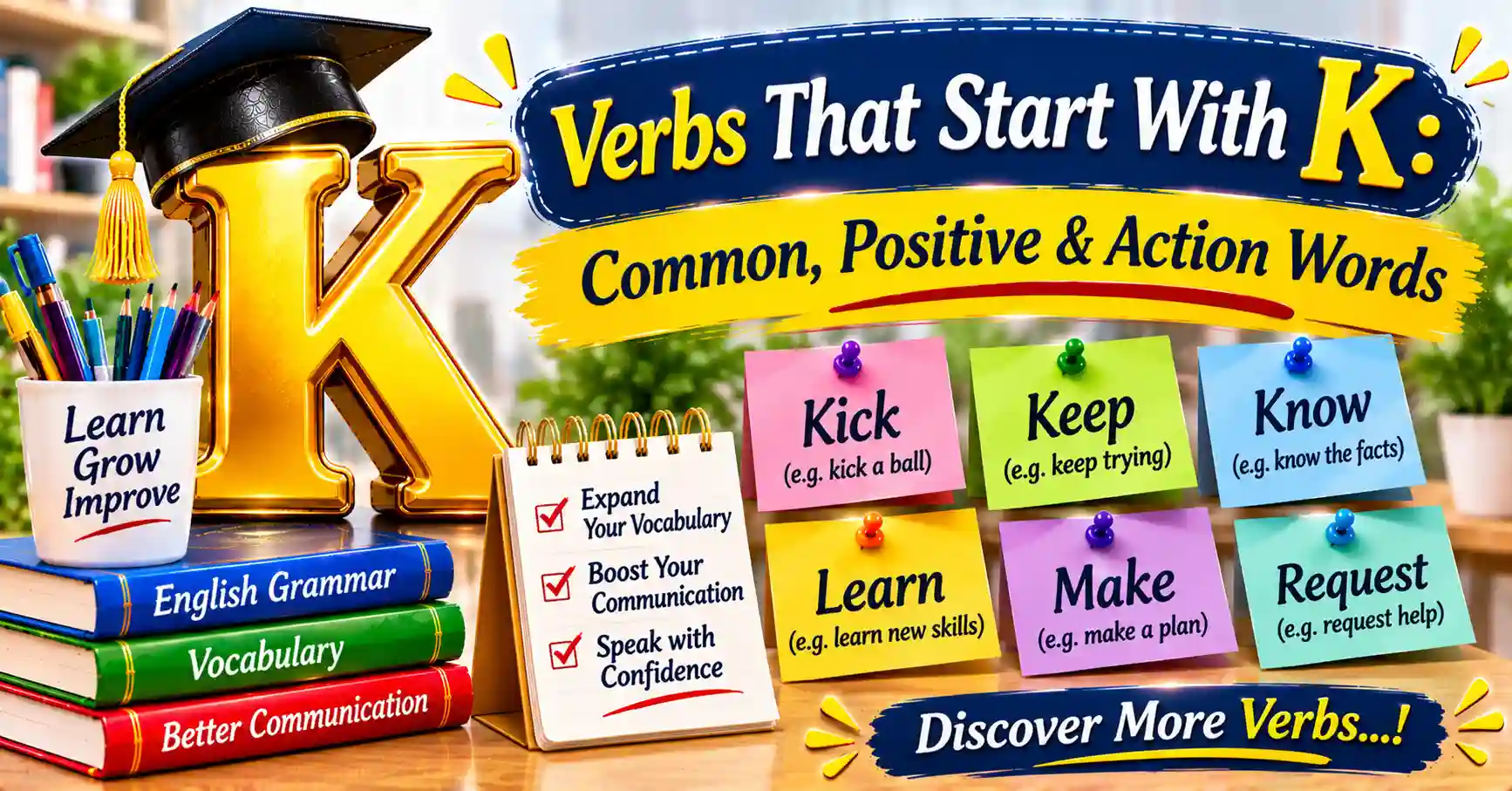
Few letters hide as many surprises as K. It stays silent in know and knee, yet it snaps loud in kick and kiss. This guide to verbs that start with K gives you every genuine K verb worth learning, with clear meanings, forms, and examples.
K is a small letter in English, so you will not find hundreds of K verbs. You will find about forty real ones, and they work hard. Words like keep, know, kick, and kill appear in daily speech. Rarer words, like kvell and kedge, add color to your writing.
Here is what you will learn:
- what verbs do in a sentence
- a complete K verbs list, sorted by meaning, length, and type
- how to build tenses and spell each verb
- how to avoid common mistakes
- Fun facts, memory tricks, and a short quiz
A strong verb vocabulary makes your writing clear. It also makes your speech confident. Let’s begin.
What Are Verbs?
Verbs are the engine of every sentence. They tell the reader what someone does, what happens, or what something is. Without a verb, a sentence has no motion and no meaning. This section defines verbs in plain words, shows five K examples, and explains why a wide verb vocabulary helps you.
A Simple Definition of a Verb
A verb is a word that shows action, a state, or an event. Look for the word that answers one question: what is the subject doing or being? That word is the verb. Read these five sentences, each with a K verb in bold. Notice how each verb carries the main meaning.
- She keeps a journal every night.
- The boy kicked the ball over the fence.
- We know the answer.
- Dad kneads the dough by hand.
- The cat knocked a glass off the table.
Action, State, and Helping Verbs
English verbs do three broad jobs. Action verbs show what someone does. State verbs show what someone knows, feels, or is. Helping verbs support another verb to show time or mood. K verbs fill the first two jobs well.
- Action verbs: kick, knock, and knit show physical action. Example: He knocked twice.
- State verbs: know shows a mental state. Example: I know your sister.
- Helping verbs: No helping verb starts with K. Words like be, have, and do handle this job.
Why a Rich Verb Vocabulary Matters
Verbs carry the energy of a sentence. A weak verb needs extra words to do its job. A precise verb does the job alone. Building your list of K verbs gives you sharper choices when you write, speak, and read.
Compare: She hit the door with She knocked on the door. The second sentence is shorter and clearer. Precise verbs also help you understand what you read. Learn one new verb a day, and your range grows fast.
Complete List of Verbs That Start With K
This is your full guide to verbs that start with K. The lists below group every verb by meaning and use. The first table gives each verb a short meaning and an example. The later lists sort the same words by theme, so you can find the right word fast.
Common Verbs Starting With K
Start here. This table lists all forty verbs in alphabetical order. Each row gives a short meaning and an example sentence. Most words are common, but a few are rare, and the meaning column makes that clear. Read the table once, then learn the first dozen.
| Verb | Meaning | Example |
| kayak | to travel in a kayak | We kayak on the lake every summer. |
| kedge | to move a ship by pulling on an anchor | The crew kedged the boat off the sandbar. |
| keel | to tip over or collapse (often keel over) | He keeled over in the heat. |
| keelhaul | to scold or punish harshly | The coach keelhauled the team after the loss. |
| keen | to wail in grief | Mourners keened at the graveside. |
| keep | to hold, save, or continue | Please keep the receipt. |
| kennel | to house a pet in a kennel | We kennel our dog when we travel. |
| kern | to adjust the space between letters | The designer kerned the logo. |
| key | to type or enter data | She keyed the numbers into the sheet. |
| keynote | to give the main speech | The founder will keynote the event. |
| kibitz | to chat or give unasked advice | He kibitzed during the card game. |
| kick | to strike with the foot | She kicked the door open. |
| kid | to tease or joke | I am only kidding. |
| kidnap | to take a person by force | Police stopped the plot to kidnap him. |
| kill | to end a life or stop something | Please kill the engine. |
| kiln | to dry or bake in a kiln | He kilned the bricks overnight. |
| kindle | to start a fire or spark a feeling | The story kindled her curiosity. |
| kink | to twist or bend | The hose kinked in the middle. |
| kip | to sleep (British, informal) | I will kip on your sofa tonight. |
| kiss | to touch with the lips | She kissed her daughter goodnight. |
| kit | to equip (often kit out) | The store kitted her out for the trek. |
| kite | to fly or glide like a kite | The hawk kited above the field. |
| kludge | to patch together in a clumsy way | He kludged a fix with tape and wire. |
| knap | to chip stone into shape | Early people knapped flint into blades. |
| knead | to press and fold dough | Knead the dough for ten minutes. |
| knee | to strike with the knee | The player kneed the ball away. |
| kneecap | to cripple or badly weaken | The new tax could kneecap small shops. |
| kneel | to rest on bent knees | They knelt in prayer. |
| knell | to ring slowly, as for a death | The bell knelled at dusk. |
| knife | to cut with a knife | The chef knifed the melon in half. |
| knight | to give someone the rank of knight | The queen knighted the scientist. |
| knit | to make fabric from yarn, or to join closely | Grandma knits warm scarves. |
| knock | to hit or tap | Please knock before you enter. |
| knot | to tie in a knot | He knotted the rope. |
| know | to know of | I know this road. |
| knuckle | to press or rub with the knuckles | He knuckled his tired eyes. |
| knurl | to mark with small ridges for grip | The machinist knurled the handle. |
| kowtow | to bow deeply or act too eager to please | Never kowtow to bullies. |
| kvell | to feel and show proud joy | Parents kvell at graduation. |
| kvetch | to complain | Stop kvetching about the weather. |
Learn keep, know, kick, kill, kiss, knock, knit, kneel, kid, key, kindle, and knot first. These twelve cover most daily use.
Action Verbs (Physical Actions)
Action verbs show movement you can see or hear. K has a good set of them. Some involve the foot, the hand, or the knee, and others involve tools or water. This list gathers the physical ones, so you can pick a vivid verb for any scene.
kayak, kick, kiss, knap, knead, knee, kneel, knit, knock, knot
Use these verbs in stories and instructions. They make each step easy to picture.
Verbs of Communication
People use verbs to speak, write, joke, and complain. K has a small but lively group for this job. Some are playful, some are formal, and some come from Yiddish. This list shows each word with a short note, so you know when to use it.
keen (to wail), key (to type), keynote (to give a main speech), kibitz (to chat or advise), kid (to joke), kvell (to share proud joy), kvetch (to complain)
Choose kid for light talk and keynote for formal events.
Verbs of Thinking and Emotion
Some verbs live inside the mind and heart. They show what we know, hold, feel, or hope. K offers a short list here. Each verb below covers a thought or feeling, from quiet knowledge to loud pride, and each one works well in everyday sentences.
keen (to grieve aloud), keep (to hold in mind), kindle (to spark a feeling), know (to understand), kvell (to feel proud), kvetch (to complain from frustration)
Example: Her kindness kindled hope in the room.
Verbs of Movement
Movement verbs describe how people and things travel, tip, or turn. K has a few useful ones, from water travel to a sudden fall. Each verb below pairs a clear picture with a short meaning, so you can match it to the scene you want.
kayak (to travel by kayak), keel (to tip over), kick (to move with the foot), kite (to glide like a kite), kneel (to drop to the knees)
Verbs for Work, School, and Daily Life
Daily life runs on verbs. You key in a password, keep a schedule, and knit a sweater. This list covers K verbs for the office, the classroom, the kitchen, and the workshop. Each word is practical, and most have simple meanings you can use today.
keep, kennel, kern, key, keynote, kiln, kit, kludge, knead, knit, know
Example: He keyed the grades into the system and kept a copy.
Positive Verbs
Positive verbs lift a sentence. They show care, honor, hope, and joy. K gives you several warm choices. Use them in cards, speeches, and captions when you want your tone to feel kind and encouraging. Here are the most uplifting K verbs.
keep (a promise), keynote, kindle, kiss, knight, knit, know, kvell
Example: We kindle hope when we keep our promises.
Negative Verbs
Negative verbs describe harm, pain, or complaint. K has a few strong ones. They carry heavy meanings, so use them with care and in the right context. Writers often choose them for news reports, history, and dramatic stories. This list names each one with its sense.
keelhaul (to punish or scold harshly), keen (to wail in grief), kidnap (to take by force), kill (to end a life), kneecap (to cripple), kowtow (to act in a servile way), kvetch (to complain)
Uncommon or Advanced Verbs
Some K verbs are rare. You will meet them in sailing, printing, metalwork, and craft talk. They can sharpen your writing, and they please crossword fans. Learn them after you master the common list. Each word below comes with a short note.
kedge (move a ship with an anchor), keelhaul, kern (space letters), kibitz, kiln, kludge, knap (shape flint), knell (ring slowly), knurl (cut grip ridges), kvell
Simple Verbs for Beginners and Kids
New learners need short, clear words. These K verbs are easy to say, easy to spell, and easy to act out. Kids can mime each one. Start with this list, and build up from there. Say each sentence aloud, and add a motion.
- kayak: We kayak on the lake.
- keep: Keep your toys here.
- kick: I kick the ball.
- kid: Dad likes to kid around.
- kiss: Kiss Grandma goodbye.
- kneel: Kneel on the mat.
- knit: Mom can knit a hat.
- knock: Knock on the door.
- knot: Knot the string.
- know: I know my ABCs.
Verbs by Word Length
Word length is a handy way to study spelling and play word games. This section sorts verbs that start with K by letter count. Short verbs tend to be common and old. Longer ones are often rarer or come from other languages. Use these lists for Scrabble, Wordle, and spelling practice.
3-Letter Verbs Starting With K
Three-letter K verbs are short and sharp. English has just four in standard use, so you can learn them in minutes. Each one is a common word with several meanings, and each one is easy to spell. Here they are, with a quick example.
- key: Key in your code.
- kid: Don’t kid me.
- kip: I need to kip for an hour.
- kit: They kit the crew out each spring.
4-Letter Verbs Starting With K
Four-letter verbs form the biggest group, and they include the most common K words. Many of them start with the silent kn- pattern. They are perfect for beginners and for quick word games. Learn these fifteen, and you will cover a large share of everyday K verbs.
keel, keen, keep, kern, kick, kill, kiln, kink, kiss, kite, knap, knee, knit, knot, know
5-Letter Verbs Starting With K
Five-letter verbs are popular in word puzzles. K gives you nine of them. Several begin with the silent kn- pair, which makes them tricky to spell. Study the list below, and say each word aloud to fix the sound and the spelling together.
kayak, kedge, knead, kneel, knell, knife, knock, knurl, kvell
6-Letter Verbs Starting With K
Six-letter verbs mix everyday words with a few rare ones. You will use kidnap, kindle, and knight in the news and in stories. Words like kowtow and kvetch have lively backgrounds. Here are eight six-letter K verbs to practice.
kennel, kibitz, kidnap, kindle, kludge, knight, kowtow, kvetch
7+ Letter Verbs Starting With K
Longer K verbs are rare in everyday English. Only four standard ones reach seven letters or more. They are useful in specific settings, such as speaking events, injuries, and sailing history. Learn them as a small bonus set once the shorter lists feel easy.
keelhaul (8 letters), keynote (7), kneecap (7), knuckle (7)
Verbs by Type
Grammar groups verbs by how they behave. Some verbs take an object, some do not, and some change form in odd ways. This section sorts K verbs into six useful types. Knowing the type helps you build correct sentences and avoid common errors.
Action and Stative Verbs
Action verbs describe things people do. Stative verbs describe conditions, such as knowing or owning. Stative verbs rarely appear in the continuous form. This split matters because it explains why I know is correct and I am knowing sounds wrong in standard English.
- Action: kayak, kick, kiss, knead, knit, knock
- Stative: know
Transitive and Intransitive Verbs
A transitive verb needs an object. An intransitive verb does not. Some verbs can do both. Check the object after the verb: if you can ask “what?” or “whom?”, the verb is transitive. This table sorts the K verbs.
| Type | K verbs |
| Transitive | keep, kidnap, kill, kindle, knead, knight, knit, knot |
| Intransitive | kayak, keel, keen, kip, kneel, kowtow, kvell, kvetch |
| Both | kick, kid, kiss, knock, know |
Example: She kicked the ball (transitive). The baby kicked (intransitive).
Regular and Irregular Verbs
Regular verbs add -ed for the past tense. Irregular verbs change in other ways. Most K verbs are regular. Four are irregular, and they are among the most common, so learn them well. The next section shows all their forms.
- Irregular: keep, know, kneel, knit
- Regular: all other K verbs, such as kick, kill, and kiss
Auxiliary (Helping) and Modal Verbs
Auxiliary verbs help main verbs show tense and mood. Modal verbs, such as can and must, show ability or duty. No auxiliary or modal verb begins with K. You will use be, have, do, will, and can with K verbs instead.
Example: We will keep the plan. Here, will is the helper, and keep is the main verb.
Linking Verbs
Linking verbs connect a subject to a description. They do not show action. The word after them describes the subject. Among K verbs, only keep works this way, and it appears often in phrases about staying in a state or condition.
- keep: She kept calm. They kept quiet.
Phrasal Verbs With K
A phrasal verb joins a verb with a small word, such as up or out, to make a new meaning. English speakers use them constantly. K has many, mostly built on keep, kick, and knock. Learn each one as a single unit.
| Phrasal verb | Meaning | Example |
| keel over | collapse | The runner keeled over at the line. |
| keep away | stay at a distance | Keep away from the edge. |
| keep on | continue | Keep on trying. |
| keep out | not enter | Please keep out. |
| keep up | stay at the same pace | I can’t keep up. |
| key in | type in | Key in your password. |
| kick around | discuss or treat roughly | We kicked around a few ideas. |
| kick back | relax | We kicked back after work. |
| kick in | start to work | The heater kicked in. |
| kick off | begin | The game kicks off at six. |
| kick out | force to leave | They kicked him out. |
| kill off | destroy completely | Frost killed off the plants. |
| kit out | equip | They kitted out the lab. |
| knock down | make fall | Wind knocked down the fence. |
| knock off | stop work, or reduce a price | Let’s knock off early. |
| knock out | make unconscious, or eliminate | The storm knocked out the power. |
| knock over | tip over | Don’t knock over the vase. |
| knuckle down | start working hard | She knuckled down before exams. |
Treat each phrasal verb as one word. Learn a few at a time, and use them in short sentences.
Verb Forms and Tenses
Every verb has five forms: base, past simple, past participle, present participle, and third-person singular. Once you know them, you can build any tense. This section shows the forms in a table, lists the irregular verbs, explains spelling rules, and gives tense examples.
Verb Forms Table
This table shows the five forms of twenty-one K verbs. Read across each row. Regular verbs follow a clear pattern, so scan for the exceptions. Notice the doubled consonants in words like kidding and knotted. They follow the spelling rules covered below.
| Base | Past simple | Past participle | Present participle | Third-person singular |
| kayak | kayaked | kayaked | kayaking | kayaks |
| keep | kept | kept | keeping | keeps |
| key | keyed | keyed | keying | keys |
| keynote | keynoted | keynoted | keynoting | keynotes |
| kick | kicked | kicked | kicking | kicks |
| kid | kidded | kidded | kidding | kids |
| kidnap | kidnapped | kidnapped | kidnapping | kidnaps |
| kill | killed | killed | killing | kills |
| kindle | kindled | kindled | kindling | kindles |
| kiss | kissed | kissed | kissing | kisses |
| kit | kitted | kitted | kitting | kits |
| knead | kneaded | kneaded | kneading | kneads |
| kneel | knelt or kneeled | knelt or kneeled | kneeling | kneels |
| knife | knifed | knifed | knifing | knifes |
| knit | knit or knitted | knit or knitted | knitting | knits |
| knock | knocked | knocked | knocking | knocks |
| knot | knotted | knotted | knotting | knots |
| know | knew | known | knowing | knows |
| knuckle | knuckled | knuckled | knuckling | knuckles |
| kowtow | kowtowed | kowtowed | kowtowing | kowtows |
| kvetch | kvetched | kvetched | kvetching | kvetches |
For regular verbs, add -ed for both past forms. Check the table whenever a doubled letter or a dropped e confuses you.
Irregular Verbs Starting With K
Irregular verbs break the -ed rule. Only four K verbs do this, but they appear very often in speech and writing. Mistakes with them are common, so study the table. Two verbs, kneel and knit, allow two correct past forms.
| Base | Past simple | Past participle | Present participle | Third-person singular |
| keep | kept | kept | keeping | keeps |
| kneel | knelt or kneeled | knelt or kneeled | kneeling | kneels |
| knit | knit or knitted | knit or knitted | knitting | knits |
| know | knew | known | knowing | knows |
In American English, kneeled is common. In British English, knelt is more common. Both are correct.
Spelling Rules for -ing, -ed, and -s
Spelling changes follow a few simple rules. Drop a silent e before -ing and -ed. Double a final consonant after one short vowel. Add -es after hissing sounds. The table gives each rule with K examples.
| Rule | Example | Result |
| Drop the silent e | kindle, kite, knife | kindling, kiting, knifing |
| Double the final consonant after one short vowel | kid, knot, kit, knit, kip, knap | kidding, knotted, kitting, knitting, kipped, knapped |
| Double the final p in kidnap and kneecap | kidnap, kneecap | kidnapped, kneecapped |
| Add -es after s, sh, ch, x, z | kiss, kvetch | kisses, kvetches |
| Keep y after a vowel | key | keys, keyed |
The usual y-to-ied rule does not apply here. No K verb ends in a consonant plus y.
Verb Tenses Explained
Tenses show when an action happens. Each tense has a simple form and a perfect form. The simple forms state facts and habits. The perfect forms link two points in time. Read the two examples for each tense below, and notice how the verb changes.
- Present simple: She keeps her promises. They kick the ball every day.
- Past simple: He knew the answer. We kayaked all morning.
- Future simple: I will keep your secret. She will knock at noon.
- Present perfect: They have kept the receipts. I have known him for years.
- Past perfect: He had knelt before the king. We had knocked twice before she answered.
- Future perfect: By May, I will have knitted ten scarves. By June, she will have known him for ten years.
Spelling Patterns and Prefixes for the Letter K
K has its own spelling habits. It often hides behind a silent partner, and it rarely works as a prefix. This section shows the main letter patterns, explains which suffixes appear on K verbs, and covers tricky spellings and sounds so you can read and say each word with confidence.
Common Letter Combinations
K is not a prefix letter in English, so you will not find a family of K prefixes like anti- or auto-. Adding a prefix such as re- or un- moves a word away from K, so this guide does not list those forms. Letter patterns are more useful.
| Pattern | Verbs |
| ka- | kayak |
| ke- | kedge, keel, keelhaul, keen, keep, kennel, kern, key, keynote |
| ki- | kibitz, kick, kid, kidnap, kill, kiln, kindle, kink, kip, kiss, kit, kite |
| kl- | kludge |
| kn- (silent K) | knap, knead, knee, kneecap, kneel, knell, knife, knight, knit, knock, knot, know, knuckle, knurl |
| ko- | kowtow |
| kv- | kvell, kvetch |
The kn- pattern is the biggest group. Fourteen verbs share it, and all of them hide the K sound.
Common Verb Suffixes
Suffixes such as -ize, -ify, -ate, and -en turn other words into verbs. K verbs rarely use them. Only a technical word, keratinize, uses -ize. A more common ending is -le, which appears in kindle and knuckle. Most K verbs are short roots with no suffix.
- -ize: keratinize (to become hard like keratin, a protein in hair and nails)
- -le: kindle, knuckle
- -ify, -ate, -en: no common K verbs use these endings
When a short root is enough, English often skips the suffix. That is why kick and kiss feel so direct.
Tricky Spellings, Silent Letters, and Pronunciation
Old English speakers said the K in kn- words aloud. Over time, the sound faded, but the spelling stayed. That history explains why know and knee look odd today. The notes below show how to say the trickiest K verbs.
- know: says noh. The K is silent.
- knead: says need. The K is silent.
- knell: rhymes with bell. The K is silent.
- knurl: starts with an N sound, then url.
- kayak: says KY-ak. Both Ks sound.
- kvell: says k-VELL. Say both sounds.
- kowtow: says kow-TOW, with ow as in cow.
- kludge: rhymes with judge, with a loo vowel.
- kidnap: double the p in kidnapped and kidnapping.
How to Use These Verbs Correctly
Knowing a verb list is only half the skill. You also need to use each verb correctly. This section covers agreement, tense choice, prepositions, common errors, and confusing word pairs. Each part gives clear examples, so you can fix mistakes in your own writing and speak with more confidence.
Subject-Verb Agreement
A verb must match its subject. A singular subject takes a singular verb, and a plural subject takes a plural verb. In the present tense, the third-person singular form adds -s or -es. Check each example below, and notice which word the verb follows.
- She keeps her keys in a bowl.
- The players kick the ball in turns.
- Neither of the boys knows the way.
- My brother and my sister kneel to tie their shoes.
- The team keeps its promise.
Choosing the Correct Tense
Tense tells the reader when something happens. Choose the tense that matches your time clue. Words like yesterday, now, and tomorrow guide you. Use the simple tense for facts and habits, and use a perfect tense when you link two moments. These five examples show the choice.
- Yesterday, she knocked twice. (past simple, finished time)
- Right now, I know the answer. (present simple, a state)
- Tomorrow, we will kayak at dawn. (future simple)
- I have kept this letter for years. (present perfect, still true)
- He had knelt by the fire before the guests arrived. (past perfect, earlier event)
Verbs Followed by Prepositions
Many verbs need a specific preposition to complete their meaning. Using the wrong one sounds unnatural. Learn each pair as a unit. This table shows eight K verbs with the prepositions that usually follow them, plus an example for each.
| Verb + preposition | Example |
| keep from | Keep children from the stove. |
| keep to | Keep to the path. |
| kid about | They kid about the old days. |
| kneel before | The knights knelt before the queen. |
| knock on | Knock on the door. |
| know about | Do you know about the meeting? |
| kowtow to | He refuses to kowtow to anyone. |
| kvetch about | She kvetches about traffic. |
Common Mistakes and Corrections
Even strong writers slip on K verbs. Most errors come from irregular forms, doubled letters, and missing prepositions. The table below shows six frequent mistakes beside their fixes. Read each pair aloud. Hearing the correct form helps it stick in your memory.
| Mistake | Correction |
| I knowed the answer. | I knew the answer. |
| She keeped the secret. | She kept the secret. |
| He has knew her for years. | He has known her for years. |
| Please knock the door. | Please knock on the door. |
| They are kiding. | They are kidding. |
| I am knowing the way. | I know the way. |
Commonly Confused Words
Several K verbs sound like other words. Because the K is silent, the spelling is the only clue. These pairs cause many errors in writing. Spellcheck often misses them because both words are real. Study the table, and check the meaning before you choose the spelling.
| Pair | Difference | Example |
| know / no | Know is a verb. No is a negative word. | I know the way, but there is no map. |
| kknead/need | Knead means to press dough. Need means to require. | You need to knead the dough. |
| knight/night | Knight means to give a rank. Night means the dark hours. | The queen will knight him tonight. |
| knot / not | Knot means to tie. Not makes a sentence negative. | Knot the rope, but do not pull it. |
| knap/nap | Knap means to shape stone. Nap means to sleep briefly. | He knapped flint while she napped. |
| knew / new | Knew is the past of know. New means recently made. | I knew the new teacher. |
Synonyms and Antonyms
Synonyms give you choices, and antonyms show contrast. Both help you avoid repeating the same word. This table lists sixteen K verbs with common synonyms and antonyms. Some verbs have no true opposite, so the table marks those with a dash. Use it to pick a word that fits your meaning.
| Verb | Synonyms | Antonyms |
| keep | retain, hold, save | discard, lose |
| key (in) | type, enter | delete, erase |
| keynote | headline, present | — |
| kick | boot, punt, strike | — |
| kid | tease, joke, jest | be serious |
| kidnap | abduct, seize | free, release |
| kill | slay, destroy, end | save, spare |
| kindle | ignite, spark, light | extinguish, douse |
| kiss | peck, smooch | — |
| knead | work, press, massage | — |
| kneel | genuflect, crouch | rise, stand |
| knit | stitch, weave, join | unravel, undo |
| knock | rap, tap, bang | — |
| knot | tie, fasten | untie, loosen |
| know | understand, recognize | misunderstand |
| kowtow | grovel, bow, fawn | defy, resist |
Choose a verb by tone, strength, and context. Kill is blunt, while end is neutral. Kindle sounds warm, while ignite sounds bold. In casual talk, kick back feels natural, but formal writing may prefer relax. This table shows that verbs that start with K offer real range, from gentle to blunt.
Practical Use Cases
Verbs earn their keep in real writing. This section shows how K verbs work in six settings, from essays to word games. Each part offers a short note and sample sentences. Copy the patterns, then swap in your own topic. You will see how verbs that start with K can sharpen almost any text.
Essays and Academic Writing
Academic writing needs clear, exact verbs. K verbs help you show connections and build arguments. Use know for evidence, keep for continuity, and knit for links between ideas. Keep sentences short, and let the verb carry the claim. These examples show the style.
- The study knits together data from three countries.
- Historians know little about the town’s earliest years.
- Good teachers kindle curiosity in their students.
Storytelling and Creative Writing
Fiction thrives on vivid verbs. A strong verb paints the scene without extra words. K gives you sound, touch, and motion. Knell rings, kneel bows, and kindle glows. Choose the verb that lets the reader see and hear the moment. Try these sentences.
- The old clock knelled midnight.
- She knelt by the hearth and kindled the first spark.
- Wind kicked up the dust along the road.
Resumes and Professional Writing
Resumes reward strong, specific verbs. Start each bullet with a past-tense action verb, and follow it with a clear result. K offers only a few resume verbs, but they stand out because few candidates use them. Match each verb to a true achievement.
- Keynoted the annual sales summit for the regional team.
- Kept project costs under budget for three straight quarters.
- Knitted three small teams into one support group.
- Kindled partnerships with local schools.
Social Media Captions
Captions need short, punchy verbs. K verbs fit well because they are brief and energetic. Pair a verb with an image or a goal, and keep the line under ten words. These examples work for fitness, travel, study, and daily motivation posts.
- Kindle your curiosity every day.
- Keep going. You are closer than you think.
- Kick off the weekend with a smile.
Everyday Conversation
Daily talk is full of K verbs. We keep in touch, we know the way, and we knock on doors. Many fixed phrases use them, so learning the verbs also teaches you natural speech. Say these sentences aloud to practice rhythm and tone.
- Keep in touch!
- I know, right?
- Just kidding!
Word Games (Scrabble, Wordle, Crosswords)
Word games reward a good vocabulary. K is worth five points in English Scrabble, so a K verb can boost your score. Five-letter K verbs also help in puzzles. Learn the silent-K pattern, and you will spot answers faster. Here are some quick tips.
- Kvetch scores 18 points in Scrabble before any bonus squares, because K and V are both high-value tiles.
- Try knock, kneel, or knead when a five-letter puzzle clue points to a K start.
- A classic crossword clue, “palindromic boat,” has the answer kayak.
Fun Facts and Learning Tips
Learning sticks when it feels fun. This section shares surprising facts about the letter K and its verbs, gives memory tricks that work, explores where six words came from, and offers daily habits you can start today. It ends with a short quiz and a full answer key. Use these tools to lock in everything you learned about verbs that start with K.
Fun Facts About the Letter K and Its Verbs
K has a rich history for such a small letter. It crossed several alphabets and lost its voice in many English words. Its verbs hide stories about sailing, trade, and daily life. These seven facts show how much a single letter can carry.
- K began as a hand. The Phoenician letter kaph meant the palm. The Greeks turned it into kappa, and Latin later borrowed it. Our K comes from that line.
- Old English often preferred C. Scribes frequently wrote the K sound with the letter c. The Old English ancestor of keep was cēpan. K spread through English spelling over the Middle English period.
- K is worth five points in Scrabble. Only four letters score higher in English Scrabble: J, X, Q, and Z. A K verb can turn a plain turn into a strong one.
- The silent K was once loud. People once said the K in knight and knee. The sound faded over the 1600s and 1700s, but the spelling stayed behind.
- Kidnap began as a blend. It joins kid, meaning a child, with nap, a dialect word for snatch. It appeared in the late 1600s and first described stealing children to work as servants.
- Knight once meant boy. The Old English word cniht meant a boy or young servant. Over centuries, it rose to mean a warrior with rank. The verb knight came later.
- Kid is a young goat. The word comes from a Norse term for a young goat. People later used it for children. In the 1800s, the verb kid took on the sense of teasing.
Memory Tricks and Mnemonics
Mnemonics turn tricky spellings and forms into easy pictures. Try one or two of these tricks, and invent your own. The best memory tool is a silly image that you can see in your mind. Each trick below uses a real K verb from this guide.
- K knocks before N. In kn- words, K stands guard at the door. Picture a K knocking on N’s door: knock, knit, know.
- Know, knew, known. Chant the vowel pattern: ow, ew, own. The rhythm fixes all three forms in your head.
- Kneel on your knee. Kneel and knelt both start with knee. If you kneel, you use your knee.
- Kid plus nap makes kidnap. Split the word to spell it, and remember the doubled p in kidnapped.
- Keep becomes kept. Shrink ee to e and add t. Say it as a rule: I kept what I keep.
- Kvell is well; kvetch is fetch. Kvell rhymes with well, so you feel good. Kvetch rhymes with fetch, so you go fetch complaints.
Word Origins and History
Words carry history. Each verb below traveled through languages and time before it reached modern English. Seeing the path helps you remember the meaning and the spelling. These six verbs show how meanings shift, narrow, and grow, based on standard etymology sources.
- kayak: From the Inuit word qajaq, a small hunting boat. English borrowed it in the 1700s. Today the verb means to paddle one for sport.
- kindle: From Old Norse kynda, meaning to light a fire. The meaning grew to include sparking feelings, as in kindle hope.
- kowtow: From Chinese kòutóu, meaning to knock the head on the ground in a deep bow. English now uses it for any servile behavior.
- kvetch: From Yiddish kvetshn, meaning to squeeze or press. In English, it came to mean constant complaining, and it became common in the 1900s.
- knight: From Old English cniht, a boy or servant. The meaning rose from servant to warrior to honored title.
- keep: From Old English cēpan, meaning to seize, watch, or take heed. Today it mostly means to hold or continue.
Daily Practice Tips
Small habits beat long, rare study sessions. Ten minutes a day builds more skill than one long weekend session. Pick two or three habits below and stick with them for a month. Track your progress in a notebook, and celebrate each new verb you use.
- Read a little every day. Read news, stories, or recipes, and circle every K verb. Seeing a word in context teaches you its meaning and use.
- Keep a verb journal. Write one sentence a day that uses a K verb. Short entries add up fast. After a month, you will own thirty fresh sentences.
- Use flashcards. Write the verb on one side and its forms on the other. Review ten cards each morning. Mix in the irregular verbs to master them.
- Speak aloud. Say each example sentence out loud. Your mouth learns silent-K words, like know and knee, faster than your eyes do.
- Act it out. Kneel, knock, knead, and kick. Movement links meaning to memory, and it helps kids most.
- Play word games. Try Scrabble, crosswords, or Wordle. Games make review feel like play, and they train your spelling.
Mini Practice Quiz
Test yourself with ten short questions. They cover forms, tenses, verb types, and meanings. Write your answers on paper before you check the key. Do not worry about mistakes. Each wrong answer shows you what to review, so reread the matching section afterward.
- Fill in the blank: She ___ (keep) the secret for years.
- Choose the correct tense: Yesterday, I (know/knew/known) the answer.
- Which verb is irregular: kick, kneel, or kiss?
- Match the meaning: kvetch means (to complain / to bow / to tie).
- Fill in the blank: Please ___ before you enter. (knock / nock)
- Add -ing to kid.
- In which word is the K silent: kvell, know, or kayak?
- Which verb means to give someone the rank of knight?
- What is the past participle of know?
- Complete the sentence: The bell ___ at midnight. (knelled/kneeled)
Answer key: 1. kept. 2. knew. 3. kneel. 4. to complain. 5. knock. 6. kidding. 7. know. 8. knight. 9. known. 10. knelled.
FAQs
These questions come from real search habits. Learners, parents, teachers, and writers ask them often. Each answer is short and direct. Use the answers as a quick reference, or return to the earlier sections for more detail on any K verb that interests you.
What are some action verbs that start with K?
Action verbs that start with K include kick, knock, knead, knit, kneel, kayak, and kiss. Each one shows a physical action you can see. You kick a ball, knead dough, and kayak across a lake. Use these words to make your writing lively and clear.
How many verbs start with K?
English has about forty well-known verbs that start with K, plus a few technical ones such as keratinize. The exact count depends on the dictionary. K is a rare starting letter, so its list is short. Even so, verbs like keep and know rank among the most useful words in the language.
What are strong verbs that start with K for a resume?
Strong K verbs for a resume include keynote, kindle, knit, and keep. “Keynoted a conference” shows leadership. “Kindled partnerships” shows influence. “Knitted teams together” shows collaboration. “Kept costs under budget” shows control. Pair each verb with a clear result, such as a goal, a deadline, or a number you can prove.
What is the longest verb that starts with K?
Among everyday verbs, keelhaul is the longest, with eight letters. Keynote, kneecap, and knuckle follow with seven. Technical words such as keratinize are longer, but they appear mostly in biology texts. Short verbs dominate this letter. Check your game’s word list before you play a rare verb.
Which K verbs have a silent K?
Verbs that begin with kn- have a silent K. They are knap, knead, knee, kneecap, kneel, knell, knife, knight, knit, knock, knot, know, knuckle, and knurl. The word starts with the N sound. Kvell, kvetch, and kayak are different. They pronounce the K clearly.
What are some positive verbs that start with K?
Positive K verbs include keep, kindle, kiss, knight, knit, know, and kvell. You can kindle hope, kiss someone goodnight, or kvell over a child’s success. These words show care, pride, and connection. Use them in cards, captions, and speeches to give your message a warm tone.
Which K verbs are irregular?
Four K verbs have irregular forms: keep (kept, kept), know (knew, known), kneel (knelt or kneeled), and knit (knit or knitted). All other K verbs are regular and take -ed. Learn these four by heart. They appear often in everyday speech and writing, and mistakes with them stand out.
What are good K verbs for kids?
Kids can start with kick, kiss, keep, knock, knit, and kneel. These words are short and easy to act out. A child can kick a ball, knock on a door, and kneel on the floor. Acting out each verb helps young learners remember its meaning.
Conclusion
Verbs that start with K are few, but each one earns its place. You now know about forty of them, from everyday words like keep, know, and kick to rare gems like kedge and kvell. You also learned their forms, their types, their tricky spellings, and their stories.
Remember the key ideas. The K in kn- words is silent. Four K verbs are irregular. Phrasal verbs such as kick off and knuckle down add even more range. Precise verbs make your writing stronger.
Now put this K verbs list to work. Pick three new verbs today. Write one sentence for each, and say each one aloud. Repeat tomorrow. In a month, these words will feel like old friends.
