

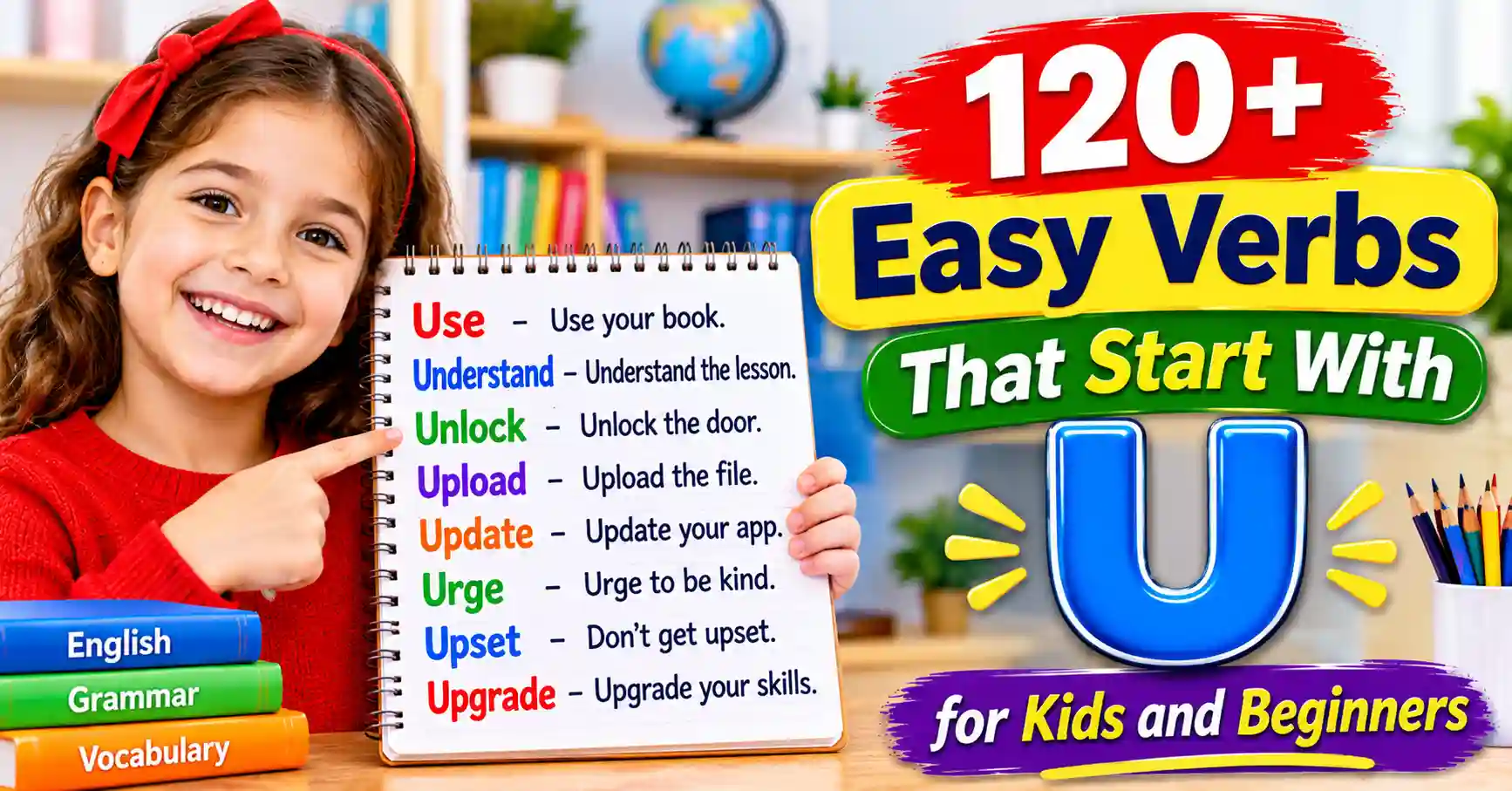
Every sentence needs a verb. Without one, nothing happens. This guide gives you a full list of verbs that start with U, from unlock and unpack to understand and update. You will find meanings, forms, tenses, and clear examples in one place.
U is a handy letter for beginners. Many U verbs start with un-, which often means “undo.” If you can lock, you can unlock. If you can pack, you can unpack. That pattern makes U one of the easiest letters to learn.
One honest note first. U has very few short verbs. It has a large group of un-, under-, and up- verbs instead. We found about 130 real ones. We did not pad the lists with nouns, adjectives, or made-up words.
In this guide, you will learn:
- about 130 real U verbs, sorted by theme, length, and type
- meanings and example sentences for the top 40 verbs
- verb forms, irregular verbs, and tense rules
- common mistakes and confusing verb pairs
- origins, memory tricks, and a ten-question quiz
Every word on these lists is a verb in its base form. A rich verb vocabulary makes your writing sharper and your speech clearer. Let’s begin.
What Are Verbs?
Verbs are the action and state words of English. They tell us what someone does, feels, or is. This section gives a simple definition and five examples. It also shows the main verb types and explains why a wide verb vocabulary makes you a stronger writer and speaker.
A verb is a word that shows an action, an event, or a state. Here are five examples that start with U:
- Action: “Please unlock the door.”
- Thought: “I understand the rule.”
- Change: “Apps update often.”
- Tools: “We use pencils.”
- Guiding: “A good host will usher guests inside.”
Verbs come in three broad groups. Action verbs show what someone does, such as unzip or unwrap. Stative verbs show a state, such as understand. Helping verbs support another verb. An honest note: no true helping verb starts with U, but used to acts like one for past habits.
A strong verb does the work of two words. “She unwrapped the gift” says more than “She took the paper off the gift.” A rich verb vocabulary saves space and adds energy.
Verbs that start with U follow the same rules as all other verbs. They change for tense, person, and number. Learn the rules once, and every new verb becomes easy to use.
Complete List of Verbs That Start With U
This is the heart of the guide. Here you will find verbs that start with U, grouped by theme, from everyday actions to rare gems. Each list is alphabetical. We begin with the top 40, with meanings and examples. Then we explore actions, speech, feelings, movement, work, tone, and advanced words. No word repeats across the main theme lists. The kids list, and later tables reuse some.
Common Verbs That Start With U (Top 40)
These forty verbs are the most useful U words for daily life. You will hear them at home, at school, and at work. Each one has a short meaning and an example sentence. Learn these first, because they form the base for every other list in this guide.
| Verb | Meaning | Example |
| unbutton | to open buttons | Unbutton your coat. |
| uncover | to remove a cover, or to find out | Uncover the dish. |
| underestimate | to guess too low | Don’t underestimate the task. |
| undergo | to go through | Patients undergo tests. |
| underline | to draw a line under, or to stress | Underline the title. |
| undermine | to weaken slowly | Doubt can undermine trust. |
| underscore | to stress | The report will underscore the risk. |
| understand | to grasp the meaning | I understand the rule. |
| undertake | to take on a task | We undertake the repairs. |
| undo | to reverse or open | Undo the knot. |
| undress | to take off clothes | Undress the doll. |
| unfasten | to open a fastener | Unfasten your belt. |
| unfold | to open out | Unfold the map. |
| unite | to join together | Unite the team. |
| unlearn | to drop a habit or idea | Unlearn the old way. |
| unleash | to set free | Unleash your ideas. |
| unload | to take off a load | Unload the truck. |
| unlock | to open a lock | Unlock the gate. |
| unpack | to take things out | Unpack your bag. |
| unplug | to disconnect from power | Unplug the lamp. |
| unravel | to untangle, or to fall apart | Unravel the yarn. |
| unroll | to open a roll | Unroll the mat. |
| unscrew | to turn a screw out | Unscrew the lid. |
| untie | to loosen a knot | Untie your shoes. |
| unveil | to reveal publicly | Unveil the plan. |
| unwind | to relax, or to loosen a coil | Unwind after work. |
| unwrap | to take off wrapping | Unwrap the gift. |
| unzip | to open a zipper | Unzip your bag. |
| update | to make current | Update the app. |
| upgrade | to improve | Upgrade your plan. |
| uphold | to support or keep | Uphold the rules. |
| uplift | to raise spirits | Music can uplift us. |
| upload | to send a file online | Upload the photo. |
| uproot | to pull out by the roots | Wind can uproot trees. |
| upset | to distress, or to tip over | Don’t upset the cat. |
| urge | to push or beg | I urge you to rest. |
| use | to employ | Use a pencil. |
| usher | to guide | Usher the guests inside. |
| utilize | to make practical use of | Utilize every tool. |
| utter | to say | Don’t utter a word. |
Pick five verbs from this table. Use each one in a sentence today.
Action Verbs (Physical Actions)
Action verbs show what hands, tools, and bodies do. They help readers see and hear a scene. Many U action verbs start with un- and reverse a simple task, such as unclip or unhook. None repeats the top 40. Use them to make instructions and stories clear.
- unbind – to untie
- unbolt – to open a bolt
- unbuckle – to open a buckle
- uncage – to free from a cage
- uncap – to remove a cap
- unclasp – to open a clasp
- unclip – to detach a clip
- unclog – to clear a block
- uncoil – to unwind a coil
- uncork – to pull out a cork
- uncouple – to disconnect
- uncross – to separate crossed things
- uncurl – to straighten out
- undrape – to remove drapes
- unfurl – to open and spread
- unglue – to separate glued parts
- unhand – to let go of (old-fashioned)
- unharness – to remove a harness
- unhinge – to take off hinges
- unhitch – to detach
- unhook – to detach from a hook
- unlace – to loosen laces
- unlatch – to open a latch
- unmake – to undo the making of
- unmask – to remove a mask
- unpick – to remove stitches
- unpin – to remove pins
- unscramble – to put in order
- unseal – to open a seal
- unsnap – to open snaps
- unspool – to unwind from a spool
- unstick – to free from sticking
- unstop – to remove a plug from
- unstrap – to loosen a strap
- untangle – to remove knots
- untuck – to pull out a tucked edge
- untwist – to straighten a twist
- upend – to turn upside down
- upholster – to cover furniture with fabric
Strong action verbs beat extra words. “Uncork the bottle” is clearer than “pull the cork out of the bottle.”
Verbs of Communication
Communication verbs show how people speak, write, and share information. They help you report what happened with the right tone. Some are calm, and some are sharp. You have five more, and we list every real one. None repeat the top 40.
- ululate – to howl or wail
- unbosom – to tell secrets
- unburden – to share worries
- unsay – to take back words
- upbraid – to scold
Choose the verb that matches the mood. Unburden sounds gentle. Upbraid sounds sharp.
Verbs of Thinking and Emotion
These verbs show what goes on inside the mind and heart. They name doubts, nerves, and wrong ideas. Writers use them to make characters feel real. The six words below are short and vivid. Several use under- to mean “too little.”
- undeceive – to free from a false belief
- underrate – to rate too low
- undervalue – to value too little
- underwhelm – to fail to impress
- unnerve – to make nervous
- unsettle – to make uneasy
Pair a feeling verb with a clear cause. “A strange noise can unnerve anyone” paints a full picture.
Verbs of Movement
Movement verbs show how people and things travel. They set speed, direction, and mood. A river that undulates feels very different from a rider who gets unhorsed. These six words help you describe motion exactly.
- undulate – to move in waves
- unhorse – to throw from a horse
- unseat – to knock from a seat
- uprise – to rise up
- upsurge – to rise suddenly
- upturn – to turn up, or to improve
Pair a movement verb with a place. “Waves undulate across the bay” paints a full picture.
Verbs for Work, School, and Daily Life
Daily life runs on practical verbs. These words name tasks at the office, in class, and at home. Many are new digital verbs, such as unfollow and uninstall. You will use them in emails, notes, and plans. The twenty-two verbs below are short, clear, and useful.
- umpire – to judge a game
- unblock – to clear a block
- undelete – to restore a deleted item
- undercut – to sell cheaper than, or to weaken
- underfund – to give too little money to
- underpay – to pay too little
- underpin – to support from below
- undersell – to sell cheaper, or to describe too modestly
- underwrite – to agree to pay for, or to insure
- unfollow – to stop following online
- unfriend – to remove from a friend list
- unify – to make one
- uninstall – to remove a program
- unionize – to form a labor union
- unmute – to turn sound back on
- unsubscribe – to cancel a subscription
- upcycle – to reuse as something better
- upsell – to persuade to buy more
- upsize – to make larger
- upskill – to teach new skills
- upvote – to vote up online
- urbanize – to make more like a city
Practical verbs keep writing plain. Choose uninstall over “remove the program from the device” when you can.
Positive Verbs
Positive verbs lift the mood of a sentence. They show care, freedom, and growth. Use them in thank-you notes, reviews, and speeches. An honest note: You have few new positive verbs. Uplift, unite, unlock, unleash, and uphold in the top table are also positive. These four are new.
- unchain – to set free
- unfetter – to free from limits
- unshackle – to free from chains
- upraise – to lift up
Positive verbs work best with a clear object. “Good teachers unchain curiosity” sounds sincere.
Negative Verbs
Negative verbs describe harm, loss, and conflict. Writers use them to show danger or sadness. They need care, because strong words can hurt. You have six more, and we list every real one.
- ulcerate – to form an ulcer
- underachieve – to do worse than expected
- undercook – to cook too little
- underplay – to downplay
- upstage – to draw attention away from
- usurp – to seize power or a place wrongly
Use these verbs with a clear fix. “Rumors can undermine a team, so share facts early” ends on a helpful note.
Uncommon and Advanced Verbs
Some U verbs are rare and elegant. They add depth to essays, speeches, and fiction. Most will not appear in casual talk. The seven below are re-listed from earlier lists with fuller notes. Unmoor and unyoke are new. Use one or two in a piece of writing. Too many can sound showy.
| Verb | Meaning | Example |
| ululate | to howl or wail | Mourners ululate at the grave. |
| unbosom | to tell secrets | She will unbosom her fears to a friend. |
| undulate | to move in waves | Hills undulate across the plain. |
| unfetter | to free from limits | Good laws unfetter honest trade. |
| unhorse | to throw from a horse | The charge will unhorse the knight. |
| unmoor | to release from moorings | Sailors unmoor the boat at dawn. |
| unyoke | to free from a yoke | Farmers unyoke the oxen at night. |
| upbraid | to scold | Parents upbraid careless drivers. |
| usurp | to seize power or a place wrongly | A rebel tried to usurp the throne. |
Learn one advanced verb a week. Say it aloud before you try it in writing.
Simple Verbs for Beginners and Kids
Young learners need short, friendly verbs. These words are easy to say, spell, and act out. Most U verbs for kids start with un-. All are re-listed from above because they suit kids best. Parents and teachers can use them in games and reading time.
- undo – “I undo the knot.”
- unfold – “I unfold the paper.”
- unlock – “I unlock the box.”
- unpack – “I unpack my bag.”
- unplug – “I unplug the lamp.”
- untie – “I untie my shoes.”
- unwrap – “I unwrap a gift.”
- unzip – “I unzip my coat.”
- use – “I use a pencil.”
Ask a child to act out each verb. Games make new words stick.
Verbs That Start With U by Word Length
Word length changes how a word feels. Short verbs are quick and punchy. Long verbs sound formal and rich. This section sorts verbs that start with U by letter count. It helps you choose words for headlines, poems, puzzles, and word games. U has very few short verbs, and we say so. Most U verbs have six or more letters.
3-Letter Verbs That Start With U
Three-letter verbs are tiny but mighty. They are popular in word games and quick notes. They fit tight spaces on a puzzle board. An honest note: U has only one common three-letter verb. We list it and add no filler.
use
Use is the shortest U verb in this guide. Try writing one sentence with it, and then one with undo.
4-Letter Verbs That Start With U
Four-letter verbs strike a nice balance. They are short enough to read fast. They are long enough to carry clear meaning. An honest note: U has only two common four-letter verbs. Both are very useful.
undo, urge
Undo reverses an action. Urge pushes someone toward one. Both fit headlines and signs well.
5-Letter Verbs That Start With U
Five-letter verbs are the favorite of puzzle fans. They fit many crossword grids and guessing games. They are also common in daily speech. The ten words below cover action, speech, and change. Say each one aloud to feel its steady rhythm.
unify, unite, unpin, unsay, untie, unzip, upend, upset, usher, utter
Use this list as a warm-up before a word game.
6-Letter Verbs That Start With U
Six-letter verbs often feel complete and friendly. Many name everyday acts, especially un- tasks. They are long enough to be specific, yet short enough to stay simple. Try using these fourteen words to replace vague verbs such as “open” or “take off” in your writing.
unbind, unbolt, uncage, uncoil, uncork, unfold, unglue, unhook, unload, unlock, unmute, unplug, unroll, update
Pick two of these and write a short, vivid sentence for each.
7+ Letter Verbs That Start With U
Long verbs add weight and detail. They are common in academic writing, reports, and formal speech. They can also name big ideas, like understand and undermine. Use them with care, because a long word can slow a sentence. One long verb per sentence is usually enough.
unbutton, uncover, undergo, underline, undermine, understand, undertake, unfasten, unleash, unscrew, upgrade, utilize
Mix long and short verbs. A short verb after a long one gives your sentence a nice beat.
Verbs by Type
Verbs can be sorted in several ways. Each type tells you how a verb behaves in a sentence. This section explains six key types with examples that begin with U. Knowing the types helps you choose the right tense, object, and form. It also makes grammar rules much easier to remember.
Action and Stative Verbs
Action verbs show things that happen. Stative verbs show states, such as thoughts, feelings, and facts. Stative verbs rarely take -ing. An honest note: understand is the main stative U verb. Nearly every other U verb shows action.
- Action: unlock, unpack, untie, unzip, upload, uproot
- Stative: understand
We say “I understand,” not “I am understanding.” Test a verb with “-ing.” If it sounds odd, it is probably stative.
Transitive and Intransitive Verbs
Transitive verbs need an object. Intransitive verbs do not. Many verbs can be both. This split tells you whether a sentence needs a noun after the verb. It also decides if the verb can be passive.
- Transitive: unlock, unwrap, uphold, undermine, upload (“She unlocks the gate.”)
- Intransitive: ululate, undulate, uprise, upsurge (“Hills undulate.”)
- Both: unfold, unravel, unwind, umpire, upturn (“The plot unfolds.” “She unfolds the map.”)
Ask “what?” after the verb. If there is an answer, the verb is transitive.
Regular and Irregular Verbs
Regular verbs add -ed for the past, as in unlocked. Irregular verbs change in other ways, such as understand, understood. Most U verbs are regular. But the under- and un- verbs built on irregular bases are irregular too. The full forms are in the tables below.
- Regular: unlock, unpack, unite, update, use, utter
- Irregular: understand, undergo, undertake, undo, unwind, uphold, upset
Learn the irregular group once. They are common in daily speech.
Auxiliary (Helping) and Modal Verbs
Auxiliary verbs help the main verb form questions, negatives, and tenses. Modal verbs, such as can and must, show ability or duty. An honest note: no true auxiliary or modal verb starts with U. But used to works like a semi-modal for past habits.
- Past habit: “We used to play here.”
- Question: “Did you use to live here?”
- Negative: “She didn’t use to like tea.”
After did, the spelling changes to use to. In the plain past, we write used to.
Linking Verbs
Linking verbs connect a subject to a description, as in “She seems calm.” Common ones include be, seem, and become. An honest note: no linking verb starts with U. We include this section to be complete, and we do not invent examples.
If you need a linking verb, choose one of these instead: be, become, seem, look, feel. Then pick a U adjective, such as useful or unhappy.
For example: “She seems unhappy.” The linking verb is seems, and the U word is an adjective.
Phrasal Verbs
Phrasal verbs join a verb with a small word to make a new meaning. They are very common in speech. An honest note: U has few of them, because un- verbs already express reversal. Here are four real ones.
- unload on – to vent feelings on someone. He unloaded on his friend.
- use up – to finish a supply. We used up the paint.
- usher in – to introduce a new era. The law will usher in change.
- usher out – to guide someone out. Usher out the guests.
Learn phrasal verbs as whole chunks. The meaning is rarely clear from the parts.
Verb Forms and Tenses
Every verb has several forms. Knowing them lets you build any tense. This section shows the five key forms for U verbs, the irregular ones, spelling rules, and the main tenses. Learn these once, and you can use any U verb with confidence.
Verb Forms Table
Verb forms are the building blocks of tenses. Each verb has a base form, a past simple, a past participle, a present participle, and a third-person singular form. The table below shows twenty regular U verbs. Study the patterns, then apply them to new verbs.
| Base | Past simple | Past participle | Present participle | Third-person singular |
| unbutton | unbuttoned | unbuttoned | unbuttoning | unbuttons |
| uncover | uncovered | uncovered | uncovering | uncovers |
| underline | underlined | underlined | underlining | underlines |
| undress | undressed | undressed | undressing | undresses |
| unfold | unfolded | unfolded | unfolding | unfolds |
| unite | united | united | uniting | unites |
| unload | unloaded | unloaded | unloading | unloads |
| unlock | unlocked | unlocked | unlocking | unlocks |
| unpack | unpacked | unpacked | unpacking | unpacks |
| unplug | unplugged | unplugged | unplugging | unplugs |
| unwrap | unwrapped | unwrapped | unwrapping | unwraps |
| unzip | unzipped | unzipped | unzipping | unzips |
| update | updated | updated | updating | updates |
| upgrade | upgraded | upgraded | upgrading | upgrades |
| upload | uploaded | uploaded | uploading | uploads |
| uproot | uprooted | uprooted | uprooting | uproots |
| urge | urged | urged | urging | urges |
| use | used | used | using | uses |
| usher | ushered | ushered | ushering | ushers |
| utilize | utilized | utilized | utilizing | utilizes |
Notice that regular verbs share the same past simple and past participle.
Irregular Verbs That Start With U
Irregular verbs break the -ed rule. U has more of them than you might expect, because many under-, un-, and up- verbs copy an irregular base verb. Learn the table below by heart.
| Base | Past simple | Past participle | Present participle | Third-person singular |
| unbind | unbound | unbound | unbinding | unbinds |
| undergo | underwent | undergone | undergoing | undergoes |
| underpay | underpaid | underpaid | underpaying | underpays |
| undersell | undersold | undersold | undersellng | undersells |
| understand | understood | understood | understanding | understands |
| undertake | undertook | undertaken | undertaking | undertakes |
| underwrite | underwrote | underwritten | underwriting | underwrites |
| undo | undid | undone | undoing | undoes |
| unlearn | unlearned or unlearnt | unlearned or unlearnt | unlearning | unlearns |
| unsay | unsaid | unsaid | unsaying | unsays |
| unstick | unstuck | unstuck | unsticking | unsticks |
| unwind | unwound | unwound | unwinding | unwinds |
| uphold | upheld | upheld | upholding | upholds |
| upset | upset | upset | upsetting | upsets |
Say the three forms aloud: undo, undid, undone. The sound pattern helps you remember. Upset never changes, so its past is also upset.
Spelling Rules for -ing, -ed, and -s
Adding endings changes spelling. A few simple rules cover most U verbs. Learn them once, and your writing will stay clean.
- Drop the silent e before -ing: unite → uniting, use → using, update → updating, unlace → unlacing.
- Double the final consonant when a short verb ends in one vowel plus one consonant: unplug → unplugged, unzip → unzipped, unwrap → unwrapped, unpin → unpinned, upset → upsetting.
- Double it in stressed endings too: underpin → underpinned.
- Do not double it in unstressed endings: unbutton → unbuttoned, upholster → upholstered, uncover → uncovered.
- Change y to i after a consonant: unify → unified.
- Add -es after s, sh, ch, x, z, and o: undress → undresses, unlatch → unlatches, unhitch → unhitches, undo → undoes.
- British spelling doubles l: unravel → unraveled (US), unravelled (UK).
Check the last letter and the stress before you add an ending.
Verb Tenses Explained
Tenses show when something happens. Here are the main ones with two examples each, using U verbs.
Present simple (habits and facts)
- “She unlocks the gate at six.”
- “Kids unwrap gifts with joy.”
Past simple (finished events)
- “We unpacked yesterday.”
- “He understood at once.”
Future with will (plans and predictions)
- “They will update the app.”
- “I will unplug the lamp.”
Present perfect (past events with a present link)
- “I have uploaded the file.”
- “She has undergone tests.”
Past perfect (an earlier past event)
- “He had unlocked the door before I arrived.”
- “They had understood the rule.”
Match the tense to the time. A clear time word, such as yesterday or tomorrow, helps.
Spelling Patterns and Prefixes for Verbs That Start With U
Spelling gets easier when you spot patterns. Most U verbs begin with the prefixes un-, under-, or up-. A few end with -ize, -ify, or -ate. This section shows the most useful patterns for verbs that start with U. Learn them once, and you can spell and understand many new words.
Common Prefixes and Letter Combinations
Prefixes are word parts that come before a root. They change or add meaning. U is rich in them. The prefix un- is the biggest. In verbs, it usually means “reverse the action.” The table below shows the most helpful patterns.
| Beginning | Meaning | Example verbs |
| un- | reverse an action | unbutton, unlock, unpack, unplug, untie, unwrap, unzip |
| under- | below, or too little | underestimate, underline, undermine, underpay, underrate |
| up- | upward, or higher | upgrade, uphold, uplift, upload, uproot, upset |
| uni- | one (Latin) | unify, unionize, unite |
| ul- | a sound word | ulcerate, ululate |
The prefix un- also means “not” in adjectives, such as unhappy. In verbs, it almost always means “reverse.” Check the meaning before you guess.
Common Verb Suffixes (-ize, -ify, -ate, -en)
Suffixes are word endings. Some turn nouns and adjectives into verbs. The four below are the most common verb endings. U has examples of most. An honest note: no U verb takes the suffix -en to form a new verb. Unfasten already contains fasten.
| Suffix | Meaning | Example verbs |
| -ize | to make or become | unionize, urbanize, utilize |
| -ify | to make or cause to be | unify |
| -ate | to do or cause | ulcerate, ululate, undulate |
| -en | to make or become | none new (unfasten is un- plus fasten) |
-ize is the biggest suffix group in U. Most of these verbs come from Latin and Greek.
Tricky Spellings, Silent Letters, and Pronunciation Notes
U looks simple, but some verbs still trip people up. A few hide doubled letters. Others sound different from how they look. Learn the trouble spots below. A quick check will keep your writing clean and your speech confident.
- use: the verb is said “yooz.” The noun is said, “yoos.”
- used to: said, “yoost too.”
- unnerve: double n, because un- meets nerve.
- underrate: double r, because under- meets rate.
- usher: say “USH-er.”
- utilize: say “YOO-tuh-lyze.”
- unify: say “YOO-nuh-fy.”
- unite: say “yoo-NYTE.”
- ululate: say “YOOL-yuh-layt.”
- usurp: say “yoo-SURP.” Some say “yoo-ZURP.”
- undulate: say “UN-juh-layt.”
- uninstall: say “un-in-STAWL.”
Say each tricky verb aloud three times. Then write it once from memory.
How to Use These Verbs Correctly
Knowing verbs is only half the job. You also need to match them with subjects, tenses, and prepositions. This section covers agreement, tense choice, verb and preposition pairs, mistakes, and confusing verbs. Learn these rules once, and you can use any U verb with confidence.
Subject-Verb Agreement
A verb must match its subject. A singular subject takes a singular verb, such as unlocks. A plural subject takes a plural verb, such as unlock. Third-person singular verbs in the present simple end in -s or -es. These five examples show the right match.
- “She unlocks the gate.” / “They unlock the gate.”
- “Each of the boys unpacks a bag.”
- “Mia and I update the list.” (two subjects joined by and)
- “The team understands the plan.” (a group as one unit, in American English)
- “Everyone uses the same door.”
Find the real subject first. Then match the verb to it.
Choosing the Correct Tense
Choose a tense by asking one question: when did it happen? A habit uses the present simple. A finished event uses the past simple. A result linked to now uses the present perfect. These five examples show the choice.
- Habit: “I unwind with music every night.”
- Finished event: “She unwound with music an hour ago.”
- Result linked to now: “I have unplugged the lamp, so it is safe.”
- Plan: “We will update the list on Friday.”
- Earlier past: “He had understood the rule before I explained.”
Time words are clues. Ago and yesterday point to the past simple.
Verbs Followed by Prepositions
Many verbs need a particular small word after them. The wrong word sounds odd, even if the meaning is clear. Learn each verb and its partner as one unit. These ten pairs are very common.
- Use for: “Use this knife for bread.”
- Use as: “Use the box as a chair.”
- unite with: “Unite with your team.”
- unload from: “Unload the boxes from the truck.”
- upload to: “Upload the file to the cloud.”
- update on: “Update me on the plan.”
- urge to: “I urge you to rest.”
- uproot from: “War can uproot families from their homes.”
- usher into: “Usher the guests into the hall.”
- unlock with: “Unlock the door with a key.”
Learn the pair together, such as upload to, and you will rarely slip.
Common Mistakes and Corrections
Even strong writers slip on verbs. Most errors are small and easy to fix. The table below shows eight common mistakes. Read each fix once. You will soon spot these errors in your own writing.
| Wrong | Right | Why |
| “I will updated the file.” | “I will update the file.” | After will, use the base form. |
| “He undoed the knot.” | “He undid the knot.” | Undo is irregular. |
| “She has understanded.” | “She has understood.” | Understand is irregular. |
| “He has underwent surgery.” | “He has undergone surgery.” | The past participle is undergone. |
| “They undertaked the job.” | “They undertook the job.” | Undertake is irregular. |
| “I use to live here.” | “I used to live here.” | Use used to for a past habit. |
| “unpluged” | “unplugged” | Double the g before -ed. |
| “She upseted him.” | “She upset him.” | Upset never changes. |
Proofread once only for verbs. You will catch more errors than when you read for everything at once.
Commonly Confused Verbs
Some verbs look or sound alike but mean different things. Mixing them up can change your message. The pairs below cause trouble for many writers. Some partners are not U verbs, and we label them. Keep the table nearby when you edit.
| Pair | Difference | Example |
| use / utilize | to employ, in plain style / to employ, in formal style | “Use a pen. Utilize every resource.” |
| undo / undue (adjective) | to reverse / more than needed | “Undo the lock. Avoid undue risk.” |
| underestimate / overestimate (an O verb) | to guess too low / to guess too high | “Don’t underestimate her. Don’t overestimate the price.” |
| uncover / discover (a D verb) | to remove a cover, or to find out / to find for the first time | “Uncover the dish. Discover a new path.” |
| unravel / ravel (an R verb) | to untangle / to tangle, or to untangle | “Unravel the yarn. The plan may unravel.” |
| underlie / underlay | to lie beneath (present) / the past form of underlie | “Facts underlie the claim. Facts underlay the old rule.” |
Ravel can mean both “tangle” and “untangle,” which is why unravel and ravel often mean the same thing. If two words confuse you, make a tiny picture for each. Pictures beat rules.
Synonyms and Antonyms
Synonyms are words with similar meanings. Antonyms are words with opposite meanings. Knowing both sharpens your verb choices fast. The table below pairs seventeen key U verbs with matches and opposites. Use it to avoid repeating yourself and to see each verb more clearly.
| Verb | Synonyms | Antonyms |
| uncover | reveal, expose | cover |
| underestimate | undervalue, underrate | overestimate |
| understand | grasp, comprehend | misunderstand |
| undress | strip, disrobe | dress |
| unfold | open out, spread | fold |
| unite | join, combine | divide |
| unleash | release, free | restrain |
| unlock | open, release | lock |
| unpack | empty, unload | pack |
| untie | loosen, undo | tie |
| unwrap | open, uncover | wrap |
| upgrade | improve, enhance | downgrade |
| uphold | support, defend | abandon |
| uplift | raise, lift | lower |
| upload | send, transfer | download |
| upset | distress, disturb | calm |
| use | employ, apply | save |
Synonyms are close, but they are not twins. Each has its own tone. Use is plain, employ is formal, and utilize is very formal. Open is broad, while unwrap fits gifts.
Think about strength too. Upset is mild. Distress is stronger. Devastate is stronger still. A strong verb for a small thing can sound false.
Finally, think about context. Unlock fits doors and ideas. Unveil fits plans and statues. When unsure, pick the simpler verb. Clear writing always wins.
Practical Use Cases
Words matter most when you use them. This section shows how verbs that start with U work in real writing and speech. You will see samples for school, stories, work, social media, daily talk, and word games. Copy them, change them, and make them your own.
Essays and Academic Writing
Academic writing needs precise, balanced verbs. Choose verbs that are accurate and measured. Avoid slang. Here are three samples you can adapt.
- “The authors underline three main causes.”
- “Early data underpin the new theory.”
- “Researchers undertake a long study of sleep.”
Storytelling and Creative Writing
Stories live on strong, vivid verbs. The right verb sets a scene in a single beat. Use sound and movement verbs to build action. Here are three lines to inspire your next story.
- “She unlatched the gate and unfurled the old map.”
- “Hills undulated under the pale moon.”
- “A strange sound unnerved the whole camp.”
Resumes and Professional Writing (Strong Action Verbs)
Resumes need short, strong verbs that show results. Start each line with a past tense verb. Back each claim with a fact. These samples show the style. Replace the details with your own facts.
- “Updated the training manual for 40 staff.”
- “Upgraded the filing system and saved ten hours a week.”
- “Unified three teams under one plan.”
- “Utilized data to cut costs by eight percent.”
- “Undertook a client survey with 300 replies.”
Social Media Captions
Captions are short, so every verb counts. A good verb adds mood in one beat. Keep your tone real. Followers can tell when words feel forced. Here are three ideas you can post today.
- “Unplug. Unwind. Unfold.”
- “Unlock your best day.”
- “Use your voice.”
Everyday Conversation
Daily talk is quick and relaxed. Simple verbs work best. A clear verb saves time and avoids confusion. Aim for natural, not fancy. Here are three samples you might hear at home, in a shop, or among friends.
- “Can you unlock the door?”
- “Please unpack the groceries.”
- “I will update you tonight.”
Word Games: Scrabble, Wordle, and Crosswords
Word games reward a large vocabulary. U verbs are handy in all of them. In standard English Scrabble, the letter U is worth one point, so it is easy to place. Short words like use and undo help you use the tile. Five-letter verbs suit guessing games and crossword grids.
- “Try unite, usher, or upset when you guess five-letter words.”
- “Clue: to open a gift (6 letters). Answer: unwrap.”
- “Clue: to loosen a knot (5 letters). Answer: untie.”
Fun Facts and Learning Tips
Learning is easier when it is fun. Verbs that start with U have surprising stories behind them. Some began with doorkeepers and sports. This section shares fun facts, memory tricks, word origins, daily habits, and a quiz. Each part helps you remember more U verbs and use them with joy.
Fun Facts About the Letter U and Its Verbs
Letters and words carry hidden stories. The seven facts below show how U has shifted across time and languages. They also make great conversation starters. Share one with a friend today.
- U and V were once one letter. Both shared a single shape for a long time. They became separate letters around the 1600s. U shares a distant ancestor with F, V, W, and Y.
- Most U verbs start with three prefixes. The prefixes un-, under-, and up- build most of this letter. That is why U has so many easy, reversible verbs.
- “Un-” has two jobs. One un- means “not,” as in unhappy. A different un- means “reverse,” as in unlock. Both are spelled the same, so a word like unlockable can be confusing.
- “Use” changes its sound. The verb is said “yooz,” and the noun is said, “yoos.” Few verbs shift their sound this way.
- “Understand” does not mean “stand under.” The under here likely meant “between” or “among” in Old English, so the word first meant to stand among the facts. The exact path is debated.
- “Usher” began as a doorkeeper. It comes from Old French uissier, from Latin ostiarius, “doorkeeper,” from ostium, “door.” An usher still guides people through a door.
- “Umpire” came from a slip of the ear. The old form was a noumpere. People heard it as an oumpere, and the n moved to the article. Linguists call this misdivision.
Memory Tricks and Mnemonics
Memory tricks make new words stick. The brain loves pictures, sounds, and stories. Try the five methods below. Each one uses real words from this guide. Mix them to find the one that works best for you.
- Un means undo. Link: unlock, unpack, unzip, unwrap, and untie. Each one reverses a simple act.
- Under means below or too little. Link: underestimate, underline, underpay, and undermine. Each one sits low or falls short.
- Up means higher. Link: upgrade, upload, uplift, and uphold. Each one raises something.
- Pair them with the base verb. Say “lock, unlock; pack, unpack; zip, unzip.” It builds both words at once.
- Story chain. Link verbs in one silly sentence: “A kid unzipped, unpacked, and unwrapped a gift.” The shared sound ties them together.
Word Origins and History
Every verb has a past. Knowing where a word came from deepens its meaning and helps you remember it. Here are six U verbs with their languages of origin and how their meanings changed.
- Usher comes from Old French uissier, from Latin ostiarius, “doorkeeper.” It first named a person at a door. Later it became a verb meaning to guide.
- Utilize comes from French utiliser, which traces to Latin utilis, “useful.” It has long meant to make practical use of something.
- Undermine first meant to dig a tunnel under a wall. Armies did this to make walls fall. Now it means to weaken anything slowly.
- Urge comes from Latin urgere, “to press” or “to drive.” It first meant to push hard. Now it means to push someone toward an act.
- Unravel joins un- with ravel, from Dutch ravelen, “to tangle.” It first meant to untangle. Now it also means to fall apart.
- Umpire came from a misheard Old French word meaning “not equal,” so a neutral third person. It now names the judge of a game, and it works as a verb too.
Daily Practice Tips
Habits beat cramming. A few minutes each day can add many verbs each month. Pick two habits to start. Add more when they feel natural and easy.
- Learn a U verb of the day. Pick one new verb each morning. Use it in a text, a note, or a chat before bed. Using a word three times helps make it yours.
- Read with a pen. When you meet a U verb, circle it. Note its tense and what follows it. You will see how writers use it.
- Keep a verb journal. Each night, write one sentence about your day with a new U verb. Real events make words memorable.
- Use flashcards. Write the base form on one side and the meaning and a sample sentence on the other. Review for five minutes. Short, spaced practice works well.
- Speak it aloud. Use one new verb in a call or a chat. Saying a word makes it yours.
- Make opposite pairs. Write each un- verb next to its base verb, such as lock and unlock. Then act out both. Your body helps your memory.
Mini Practice Quiz
Testing yourself locks in what you learned. This quiz has ten questions. It mixes fill-in-the-blank, tense choice, verb types, and matching tasks. Try it without peeking. Then check the answer key.
Fill in the blank. Word bank: unlock, upgrade, undermine.
- Use a key to ______ the door.
- Please ______ the app for new tools.
- Rumors can ______ trust.
Choose the correct tense.
- Yesterday I ______ the lesson. (a) understood (b) understanded
- She has ______ a big change. (a) underwent (b) undergone
Identify the verb type.
- Is undo regular or irregular?
- Is ululate transitive or intransitive?
Match the meaning.
- Match each verb: 1. usurp 2. upbraid 3. unfetter
(a) to scold (b) to free from limits (c) to seize power wrongly - Match each phrasal verb: 1. use up 2. usher in 3. unload on
(a) to finish a supply (b) to introduce a new era (c) to vent feelings on someone
Choose the correct sentence.
- Which is correct? (a) We used to play here. (b) We used to play here.
Answer key:
- unlock
- upgrade
- undermine
- (a) understood
- (b) undergone
- irregular (undo, undid, undone)
- intransitive (it has no object)
- 1–c, 2–a, 3–b
- 1–a, 2–b, 3–c
- (a) We used to play here.
FAQs
People often ask the same questions about U verbs. This section gives short, clear answers. Use them for quick study, classroom review, or fast reference. Each answer points back to the lists above for more detail. Skim the questions to find the one you need.
What are some verbs that start with U?
Some common examples are unlock, unpack, understand, undo, unite, update, upgrade, upload, use, and utter. Others include unwrap, unzip, and unwind. U verbs cover actions, thoughts, and everyday tasks. This guide lists about 130 of them, with meanings and examples, so you can find the right verb for any topic.
What are some action verbs that start with U?
Strong action verbs include unlock, unpack, unscrew, unzip, unfold, uproot, upend, and unload. For hands-on tasks, try uncork, unclip, unhook, and untangle. Action verbs show clear movement or effort. Use them in stories and instructions because they make sentences feel quick and real.
What are strong verbs that start with U for a resume?
Good choices include updated, upgraded, unified, utilized, undertook, underpinned, and upskilled. Start each bullet with one verb in the past tense. Back it with a number, such as “Updated the manual for 40 staff.” Strong verbs plus facts make a resume clear and believable.
What is the longest verb that starts with U?
There is no single answer, because technical verbs can be very long. Among the verbs in this guide, underestimate is the longest, with 13 letters. Unsubscribe has 11, and understand and unscramble have 10. For a word game, check an official word list. Never guess, because rules vary.
What are easy U verbs for kids?
Try undo, unfold, unlock, unpack, unplug, untie, unwrap, unzip, and use. These words are short and easy to say. Each one is easy to act out, so kids can learn by moving. Play a game where children mime each verb. Fun practice builds strong word memory.
What does “un-” mean in verbs?
In verbs, un- usually means “reverse the action.” Unlock reverses lock, and unpack reverses pack. This differs from un- in adjectives, where it means “not,” as in unhappy. Learn each un- verb with its base verb, and you can build many new words quickly.
Are there 120 verbs that start with U?
Yes. We found about 130 clear, real U verbs. Most start with un-, under-, or up-. Lists with far more usually add nouns, adjectives, duplicates, or very rare words. This guide keeps to real verbs only. That is why it says “120+” and lists each one.
Conclusion
Verbs make language move, and U gives us an easy and useful share of them. In this guide, you explored a full list of verbs that start with U. You met action verbs like unlock and unzip, thinking verbs like understand and unnerve, and work verbs like update and upgrade. You also learned forms, tenses, and common mistakes.
Remember the key points. Use un- to reverse a simple action. Learn the irregular forms, especially undo, undid, undone and understand, understood. Pair each verb with the right preposition, such as upload to and use for. Practice a little each day.
Now it is your turn. Pick three U verbs from this guide. Use each one in a sentence today. Save this list, share it with a friend, and keep building your vocabulary one verb at a time.
