

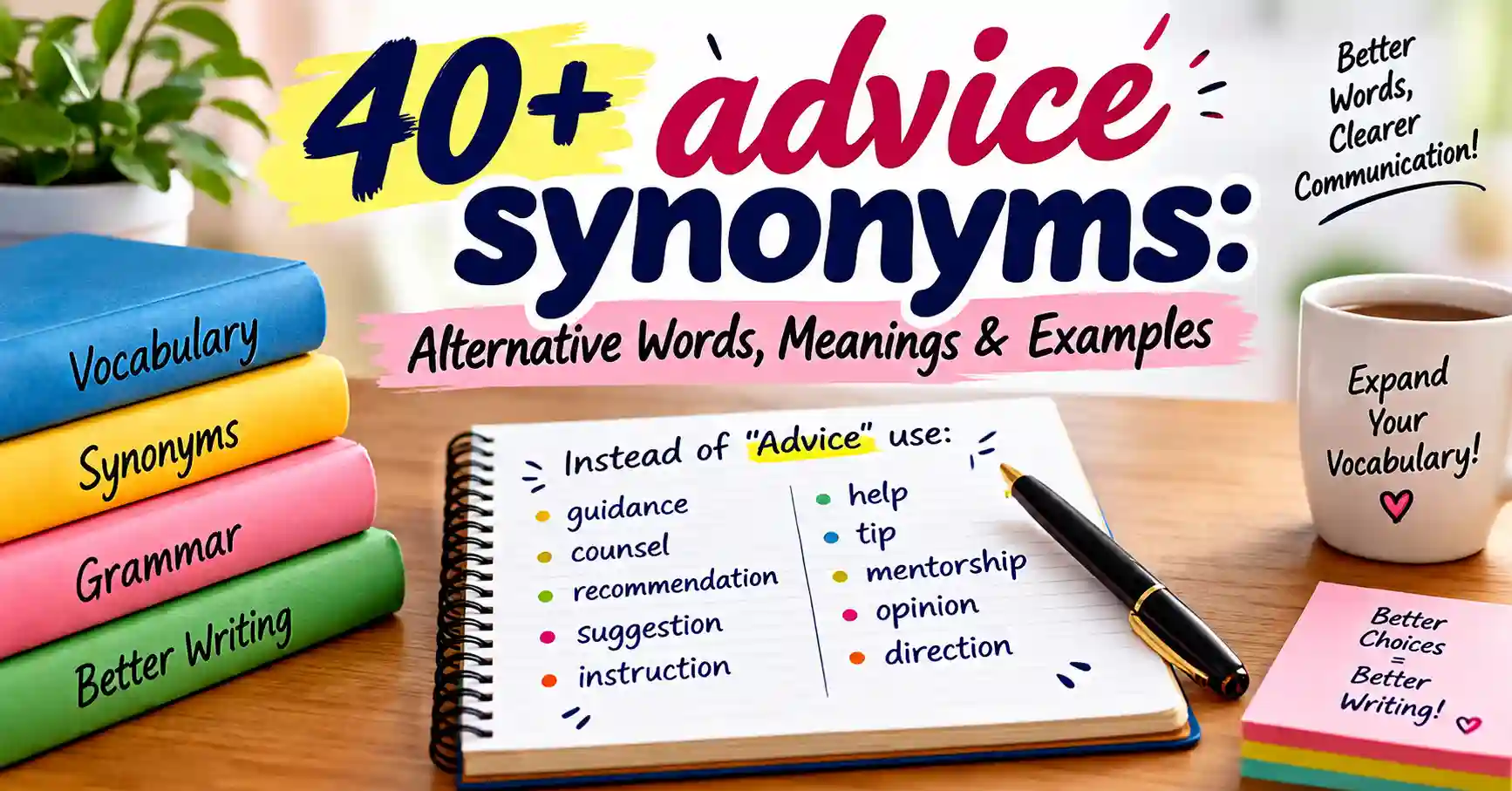
Need another word for advice? You are in the right place. This advice synonym guide gives you every real alternative we could verify: 27 single words and 16 set phrases. Each one comes with a meaning, a tone note, and a correct example sentence.
English has fewer than 100 true matches for this word. So we list every real one we found, and we do not pad the list with loosely related words. You will also learn which word fits an essay, an email, a speech, or a text to a friend.
Why does this matter? Synonyms are rarely identical. “Tip,” “counsel,” and “guidance” all help someone decide. But each one sounds different. The right choice makes your writing clearer and more natural. The wrong one can sound stiff, casual, or even rude.
Read it once. Then use the tables as a quick guide. Let’s begin.
What Does Advice Mean?
Before we swap a word, we need to know it well. Advice is a common noun with a plain, helpful job. It names guidance that helps someone decide what to do. Let’s look at its meaning, sound, grammar, and the moments when it fits or feels worn out.
Part of speech: noun (usually uncountable)
Pronunciation: ad-VYSS (it rhymes with “price”)
Main meanings:
- Guidance or a recommendation about what to do. This is the everyday meaning.
- Information or notice given, mostly in formal or business writing. You see it in terms like “advice note” and “remittance advice.”
Here are five examples:
- She gave me good advice about my first job.
- Take my advice and read the contract twice.
- We asked a lawyer for advice on the lease.
- Thank you for your advice. It helped a lot.
- The bank sent advice on payment by email.
The word is neutral, so it fits almost anywhere. But it can feel repetitive if it appears five times in one email. In formal writing, “counsel” or “guidance” may sound more polished. In casual talk, “tip” or “heads-up” may sound friendlier.
Now let’s explore the advice synonym options, one group at a time.
Advice Synonym: Complete List of Alternative Words
This is the full word bank. It holds 27 single-word synonyms and 16 set phrases. Each one matches a real meaning of advice. Words are grouped by tone and use. The first table gives meanings, formality labels, and example sentences. Later lists regroup the same words so you can choose fast.
Top Synonyms for Advice
English has 27 solid single-word matches for advice, so this table is shorter than a typical list. Each row shows how the word differs from advice, like nuance, and an example. Read the nuance note before you swap a word, because few of these are identical.
| Word | How it differs from “advice” | Formality | Example |
| admonition | a gentle warning that urges better behavior; stronger than advice | formal | The teacher’s admonition to stay focused was kind but firm. |
| advisory | an official notice that gives advice or warns of a situation | formal | A weather advisory urged drivers to stay home. |
| caution | advice to take care; narrower than advice | neutral | Her only caution was to read the contract slowly. |
| coaching | ongoing, goal-focused guidance; more structured | neutral | Weekly coaching improved her speaking skills. |
| counsel | serious, thoughtful advice, often from a wise or expert person | formal | He sought counsel from an experienced judge. |
| counseling | professional advice and support, often on personal matters | neutral | School counseling helped him choose a course. |
| direction | guidance about which way to go; broader and less specific | neutral | She needed direction after graduation. |
| exhortation | strong, urgent advice meant to inspire action | formal | The coach’s exhortation lifted the whole team. |
| guidance | steady, supportive help in making choices | neutral | We thank you for your guidance. |
| guidelines | written rules or advice on how to do something | neutral | Please follow the safety guidelines. |
| heads-up | quick, friendly advance warning or tip | informal | Thanks for the heads-up about the schedule change. |
| hint | a light, indirect clue; weaker than advice | neutral | She gave me a hint about the answer. |
| input | opinions or ideas offered to help a decision | informal | I would value your input on this plan. |
| instruction | directions on how to do something; more directive than advice | neutral | Follow the instruction on the label. |
| intelligence | a dated word for news or information received | formal (dated) | Intelligence of the delay reached us by evening. |
| intimation | a formal word for a hint or an announcement | formal | There was no intimation of a change. |
| mentorship | long-term guidance from a trusted, experienced person | neutral | Her mentorship shaped my career. |
| notice | a formal message that informs someone | neutral | We received notice of the change. |
| notification | an official or automatic message that informs | neutral | A notification arrived this morning. |
| pointer | a short, practical piece of advice | informal | Here is a pointer for new learners. |
| recommendation | advice to choose a specific option | neutral | The doctor’s recommendation was rest. |
| rede | an archaic or literary word for counsel | formal (archaic) | In the old tale, he ignored his friend’s rede. |
| steer | an informal British word for a helpful guiding tip | informal | Thanks for the steer on where to apply. |
| suggestion | a gentle idea offered for someone to consider; softer than advice | neutral | I have one suggestion for the speech. |
| tidings | a dated word for news | formal (dated) | Glad tidings arrived by post. |
| tip | a small, practical piece of advice | informal | Here is a tip for cooking rice. |
| tutelage | guidance and teaching from a mentor or teacher | formal | She grew under his tutelage. |
Match the tone of the word to the setting. “Counsel” suits a serious letter, and “tip” suits a quick chat.
Formal Synonyms
Formal synonyms suit essays, reports, letters, and official notices. They sound serious and polished. Use them when your reader expects care and respect. Avoid them in casual talk, where they can sound stiff. The words below are the formal options, with a short note on each.
- admonition – gentle warning with advice
- advisory – official notice of advice or warning
- counsel – serious, wise advice
- exhortation – strong urging to act
- intimation – formal hint or announcement
- rede – archaic counsel, found in old texts
- tutelage – guidance from a teacher or mentor
- intelligence and tidings – dated words for news
Choose “counsel” for the most natural formal swap. The others are more specific or old-fashioned.
Neutral Synonyms
Neutral synonyms work in almost every setting. They are not too casual and not too stiff. They are the safest choices for emails, schoolwork, and daily writing. Use them when you want variety without changing the tone. The words below are the neutral options.
- caution, coaching, counseling, direction, guidance
- guidelines, hint, instruction, mentorship
- notice, notification, recommendation, suggestion
When in doubt, pick “guidance,” “recommendation,” or “suggestion.” They are clear and friendly.
Informal and Conversational Synonyms
Informal synonyms suit chats, texts, and friendly talk. They feel quick and warm. They are short, practical, and often about small matters. Avoid them in legal or academic writing, where they may sound too casual. The words below are the informal options.
- heads-up – quick advance warning
- input – ideas offered to help a decision
- pointer – short, useful advice
- steer – helpful guiding tip (British)
- tip – small, practical advice
Use “tip” for small matters and “heads-up” when timing matters.
Simple Synonyms for Beginners and Kids
If you are just starting, begin with short, common words. These are easy to say and easy to remember. They cover most everyday needs. Learn them first, then add the advanced words later. Make one sentence for each word to help it stick.
- tip – “Here is a tip for your test.”
- hint – “Can you give me a hint?”
- suggestion – “I have a suggestion.”
- pointer – “She gave me a pointer.”
- guidance – “I need some guidance.”
Say each sentence aloud. Then change the word and listen to the tone.
Advanced and Uncommon Synonyms
Rare words make your writing stand out. Use them in small doses. One advanced word per paragraph is plenty. Too many can confuse a reader. The words below are precise and formal. Check each in a dictionary before you use it, and note that some are dated or archaic.
- admonition – gentle warning with advice
- exhortation – strong, urgent urging
- intimation – formal hint or announcement
- rede – archaic counsel
- tidings – dated word for news
- tutelage – guidance from a teacher
Try “under her tutelage” when you want to honor a teacher in a formal way.
Phrases and Multi-Word Alternatives
Phrases add color and rhythm. Some are warm and casual. Others are wise and formal. They are not always one-to-one swaps, so read each meaning. The table below lists sixteen set phrases that work like advice in the right setting.
| Phrase | Meaning | Example |
| dos and don’ts | a list of what to do and avoid | Check the dos and don’ts before your trip. |
| good steer | helpful guidance (British informal) | Thanks, that was a good steer. |
| helpful hints | useful small pieces of advice | The site shares helpful hints for new gardeners. |
| inside tip | useful private information | A friend gave me an inside tip about the sale. |
| a nudge in the right direction | gentle guidance | A short chat gave him a nudge in the right direction. |
| pearl of wisdom | a wise piece of advice | She shared a pearl of wisdom about patience. |
| rule of thumb | a practical guideline | A good rule of thumb is to save first. |
| second opinion | advice from another expert | I asked for a second opinion. |
| sound counsel | wise, reliable advice | He gave sound counsel in hard times. |
| tip-off | secret advance information or warning | A tip-off helped her avoid the traffic. |
| tips and tricks | practical, clever advice | Here are tips and tricks for beginners. |
| two cents | informal word for one’s opinion or advice | Let me add my two cents. |
| wise counsel | thoughtful advice from a sage person | She relied on wise counsel. |
| a word to the wise | a hint of advice for sensible people | A word to the wise: read the contract first. |
| words of caution | advice to be careful | A few words of caution before you start. |
| words of wisdom | wise advice | His words of wisdom stayed with me. |
Use phrases sparingly. One good phrase can brighten a paragraph, but too many feel cluttered.
Synonyms by Meaning and Context
Advice has more than one shade of meaning. Sometimes it is a warning or a formal notice. This section groups synonyms by those senses, so you can pick the closest match for your exact need.
Advice as a Friendly Tip or Suggestion
This sense covers small, helpful ideas between friends and colleagues. The tone is light and practical. These words suit chats, emails, and short notes. They are weaker than expert advice, so use them for everyday matters.
| Word | Nuance | Example |
| hint | indirect and light | Her smile was a hint that I should stay. |
| input | informal; ideas for a decision | Please send your input by Friday. |
| pointer | short and practical | He gave me a pointer on my grammar. |
| steer | British, informal | Can you give me a steer on the best hotel? |
| suggestion | gentle and open | My suggestion is to start early. |
| tip | small and specific | A good tip is to label your files. |
Pick “tip” or “pointer” for small, practical help. Pick “suggestion” when you want to stay gentle.
Advice as Expert or Professional Guidance
This sense covers serious help from someone with skill or experience. The tone is respectful and steady. These words suit schools, workplaces, and official writing. They often describe an ongoing relationship, not a single remark.
| Word | Nuance | Example |
| coaching | structured and goal-focused | His coaching helped her pass the exam. |
| counsel | formal and wise | The king sought counsel from his elders. |
| counseling | professional and personal | Career counseling helped her choose a path. |
| direction | broad guidance | The new manager gave the team clear direction. |
| guidance | supportive and steady | Students receive guidance from teachers. |
| guidelines | written rules or advice | The guidelines explain each step. |
| instruction | directive and step-by-step | The instruction is to boil for ten minutes. |
| mentorship | long-term and personal | Mentorship made her braver at work. |
| recommendation | points to one option | The committee’s recommendation was approved. |
| tutelage | formal and teacher-based | He studied piano under her tutelage. |
Use “guidance” for general help and “counsel” for serious, formal advice.
Advice as a Warning or Caution
Sometimes advice means “be careful.” These words carry a warning along with the guidance. They suit safety notes, formal letters, and gentle reminders. Choose them when you want the reader to pause and think.
| Word | Nuance | Example |
| admonition | gentle but firm | The admonition to drive slowly was clear. |
| advisory | official notice | A travel advisory warned of storms. |
| caution | advice to take care | The guide offered one caution about the trail. |
| exhortation | strong urging | The mayor’s exhortation to stay calm worked. |
| heads-up | quick and informal | Thanks for the heads-up about the road work. |
Use “heads-up” for a friendly warning and “advisory” for an official one.
Advice as Notice or Information
In business and formal writing, advice can mean a notice or a piece of information. This older sense appears in terms like “advice note.” These words are formal and precise. They suit letters, bank records, and official messages.
| Word | Nuance | Example |
| intelligence | dated word for news | Intelligence of the storm came by telegram. |
| intimation | formal announcement | We had no intimation of the delay. |
| notice | formal message | The tenant received notice in writing. |
| notification | official or automatic message | A notification confirmed the payment. |
| tidings | dated word for news | The messenger brought sad tidings. |
Use “notice” or “notification” for modern writing. Save “tidings” for stories set in the past.
Synonyms by Word Length
Word length affects rhythm and style. Short words feel quick and plain. Long words feel formal and rich. This section sorts the single-word synonyms by length, so you can fit them into headlines, tight sentences, or formal paragraphs with ease.
Short Synonyms (Up to 5 Letters)
Short words are easy to say and spell. They fit headlines, texts, and quick tips. English has only five short synonyms for advice, so we list all of them. Each one is informal or archaic, so use them with the right audience.
- hint – “Give me a hint.”
- input – “Share your input.”
- rede – archaic; appears in old stories
- steer – British informal
- tip – “Here is a tip.”
Short words suit casual tone. Avoid them in formal letters.
Medium Synonyms (6 to 9 Letters)
Medium words balance clarity and style. They fit most writing, from emails to essays. This group is the largest and most useful. Many are neutral, so they are safe in almost any setting. Here are eleven options.
- advisory, caution, coaching, counsel, direction
- guidance, heads-up, notice, pointer, tidings, tutelage
Pick from this group first. It offers the widest choice.
Long Synonyms (10 or More Letters)
Long words add weight and detail. They suit reports, letters, and formal speeches. They can feel heavy in casual talk. Use them when you want your writing to sound careful and complete. Here are eleven long options.
- admonition, counseling, exhortation, guidelines
- instruction, intelligence, intimation, mentorship
- notification, recommendation, suggestion
Long words suit formal writing. Short ones suit friendly talk.
Synonym Comparison and Nuance
Synonyms share a core meaning, but each has its own flavor. Some are soft, some strong, some casual, and some formal. This section helps you compare the advice synonym options by strength, by situation, and by the cases where a swap can go wrong.
Intensity and Formality Ranking
This table ranks twelve synonyms from the most casual and light to the most formal and strong. It is a quick guide to tone. Use it when you want to raise or lower the force of your message.
| Rank | Word | Tone and strength |
| 1 | tip | very casual, light |
| 2 | heads-up | casual, quick warning |
| 3 | pointer | casual, practical |
| 4 | hint | light, indirect |
| 5 | suggestion | polite, gentle |
| 6 | input | casual-professional |
| 7 | guidance | neutral, supportive |
| 8 | coaching | structured, goal-focused |
| 9 | recommendation | neutral-formal, specific |
| 10 | counsel | formal, serious |
| 11 | admonition | formal, firm warning |
| 12 | exhortation | formal, strong urging |
Move down the table when the matter is more serious. Move up when the tone should stay light.
Best Synonym for Each Situation
Different settings need different words. This table gives ten common situations, with the best choice and the reason. Use it as a quick lookup before you write.
| Situation | Best choice | Reason |
| Academic essay | guidance | neutral and clear |
| Business email | input | friendly and professional |
| Formal letter | counsel | serious and polished |
| Text to a friend | tip | short and warm |
| Safety notice | caution | focuses on care |
| Weather or travel alert | advisory | official and precise |
| Doctor’s letter | recommendation | points to one choice |
| Resume or reference | mentorship | shows lasting support |
| Speech | words of wisdom | warm and memorable |
| Quick workplace warning | heads-up | fast and friendly |
When two choices fit, pick the one your reader would use in speech.
Synonyms That Cannot Always Replace “Advice”
Some synonyms only fit one shade of meaning. If you swap them blindly, the sentence can sound odd or change its meaning. Here are six cases to watch.
- Instruction is more directive. “Follow my advice” is a suggestion, but “follow my instructions” is closer to an order.
- Hint is indirect. “I need advice, not hints” shows the difference.
- Recommendation points to one choice. It cannot replace advice in “advice about life.”
- Counsel can also mean a lawyer. “Legal counsel” is a person or team, not just advice.
- tip is small. You would not say “She gave me life-changing tips” for deep guidance.
- Direction can mean a way to go. “Which direction?” is not a request for advice.
Check each sentence after a swap. Read it aloud, and trust your ear.
Antonyms and Opposites
Advice has no true antonym. It is an uncountable noun that names a kind of help, so there is no single word for “the opposite of advice.” Instead, we can find words that contrast with its qualities. Some oppose helpful guidance. Some oppose taking it. Below are nineteen contrasting words with examples.
| Word | What it contrasts with | Example |
| command | advice is optional; a command is required | The captain’s command left no room for choice. |
| confusion | advice brings clarity | Confusion followed the unclear instructions. |
| deception | advice is honest | Deception led them down the wrong path. |
| defiance | taking advice | His defiance cost him the job. |
| directive | advice is a suggestion | A directive from the board changed the plan. |
| disobedience | following advice | Her disobedience worried her parents. |
| disregard | listening to advice | His disregard for the warning was risky. |
| folly | wise advice | It was folly to ignore the map. |
| ignorance | lack of guidance | Ignorance of the rules caused the mistake. |
| interference | unwanted advice | His constant interference annoyed the team. |
| mandate | advice is optional | The new mandate applies to every worker. |
| misdirection | helpful guidance | Misdirection sent the tourists to the wrong gate. |
| misguidance | good guidance | Misguidance from a poor source cost her time. |
| misinformation | accurate information | Misinformation spread quickly online. |
| neglect | giving help | Neglect left the new staff without support. |
| order | advice is optional | The officer gave a clear order. |
| refusal | accepting advice | His refusal to listen surprised us. |
| rejection | accepting advice | The rejection of her advice hurt her feelings. |
| silence | giving advice | The silence left him without direction. |
Choose a contrast word by the quality you want to oppose. “Command” opposes the optional nature of advice. “Misguidance” opposes its helpfulness.
How to Use Advice and Its Synonyms Correctly
Knowing a word is not enough. You must use it with correct grammar and punctuation. Advice has a few special rules that trip up many learners. This section covers them, along with placement, common mistakes, confusing pairs, and ways to avoid repeating yourself. Every advice synonym follows its own pattern, so check each one.
Grammar and Word Order for “Advice”
Advice is uncountable in modern English. That means it has no plural form in everyday use, and it takes a singular verb. You say “some advice,” “a piece of advice,” or “a word of advice.” You do not say “an advice” or “advices.” Use “give,” “take,” “seek,” or “ask for” with it.
- Her advice is always helpful.
- I need some advice on my résumé.
- He gave me a piece of advice about saving money.
Synonyms differ. “Suggestions,” “tips,” and “recommendations” are countable, so they take plurals: “three tips,” “two suggestions.”
Punctuation Rules
Punctuation helps your advice sound clear. Use commas around extra details. Use a hyphen in “heads-up” and “tip-off.” Here are six examples.
- Here is my advice: rest before the exam.
- Her advice, always kind, helped him decide.
- Thanks for the heads-up about the meeting.
- A tip-off helped them avoid the delay.
- Check the dos and don’ts before you travel.
- My tip is simple, so keep it short.
Placement in a Sentence
Advice and its synonyms usually appear as subjects or objects. They can start a sentence, sit in the middle, or end it. Placement changes emphasis. A word at the start feels bold. A word at the end feels natural and calm.
- Beginning: Advice from experts can save time.
- Middle: We followed the guidance of our teacher.
- End: She asked for advice.
For emphasis, move the key word to the start or the end.
Common Mistakes and How to Avoid Them
Everyone makes mistakes. The key is to spot them early. Most errors with advice come from treating it as countable or mixing it with its verb. Here are six that learners make often. Each has a quick fix.
- Wrong: “She gave me an advice.” Right: “She gave me a piece of advice.”
- Wrong: “I got many advices.” Right: “I got a lot of advice.”
- Wrong: “Can you advice me?” Right: “Can you advise me?” (The verb is “advise.”)
- Wrong: “Thanks for your advises.” Right: “Thanks for your advice.”
- Wrong: “He gave good advices to us.” Right: “He gave us good advice.”
- Wrong: “I want to advise for your help.” Right: “I want to ask for your advice.”
Commonly Confused Words
Some words look or sound alike but mean different things. Mixing them up can change your message. Here are six pairs worth learning. Study the difference, then try each word in a sentence of your own.
- advice / advise: Advice is the noun. Advise is the verb.
- counsel / council: Counsel is advice, or a lawyer. A council is a group that makes decisions.
- rede / read: Rede is an old word for counsel. Read is what you do with a book.
- advisory / advisor: An advisory is a notice. An advisor is a person.
- guidance / guidelines: Guidance is uncountable help. Guidelines are written rules or tips.
- notice / notion: A notice is a message. A notion is an idea.
Overuse and Repetition
Repeating the same word five times makes writing feel flat. Vary your word choice, but keep the meaning clear. Use pronouns, swap in synonyms, and rephrase when you can. Compare these two versions.
Repetitive: “I need advice. Your advice helps. I will follow your advice.”
Varied: “I need guidance. Your input helps. I will follow your recommendation.”
Do not swap words just to look clever. Keep the tone steady, and use the simplest word that fits.
Practical Use Cases
Words matter most when you use them. This section shows how to use an advice synonym in seven common settings. Each setting has its own tone. Match your word choice to that tone, and your message will land well. Every example below uses a different synonym.
Essays and Academic Writing
Academic writing needs neutral, precise words. Choose terms that sound measured and clear. Avoid slang like “tip” or “heads-up.” Words like “guidance,” “recommendation,” and “counsel” suit essays and reports.
- The study offers guidance for future teachers.
- The authors make a clear recommendation for policy.
- Leaders in the past often sought counsel from advisers.
Business Emails and Reports
Business writing should be polite, clear, and short. Words like “input” and “recommendation” sound friendly and professional. Use “notification” for official messages. Avoid heavy words that sound old-fashioned.
- Please share your input before the meeting.
- Our recommendation is to launch in March.
- You will receive a notification when the file is ready.
Resumes and Cover Letters
Resumes need strong, specific words. Show how you gave or received guidance, and name the result. “Mentorship” and “coaching” suit this setting well. Always back each claim with a number or outcome.
- Provided mentorship to five new hires.
- Delivered coaching that raised team scores by 15%.
- Wrote guidelines that cut errors in half.
Storytelling and Creative Writing
Stories need voice and mood. Older words like “rede,” “tidings,” and “tutelage” add a classic feel. Use them sparingly so the story stays easy to read. A single rare word can set the tone.
- He ignored his elder’s rede and rode into the storm.
- Glad tidings reached the village at dawn.
- Under her tutelage, the boy became a skilled healer.
Speeches and Presentations
Speeches need warm, memorable words. Phrases like “words of wisdom” and “a word to the wise” give rhythm. Use them to connect with the audience. Keep the rest of your language simple and clear.
- Let me share a few words of wisdom from my teacher.
- A word to the wise: start before you feel ready.
- I offer one caution: protect your time.
Social Media and Everyday Conversation
Casual settings welcome short, friendly words. “Tip,” “heads-up,” and “two cents” feel natural in chats and captions. Keep your tone light. Avoid formal words that would sound out of place.
- Quick tip: label your cables before you move.
- Thanks for the heads-up about the sale!
- Just my two cents, but I love the second photo.
IELTS, TOEFL, and Exam Writing
Exam writing rewards clear, varied vocabulary. Use “guidance,” “recommendation,” and “suggestion” in your answers. Avoid slang. Show control by varying words without changing the meaning, and check grammar carefully.
- Students should seek guidance from their teachers.
- One useful suggestion is to plan before writing.
- The report’s main recommendation is to invest in training.
Rewrite Examples: Before and After
The best way to learn synonyms is to rewrite real sentences. This section shows eight weak or repetitive sentences next to improved versions. Each pair has a one-line explanation. Read them aloud, and notice how each advice synonym changes the tone, the focus, or the clarity of the sentence.
- Before: “I need advice. Please give me advice on the advice you mentioned.”
After: “I need guidance. Could you expand on the recommendation you mentioned?”
Why: It removes repetition and uses more precise nouns. - Before: “Here is some advice for new drivers.”
After: “Here are a few pointers for new drivers.”
Why: “Pointers” sounds friendly and focuses on small, practical tips. - Before: “She gave good advice to her team.”
After: “She offered sound counsel to her team.”
Why: “Counsel” adds a formal, serious tone. - Before: “Thanks for your advice about the schedule.”
After: “Thanks for the heads-up about the schedule.”
Why: “Heads-up” fits a quick, informal warning. - Before: “We follow the advice in the manual.”
After: “We follow the guidelines in the manual.”
Why: “Guidelines” matches written rules. - Before: “He took his coach’s advice.”
After: “He took his coach’s recommendation.”
Why: “Recommendation” shows a specific choice. - Before: “The agency gave advice on safety.”
After: “The agency issued a safety advisory.”
Why: “Advisory” names an official notice. - Before: “I’d like your advice on the draft.”
After: “I’d value your input on the draft.”
Why: “Input” sounds collaborative and professional.
Fun Facts and Learning Tips
Learning words should be fun. Stories stick better than lists. In this section, you will find surprising facts, memory tricks, word histories, daily habits, and a quiz. Take your time here. Try one idea at a time. Soon, every advice synonym on this page will feel like an old friend, and your word choice will grow richer with every page you read.
Fun Facts About “Advice” and Its Synonyms
Words carry stories. Some hide old kings, odd spellings, or surprising cousins. These six facts show how alive English can be. Share a few with friends. They make great conversation starters, and they help words stay in your memory.
- “Advice” means “it seems to me.” It came from Old French avis, which grew from a phrase meaning “it seems to me.” Advice began as someone’s view or opinion.
- The noun and verb differ by one letter. Advice is the noun, and advise is the verb. The same pattern appears in “device” and “devise,” and in British “practice” and “practise.”
- A famous king was “unadvised.” King Æthelred is called “the Unready,” but the Old English word unræd meant “badly advised.” His name meant “noble counsel,” so the nickname was a joke.
- “Counsel” and “council” are not twins. Counsel comes from Latin consilium, meaning “advice.” Council comes from Latin concilium, meaning “assembly.” English spells them almost alike.
- French counts advice, but English does not. The French word avis is countable, so you can say “des avis.” English treats advice as uncountable, so we say “a piece of advice.”
- “Mentor” comes from a story. In Homer’s Odyssey, Mentor is a wise friend who guides a young man. His name became our word for a trusted guide, which gives us “mentorship.”
Memory Tricks and Mnemonics
Memory tricks turn hard words into easy ones. Your brain loves pictures, sounds, and stories. Use the five tricks below. Each one has an example from our list. Try making your own too. Personal tricks work best because they connect to things you already know.
- Ice and wise: Advice (noun) has “ice,” a thing you can hold. Advise (verb) rhymes with “wise,” which is an action word.
- Council has a “c” for committee: A council is a group. Counsel is the help it gives.
- Tip is tiny: The word is short, and so is the help. Picture a tiny tip of a pencil.
- Admonition hides “admonish”: If you admonish, you warn. An admonition is a warning with advice.
- Mentorship carries a ship: Picture a ship that carries you across a hard stretch of life, guided by a mentor.
Word Origins and History
Word origins explain why meanings feel the way they do. Here are five synonyms and where they came from. Notice how many started with a simple idea and grew. Seeing the root often unlocks the meaning. It also helps you guess new words.
- Tutelage: From Latin tutela, meaning “protection” or “guardianship.” It moved from “guarding” to “guiding and teaching.”
- Admonition: From Latin admonere, meaning “to remind” or “to warn.” It moved from “reminding” to “gentle warning with advice.”
- Exhortation: From Latin exhortari, meaning “to encourage.” It moved from “encouraging” to “strong urging.”
- Guidance: From “guide,” which came through Old French from a Germanic root meaning “to show the way.” It moved from “leading” to “helping someone choose.”
- Recommendation: From Latin recommendare, meaning “to commend.” It moved from “praising” to “advising someone to choose.”
Daily Practice Tips
Small habits beat big plans. Ten minutes a day can change your vocabulary in a month. Pick two or three of the habits below. Stay steady, and progress will come. Regular practice matters far more than long, rare study sessions.
- Rewrite one sentence a day. Take a sentence with “advice” and swap in a better synonym. Check the tone, then note why it works.
- Keep a synonym journal. Write each new word with its meaning, tone, and your own example. Review the page each week.
- Use flashcards. Put “advice” on one side and the synonym with its tone on the other. Short, frequent reviews are best.
- Swap words in emails. Before you send an email, look for repeated words. Replace one with a fitting synonym.
- Practice speaking. Give a friend a tip, then a suggestion, then a recommendation. Notice how each one feels.
- Read and underline. Read articles and underline how writers give guidance. Add new words to your list.
Mini Practice Quiz
Quizzes show what you know. They also show what to review. Try these ten questions without peeking. Write your answers on paper. Then check the answer key. Be kind to yourself. Every mistake is a step forward, and every correct answer proves your hard work is paying off.
- Can I give you some ___? (advice / advise)
- Which synonym is the most formal? (tip / heads-up / counsel)
- Which synonym is best for a small, casual piece of advice? (tip / exhortation / tutelage)
- A travel ___ warned of storms. (advisory / advisor)
- What does “admonition” mean? (gentle warning with advice / a type of food / a loud noise)
- Which is uncountable? (advice / suggestion)
- She grew under his ___. (tutelage / tutor)
- Choose the correct phrase. (a piece of advice / an advice)
- Which word is archaic? (rede / tip)
- Which is best in a text to a friend? (heads-up / exhortation)
Answer Key
- advice – It is the noun.
- counsel – It sounds serious and formal.
- tip – It is short and casual.
- advisory – It is an official notice.
- gentle warning with advice – That is an admonition.
- advice – It has no plural in everyday use.
- tutelage – It means guidance from a teacher.
- a piece of advice – “An advice” is wrong.
- rede – It appears in old texts.
- heads-up – It is quick and friendly.
Frequently Asked Questions
Learners often ask the same smart questions. This section answers the most common ones. Each answer is short and clear. Use them as quick reminders when you study or write. If you still have a question after reading, test the words in your own sentences and see how they sound.
What is the best advice synonym for formal writing?
“Counsel” is the most natural formal choice. It sounds serious and polished, as in “sought counsel from an expert.” “Guidance” and “recommendation” also work well in formal writing and are a little more neutral. Avoid casual words like “tip,” “pointer,” and “heads-up” in reports, essays, and official letters.
What is another word for advice?
Common options include guidance, counsel, recommendation, suggestion, tip, pointer, and input. Each has a slightly different tone. “Guidance” is supportive, “counsel” is formal, and “tip” is casual. Pick the word that fits your reader and your setting, and add one detail to make your point clear.
What is a simple word for advice?
The simplest options are “tip,” “hint,” and “suggestion.” They are short and easy to learn. “Tip” suits small, practical matters. “Hint” suits indirect clues. “Suggestion” is gentle and polite. For beginners and kids, these three words cover most everyday needs without sounding stiff.
Is advice a countable noun?
No. In modern English, advice is uncountable. You say “some advice” or “a piece of advice,” and you use a singular verb: “The advice is helpful.” You do not say “advices” or “an advice.” The word “advices” appears only in old texts and some business terms, such as “remittance advices.”
What is the difference between advice and advise?
Advice is a noun, and it ends in “-ice.” Advise is a verb, and it ends in “-ise.” You give someone advice, and you advise someone. They also sound different. Advice ends with an “s” sound, while advise ends with a “z” sound. Remember: “ice” is a noun, and “wise” is an adjective.
What is a formal synonym for advice?
Formal synonyms include counsel, guidance, recommendation, admonition, exhortation, and tutelage. “Counsel” is the most general. “Admonition” adds a gentle warning. “Exhortation” adds strong urging. “Tutelage” fits teacher-student guidance. Use the one that matches your meaning, and check that the sentence still reads naturally.
Can I say “words of advice” in formal writing?
Yes. “A word of advice” and “words of advice” are acceptable in formal writing, though they sound slightly warm and personal. For a stricter tone, use “counsel,” “guidance,” or “recommendation.” For a warmer tone, use “words of wisdom,” but only when the advice is truly wise and meant to inspire.
Conclusion
You learned what advice means and how it behaves in a sentence. You explored the advice synonym options:
Here are the key takeaways. Match the word to the setting. Remember that advice is uncountable. Use “counsel” for formal writing and “tip” for casual talk. Vary your words, but never at the cost of clarity.
Vocabulary grows through use, not just reading. So take action today. Pick three synonyms from this page. Write one sentence for each. Save this article for later. Share it with a friend who loves words. Keep practicing, and your writing will shine.
Meta Title: Advice Synonym: 40+ Alternative Words
Meta Description:
