

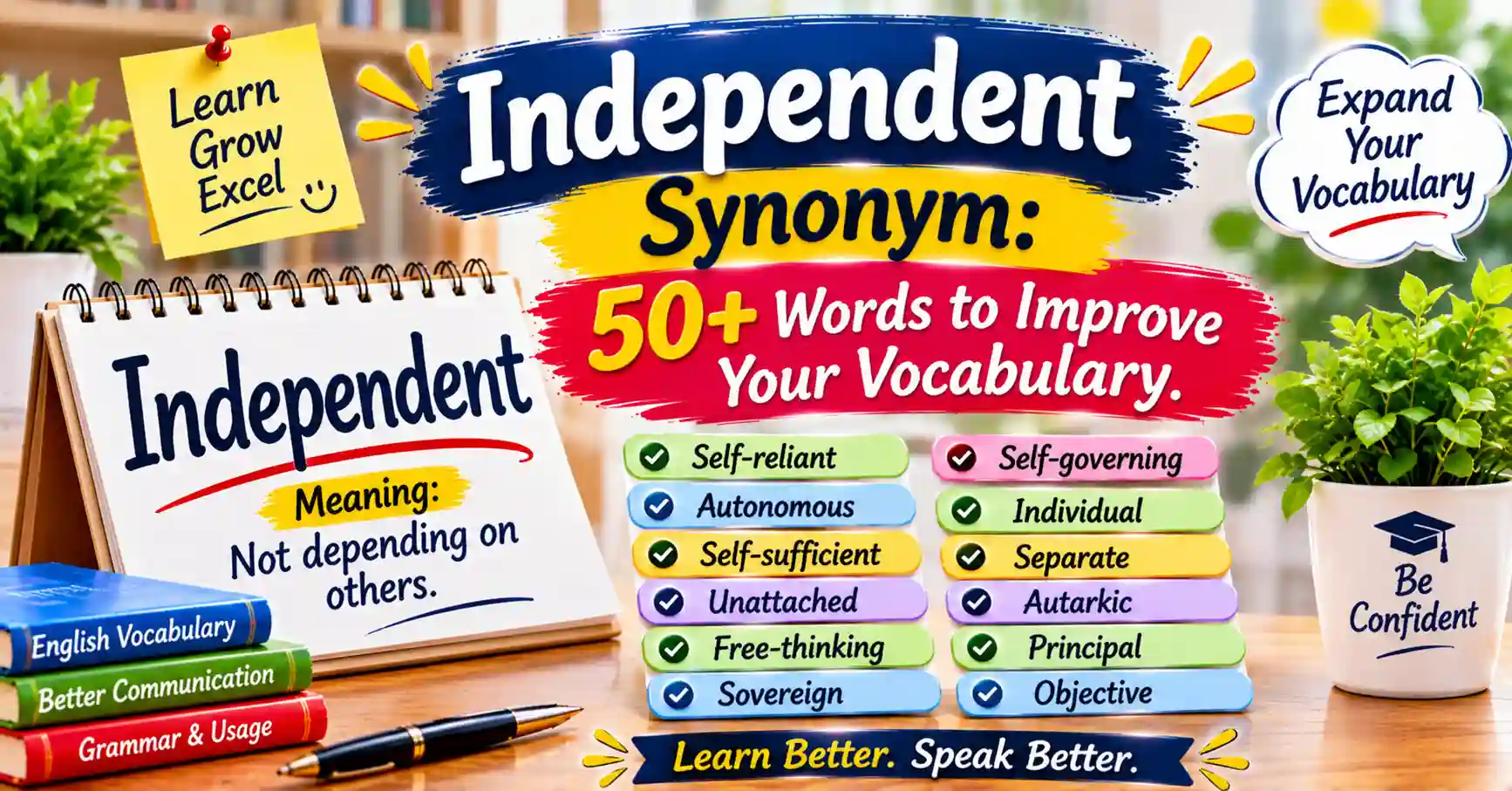
“Independent” is a proud word. But use it five times on one page, and it starts to blur. This guide gives you a full independent synonym list, with clear meanings, tone notes, and easy examples.
Every word here fits one real sense of independent. Some are phrases, like standing on one’s own two feet.
One honest note first. Independent has fewer true synonyms than many common words. We found 52, counting single words and phrases. We did not pad the list with loosely related words like detached or brave.
In this guide, you will learn:
- 52 synonyms and phrases for independent
- how each one differs in tone, strength, and formality
- the best choice for essays, emails, speeches, and texts
- grammar, punctuation, and common mistakes
- origins, memory tricks, and a ten-question quiz
Choosing the right word makes your meaning exact. Let’s begin.
What Does Independent Mean?
Independent describes someone or something free from outside control, help, or influence. It is a common, positive word. This section gives the definition, the pronunciation, and five examples. It also shows when the word works well and when another word fits better.
Part of speech: adjective (also a noun). Pronunciation: in-dih-PEN-dunt.
Independent has four main senses:
- Free from outside control: “India became an independent country in 1947.”
- Self-reliant: “She is an independent young woman.”
- Impartial or unaffiliated: “An independent review found no errors.”
- Separate and unconnected: “The two studies were independent of each other.”
Here are five examples:
- “He runs an independent bookshop.”
- “My sister has always been very independent.”
- “The court is independent of the government.”
- “We need an independent expert.”
- “Each team works independently of the others.”
Independent is neutral and clear. It fits daily talk, news, and reports. But it is a common word so it can feel repeated. A good independent synonym adds color or exact meaning.
Note one point of grammar. We say an independent voice, with an, because independent starts with a vowel sound.
Complete List of Independent Synonyms
This is the heart of the guide. Here you will find every independent synonym we trust, sorted by tone. We start with a table of the twenty-four most useful words. Then we cover formal, neutral, informal, simple, advanced, and phrase options. Each list is alphabetical. No word appears twice in the new-word lists.
Top 24 Synonyms for Independent
These twenty-four words are the most useful. You will meet them in news, books, reviews, and speech. Each one has a meaning, a formality label, a note on how it differs from independent, and an example. Learn these first. They form the base for every other list.
| Word | Meaning | Formality | How it differs from “independent” | Example |
| autonomous | self-governing | formal | stresses the right to rule oneself | The region became autonomous in 1998. |
| free | not controlled by others | neutral | plainer and broader | She is free to make her own choices. |
| freelance | self-employed, working for many clients | neutral | work only; stresses no single employer | He is a freelance designer. |
| freestanding | standing alone, not attached | neutral | things only | We bought a freestanding bathtub. |
| freethinking | forming your own views | neutral | stresses thought, not action | She is a freethinking writer. |
| impartial | fair and not taking sides | formal | stresses fairness | An impartial judge heard the case. |
| independent-minded | forming your own opinions | neutral | stresses mind, not money or work | He is an independent-minded student. |
| neutral | not taking a side | neutral | stresses no side, not self-reliance | The country stayed neutral in the war. |
| non-aligned | not joined to a bloc or alliance | formal | politics only | Several non-aligned nations met in Delhi. |
| nonpartisan | not tied to a political party | neutral | politics; stresses no party | It is a nonpartisan group. |
| objective | based on facts, not feelings | neutral | stresses facts over opinion | We need an objective report. |
| self-contained | complete in itself | neutral | stresses needing nothing outside | Each lesson is self-contained. |
| self-directed | guiding your own work | neutral | stresses setting your own aims | She is a self-directed learner. |
| self-employed | working for yourself | neutral | work only; not for a boss | He is self-employed and works from home. |
| self-governing | ruling itself | formal | groups and places | The island is a self-governing territory. |
| self-reliant | able to depend on yourself | neutral | people; stresses not needing help | Camping makes kids self-reliant. |
| self-sufficient | able to meet your own needs | neutral | stresses needs like food and money | The farm is almost self-sufficient. |
| self-supporting | earning your own living | neutral | stresses money | She became self-supporting at nineteen. |
| separate | apart and not joined | neutral | stresses no link | They live in separate houses. |
| sovereign | holding the highest power | formal | nations; very strong | Iceland is a sovereign state. |
| standalone | working without other items | neutral | tech and products | It is a standalone device. |
| unaffiliated | not joined to a group | formal | stresses no membership | He is an unaffiliated voter. |
| unbiased | free from unfair leaning | neutral | stresses no unfair leaning | We want unbiased advice. |
| unconnected | with no link | neutral | stresses no link between things | The two events were unconnected. |
Pick three words from this table. Use one each day this week.
Formal Synonyms
Formal words suit essays, reports, and legal writing. They sound polished and exact. Most describe politics, law, or fairness. Use them with care, because too many can feel stiff. These five are new to the table above.
- discrete – separate and distinct. Stresses clear edges between parts. The data fell into three discrete groups.
- disinterested – fair because you have nothing to gain. Often confused with uninterested. A disinterested expert settled the dispute.
- emancipated – freed from legal or social control. Often used for history and law. The court declared her an emancipated minor.
- self-determining – free to decide your own future. Stresses choice. They are a self-determining people.
- self-ruling – governing itself. Plain and formal. The self-ruling province kept its own laws.
Use one formal word per paragraph. It keeps your tone steady and clear.
Neutral Synonyms
Neutral words fit almost any setting. They sound natural in an email, a review, or a chat. They are a safe choice when you are unsure. These six are new to the lists above.
- even-handed – fair to all sides. Stresses equal treatment. She gave an even-handed account.
- fair-minded – willing to hear all views. Warm and plain. A fair-minded editor checked the facts.
- self-managed – run by those inside. Used for teams and groups. We work in a self-managed team.
- self-sustaining – able to keep going alone. Used for systems and projects. The garden is now self-sustaining.
- unattached – not belonging to a group. Stresses no link. He ran as an unattached candidate.
- unprejudiced – free from unfair opinions. A little formal. We need an unprejudiced jury.
Neutral words are the workhorses of good writing. Pick them when clarity matters most.
Informal and Conversational Synonyms
Informal words suit texts, chats, and social posts. They sound friendly and fresh. But they can feel out of place in a report. These three are new to the lists above.
- free-spirited – bold and unbound by rules. Warm and casual. She is a free-spirited traveler.
- indie – made or run outside big companies. Short for independent. We love an indie film.
- maverick – a person who thinks and acts alone. Can be a noun or an adjective. He took a maverick approach to design.
Match your slang to your audience. Check the tone before you send.
Simple Synonyms for Beginners and Kids
Young learners need short, friendly words. These are easy to say and easy to spell. They also build a happy habit of clear speech. Parents and teachers can use them every day. All four are re-listed from above, and one is a phrase.
- free – “You are free to choose.”
- self-reliant – “A self-reliant child ties her own shoes.”
- separate – “We sat at separate desks.”
- on one’s own (phrase) – “He did the puzzle on his own.”
Say one of these to a child today. Name what they did by themselves, too.
Advanced and Uncommon Synonyms
A few independent synonyms are rare. They are not used in daily talk. But they add flavor to essays, history, and fiction. Use one or two per page. Too many can sound showy. Both are new to the lists above.
- autarkic – economically self-sufficient. From Greek; formal and technical. The state followed an autarkic policy.
- unbeholden – owing nothing to anyone. Literary. She stayed unbeholden to any donor.
Say these aloud before you write them. Rare words need a sure hand.
Phrases and Multi-Word Alternatives
Phrases give your writing rhythm. They can say “independent” in a fresh, lively way. Some are idioms, so they suit speech and stories. Note that these are phrases, not single adjectives. Some describe a person, and some describe a state.
- answerable to no one – free from any boss or ruler. The owner is answerable to no one.
- fending for oneself – looking after yourself. He left home and began fending for himself.
- flying solo – acting without help. Informal. She is flying solo on this project.
- free from outside control – not ruled by others. The press must be free from outside control.
- going it alone – acting without partners. They chose to go it alone.
- a law unto oneself – acting by your own rules. It can sound critical. The old judge was a law unto himself.
- not beholden to anyone – owing nothing to anyone. She is not beholden to anyone.
- of independent means – having enough money without working. Formal. He is a man of independent means.
- on one’s own – without help. She lives on her own.
- one’s own boss – working for yourself. He is his own boss now.
- paddling one’s own canoe – managing your own affairs. Informal. She has paddled her own canoe since college.
- standing on one’s own two feet – supporting yourself. He is finally standing on his own two feet.
Phrases work best in speech and stories. In a formal report, pick a single word.
Synonyms by Meaning and Context
Independent has four main senses, and the best synonym depends on the sense. A word that fits a country may not fit a judge. A money word may not fit two events. This section sorts each independent synonym by sense, so you can choose with care.
Synonyms for “Free From Outside Control”
Use these for nations, regions, and groups that rule themselves. They stress power, law, and freedom. They suit news, history, and reports. Sovereign is the strongest. Free is the plainest.
| Synonym | Formality | Example |
| autonomous | formal | The university is autonomous. |
| emancipated | formal | The emancipated colony wrote its own laws. |
| free | neutral | The country is now free. |
| self-determining | formal | A self-determining nation chooses its leaders. |
| self-governing | formal | The town is self-governing. |
| self-ruling | formal | A self-ruling island kept its customs. |
| sovereign | formal | A sovereign state makes its own treaties. |
| unbeholden | formal | The council stayed unbeholden to donors. |
Pair the word with a fact. “A sovereign state since 1991” sounds more exact than “independent.”
Synonyms for “Self-Reliant” (People and Work)
Use these for people who stand on their own. They stress character, money, and work. They suit resumes, profiles, and speeches. Words like self-employed describe work only.
| Synonym | Formality | Example |
| autarkic | formal | The village was autarkic for years. |
| free-spirited | informal | She is a free-spirited artist. |
| freelance | neutral | He is a freelance editor. |
| freethinking | neutral | They raised a freethinking daughter. |
| independent-minded | neutral | He is an independent-minded voter. |
| maverick | informal | The maverick chef broke every rule. |
| self-directed | neutral | A self-directed student sets her own goals. |
| self-employed | neutral | My aunt is self-employed. |
| self-managed | neutral | Our crew is self-managed. |
| self-reliant | neutral | Hiking made him self-reliant. |
| self-sufficient | neutral | She is self-sufficient and rarely asks for help. |
| self-supporting | neutral | He is self-supporting and pays his own rent. |
| self-sustaining | neutral | The project is self-sustaining. |
Notice that maverick and free-spirited praise boldness, not money.
Synonyms for “Impartial or Unaffiliated”
Use these for judges, reviews, voters, and news. They stress fairness and no ties. They suit essays, reports, and news writing. Disinterested and impartial are the most formal.
| Synonym | Formality | Example |
| disinterested | formal | A disinterested referee made the call. |
| even-handed | neutral | The report was even-handed. |
| fair-minded | neutral | A fair-minded jury listened. |
| impartial | formal | We asked an impartial adviser. |
| neutral | neutral | The mediator stayed neutral. |
| non-aligned | formal | The non-aligned bloc met in May. |
| nonpartisan | neutral | The panel is nonpartisan. |
| objective | neutral | Give an objective summary. |
| unaffiliated | formal | The unaffiliated candidate won. |
| unattached | neutral | He is an unattached member. |
| unbiased | neutral | We trust unbiased reviews. |
| unprejudiced | neutral | An unprejudiced mind weighs the facts. |
Notice that objective fits facts, while impartial fits people.
Synonyms for “Separate and Unconnected”
Use these for things, events, and parts that do not depend on each other. They stress no link. They suit science, tech, and product writing. Discrete is formal. Standalone is common in tech.
| Synonym | Formality | Example |
| discrete | formal | Each unit is a discrete part. |
| freestanding | neutral | The shed is freestanding. |
| self-contained | neutral | The flat is self-contained. |
| separate | neutral | The files are saved in separate folders. |
| standalone | neutral | We sell a standalone app. |
| unconnected | neutral | The crimes seem unconnected. |
Test the swap: “The two studies were independent of each other” becomes “The two studies were unconnected.” It works.
Independent Synonyms by Word Length
Word length changes how a word feels. Short words are quick and punchy. Long words sound formal and rich. This section sorts each independent synonym by letter count, ignoring hyphens and spaces. Independent is a long word, and most of its synonyms are long too. So the short group is tiny, and we say so.
Short Synonyms (Up to 5 Letters)
Short words fit headlines, texts, and captions. They are easy to read at a glance. An honest note: only two single-word synonyms have five letters or fewer. Short phrases like on one’s own also help when space is tight.
free, indie
Short words give your sentence speed. Keep a longer word nearby for balance.
Medium Synonyms (6–9 Letters)
Medium words fit nearly every setting. They are long enough to be exact, yet short enough to stay clear. Most are neutral, so they suit emails and essays. These ten are a strong everyday set.
autarkic, discreet, freelance, impartial, maverick, neutral, objective, separate, sovereign, unbiased
Medium words are the sweet spot for most writers. Start here when unsure.
Long Synonyms (10+ Letters)
Long words add weight and formality. They suit reports, law, and profiles. But a long word can slow a sentence. Use one per sentence at most. Here are ten.
autonomous, disinterested, emancipated, nonpartisan, self-governing, self-reliant, self-sufficient, unaffiliated, unconnected, unprejudiced
Mix long and short words. A short word after a long one gives a nice beat.
Synonym Comparison and Nuance
Synonyms are close, but they are never twins. Each independent synonym has its own strength, tone, and best use. Some praise self-reliance, and some praise fairness. Some are casual, and some are formal. This section helps you compare them and pick with care.
Intensity and Formality Ranking Table
Words differ in strength and tone. Free is plain and light. Sovereign is grand and formal. This table ranks independent synonyms from casual to formal. Use it to match the word to your audience.
| Level | Words | Tone |
| 1 – Casual | indie, free-spirited, flying solo | light, friendly |
| 2 – Plain | free, separate, self-reliant, on one’s own | clear, everyday |
| 3 – Warm | self-sufficient, self-employed, independent-minded | positive, practical |
| 4 – Polished | impartial, autonomous, self-governing, unaffiliated | formal, exact |
| 5 – Grand | sovereign, self-determining, emancipated, autarkic | rare, strong |
Read down the table. Notice how the tone grows more formal. A grand word in a casual chat can sound odd.
Best Synonym for Each Situation
The right word depends on the setting. A text message and a thesis need different words. This table gives ten common situations, with a best choice and a reason. Use it as a quick guide when you write.
| Situation | Best choice | Reason |
| Academic essay | autonomous | formal and precise |
| Business email | self-reliant | professional and clear |
| Speech | standing on one’s own two feet | vivid and easy to say aloud |
| Text message | on my own | casual and friendly |
| Resume | self-directed | shows initiative |
| Cover letter | self-motivated learner? no: self-managed | factual and calm |
| News report | nonpartisan | clear for politics |
| Legal writing | impartial | exact and formal |
| Product page | standalone | practical and exact |
| Film or music review | indie | short and widely understood |
Always back the word with a fact. “Self-directed, with three projects led alone” proves your claim.
Synonyms That Cannot Always Replace “Independent”
Not every synonym fits every sentence. Some change the meaning. Some sound odd in the wrong setting. Check each swap before you commit. Here are the common traps.
- free: it can mean “without cost.” “A free country” is fine, but “a free review” is not an independent one.
- neutral: it means taking no side. A neutral person may still depend on others.
- separate: it means apart, not self-reliant. “A separate woman” is wrong.
- sovereign: it fits nations and rulers. “A sovereign teenager” sounds odd.
- self-employed and freelance: they fit work only. “A freelance country” is wrong.
- disinterested: it means fair, not bored. Many readers will take it as “uninterested.”
- objective: it fits facts and reports. “An objective person” is possible, but the sense is narrower.
- a law unto oneself: it can sound critical. It is not pure praise.
- maverick: it hints at breaking rules. It may sound risky in a formal reference.
When in doubt, read the sentence aloud. If it sounds off, return to independent.
Antonyms and Opposites
Antonyms are words with opposite meanings. They help you see what independent really means. The clearest antonym is dependent. Others describe control, ties, or bias. Each one fits one sense of the word.
| Antonym | Meaning | Example |
| affiliated | joined to a group | The clinic is affiliated with the hospital. |
| aligned | joined to a side | The party is aligned with the unions. |
| beholden | owing something to someone | He felt beholden to his donors. |
| biased | unfairly leaning to one side | The judge seemed biased. |
| bound | tied by duty | She felt bound by her promise. |
| clingy | needing too much support (informal) | The puppy is clingy. |
| conformist | following the group | He was a quiet conformist. |
| connected | linked | The two cases are connected. |
| controlled | ruled by others | The press was controlled by the state. |
| dependent | needing support from others | The baby is dependent on her parents. |
| needy | in need of help | The needy family received aid. |
| partisan | strongly backing a side | The report was partisan. |
| reliant | depending on someone | He is reliant on his brother. |
| subject | under the rule of another | The island was subject to a foreign crown. |
| subordinate | lower in rank | She holds a subordinate role. |
| subservient | too ready to obey | The clerk was subservient to his boss. |
| tied | linked by duty or money | The grant is tied to results. |
Use antonyms with care. Dependent is not a flaw. We all rely on others at times.
How to Use Independent and Its Synonyms Correctly
Great words need great grammar. Independent is an adjective, so it follows adjective rules. Most of its synonyms do too. This section covers word order, punctuation, placement, mistakes, and confusing words. Learn these rules once, and you can use any independent synonym with confidence.
Grammar and Word Order
Independent is an adjective. It can come before the noun, as in “an independent review.” It can also come after a linking verb, as in “The review is independent.”
Independent is gradable. We can say “very independent,” “more independent,” and “the most independent.” We can also say “completely independent.”
It usually takes off: “independent of the government.” Many writers also accept ” independent from, as in “independent from the state.” Use in formal writing.
Independent can also be a noun: “She voted as an independent.” Related forms are easy to learn. The noun is independence. The adverb is independently. The opposite is dependent.
Punctuation Rules
Punctuation makes your meaning clear. These six examples show the main rules.
- Commas between equal adjectives: “She is a calm, independent thinker.”
- A serial comma in a list: “He is curious, honest, and independent.”
- A hyphen in a compound before a noun: “She is a self-reliant leader.”
- Often no hyphen after the noun: “The leader is self-reliant.” (Keep the hyphen in self- words.)
- A semicolon between linked clauses: “The panel is independent; the funding is public.”
- A colon to introduce a list: “Good freelancers share three habits: focus, honesty, and planning.”
A capital letter appears in names: “the Independent Party.” Use lowercase for the general word.
Placement in a Sentence
An adjective can sit in different spots. Each spot changes the rhythm. Here are the three common ones.
- Before the noun: “An independent court ruled.” This is the most common form.
- After a linking verb: “The court is independent.” This puts the idea last, for emphasis.
- After the noun, in a phrase: “A court independent of the crown.” This is formal.
Try each spot, and pick the one that sounds best.
Common Mistakes and Corrections
Even strong writers slip on adjectives. The table below shows seven common errors with simple fixes. Study it once. You will avoid the same slips for good.
| Wrong | Right | Why |
| “independant” | “independent” | The ending is -ent. |
| “indepedent” | “independent” | Keep the n before -dent. |
| “a independent voter” | “an independent voter” | Independent starts with a vowel sound. |
| “independent on” | “independent of” | Use of after independent. |
| “She lives independent.” | “She lives independently.” | Use an adverb to describe a verb. |
| “He values his independent.” | “He values his independence.” | Use the noun after his. |
| “dependent of the state” | “independent of the state” | Add the prefix in- to flip the meaning. |
Commonly Confused Words
Some words look or sound alike but mean different things. Mixing them up can change your message. The pairs below are worth learning. Keep this table nearby when you edit.
| Pair | Difference | Example |
| independent/dependent | free from support / needing support | “An independent adult. A dependent child.” |
| independent/interdependent | free alone / relying on each other | “Independent firms. Interdependent nations.” |
| independent/indifferent | free from control / not caring | “An independent voter. An indifferent crowd.” |
| disinterested/uninterested | fair, with no stake / not interested | “A disinterested judge. An uninterested child.” |
| discrete/discreet | separate/careful and private | “Discrete parts. A discreet note.” |
| autonomous/anonymous | self-governing/unnamed | “An autonomous region. An anonymous donor.” |
Discrete and discreet share an old root, but today they have split. Check the spelling before you send.
Overuse and Repetition
Even a strong word loses power when repeated. Readers notice when one word fills a page. Here are easy ways to vary your choice.
- Use one strong word per paragraph. Then switch to another.
- Show, don’t only praise. “She paid her own rent at nineteen” proves independence.
- Swap in a phrase. “On her own two feet” adds rhythm.
- Match the word to the thing. Sovereign fits nations. Self-employed fits workers. Impartial fits judges.
- Cut the word. Sometimes “She lives alone and works for herself” says more.
Aim for variety, not a thesaurus dump. A plain word is often the best word.
Practical Use Cases
Words matter most when you use them. This section shows how an independent synonym works in real writing and speech. You will see samples for school, work, stories, and exams. Each use has three examples with different words. Copy them, change them, and make them your own.
Essays and Academic Writing
Academic writing needs precise, measured words. Formal synonyms fit best. Avoid slang. Pair each word with evidence. Here are three samples.
- “The region became autonomous after the treaty.”
- “The authors offer an impartial review of the data.”
- “The two variables are discrete and unconnected.”
Business Emails and Reports
Work writing needs a clear, professional tone. Neutral and formal words work well. Keep your praise short and specific. Here are three samples.
- “She is a self-directed analyst who needs little supervision.”
- “We hired an unbiased firm to audit the books.”
- “The team is self-managed and meets every Monday.”
Resumes and Cover Letters
Job documents need honest, confident language. Back each word with a fact. Avoid vague claims. Here are three samples.
- “Self-employed designer with twelve repeat clients.”
- “Self-reliant researcher who led three studies alone.”
- “Freelance writer, published in six magazines.”
Storytelling and Creative Writing
Stories use color and rhythm. Fresh synonyms keep readers hooked. Phrases and rare words add flavor. Here are three lines to inspire your next story.
- “She had been standing on her own two feet since fifteen.”
- “The old captain was a law unto himself.”
- “He stayed unbeholden to king and crown.”
Speeches and Presentations
Speeches are heard, not read. Choose words that are easy to say and easy to follow. Short, strong words land well. Here are three samples.
- “A free press must be free from outside control.”
- “Our nation is sovereign, and our people are self-determining.”
- “Teach children to be self-reliant.”
Social Media and Everyday Conversation
Daily talk is quick and relaxed. Informal words sound natural. Aim for warm and real, not fancy. Here are three samples.
- “Loving this indie cafe!”
- “She is such a free spirit.”
- “I’m flying solo this weekend.”
IELTS, TOEFL, and Exam Writing
Exams reward range and accuracy. A varied vocabulary can help, but only if each word is correct. Use neutral or formal words. Avoid slang. Here are three samples.
- “Young people should become self-reliant.”
- “An impartial judge is vital for fair trials.”
- “Many countries gained sovereignty in the twentieth century.”
Do not force rare words. A clear, correct word beats a fancy, wrong one.
Rewrite Examples: Before and After
Seeing a change is the best way to learn. This section shows eight weak or repetitive sentences, each with an improved version. Each pair ends with a one-line note on the change. Try rewriting your own sentences in the same way.
- Before: “She is an independent woman with an independent income and an independent mind.”
After: “She is a self-reliant woman with her own income and a free-thinking mind.”
Varied words remove repetition. - Before: “The country is independent.”
After: “The country is sovereign.”
The new word shows full political power. - Before: “We need an independent review.”
After: “We need an impartial review.”
The word stresses fairness. - Before: “He is an independent worker.”
After: “He is self-employed.”
The word names the work clearly. - Before: “The two files are independent.”
After: “The two files are separate.”
A plain word fits things. - Before: “She is an independent voter.”
After: “She is an unaffiliated voter.”
The formal word shows no party link. - Before: “It is an independent film.”
After: “It is an indie film.”
A casual word suits a review. - Before: “He is independent in his job.”
After: “He is his own boss.”
The idiom gives a fresh image.
Fun Facts and Learning Tips
Learning is easier when it is fun. Words for freedom have odd stories behind them. Some began as words for hanging, for spears, or for letting go of a hand. Some changed meaning along the way. This section shares fun facts, memory tricks, word origins, daily habits, and a quiz. Each part helps you remember more independent synonyms and use them with joy.
Fun Facts About “Independent” and Its Synonyms
Words carry hidden stories. The six facts below show how these words came to be. They also make great conversation starters. Share one with a friend today.
- “Independent” means “not hanging from.” It comes from Latin in-, “not,” plus dependere, “to hang from.” So dependent literally means “hanging from” something. An independent person hangs from nothing.
- “Freelance” began with a spear. In medieval times, a “free lance” was a soldier who sold his skills to any ruler. Sir Walter Scott used the word in his novels, and it spread. Later it came to mean a self-employed worker.
- “Disinterested” once meant “fair.” For a long time, it meant having no personal stake. Many people now use it to mean “bored,” which is the old sense of uninterested. Careful writers keep the two apart.
- “Sovereign” has a sneaky letter. It comes from Old French and Latin roots meaning “above.” The g seems to have crept in by a false link to reign.
- “Indie” is a short form. It cuts independent down to its first part. It is common in film, music, and games, as in “indie band.”
- “Discrete” and “discreet” are twins that split. Both grew from the same Latin source. Today, one means separate, and the other means careful and private.
Memory Tricks and Mnemonics
Memory tricks make new words stick. The brain loves patterns, pictures, and sounds. Try the five methods below. Each uses real words from this guide. Mix and match to find your favorite.
- Spell it with a chant. Say “independ-ENT: ends in -ent, not -ant.” It stops the independant slip.
- Self means on your own. Link self-reliant, self-sufficient, self-governing, and self-directed. Each one starts with “on your own.”
- Non means no side. Link nonpartisan, non-aligned, and neutral. Each says “no side taken.”
- Discrete has two e’s apart. Say “The two e’s stand apart, like separate parts.” That helps you pick discrete over discreet.
- Story chain. Link words in one silly sentence: “A free, freelance, freethinking fox flew solo.” The shared sounds lock them together.
Word Origins and History
Every word has a past. Knowing where a word came from deepens its meaning and helps you remember it. Here are six synonyms with their languages of origin and how their meanings changed.
- Independent comes from Latin in- and dependere, “to hang from,” through French. It first meant “not hanging from.” Now it means free from control or help.
- Autonomous comes from Greek autos, “self,” and nomos, “law.” It first meant “living by your own laws.” Now it means self-governing.
- Sovereign comes from Old French soverain, from Latin roots meaning “above.” It first named a ruler. Now it also describes a state with full power.
- Impartial joins Latin in-, “not,” with partialis, from pars, “part.” It first meant “not taking one part.” Now it means fair.
- Emancipated comes from Latin emancipare, “to release from control.” In Roman law, it freed a son from a father’s authority. Now it means freed from any control.
- Freelance joins free and lance. It was first used to name a mercenary soldier. Now it means a self-employed worker.
Daily Practice Tips
Habits beat cramming. A few minutes a day can add many words each month. These six habits are simple and joyful. Pick two to start. Add more as they feel natural.
- Read with a pen. When you meet an independent, circle it. Note which sense it has. You will see how writers choose.
- Keep a synonym journal. Each night, write one sentence with a new synonym. Real events make words memorable.
- Use flashcards. Write the word on one side and the meaning and tone on the other. Review for five minutes. Short, spaced practice works well.
- Rewrite your own sentences. Take an old email and swap each independent clause for a better fit. Compare the two versions.
- Speak it aloud. Use one new word in a call or a chat. Saying a word makes it yours.
- Sort by sense. Make four columns: control, self-reliant, impartial, and separate. Add new words to the right one as you learn them.
Mini Practice Quiz
Testing yourself locks in what you learned. This quiz has ten questions. It mixes fill-in-the-blank, best-synonym, formality, and matching tasks. Try it without peeking. Then check the answer key.
Fill in the blank. Word bank: impartial, sovereign, freelance.
- The jury must stay ______ and weigh every fact.
- Iceland is a ______ state with its own parliament.
- He works as a ______ photographer for several magazines.
Choose the best synonym.
- Which fits a formal report best? “The region is now ______.” (a) indie (b) autonomous.
- Which is the most formal? (a) free (b) on one’s own (c) self-determining
Choose the correct form.
- Which is correct? (a) independant (b) independent
- Which is correct? (a) independent of the state (b) independent on the state
Match the meaning.
- Match each word: 1. discrete 2. unbeholden 3. autarkic.
(a) owing nothing to anyone (b) economically self-sufficient (c) separate and distinct - Match each phrase: 1. flying solo 2. a law unto oneself 3. one’s own boss.
(a) working for yourself (b) acting without help (c) acting by your own rules
Choose the correct article.
- Which is correct? (a) an independent voter (b) a independent voter
Answer key:
- impartial
- sovereign
- freelance
- (b) autonomous
- (c) self-determining
- (b) independent
- (a) independent of the state
- 1–c, 2–a, 3–b
- 1–b, 2–c, 3–a
- (a) an independent voter
FAQs
People often ask the same questions about this word. This section answers the most common ones in short, clear replies. Use them for quick study, classroom use, or fast reference. Each answer points you back to the lists above for more detail.
What is another word for independent?
Common choices include self-reliant, autonomous, free, impartial, and self-sufficient. Each has its own tone. Autonomous is formal. Self-reliant is warm and plain. This guide lists 52 options, so you can pick the best independent synonym for any sentence.
What is a formal synonym for independent?
Good formal choices include autonomous, sovereign, impartial, self-governing, and self-determining. They suit essays, reports, and legal writing. Sovereign fits nations. Impartial fits judges. Pick one that matches both your meaning and your setting.
What is a simple word for independent?
Simple choices include free, separate, and self-reliant. A simple phrase is “on your own.” These are easy to say and spell, so they suit kids and new learners. Add an example, such as “a self-reliant child,” for clarity.
Is independent formal or informal?
Independent is neutral. It fits both formal and casual settings. You can use it in an essay, a news story, or a chat. For a more formal tone, try autonomous. For a casual one, try indie or on one’s own.
Is it “independent of” or “independent from”?
Both appear in real writing. Independent of is the traditional form and is safest in formal writing. Independent from is common in speech and in some regions. Pick one, and stay with it in the same piece.
What is the opposite of independent?
The clearest opposite is dependent. Others include reliant, controlled, subordinate, and biased. Each fits a different sense. Dependent fits support. Biased fits fairness. Use them with care, because relying on others is not a flaw.
Can independent be a noun?
Yes. An independent is a person or group not tied to a party or firm, as in “She ran as an independent.” In party names, it takes a capital letter: “the Independent Party.” As an adjective, it is lowercase.
Conclusion
Words about freedom are small, but they carry big power. In this guide, you explored a full independent synonym list, from formal words like autonomous to casual ones like indie. You saw how sense, tone, and context shape each choice.
Remember the key points. Match the word to the sense. Back praise with a fact. Check that a synonym keeps the meaning, because neutral and independent are not twins. Say an independent voter, and spell the ending -ent. Vary your words, but keep them natural.
Now it is your turn. Pick three words from this list. Use each one in a sentence today. Save this guide, share it with a friend, and let your writing stand on its own two feet.
