

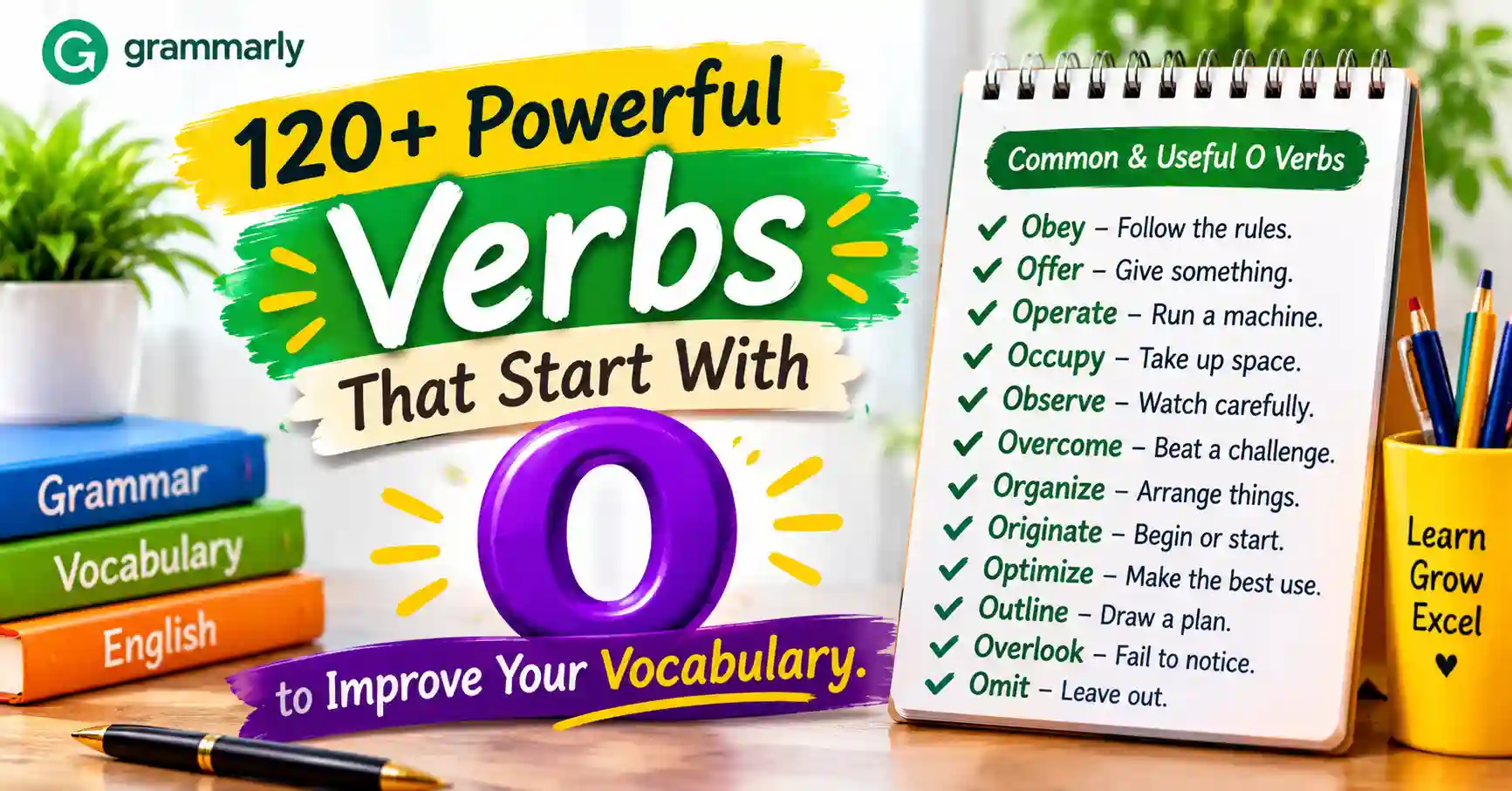
Open a door. Offer a hand. Overcome a fear. Each phrase starts with an O verb, and each one shows how much power a single letter can hold. This guide to verbs that start with O gives you 154 real verbs, with clear meanings, forms, and examples.
O is a rich letter for verbs. It gives us everyday words like open, own, and order. It also gives us two big word families, built with out- and over-. You will meet them all here, sorted by theme, length, and type.
Here is what you will learn:
- what verbs do in a sentence
- a complete O verbs list, sorted by meaning, length, and type
- how to build every tense and spell each form
- how the prefixes out- and over- work
- fun facts, memory tricks, and a short quiz
Strong verbs make your writing clear. They also make your speech confident. Let’s begin.
What Are Verbs?
Verbs are the engine of every sentence. They tell the reader what someone does, what happens, or what something is. Without a verb, a sentence has no motion and no meaning. This section defines verbs in plain words, shows five O examples, and explains why a wide verb vocabulary helps you.
A Simple Definition of a Verb
A verb is a word that shows action, a state, or an event. Look for the word that answers one question: what is the subject doing or being? That word is the verb. Read these five sentences, each with an O verb in bold. Notice how each verb carries the main meaning.
- She opens the shop at nine.
- The company offers free training.
- We observe the stars each night.
- He overcame his fear of water.
- They own a small farm.
Action, State, and Helping Verbs
English verbs do three broad jobs. Action verbs show what someone does. State verbs show what someone owns, feels, or is. Helping verbs support another verb to show time or mood. O verbs fill the first two jobs well, and one O verb acts as a modal.
- Action verbs: open, outrun, and overturn show physical action. Example: She outran the storm.
- State verbs: own and owe show a state. Example: We owe them thanks.
- Helping verbs: ought works as a modal helper. Example: You ought to rest.
Why a Rich Verb Vocabulary Matters
Verbs carry the energy of a sentence. A weak verb needs extra words to do its job. A precise verb does the job alone. Building your list of O verbs gives you sharper choices when you write, speak, and read.
Compare She did better than her rival with She outperformed her rival. The second sentence is shorter and clearer. Precise verbs also help you understand what you read. Learn one new verb a day, and your range grows fast.
Complete List of Verbs That Start With O
This is your full guide to verbs that start with O. The lists below group every verb by meaning and use. The first table gives forty common verbs with a meaning and an example. The later lists sort the wider set by theme, so you can find the right word fast.
Common Verbs Starting With O
Start here. This table lists forty of the most useful O verbs in alphabetical order. Each row gives a short meaning and an example sentence. Most words are everyday words, so reading the table once gives you a strong base. Then explore the themed lists that follow.
| Verb | Meaning | Example |
| obey | to follow an order or rule | Dogs obey simple commands. |
| object | to say you disagree | I object to that plan. |
| oblige | to require, or to do a favor | The law obliges drivers to stop. |
| observe | to watch carefully, or to follow a rule | Scientists observe the stars. |
| obtain | to get | You can obtain a permit online. |
| occupy | to fill or take up | Fans occupied every seat. |
| occur | to happen | Accidents occur on wet roads. |
| offend | to upset or insult | His words offended her. |
| offer | to present for acceptance | She offered me a seat. |
| oil | to put oil on | He oiled the hinges. |
| omit | to leave out | Do not omit the date. |
| open | to unfasten or begin | Open the window. |
| operate | to work or run | The shop operates daily. |
| oppose | to act against | Many voters oppose the plan. |
| opt | to choose | They opted for a quiet dinner. |
| orbit | to travel around a body in space | The moon orbits Earth. |
| order | to command or request | We ordered two coffees. |
| organize | to arrange in a clear way | She organized the files. |
| originate | to begin or come from | The custom originated in Spain. |
| oust | to force out | Voters ousted the mayor. |
| outdo | to do better than | He tried to outdo his brother. |
| outgrow | to grow too big for | Kids outgrow shoes fast. |
| outline | to sum up the main points | Outline your essay first. |
| outperform | to do better than | The new model outperforms the old one. |
| outrun | to run faster than | She outran her rivals. |
| outsmart | to beat by cleverness | The fox outsmarted the dog. |
| outweigh | to be greater in value than | The benefits outweigh the costs. |
| overcome | to beat a problem | She overcame her fear. |
| overhear | to hear by chance | I overheard their plan. |
| overlook | to miss or ignore | Don’t overlook small errors. |
| overpower | to defeat by force | The smell overpowered us. |
| override | to cancel or set aside | The boss overrode the decision. |
| oversee | to supervise | A manager oversees the team. |
| oversleep | to sleep too long | I overslept this morning. |
| overtake | to pass or catch up | The truck overtook us. |
| overturn | to flip or cancel | The court overturned the ruling. |
| overwhelm | to overpower with emotion or size | The news overwhelmed her. |
| overwork | to work too hard | Don’t overwork your staff. |
| owe | to have to pay or give | I owe you lunch. |
| own | to possess | They own a small farm. |
Learn open, own, order, offer, obtain, occur, organize, observe, oppose, and overcome first. These ten cover most daily use.
Action Verbs (Physical Actions)
Action verbs show movement you can see or hear. O has a strong set of them. Some involve doors, oil, and engines, and others involve speed and force. This list gathers the physical ones, so you can pick a vivid verb for any scene.
oil, open, orbit, oscillate, outrun, overfill, overheat, overturn
Use these verbs in stories and instructions. They make each step easy to picture.
Verbs of Communication
People use verbs to speak, write, request, and explain. O has a lively group for this job. Some are plain, some are formal, and some hide the meaning on purpose. This list shows the words that carry a message, so you can choose the right tone.
obfuscate, object, offer, okay, omit, opine, orate, order, outline, overstate
Choose outline for a clear summary and obfuscate for the opposite. The two words sit at opposite ends of clarity.
Verbs of Thinking and Emotion
Some verbs live inside the mind and heart. They show what we notice, judge, and feel. O offers a useful list here. Each verb below covers a thought or feeling, from calm watching to strong emotion, and each one works well in everyday sentences.
obsess, observe, oppose, outthink, overestimate, overrate, overreact, overvalue, overwhelm
Example: She overestimated the cost, then overreacted to the bill.
Verbs of Movement
Movement verbs describe how people and things travel, swing, or flow. O has many of them, from slow oozing to fast passing. Each verb below paints a clear picture of motion, so you can match it to the pace and mood of your scene.
ooze, orbit, oscillate, outpace, outrun, overflow, overshoot, overstep, overtake
Example: The river overflowed, and the water oozed across the road.
Verbs for Work, School, and Daily Life
Daily life runs on verbs. You order supplies, organize files, and oversee a project. This list covers O verbs for the office, the classroom, and the home. Each word is practical, and most have simple meanings you can use today.
obtain, occupy, offer, onboard, operate, order, organize, outline, outsource, overhaul, oversee
Example: She organized the files, ordered new supplies, and onboarded two interns.
Positive Verbs
Positive verbs lift a sentence. They show skill, growth, and success. O gives you many strong choices. Use them in cards, speeches, and reviews when you want your tone to feel confident and encouraging. Here are the most uplifting O verbs.
offer, open, optimize, orchestrate, organize, outdo, outperform, outshine, outsmart, overcome
Example: Hard work helps you outperform your goals and overcome obstacles.
Negative Verbs
Negative verbs describe harm, pressure, and loss. O has several strong ones. They carry heavy meanings, so use them with care and in the right context. Writers often choose them for news reports, history, and dramatic stories. This list names the main ones.
obliterate, obstruct, offend, oppress, ostracize, outrage, overburden, overcharge, overwhelm, overwork
Use these words with precision. A clear negative verb is stronger than a long, vague phrase.
Uncommon or Advanced Verbs
Some O verbs are rare. You will meet them in law, science, medicine, and formal writing. They sharpen your writing, and they please crossword fans. Learn them after you master the common list. Each word below is a real verb found in standard dictionaries.
obfuscate, obtrude, obviate, occlude, operationalize, ossify, ostracize, outmaneuver, ovulate, oxygenate
Pick two or three of these each week and try them in your own sentences.
Simple Verbs for Beginners and Kids
New learners need short, clear words. These O verbs are easy to say, easy to spell, and easy to act out. Kids can mime each one. Start with this list, and build up from there. Say each sentence aloud, and add a motion.
- obey: Dogs obey their owners.
- offer: I offer you a snack.
- oil: Dad will oil the door.
- okay: Mom will okay the trip.
- ooze: Mud can ooze between toes.
- open: Open the box.
- order: I order a juice.
- own: I own a red kite.
Verbs by Word Length
Word length is a handy way to study spelling and play word games. This section sorts verbs that start with O by letter count. Short O verbs are rare, because most O verbs come from Latin or use the prefixes out- and over-. Use these lists for Scrabble, Wordle, and spelling practice.
3-Letter Verbs Starting With O
Three-letter O verbs are very short. English has just four in standard use, so you can learn them in a minute. Each one is a common word with several meanings, and each one is easy to spell. Here they are, with a quick example.
- oil: Oil the chain.
- opt: Opt for the early train.
- owe: I owe you a call.
- own: They own the shop.
4-Letter Verbs Starting With O
Four-letter O verbs are few, but they are very useful. English has seven in standard use. They include some of the most common O words, and they are perfect for beginners and for quick word games. Learn them first.
obey, ogle, okay, omit, ooze, open, oust
5-Letter Verbs Starting With O
Five-letter verbs are popular in word puzzles. O gives you eight of them. Several are very common, such as offer, order, and occur. Study the list below, and say each word aloud to fix the sound and the spelling together.
occur, offer, opine, orate, orbit, order, ought, outdo
6-Letter Verbs Starting With O
Six-letter verbs mix everyday words with a few rare ones. You will use object, obtain, occupy, and oppose often. Words like ossify and orphan have unusual meanings. Here are nineteen six-letter O verbs to practice.
object, oblige, obsess, obtain, occupy, offend, offset, oppose, ordain, orient, orphan, ossify, outbid, outfit, outfox, outlaw, outrun, outwit, overdo
7+ Letter Verbs Starting With O
Longer O verbs make up most of the letter. Many begin with out- or over-, and many end in -ate or -ize. They are common in school, business, and formal writing. This list holds 116 verbs from seven to fourteen letters. Learn them in small groups.
obfuscate, objectify, obligate, obliterate, obscure, observe, obstruct, obtrude, obviate, occasion, occlude, officiate, offload, onboard, operate, operationalize, oppress, optimize, orchestrate, organize, orientate, originate, ornament, oscillate, ostracize, outclass, outdistance, outflank, outgrow, outlast, outline, outlive, outmaneuver, outmatch, outnumber, outpace, outperform, outplay, outpour, outrage, outrank, outreach, outride, outscore, outsell, outshine, outsmart, outsource, outstay, outstrip, outthink, outvote, outwear, outweigh, outwork, overact, overbook, overburden, overcharge, overcome, overcook, overcrowd, overdose, overdraw, overdress, overeat, overestimate, overfeed, overfill, overflow, overgrow, overhaul, overhear, overheat, overindulge, overlap, overlay, overload, overlook, overpay, overplay, overpower, overprice, overprotect, overrate, overreach, overreact, override, overrule, overrun, oversee, oversell, overshadow, overshoot, oversleep, overspend, overspill, overstate, overstay, overstep, overstock, overstretch, overtake, overtax, overthrow, overtire, overturn, overuse, overvalue, overwhelm, overwinter, overwork, overwrite, ovulate, oxidize, oxygenate
The longest verb here is operationalize, with fourteen letters. Next come overestimate and overindulge.
Verbs by Type
Grammar groups verbs by how they behave. Some verbs take an object, some do not, and some change form in odd ways. This section sorts O verbs into six useful types. Knowing the type helps you build correct sentences and avoid common errors.
Action and Stative Verbs
Action verbs describe things people do. Stative verbs describe conditions, such as owning or owing. Stative verbs rarely appear in the continuous form. This split explains why I own a car is natural, and I am owning a car sounds odd in careful writing.
- Action: obey, open, operate, outrun, overtake, overturn
- Stative: owe, own
Transitive and Intransitive Verbs
A transitive verb needs an object. An intransitive verb does not. Some verbs can do both. Check the word after the verb: if you can ask “what?” or “whom?”, the verb is transitive. This table sorts the O verbs.
| Type | O verbs |
| Transitive | obtain, occupy, offend, omit, oppress, outdo, oversee, owe, own |
| Intransitive | occur, ooze, oscillate, overeat, overreact, oversleep |
| Both | open, operate, orbit, overflow |
Example: She opened the door (transitive). The shop opens at nine (intransitive).
Regular and Irregular Verbs
Regular verbs add -ed for the past tense. Irregular verbs change in other ways. Most O verbs are regular. Almost all the irregular ones are compounds built on out- or over-, such as outdo and overcome. They follow the pattern of their base verbs.
- Irregular: outbid, outdo, outgrow, overcome, overhear, override, oversee, overtake
- Regular: all other O verbs, such as open, own, and order
Auxiliary (Helping) and Modal Verbs
Auxiliary verbs help main verbs show tense and mood. Modal verbs, such as can and must, show ability or duty. Only one O word does this job: ought. It gives advice or states a duty, and it always takes to before the main verb.
Example: You ought to rest. Here, ought is the modal, and rest is the main verb. The negative form is ought not to.
Linking Verbs
Linking verbs connect a subject to a description. They do not show action. The word after them describes the subject. No standard linking verb begins with O. Common linking verbs, such as be, seem, and become, take their place.
- Example: The room seems quiet. (Seem links, but it does not start with O.)
Phrasal Verbs With O
A phrasal verb joins a verb with a small word, such as up or out, to make a new meaning. English speakers use them constantly. O has fewer of them than many letters, but the few it has are common. Learn each one as a single unit.
| Phrasal verb | Meaning | Example |
| open out | spread wider | The path opens out into a field. |
| open up | become more honest, or unlock | He finally opened up to us. |
| opt for | choose | She opted for tea. |
| opt in | choose to take part | Opt in to the newsletter. |
| opt out | choose not to take part | You can opt out at any time. |
| order around | give orders to | Don’t order me around. |
| order in | have food delivered | We ordered in pizza. |
| own up | admit | He owned up to the mistake. |
Treat each phrasal verb as one word. Learn a few at a time, and use them in short sentences.
Verb Forms and Tenses
Every verb has five forms: base, past simple, past participle, present participle, and third-person singular. Once you know them, you can build any tense. This section shows the forms in a table, lists the irregular verbs, explains spelling rules, and gives tense examples.
Verb Forms Table
This table shows the five forms of twenty-two O verbs. Read across each row. Regular verbs follow a clear pattern, so scan for the exceptions. Notice the doubled consonants in omitted and occurred. Those changes follow the spelling rules covered below.
| Base | Past simple | Past participle | Present participle | Third-person singular |
| obey | obeyed | obeyed | obeying | obeys |
| observe | observed | observed | observing | observes |
| occupy | occupied | occupied | occupying | occupies |
| occur | occurred | occurred | occurring | occurs |
| offer | offered | offered | offering | offers |
| ogle | ogled | ogled | ogling | ogles |
| oil | oiled | oiled | oiling | oils |
| omit | omitted | omitted | omitting | omits |
| ooze | oozed | oozed | oozing | oozes |
| open | opened | opened | opening | opens |
| oppose | opposed | opposed | opposing | opposes |
| orbit | orbited | orbited | orbiting | orbits |
| order | ordered | ordered | ordering | orders |
| organize | organized | organized | organizing | organizes |
| outdo | outdid | outdone | outdoing | outdoes |
| outrun | outran | outrun | outrunning | outruns |
| overcome | overcame | overcome | overcoming | overcomes |
| overlook | overlooked | overlooked | overlooking | overlooks |
| oversee | oversaw | overseen | overseeing | oversees |
| overtake | overtook | overtaken | overtaking | overtakes |
| owe | owed | owed | owing | owes |
| own | owned | owned | owning | owns |
For regular verbs, add -ed for both past forms. Check the table whenever a dropped e or a doubled letter confuses you.
Irregular Verbs Starting With O
Irregular verbs break the -ed rule. O has twenty-seven of them, and every one is a compound of out- or over- with an irregular base verb. Once you know the base verb, you know the pattern. Study the table below, and say each row aloud.
| Base | Past simple | Past participle | Present participle | Third-person singular |
| outbid | outbid | outbid | outbidding | outbids |
| outdo | outdid | outdone | outdoing | outdoes |
| outgrow | outgrew | outgrown | outgrowing | outgrows |
| outride | outrode | outridden | outriding | outrides |
| outrun | outran | outrun | outrunning | outruns |
| outsell | outsold | outsold | outselling | outsells |
| outshine | outshone | outshone | outshining | outshines |
| outthink | outthought | outthought | outthinking | outthinks |
| outwear | outwore | outworn | outwearing | outwears |
| overcome | overcame | overcome | overcoming | overcomes |
| overdo | overdid | overdone | overdoing | overdoes |
| overdraw | overdrew | overdrawn | overdrawing | overdraws |
| overeat | overate | overeaten | overeating | overeats |
| overfeed | overfed | overfed | overfeeding | overfeeds |
| overgrow | overgrew | overgrown | overgrowing | overgrows |
| overhear | overheard | overheard | overhearing | overhears |
| overlay | overlaid | overlaid | overlaying | overlays |
| overpay | overpaid | overpaid | overpaying | overpays |
| override | overrode | overridden | overriding | overrides |
| overrun | overran | overrun | overrunning | overruns |
| oversee | oversaw | overseen | overseeing | oversees |
| oversell | oversold | oversold | overselling | oversells |
| overshoot | overshot | overshot | overshooting | overshoots |
| oversleep | overslept | overslept | oversleeping | oversleeps |
| overspend | overspent | overspent | overspending | overspends |
| overtake | overtook | overtaken | overtaking | overtakes |
| overthrow | overthrew | overthrown | overthrowing | overthrows |
If you forget a form, look up the base verb. Overtake follows take, and oversee follows see.
Spelling Rules for -ing, -ed, and -s
Spelling changes follow a few simple rules. Drop a silent e before -ing and -ed. Double a final consonant when the last syllable is stressed. Change y to ied after a consonant. Add -es after hissing sounds. The table gives each rule with O examples.
| Rule | Example | Result |
| Drop the silent e | observe, oppose, organize, owe, ooze, ogle | observing, opposing, organizing, owing, oozing, ogling |
| Double the final consonant when the last syllable is stressed | omit, occur, outbid, outrun, overlap, offset | omitted, occurred, outbidding, outrunning, overlapped, offsetting |
| Do not double when stress falls earlier | offer, open, orbit, order | offered, opened, orbited, ordered |
| Change y to ied after a consonant | occupy | occupied, occupies |
| Keep y after a vowel | obey, overstay | obeyed, overstayed |
| Add -es after s, sh, ch, x, z | outclass, overdress, overreach | outclasses, overdresses, overreaches |
Note that occur and omit double their last letter, but offer and open do not. Stress decides the spelling.
Verb Tenses Explained
Tenses show when an action happens. Each tense has a simple form and a perfect form. The simple forms state facts and habits. The perfect forms link two points in time. Read the two examples for each tense below, and notice how the verb changes.
- Present simple: She opens the shop daily. They own two cars.
- Past simple: He overslept again. We observed the eclipse.
- Future simple: I will organize the files. She will oversee the project.
- Present perfect: They have outgrown the house. I have overcome my fear.
- Past perfect: He had overheard the plan. We had ordered before they arrived.
- Future perfect: By May, I will have opened three shops. By noon, she will have overseen the move.
Spelling Patterns and Prefixes for the Letter O
O has two famous prefixes, out- and over-, and they build almost two-thirds of its verbs. It also has a Latin prefix that changes shape. This section shows the main patterns, explains the suffixes that build O verbs, and covers tricky spellings and sounds so you can read and say each word with confidence.
Common Prefixes and Letter Combinations
The prefix out- means to do better than, or to go beyond. The prefix over- means too much, above, or across. A third pattern comes from Latin ob-, which changes to oc-, of-, or op- before some letters. Study each group below.
| Prefix | Meaning | Example verbs |
| out- | to surpass or go beyond | outbid, outdo, outgrow, outlast, outlaw, outline, outlive, outnumber, outperform, outrun, outsell, outshine, outsmart, outsource, outwit, outwork |
| over- | too much, above, or across | overbook, overcharge, overcome, overcook, overcrowd, overdo, overeat, overflow, overhaul, overhear, overlook, overpay, override, oversee, overtake, overturn, overwhelm, overwork |
| ob- | toward or against | obey, obfuscate, object, oblige, obliterate, obscure, observe, obsess, obstruct, obtain, obviate |
| oc- | toward or against | occasion, occlude, occupy, occur |
| of- | toward or against | offend, offer, officiate, offload, offset |
| op- | toward or against | operate, opine, oppose, oppress, optimize |
Note that out- verbs usually mean winning or beating, as in outrun and outsmart. Note also that over- verbs usually mean excess, as in overwork and overeat.
Common Verb Suffixes
Suffixes such as -ize, -ify, -ate, and -en turn other words into verbs. O uses the first three often, which is why so many longer O verbs end the same way. Study the groups below, and notice how each ending shapes the meaning of the root word.
- -ize (to make or become): operationalize, optimize, organize, ostracize, oxidize
- -ify (to make or cause): objectify, ossify
- -ate (to act or cause): obfuscate, obligate, obliterate, obviate, officiate, operate, orate, orchestrate, orientate, originate, oscillate, overestimate, overrate, overstate, ovulate, oxygenate
- -en: no common O verbs use this ending
The -ate ending is the most common in O verbs. It often comes straight from a Latin verb form.
Tricky Spellings, Silent Letters, and Pronunciation
Some O verbs hide silent letters or odd sounds. The spelling often keeps an old form, even when speech has changed. The notes below show how to say and spell the trickiest words, so you can avoid errors when you speak and write.
- ought: says AWT. The gh is silent.
- obey: says oh-BAY.
- okay: says oh-KAY.
- ogle: says OH-gul.
- ooze: says OOZ, with a long oo sound.
- occur: says uh-KUR. Spell it with two c’s, and double the r in occurred and occurring.
- occasion: says uh-KAY-zhun. It has two c’s and one s.
- officiate: says uh-FISH-ee-ayt.
- oscillate: says OSS-ih-layt.
- ostracize: says OSS-truh-size.
- orchestrate: says OR-kuh-strayt.
- omit: has one m, but omitted and omitting have two.
How to Use These Verbs Correctly
Knowing a verb list is only half the skill. You also need to use each verb correctly. This section covers agreement, tense choice, prepositions, common errors, and confusing word pairs. Each part gives clear examples, so you can fix mistakes in your own writing and speak with more confidence.
Subject-Verb Agreement
A verb must match its subject. A singular subject takes a singular verb, and a plural subject takes a plural verb. In the present tense, the third-person singular form adds -s or -es. Check each example below, and notice which word the verb follows.
- She opens the store at eight.
- The workers oppose the new rule.
- Each of the players obeys the coach.
- The manager and her assistant oversee the launch.
- The team owns the result.
Choosing the Correct Tense
Tense tells the reader when something happens. Choose the tense that matches your time clue. Words like yesterday, now, and tomorrow guide you. Use the simple tense for facts and habits, and use a perfect tense when you link two moments. These five examples show the choice.
- Yesterday, she overslept. (past simple, finished time)
- Right now, they own the building. (present simple, a state)
- Tomorrow, we will open early. (future simple)
- I have overcome many problems. (present perfect, still true)
- They had outgrown the old house before they moved. (past perfect, earlier event)
Verbs Followed by Prepositions
Many verbs need a specific preposition to complete their meaning. Using the wrong one sounds unnatural. Learn each pair as a unit. This table shows eight O verbs with the prepositions that usually follow them, plus an example for each.
| Verb + preposition | Example |
| object to | I object to the rule. |
| occur to | A new idea occurred to me. |
| open to | The park is open to everyone. |
| operate on | The doctor will operate on her knee. |
| opt for | She opted for the blue one. |
| originate from | The word originates from Latin. |
| owe to | We owe our success to the team. |
| own up to | He owned up to the error. |
Common Mistakes and Corrections
Even strong writers slip on O verbs. Most errors come from irregular forms, doubled letters, and modal grammar. The table below shows seven frequent mistakes beside their fixes. Read each pair aloud. Hearing the correct form helps it stick in your memory.
| Mistake | Correction |
| He overtaked the truck. | He overtook the truck. |
| She has overcame many problems. | She has overcome many problems. |
| I oversleeped today. | I overslept today. |
| The kids outgrew their shoes. | The kids outgrew their shoes. |
| You ought to go home. | You ought to go home. |
| The event occurred on Monday. | The event occurred on Monday. |
| The firm offered a deal. | The firm offered a deal. |
Commonly Confused Words
Several O verbs look or sound alike, yet their meanings differ. Writers swap them often, and spellcheck rarely catches the error because both words are real. These pairs cause many mistakes. Study the table, and check the meaning before you choose the word.
| Pair | Difference | Example |
| oversee/overlook | Oversee means to supervise. Overlook means to miss or ignore. | She oversees the team but overlooked one error. |
| observe/obey | Observe means to watch, or to follow a rule. Obey means to do as told. | Observe the speed limit, and obey the officer. |
| oppose/oppress | Oppose means to act against. Oppress means to treat cruelly. | Citizens oppose any ruler who oppresses them. |
| overdo / overdose | Overdo means to do too much. Overdose means to take too much of a drug. | Don’t overdo the salt. |
| override/overrule | Override means to cancel by using power over something. Overrule means to reject a decision by authority. | The judge overruled the claim, and the senate overrode the veto. |
| own / owe | Own means to possess. Owe means to be bound to pay or give. | I own the car, but I owe the bank money. |
Synonyms and Antonyms
Synonyms give you choices, and antonyms show contrast. Both help you avoid repeating the same word. This table lists fifteen O verbs with common synonyms and antonyms. Use it to pick a word that fits your meaning and to build contrast in your sentences.
| Verb | Synonyms | Antonyms |
| obey | follow, comply | defy, disobey |
| obscure | hide, cloud | reveal, clarify |
| observe | watch, notice | ignore, overlook |
| obtain | get, gain | lose, forfeit |
| offer | propose, present | withdraw, refuse |
| omit | skip, leave out | include, add |
| open | unlock, unfold | close, shut |
| operate | run, work | stop, halt |
| oppose | resist, contest | support, back |
| organize | arrange, sort | scatter, muddle |
| outdo | surpass, beat | trail, lag behind |
| overcome | conquer, defeat | surrender, yield |
| overlook | miss, ignore | notice, spot |
| overstate | exaggerate, inflate | understate, downplay |
| own | possess, hold | lack, lose |
Choose a verb by tone, strength, and context. Oppose is neutral, while resist sounds more active. Obtain sounds formal, while get sounds casual. Outdo is friendly, while crush is harsh. This table shows that verbs that start with O offer real range, from gentle to strong.
Practical Use Cases
Verbs earn their keep in real writing. This section shows how O verbs work in six settings, from essays to word games. Each part offers a short note and sample sentences. Copy the patterns, then swap in your own topic. You will see how verbs that start with O can sharpen almost any text.
Essays and Academic Writing
Academic writing needs clear, exact verbs. O verbs help you describe evidence, weigh ideas, and show cause. Use observe for findings, outweigh for comparisons, and oppose for counterarguments. Keep sentences short, and let the verb carry the claim. These examples show the style.
- The authors observe a clear pattern in the data.
- In this case, the benefits outweigh the risks.
- Some critics oppose the theory on cost grounds.
Storytelling and Creative Writing
Fiction thrives on vivid verbs. A strong verb paints the scene without extra words. O gives you slow flow, spinning motion, and secret sound. Ooze adds texture, orbit adds scale, and overhear adds suspense. Choose the verb that lets the reader see and feel the moment.
- Smoke oozed from the cracks in the wall.
- The moon orbited above the silent town.
- She overheard a whisper behind the door.
Resumes and Professional Writing
Resumes reward strong, specific verbs. Start each bullet with a past-tense action verb, and follow it with a clear result. O offers many leadership and business verbs that stand out. Match each verb to a true achievement. These lines are samples only.
- Organized a team of eight for a product launch.
- Optimized the weekly reporting workflow.
- Oversaw a project from start to finish.
- Orchestrated a company-wide training program.
- Outperformed quarterly sales targets.
Social Media Captions
Captions need short, punchy verbs. O verbs fit well because many are brief and bold. Pair a verb with an image or a goal, and keep the line under ten words. These examples work for travel, fitness, study, and daily motivation posts.
- Open your mind. Open your day.
- Overcome one fear today.
- Own your story.
Everyday Conversation
Daily talk is full of O verbs. We open doors, order food, and owe favors. Many fixed phrases use them, so learning the verbs also teaches you natural speech. Say these sentences aloud to practice rhythm and tone.
- Okay, let’s go.
- Open the door, please.
- I owe you one.
Word Games (Scrabble, Wordle, Crosswords)
Word games reward a good vocabulary. O is worth one point in English Scrabble, but it is one of the most common tiles. Many O verbs also fit five-letter puzzles. Learn the common prefixes, and you will spot answers faster. Here are some quick tips.
- Seven-letter verbs such as observe, operate, and outline can earn the 50-point bonus for using all seven tiles.
- Try occur, offer, orbit, or order when a five-letter puzzle clue points to an O start.
- Ooze has a double O, so it fits tight crossword grids.
Fun Facts and Learning Tips
Learning sticks when it feels fun. This section shares surprising facts about the letter O and its verbs, gives memory tricks that work, explores where six words came from, and offers daily habits you can start today. It ends with a short quiz and a full answer key. Use these tools to lock in everything you learned about verbs that start with O.
Fun Facts About the Letter O and Its Verbs
O has a rich history for such a round letter. It began as a picture, split into two Greek letters, and grew into two big verb families. Its verbs hide stories about the law, the sea, and the eye. These eight facts show how much a single letter can carry.
- O began as an eye. The Phoenician letter ayin meant eye, and its shape was a simple circle. The Greeks later split the sound into omicron, meaning small o, and omega, meaning big o.
- O is a top-five letter. In English text, only E, T, and A appear more often. That helps explain why O verbs fill so many dictionary pages.
- Okay is a verb too. The word first appeared in print in 1839 in a Boston newspaper. People now use okay as a verb meaning to approve, as in: The manager okayed the plan.
- Own, owe, and ought are relatives. All three trace back to the Old English word āgan, meaning to possess. Ought began as the past tense of owe.
- Out- builds beating verbs. This guide lists 37 verbs with out-, and most mean to do better than someone or something. Think of outrun, outsmart, and outperform.
- Over- is even bigger. This guide lists 59 verbs with over-. They usually mean too much, as in overwork, or above, as in oversee.
- Ogle is an eye word. It probably came from Low German, and it relates to the word for eye. That links it back to the first O, which began as an eye.
- Irregular O verbs are borrowed patterns. All 27 irregular O verbs in this guide are compounds. Each one copies the pattern of a shorter verb, such as take in overtake.
Memory Tricks and Mnemonics
Mnemonics turn tricky spellings and forms into easy pictures. Try one or two of these tricks, and invent your own. The best memory tool is a silly image that you can see in your mind. Each trick below uses a real O verb from this guide.
- Out- wins, over- goes too far. Outrun means to beat in a race. Overrun means to go past the limit. Picture a runner winning, then a runner flying past the finish line.
- Occur has two c’s and two r’s in -ed. Say it as a chant: oc-cur-red. The double c and the double r both show up.
- Omit has one m; omitted has two. Picture the word growing a second m when it gets longer.
- See the project, oversee it. Oversee means to look over a job, so you manage it. Overlook means to look past it, so you miss it.
- Ought rhymes with thought. The gh is silent in both words, and both end in -ought.
- Own is mine, owe is yours. You own what you have. You owe what you must give.
Word Origins and History
Words carry history. Each verb below traveled through languages and time before it reached modern English. Seeing the path helps you remember the meaning and the spelling. These six verbs show how meanings shift, narrow, and grow, based on standard etymology sources.
- ostracize: From Greek ostrakon, a piece of broken pottery. Athenians scratched names on pottery pieces to vote someone into exile. Today it means to shut someone out of a group.
- overwhelm: Built from over and the old verb whelm, which meant to turn upside down. It first described a boat that capsized. Today it describes any strong force or feeling.
- orient: From Latin oriens, meaning rising, and so the east. To orient first meant to face east. Today it means to set a direction or to adjust to a new place.
- orbit: From Latin orbita, meaning a wheel track, from orbis, a circle. It now describes the path of a body around another body in space.
- obey: From Latin oboedire, built from ob and audire, meaning to hear. The idea is to listen and then act on what you hear.
- oust: From Anglo-French ouster, a legal word meaning to remove someone from property. Today it means to force anyone out of a position.
Daily Practice Tips
Small habits beat long, rare study sessions. Ten minutes a day builds more skill than one long weekend session. Pick two or three habits below and stick with them for a month. Track your progress in a notebook, and celebrate each new verb you use.
- Read a little every day. Read news, stories, or recipes, and circle every O verb. Seeing a word in context teaches you its meaning and use.
- Keep a verb journal. Write one sentence a day that uses an O verb. Short entries add up fast. After a month, you will own thirty fresh sentences.
- Use flashcards. Write the verb on one side and its forms on the other. Review ten cards each morning. Mix in the irregular verbs to master them.
- Speak aloud. Say each example sentence out loud. Your mouth learns tricky words, like ought and occur, faster than your eyes do.
- Study the prefixes. Learn one out- verb and one over- verb each day. When you know the prefix, you can guess new words.
- Play word games. Try Scrabble, crosswords, or Wordle. Games make review feel like play, and they train your spelling.
Mini Practice Quiz
Test yourself with ten short questions. They cover forms, tenses, verb types, and meanings. Write your answers on paper before you check the key. Do not worry about mistakes. Each wrong answer shows you what to review, so reread the matching section afterward.
- Choose the correct tense: She (has overcome/has overcome) many problems.
- Fill in the blank: He ___ (oversleep) yesterday.
- What is the past simple of outgrow?
- Which verb is irregular: obey, offer, or override?
- Match the meaning: obfuscate means (to make unclear / to make clear / to make longer).
- Add -ed to occur.
- Which word is a modal verb: ought, own, or owe?
- Fill in the blank: The manager will ___ the project. (oversee/overlook)
- What does out- usually mean in outrun?
- Is own transitive or intransitive?
Answer key: 1. has overcome. 2. overslept. 3. outgrew. 4. override. 5. to make unclear. 6. occurred. 7. ought. 8. oversee. 9. to do better than, or go beyond. 10. transitive.
FAQs
These questions come from real search habits. Learners, parents, teachers, and writers ask them often. Each answer is short and direct. Use the answers as a quick reference, or return to the earlier sections for more detail on any O verb that interests you.
What are some action verbs that start with O? Action verbs that start with O include open, oil, orbit, outrun, overtake, overturn, overheat, and oscillate. Each one shows a physical action you can see. You open a door, oil a hinge, and outrun a rival. Use these words to make your writing lively and clear.
How many verbs start with O? This guide lists 154 real verbs that start with O, from common words like open and own to rare words like occlude and ossify. Dictionaries list more, especially compounds built with out- and over-. O is a productive letter, so you will always find fresh choices.
What are strong verbs that start with O for a resume? Strong O verbs for a resume include organized, optimized, oversaw, orchestrated, outperformed, operationalized, onboarded, and overhauled. “Oversaw a project” shows leadership. “Optimized a workflow” shows efficiency. “Outperformed targets” shows results. Pair each verb with a clear outcome, such as a goal, a deadline, or a number you can prove.
What is the longest verb that starts with O? In this guide, operationalize is the longest O verb, with fourteen letters. Overestimate follows with twelve letters, and overindulge has eleven. Technical or variant forms may be longer, but they are rare. For word games, remember that most everyday O verbs have four to eight letters. Check your game’s word list before you play a rare verb.
Which O verbs are irregular? Twenty-seven O verbs in this guide are irregular, and all are compounds. Examples include outdo (outdid, outdone), outgrow (outgrew, outgrown), overcome (overcame, overcome), oversee (oversaw, overseen), and overtake (overtook, overtaken). Each copies the pattern of its base verb. Learn the base verb, and you can build every form.
What do out- and over- mean in verbs? The prefix out- usually means to do better than or go beyond, as in outrun and outsmart. The prefix over- usually means too much, above, or across, as in overwork, oversee, and overturn. Knowing these two prefixes helps you guess the meaning of many new O verbs, even if you have never seen them before.
What are some positive verbs that start with O? Positive O verbs include offer, open, optimize, orchestrate, organize, outperform, outshine, and overcome. You can offer help, open a door, or overcome a challenge. These words show skill, growth, and success. Use them in cards, reviews, and speeches to give your message a confident tone.
What are good O verbs for kids? Kids can start with obey, offer, oil, okay, open, order, and own. These words are short and easy to act out. A child can open a box, oil a squeaky hinge, and order a snack in a play shop. Acting out each verb helps young learners remember its meaning.
Conclusion
Verbs that start with O give you power, range, and precision. You now know 154 of them, from everyday words like open, own, and order to rare gems like occlude and ossify. You also learned their forms, their types, their tricky spellings, and their stories.
Remember the key ideas. The prefix out- means to do better than, and over- means too much or above. Every irregular O verb is a compound with a familiar base. The word ought is the one modal that starts with O. Precise verbs make your writing stronger.
Now put this O verbs list to work. Pick three new verbs today. Write one sentence for each, and say each one aloud. Repeat tomorrow. In a month, these words will feel like old friends.
