

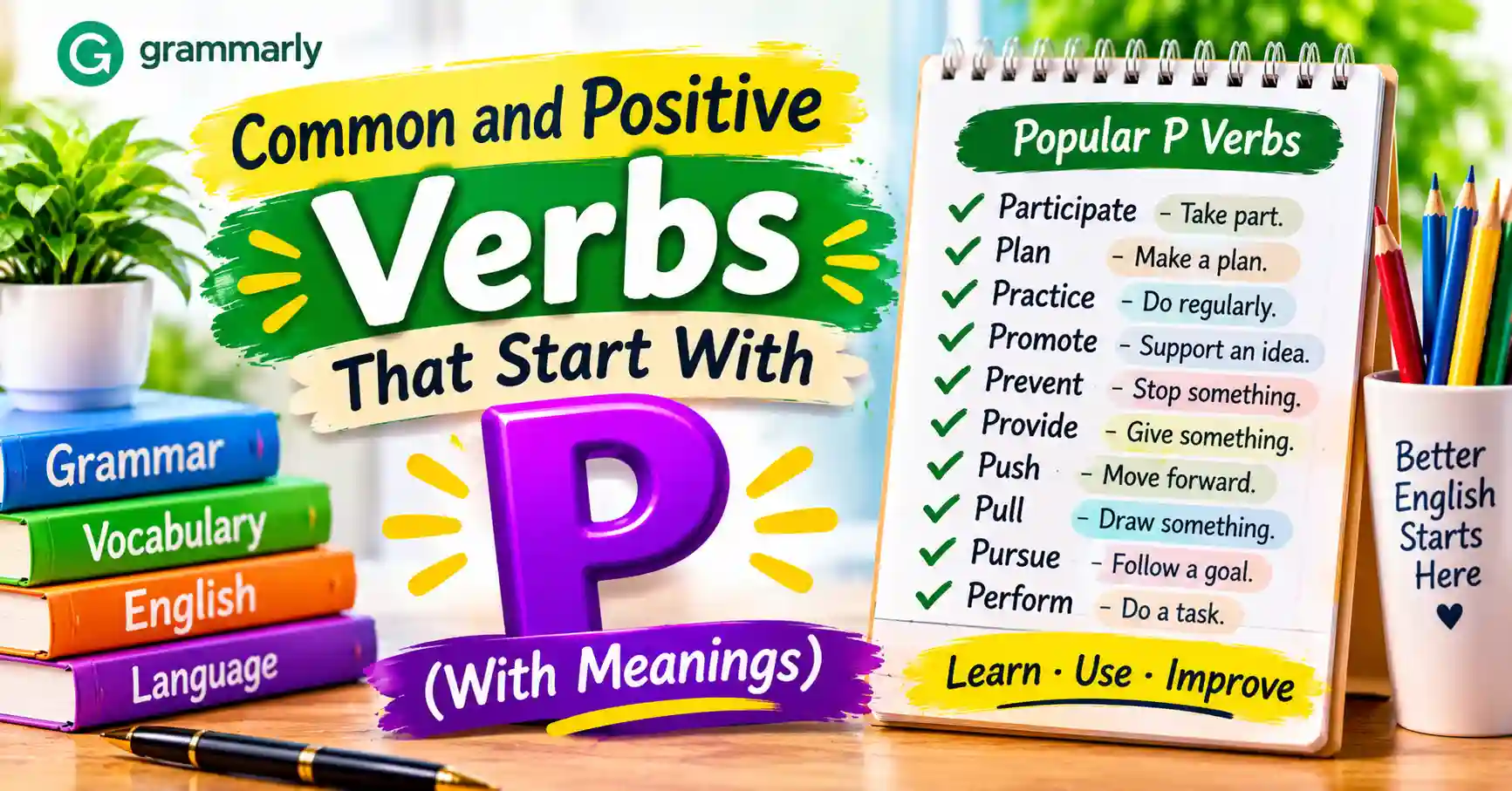
Pick up a pen. Plan your day. Praise a friend. Each phrase starts with a P verb, and each one moves a sentence forward. This guide to verbs that start with P gives you 218 real verbs, with clear meanings, forms, and examples.
P is one of the busiest letters for verbs. It gives us everyday words like play, pay, and put. It also gives us strong, positive words like praise, prosper, and persevere. You will meet them all here, sorted by theme, length, and type.
Here is what you will learn:
- what verbs do in a sentence
- a complete P verbs list, sorted by meaning, length, and type
- how to build every tense and spell each form
- how the prefixes pre-, pro-, and per- work
- fun facts, memory tricks, and a short quiz
Strong verbs make your writing clear. They also make your speech confident. Let’s begin.
What Are Verbs?
Verbs are the engine of every sentence. They tell the reader what someone does, what happens, or what something is. Without a verb, a sentence has no motion and no meaning. This section defines verbs in plain words, shows five P examples, and explains why a wide verb vocabulary helps you.
A Simple Definition of a Verb
A verb is a word that shows action, a state, or an event. Look for the word that answers one question: what is the subject doing or being? That word is the verb. Read these five sentences, each with a P verb in bold. Notice how each verb carries the main meaning.
- She plays the piano every evening.
- The team planned a surprise party.
- We paint the fence each spring.
- He praised his students.
- They protect the forest.
Action, State, and Helping Verbs
English verbs do three broad jobs. Action verbs show what someone does. State verbs show what someone prefers, owns, or is. Helping verbs support another verb to show time or mood. P verbs fill the first two jobs well.
- Action verbs: push, pull, and paint show physical action. Example: She pushed the cart.
- State verbs: prefer and possess show a state. Example: I prefer tea.
- Helping verbs: No standard helping verb starts with P. Words like be, have, and do handle this job.
Why a Rich Verb Vocabulary Matters
Verbs carry the energy of a sentence. A weak verb needs extra words to do its job. A precise verb does the job alone. Building your list of P verbs gives you sharper choices when you write, speak, and read.
Compare: She gave us a talk with She presented the plan. The second sentence is shorter and clearer. Precise verbs also help you understand what you read. Learn one new verb a day, and your range grows fast.
Complete List of Verbs That Start With P
This is your full guide to verbs that start with P. The lists below group every verb by meaning and use. The first table gives forty common verbs with a meaning and an example. The later lists sort the wider set by theme, so you can find the right word fast.
Common Verbs Starting With P
Start here. This table lists forty of the most useful P verbs in alphabetical order. Each row gives a short meaning and an example sentence. Most words are everyday words, so reading the table once gives you a strong base. Then explore the themed lists that follow.
| Verb | Meaning | Example |
| pack | to fill a bag or box | She packed her suitcase. |
| paint | to cover with color | We painted the fence. |
| park | to leave a vehicle | Park near the gate. |
| pass | to go by, or to hand over | Pass the salt, please. |
| pause | to stop for a short time | He paused before he spoke. |
| pay | to give money for something | I paid the bill. |
| perform | to carry out, or to entertain | She performed a solo. |
| permit | to allow | The rules permit pets. |
| persuade | to convince | He persuaded me to join. |
| pick | to choose, or to gather | Pick a card. |
| place | to put in a spot | Place the vase on the table. |
| plan | to decide ahead of time | We planned a picnic. |
| plant | to put in the ground | She planted roses. |
| play | to take part in a game or activity | Kids play outside. |
| please | to make happy | Your gift pleased her. |
| point | to show with a finger | He pointed at the map. |
| post | to publish or mail | She posted a photo. |
| pour | to make liquid flow | Pour the milk slowly. |
| practice | to repeat to improve | I practice piano daily. |
| praise | to say good things about | The coach praised the team. |
| pray | to speak to a higher power | They pray before meals. |
| prefer | to like better | I prefer tea. |
| prepare | to get ready | Prepare for the test. |
| present | to give or show | She presented the award. |
| press | to push firmly | Press the button. |
| pretend | to act as if | The kids pretend to be pirates. |
| prevent | to stop from happening | Seat belts prevent injuries. |
| to produce on paper | Print the form. | |
| produce | to make | The farm produces corn. |
| promise | to give your word | I promise to call. |
| protect | to keep safe | Helmets protect your head. |
| protest | to speak out against | Students protested the change. |
| prove | to show to be true | The test proved her right. |
| provide | to supply | The school provides books. |
| publish | to issue to the public | They published a new book. |
| pull | to draw toward you | Pull the door. |
| punish | to give a penalty | The law punishes theft. |
| purchase | to buy | We purchased a new car. |
| push | to press away | Push the cart. |
| put | to place | Put the keys here. |
Learn put, play, pay, pick, plan, pass, place, point, prepare, and provide first. These ten cover most daily use.
Action Verbs (Physical Actions)
Action verbs show movement you can see or hear. P has a big set of them. Some involve the hands, the feet, or tools, and others involve force and liquid. This list gathers the physical ones, so you can pick a vivid verb for any scene.
pack, paddle, paint, patch, pedal, peel, pick, pinch, plant, pluck, poke, polish, pour, pull, punch, push, put
Use these verbs in stories and instructions. They make each step easy to picture.
Verbs of Communication
People use verbs to speak, write, promise, and persuade. P has a rich group for this job. Some are plain, some are formal, and some carry strong feeling. This list shows the words that carry a message, so you can choose the right tone.
paraphrase, persuade, petition, phone, plead, pledge, praise, predict, present, proclaim, promise, pronounce, propose, protest, publish
Choose promise for a personal vow and pledge for a formal one. Both show commitment, but the tone differs.
Verbs of Thinking and Emotion
Some verbs live inside the mind and heart. They show what we notice, prefer, and feel. P offers a useful list here. Each verb below covers a thought or feeling, from calm pondering to sudden panic, and each one works well in everyday sentences.
panic, perceive, pine, pity, ponder, prefer, presume, puzzle
Example: She pondered the question, then preferred the simpler answer.
Verbs of Movement
Movement verbs describe how people and things travel, jump, or slide. P has many of them, from slow plodding to sudden pouncing. Each verb below paints a clear picture of motion, so you can match it to the pace and mood of your scene.
pace, parade, pass, pedal, pivot, plod, plummet, plunge, pounce, prance, proceed, prowl, pursue
Example: The cat prowled along the fence, then pounced on the toy.
Verbs for Work, School, and Daily Life
Daily life runs on verbs. You pay a bill, plan a trip, and prepare a meal. This list covers P verbs for the office, the classroom, and the home. Each word is practical, and most have simple meanings you can use today.
pack, pay, plan, post, practice, prepare, present, print, process, produce, program, promote, proofread, publish, purchase
Example: She planned the lesson, printed the notes, and presented them on Monday.
Positive Verbs
Positive verbs lift a sentence. They show praise, growth, care, and success. P gives you many warm choices. Use them in cards, speeches, and reviews when you want your tone to feel kind and encouraging. Here are the most uplifting P verbs.
pamper, perfect, persevere, pioneer, please, praise, prevail, prize, progress, promote, prosper, protect, provide
Example: Teams that persevere often prevail, and kind leaders promote growth.
Negative Verbs
Negative verbs describe harm, loss, and blame. P has several strong ones. They carry heavy meanings, so use them with care and in the right context. Writers often choose them for news reports, history, and dramatic stories. This list names the main ones.
perish, persecute, pester, pilfer, pillage, plague, plunder, pollute, procrastinate, punish
Use these words with precision. A clear negative verb is stronger than a long, vague phrase.
Uncommon or Advanced Verbs
Some P verbs are rare. You will meet them in law, science, and formal writing. They sharpen your writing, and they please crossword fans. Learn them after you master the common list. Each word below is a real verb found in standard dictionaries.
perturb, peruse, pervade, philosophize, pluralize, pontificate, precipitate, preclude, predominate, proliferate, proscribe, protract, protrude, purloin
Pick two or three of these each week and try them in your own sentences.
Simple Verbs for Beginners and Kids
New learners need short, clear words. These P verbs are easy to say, easy to spell, and easy to act out. Kids can mime each one. Start with this list, and build up from there. Say each sentence aloud, and add a motion.
- pack: Pack your bag.
- pet: I pet the cat.
- pick: Pick a red ball.
- play: We play in the park.
- pop: Pop the bubble.
- pour: Pour the juice.
- pull: Pull the wagon.
- push: Push the swing.
- put: Put the toy away.
Verbs by Word Length
Word length is a handy way to study spelling and play word games. This section sorts verbs that start with P by letter count. Short P verbs are very common, and longer ones often come from Latin. Use these lists for Scrabble, Wordle, and spelling practice.
3-Letter Verbs Starting With P
Three-letter P verbs are short and sharp. English has eight in standard use, so you can learn them in minutes. Each one is easy to spell, and most have several meanings. Here they are, with a quick example for each.
- pan: Pan the camera slowly.
- pay: Pay the fee.
- pet: Pet the dog gently.
- pin: Pin the note to the board.
- ply: Boats ply the river daily.
- pop: Pop the lid.
- pry: Don’t pry into other people’s lives.
- put: Put it down.
4-Letter Verbs Starting With P
Four-letter verbs form a big group, and they include many of the most common P words. They are perfect for beginners and for quick word games. Learn these thirty-five, and you will cover a large share of everyday P verbs.
pace, pack, page, pair, park, part, pass, peak, peck, peek, peel, peer, perk, pick, pile, pine, pity, plan, play, plod, plot, plug, poke, pore, post, pour, pout, pray, prey, prod, puff, pull, pump, punt, push
5-Letter Verbs Starting With P
Five-letter verbs are popular in word puzzles. P gives you thirty-one of them. Several are very common, such as place, point, and press. Study the list below, and say each word aloud to fix the sound and the spelling together.
paint, panic, parse, paste, patch, pause, pedal, perch, phase, phone, piece, pilot, pinch, pique, pitch, pivot, place, plant, plead, pluck, point, preen, press, print, prize, probe, prove, prowl, psych, punch, purge
6-Letter Verbs Starting With P
Six-letter verbs mix everyday words with a few rare ones. You will use prefer, please, and praise often. Words like pander and peruse have more specific meanings. Here are thirty-nine six-letter P verbs to practice.
pacify, paddle, pamper, pander, parade, pardon, patent, patrol, peddle, pepper, perish, permit, peruse, pester, phrase, picket, picnic, pilfer, plague, please, pledge, plunge, poison, polish, ponder, pounce, praise, prance, preach, prefer, prepay, preset, profit, prompt, propel, punish, purify, pursue, puzzle
7+ Letter Verbs Starting With P
Longer P verbs make up the biggest group. Many begin with pre-, pro-, or per-, and many end in -ate or -ize. They are common in school, business, and formal writing. This list holds 105 verbs from seven to thirteen letters. Learn them in small groups.
package, parachute, paralyze, paraphrase, partake, participate, partner, pasteurize, patronize, penalize, penetrate, perceive, perfect, perform, perfume, permeate, perpetuate, persecute, persevere, persist, personalize, personify, persuade, pertain, perturb, pervade, petition, petrify, philosophize, photocopy, photograph, picture, pillage, pinpoint, pioneer, placate, plaster, plummet, plunder, pluralize, pollute, pontificate, populate, portray, position, possess, postpone, practice, prattle, precede, precipitate, preclude, predict, predominate, preface, preheat, prejudge, preoccupy, prepare, prescribe, present, preserve, preside, pressure, presume, pretend, prevail, prevent, prioritize, privatize, proceed, process, proclaim, procrastinate, procure, produce, profess, program, progress, prohibit, project, proliferate, prolong, promise, promote, pronounce, proofread, propagate, propose, proscribe, prosecute, prosper, protect, protest, protract, protrude, provide, provoke, publicize, publish, pulverize, punctuate, puncture, purchase, purloin
The longest verb here is procrastinate, with thirteen letters. Next comes philosophize, with twelve.
Verbs by Type
Grammar groups verbs by how they behave. Some verbs take an object, some do not, and some change form in odd ways. This section sorts P verbs into six useful types. Knowing the type helps you build correct sentences and avoid common errors.
Action and Stative Verbs
Action verbs describe things people do. Stative verbs describe conditions, such as preferring or possessing. Stative verbs rarely appear in the continuous form. This split explains why I prefer tea is natural and I am preferring tea sounds odd in careful writing.
- Action: pack, paint, pass, pick, pour, pull, push
- Stative: pertain, possess, prefer
Transitive and Intransitive Verbs
A transitive verb needs an object. An intransitive verb does not. Some verbs can do both. Check the word after the verb: if you can ask “what?” or “whom?”, the verb is transitive. This table sorts the P verbs.
| Type | P verbs |
| Transitive | paint, perform, persuade, pick, place, plant, praise, prepare, prevent, produce, punish |
| Intransitive | panic, pause, perish, persist, pout, prevail, prosper, prowl |
| Both | pass, pay, play, point, practice, pull |
Example: She painted the wall (transitive). The crowd panicked (intransitive).
Regular and Irregular Verbs
Regular verbs add -ed for the past tense. Irregular verbs change in other ways. Most P verbs are regular. A small group is irregular, and it includes some of the most common verbs in English, such as pay and put. Learn them well.
- Irregular: partake, pay, plead, prepay, preset, proofread, prove, put
- Regular: all other P verbs, such as play, paint, and push
Auxiliary (Helping) and Modal Verbs
Auxiliary verbs help main verbs show tense and mood. Modal verbs, such as can and must, show ability or duty. No auxiliary or modal verb begins with P. You will use be, have, do, will, and can with P verbs instead.
Example: We will plan the trip. Here, will is the helper, and plan is the main verb.
Linking Verbs
Linking verbs connect a subject to a description. They do not show action. The word after them describes the subject. Among P verbs, prove is the clearest example, and it often appears in phrases about how something turns out.
- prove: The rumor proved false. The plan proved easy.
Phrasal Verbs With P
A phrasal verb joins a verb with a small word, such as up or out, to make a new meaning. English speakers use them constantly. P has many, built mostly on pass, pay, pick, pull, and put. Learn each one as a single unit.
| Phrasal verb | Meaning | Example |
| pass out | faint | He passed out in the heat. |
| pass up | decline an opportunity | Don’t pass up this chance. |
| pay back | return money | I will pay you back on Friday. |
| pay off | succeed, or finish paying | Hard work pays off. |
| pay up | pay what is owed | Pay up before you leave. |
| phase out | end gradually | The firm phased out old models. |
| pick on | treat unfairly | Don’t pick on your brother. |
| pick out | choose | She picked out a red scarf. |
| pick up | lift, collect, or learn | Pick up the toys. |
| pile up | grow in amount | Dishes pile up fast. |
| pitch in | help | Everyone pitched in. |
| play along | pretend to agree | He played along with the joke. |
| play down | make seem less important | She played down the risk. |
| plug in | connect to power | Plug in the lamp. |
| point out | draw attention to | He pointed out the mistake. |
| pop up | appear suddenly | A message popped up. |
| pull over | stop at the roadside | Pull over here. |
| pull through | survive | The patient pulled through. |
| push back | resist or delay | They pushed back the deadline. |
| put away | store | Put away your clothes. |
| put off | delay | Don’t put off the work. |
| put on | wear or switch on | Put on your coat. |
| put out | extinguish | Firefighters put out the fire. |
| put up with | tolerate | I can’t put up with noise. |
Treat each phrasal verb as one word. Learn a few at a time, and use them in short sentences.
Verb Forms and Tenses
Every verb has five forms: base, past simple, past participle, present participle, and third-person singular. Once you know them, you can build any tense. This section shows the forms in a table, lists the irregular verbs, explains spelling rules, and gives tense examples.
Verb Forms Table
This table shows the five forms of twenty-two P verbs. Read across each row. Regular verbs follow a clear pattern, so scan for the exceptions. Notice the doubled consonants in words like planned and preferred. Those changes follow the spelling rules covered below.
| Base | Past simple | Past participle | Present participle | Third-person singular |
| pack | packed | packed | packing | packs |
| partake | partook | partaken | partaking | partakes |
| pass | passed | passed | passing | passes |
| pay | paid | paid | paying | pays |
| pick | picked | picked | picking | picks |
| pity | pitied | pitied | pitying | pities |
| plan | planned | planned | planning | plans |
| play | played | played | playing | plays |
| plead | pleaded or pled | pleaded or pled | pleading | pleads |
| please | pleased | pleased | pleasing | pleases |
| pour | poured | poured | pouring | pours |
| practice | practiced | practiced | practicing | practices |
| prefer | preferred | preferred | preferring | prefers |
| prepare | prepared | prepared | preparing | prepares |
| promise | promised | promised | promising | promises |
| protect | protected | protected | protecting | protects |
| prove | proved | proved or proven | proving | proves |
| pry | pried | pried | prying | pries |
| publish | published | published | publishing | publishes |
| pursue | pursued | pursued | pursuing | pursues |
| push | pushed | pushed | pushing | pushes |
| put | put | put | putting | puts |
For regular verbs, add -ed for both past forms. Check the table whenever a dropped e or a doubled letter confuses you.
Irregular Verbs Starting With P
Irregular verbs break the -ed rule. P has eight of them, and they appear very often in speech and writing. Mistakes with them stand out, so study the table. Two verbs, plead and prove, allow two correct forms in some cases.
| Base | Past simple | Past participle | Present participle | Third-person singular |
| partake | partook | partaken | partaking | partakes |
| pay | paid | paid | paying | pays |
| plead | pleaded or pled | pleaded or pled | pleading | pleads |
| prepay | prepaid | prepaid | prepaying | prepays |
| preset | preset | preset | presetting | presets |
| proofread | proofread | proofread | proofreading | proofreads |
| prove | proved | proved or proven | proving | proves |
| put | put | put | putting | puts |
Note that prepay follows pay, and proofread keeps the same spelling in all past forms. In American English, pleaded is the more common past form of plead.
Spelling Rules for -ing, -ed, and -s
Spelling changes follow a few simple rules. Drop a silent e before -ing and -ed. Double a final consonant after one short vowel when the last syllable is stressed. Change y to ied after a consonant. Add -es after hissing sounds. The table gives each rule with P examples.
| Rule | Example | Result |
| Drop the silent e | pause, place, praise, prepare, provide | pausing, placing, praising, preparing, providing |
| Keep the e when it follows u | pursue | pursuing |
| Double the final consonant after one short vowel | plan, pin, plot, pop, plug, pet, put | planned, pinned, plotted, popped, plugged, petted, putting |
| Double when the last syllable is stressed | prefer, permit, propel, patrol | preferred, permitted, propelled, patrolled |
| Do not double when stress falls earlier | pilot, profit, pivot, perform | piloted, profited, pivoted, performed |
| Change y to ied after a consonant | pity, pry, ply, pacify, purify, photocopy | pitied, pried, plied, pacified, purified, photocopied |
| Keep y after a vowel | play, pray, portray, prey | played, prayed, portrayed, preyed |
| Add -es after s, sh, ch, x, z | pass, patch, preach, pinch, pitch, polish, punch, push | passes, patches, preaches, pinches, pitches, polishes, punches, pushes |
Note that pay is irregular, so it becomes paid, not payed. Stress decides most doubling in longer verbs.
Verb Tenses Explained
Tenses show when an action happens. Each tense has a simple form and a perfect form. The simple forms state facts and habits. The perfect forms link two points in time. Read the two examples for each tense below, and notice how the verb changes.
- Present simple: She plays the piano. They plan carefully.
- Past simple: He paid in cash. We painted the room.
- Future simple: I will prepare dinner. She will present the results.
- Present perfect: They have proved their point. I have put the keys away.
- Past perfect: We had pushed the car before help arrived. She had practiced for hours.
- Future perfect: By June, I will have painted every room. By noon, they will have published the news.
Spelling Patterns and Prefixes for the Letter P
P has several useful Latin prefixes, and they build many of its verbs. It also has a few odd spellings, such as the silent P in psych and the ph sound in phone. This section shows the main patterns, explains the suffixes that build P verbs, and covers tricky spellings and sounds.
Common Prefixes and Letter Combinations
A few Greek patterns also appear, such as para- and photo-. Study each group below, and notice how the prefix shapes the meaning.
| Prefix | Meaning | Example verbs |
| pre- | before | precede, predict, preheat, prejudge, preoccupy, prepay, prescribe, preset, preside |
| pro- | forward, for | proceed, proclaim, produce, profess, progress, prohibit, project, prolong, promote, pronounce, propel, propose, protect, protest, provide, provoke |
| per- | through, thoroughly | perceive, perform, perish, permeate, permit, perpetuate, persecute, persevere, persist, persuade, pertain, perturb, peruse, pervade |
| para- | beside | parachute, paralyze, paraphrase |
| photo- | light | photocopy, photograph |
| post- | after | postpone |
Note that pre- verbs usually point to time before, as in preheat and prepay. Note also that pro- verbs often move something forward, as in promote and propel.
Common Verb Suffixes
Suffixes such as -ize, -ify, -ate, and -en turn other words into verbs. P uses the first three often, which is why so many longer P verbs end the same way. Study the groups below, and notice how each ending shapes the meaning of the root word.
- -ize (to make or become): pasteurize, patronize, penalize, personalize, philosophize, pluralize, prioritize, privatize, publicize, pulverize
- -ify (to make or cause): pacify, personify, petrify, purify
- -ate (to act or cause): participate, penetrate, permeate, perpetuate, placate, pontificate, populate, precipitate, predominate, procrastinate, proliferate, propagate, punctuate
- -en: no common P verbs use this ending
The -ate ending is the most common in longer P verbs. It often comes straight from a Latin verb form. Note that paralyze uses the spelling -yze in American English.
Tricky Spellings, Silent Letters, and Pronunciation
Some P verbs hide silent letters or odd sounds. The spelling often keeps an old form, even when speech has changed. The notes below show how to say and spell the trickiest words, so you can avoid errors when you speak and write.
- psych: says SYKE. The P is silent.
- phone, phase, phrase, photograph: the ph sounds like f.
- pique: says PEEK.
- plague: says PLAYG.
- plead: says PLEED.
- pause: says PAWZ.
- persuade: says per-SWAYD.
- pursue: says per-SOO.
- peruse: says puh-ROOZ.
- preside: says prih-ZYDE.
- pronounce: says pruh-NOUNS. The noun pronunciation drops the first o in its spelling.
- practice: American English uses practice for both noun and verb. British English uses practise for the verb.
- paralyze: British English spells it paralyse.
How to Use These Verbs Correctly
Knowing a verb list is only half the skill. You also need to use each verb correctly. This section covers agreement, tense choice, prepositions, common errors, and confusing word pairs. Each part gives clear examples, so you can fix mistakes in your own writing and speak with more confidence.
Subject-Verb Agreement
A verb must match its subject. A singular subject takes a singular verb, and a plural subject takes a plural verb. In the present tense, the third-person singular form adds -s or -es. Check each example below, and notice which word the verb follows.
- She plays the guitar well.
- The children paint every Friday.
- Each of the actors practices daily.
- The teacher and the students prepare the stage.
- Neither of them pays late fees.
Choosing the Correct Tense
Tense tells the reader when something happens. Choose the tense that matches your time clue. Words like yesterday, now, and tomorrow guide you. Use the simple tense for facts and habits, and use a perfect tense when you link two moments. These five examples show the choice.
- Yesterday, he paid the rent. (past simple, finished time)
- Right now, she prefers the quiet room. (present simple, a state)
- Tomorrow, we will pack early. (future simple)
- I have put the keys away. (present perfect, result now)
- They had planned the trip before it rained. (past perfect, earlier event)
Verbs Followed by Prepositions
Many verbs need a specific preposition to complete their meaning. Using the wrong one sounds unnatural. Learn each pair as a unit. This table shows eight P verbs with the prepositions that usually follow them, plus an example for each.
| Verb + preposition | Example |
| participate in | Everyone can participate in the game. |
| pay for | I will pay for lunch. |
| point at | She pointed at the map. |
| pray for | They pray for peace. |
| prefer to | I prefer tea to coffee. |
| prepare for | Prepare for the exam. |
| protect from | Sunscreen protects skin from the sun. |
| provide with | The school provides students with books. |
Common Mistakes and Corrections
Even strong writers slip on P verbs. Most errors come from irregular forms, doubled letters, and wrong prepositions. The table below shows seven frequent mistakes beside their fixes. Read each pair aloud. Hearing the correct form helps it stick in your memory.
| Mistake | Correction |
| She payed the bill. | She paid the bill. |
| I putted the book away. | I put the book away. |
| He preferred tea. | He preferred tea. |
| We are planning a trip. | We are planning a trip. |
| They proceeded to the gate. | They proceeded to the gate. |
| He pronounced the word clearly. | He pronounced the word clearly. |
| This rule pertains to safety. | This rule pertains to safety. |
Commonly Confused Words
Several P verbs sound alike or look alike. Writers swap them often, and spellcheck rarely catches the error because both words are real. These pairs cause many mistakes. Study the table, and check the meaning before you choose the word.
| Pair | Difference | Example |
| pedal / peddle | Pedal means to push a bike pedal. Peddle means to sell. | He pedals to work and peddles fruit at the market. |
| pore / pour | Pore means to study closely. Pour means to make liquid flow. | She pored over the map and poured the tea. |
| prey / pray | Prey means to hunt. Pray means to speak to a higher power. | Owls prey on mice, and people pray for rain. |
| proceed/precede | Proceed means to go on. Precede means to come before. | Please proceed to the gate, which precedes the exit. |
| persecute/prosecute | Persecute means to treat cruelly. Prosecute means to take legal action. | The state will prosecute the case. |
| peak/peek/pique | Peak means to reach a top. Peek means to look quickly. Pique means to stir up. | Sales peaked, so she peeked at the chart, and it piqued her interest. |
| practice / practise | In British English, practise is the verb and practice is the noun. American English uses practice for both. | I practise piano every day. |
Synonyms and Antonyms
Synonyms give you choices, and antonyms show contrast. Both help you avoid repeating the same word. This table lists eighteen P verbs with common synonyms and antonyms. Use it to pick a word that fits your meaning and to build contrast in your sentences.
| Verb | Synonyms | Antonyms |
| pacify | calm, soothe | provoke, upset |
| permit | allow, let | forbid, ban |
| persuade | convince, sway | dissuade, discourage |
| pick | choose, select | reject |
| praise | compliment, applaud | criticize, blame |
| prefer | favor | dislike |
| prepare | ready, arrange | neglect |
| present | give, show | withhold, hide |
| preserve | keep, protect | destroy, waste |
| prevent | stop, block | allow, enable |
| produce | make, create | consume |
| promote | boost, advance | demote, hinder |
| protect | guard, shield | harm, endanger |
| prove | show, confirm | disprove, refute |
| provide | supply, give | withhold, take |
| pull | drag, tug | push |
| punish | penalize, discipline | reward, pardon |
| push | shove, press | pull |
Choose a verb by tone, strength, and context. Praise is warm, while applaud is public. Prevent is firm, while discourage is gentle. Punish is heavy, while discipline sounds calmer. This table shows that verbs that start with P offer real range, from gentle to strong.
Practical Use Cases
Verbs earn their keep in real writing. This section shows how P verbs work in six settings, from essays to word games. Each part offers a short note and sample sentences. Copy the patterns, then swap in your own topic. You will see how verbs that start with P can sharpen almost any text.
Essays and Academic Writing
Academic writing needs clear, exact verbs. P verbs help you present evidence, prove points, and show results. Use present for arguments, prove for evidence, and perform for tests. Keep sentences short, and let the verb carry the claim. These examples show the style.
- The study proves a clear link between sleep and memory.
- Researchers performed the test in three stages.
- The author presents two opposing views.
Storytelling and Creative Writing
Fiction thrives on vivid verbs. A strong verb paints the scene without extra words. P gives you stealth, speed, and sudden action. Prowl adds threat, pounce adds surprise, and pluck adds touch. Choose the verb that lets the reader see and feel the moment.
- The cat prowled along the fence.
- The tiger pounced from the tall grass.
- The wind plucked at her coat.
Resumes and Professional Writing
Resumes reward strong, specific verbs. Start each bullet with a past-tense action verb, and follow it with a clear result. P offers many leadership and business verbs that stand out. Match each verb to a true achievement. These lines are samples only.
- Planned a team event for forty guests.
- Produced weekly reports for senior managers.
- Prioritized tasks to meet tight deadlines.
- Pioneered a new onboarding process.
- Presented findings to the executive team.
Social Media Captions
Captions need short, punchy verbs. P verbs fit well because many are brief and bold. Pair a verb with an image or a goal, and keep the line under ten words. These examples work for travel, fitness, study, and daily motivation posts.
- Pause. Breathe. Begin again.
- Plant a seed today.
- Persevere through the hard days.
Everyday Conversation
Daily talk is full of P verbs. We pass the salt, pick up the kids, and pay attention. Many fixed phrases use them, so learning the verbs also teaches you natural speech. Say these sentences aloud to practice rhythm and tone.
- Please pass the salt.
- Pick me up at six.
- Pay attention to the signs.
Word Games (Scrabble, Wordle, Crosswords)
Word games reward a good vocabulary. P is worth three points in English Scrabble, so a P verb can boost your score. Many P verbs also fit five-letter puzzles. Learn the common endings, and you will spot answers faster. Here are some quick tips.
- Seven-letter verbs such as perform, predict, protect, provide, and publish can earn the 50-point bonus for using all seven tiles.
- Try place, point, press, or print when a five-letter puzzle clue points to a P start.
- Psych has no standard vowel letters, so it helps when your rack has few vowels.
Fun Facts and Learning Tips
Learning sticks when it feels fun. This section shares surprising facts about the letter P and its verbs, gives memory tricks that work, explores where six words came from, and offers daily habits you can start today. It ends with a short quiz and a full answer key. Use these tools to lock in everything you learned about verbs that start with P.
Fun Facts About the Letter P and Its Verbs
P has a rich history for such a short letter. It began as a picture, crossed several alphabets, and grew into one of the busiest starting letters in English. Its verbs hide stories about spelling, sound, and shifting meaning. These eight facts show how much a single letter can carry.
- P began as a mouth. The Phoenician letter pe meant mouth. The Greeks turned it into pi, and Latin borrowed it as P. Our P comes from that line.
- P is a busy starting letter. English dictionaries give it a very large section. Many of those words come from the Latin prefixes pre-, pro-, and per-.
- The silent P in psych is old. English borrowed many words from Greek that start with ps. Speakers dropped the P sound at the start, but the spelling stayed. That is why psych says SYKE.
- Prove has two past participles. Both proved and proven are correct. Proven is especially common before a noun, as in a proven method.
- Peruse can mean two things. Many dictionaries list both to read carefully and to skim. Because the senses clash, writers should add context to make the meaning clear.
- Put never changes. The past tense and past participle of put are the same as the base form. It is one of the shortest and most-used irregular verbs in English.
- Pronounce loses a letter in its noun. The verb has ou, but the noun pronunciation does not. This spelling trap catches many careful writers.
- Practice has a split spelling. American English uses practice for both noun and verb. British English uses practise for the verb and practice for the noun.
Memory Tricks and Mnemonics
Mnemonics turn tricky spellings and forms into easy pictures. Try one or two of these tricks, and invent your own. The best memory tool is a silly image that you can see in your mind. Each trick below uses a real P verb from this guide.
- Pay turns y into i. The past tense of pay is paid, not payed. Picture the y flipping into an i.
- Pro means forward, pre means before. Proceed means to go forward. Precede means to come before.
- Persecute has a person in it. A person gets treated cruelly. Prosecute starts with pro, like a pro lawyer in court.
- Peek has two e’s, like two eyes. The double e reminds you of a quick look.
- Ice is a noun; ise is a verb. In British English, practice is the noun and practise is the verb, like advice and advise.
- Prefer doubles its r. The stress falls on the second syllable, pre-FER, so preferred gets two r’s.
Word Origins and History
Words carry history. Each verb below traveled through languages and time before it reached modern English. Seeing the path helps you remember the meaning and the spelling. These six verbs show how meanings shift, narrow, and grow, based on standard etymology sources.
- pay: From Old French paier, from Latin pacare, meaning to pacify. The meaning moved from calming a creditor to giving money.
- pester: From Middle French empestrer, meaning to hobble a horse. English later linked it with pest, and it came to mean to annoy.
- pioneer: From Old French pionnier, meaning a foot soldier. It now means to lead the way into new territory.
- persuade: From Latin persuadere, built from per-, meaning thoroughly, and suadere, meaning to urge. It is related to the word suave.
- pretend: From Latin praetendere, meaning to stretch out in front. The meaning moved from putting forward to claiming, to making believe.
- ponder: From Latin ponderare, meaning to weigh, from pondus, a weight. To ponder is to weigh an idea in your mind.
Daily Practice Tips
Small habits beat long, rare study sessions. Ten minutes a day builds more skill than one long weekend session. Pick two or three habits below and stick with them for a month. Track your progress in a notebook, and celebrate each new verb you use.
- Read a little every day. Read news, stories, or recipes, and circle every P verb. Seeing a word in context teaches you its meaning and use.
- Keep a verb journal. Write one sentence a day that uses a P verb. Short entries add up fast. After a month, you will own thirty fresh sentences.
- Use flashcards. Write the verb on one side and its forms on the other. Review ten cards each morning. Mix in the irregular verbs to master them.
- Speak aloud. Say each example sentence out loud. Your mouth learns tricky words, like psych and pique, faster than your eyes do.
- Study the prefixes. Learn one pre- verb, one pro- verb, and one per- verb each week. When you know the prefix, you can guess new words.
- Play word games. Try Scrabble, crosswords, or Wordle. Games make review feel like play, and they train your spelling.
Mini Practice Quiz
Test yourself with ten short questions. They cover forms, tenses, verb types, and meanings. Write your answers on paper before you check the key. Do not worry about mistakes. Each wrong answer shows you what to review, so reread the matching section afterward.
- Fill in the blank: She ___ (pay) the bill yesterday.
- What is the past participle of partake?
- Choose the correct tense: They (had planned/have plan) the trip before it rained.
- Which verb is irregular: pause, put, or pack?
- Match the meaning: pacify means (to calm / to push / to cut).
- Add -ed to prefer.
- Fill in the blank: Please ___ the cake in the oven. (put/putted)
- Match the meaning: procrastinate means (to delay / to hurry / to praise).
- Choose the right word: Dad will ___ the car on the street. (park/pack)
- In the sentence The rumor proved false, is prove a linking verb?
Answer key: 1. paid. 2. partaken. 3. had planned. 4. put. 5. to calm. 6. preferred. 7. put. 8. to delay. 9. park. 10. Yes, it links the subject to the adjective.
FAQs
These questions come from real search habits. Learners, parents, teachers, and writers ask them often. Each answer is short and direct. Use the answers as a quick reference, or return to the earlier sections for more detail on any P verb that interests you.
What are some action verbs that start with P?
Action verbs that start with P include push, pull, pick, pour, pack, paint, punch, and pedal. Each one shows a physical action you can see. You push a cart, pour a drink, and paint a wall. Use these words to make your writing lively and clear.
How many verbs start with P?
This guide lists 218 real verbs that start with P, from common words like play and put to rare words like purloin and proscribe. Dictionaries list more, especially technical terms. P is a productive letter, so you will always find fresh choices.
What are strong verbs that start with P for a resume?
Strong P verbs for a resume include planned, produced, prioritized, pioneered, presented, programmed, promoted, and processed. “Pioneered a process” shows initiative. “Presented findings” shows communication. “Prioritized tasks” shows judgment. Pair each verb with a clear result, such as a goal, a deadline, or a number you can prove.
What is the longest verb that starts with P?
In this guide, procrastinate is the longest P verb, with thirteen letters. Philosophize follows with twelve letters. Four verbs have eleven letters: pontificate, precipitate, predominate, and proliferate. Technical words may be longer, but they are rare. Check your game’s word list before you play a rare verb.
Which P verbs are irregular?
Eight P verbs are irregular: partake (partook, partaken), pay (paid), plead (pleaded or pled), prepay (prepaid), preset (preset), proofread (proofread), prove (proved, proved or proven), and put (put). All other P verbs take -ed. Learn these eight by heart, since they appear often.
What are some positive verbs that start with P?
Positive P verbs include praise, prosper, persevere, pioneer, please, prevail, progress, protect, provide, and promote. You can praise a friend, provide support, or persevere through a hard task. These words show care, growth, and success. Use them in cards, reviews, and speeches to give your message a warm tone.
What do pre-, pro-, and per- mean in verbs?
The prefix per- usually means through or thoroughly, as in perform and persuade. Knowing these three helps you guess the meaning of many new P verbs.
What are good P verbs for kids? Kids can start with pack, pet, pick, play, pop, pour, pull, push, and put. These words are short and easy to act out. A child can pour juice, pull a wagon, and push a swing. Acting out each verb helps young learners remember its meaning.
Conclusion
Verbs that start with P give you power, range, and precision. You now know 218 of them, from everyday words like play, pay, and put to rare gems like purloin and proscribe. You also learned their forms, their types, their tricky spellings, and their stories.
Remember the key ideas. The prefix pre- means before, pro- means forward, and per- means through. Eight P verbs are irregular. Pay becomes paid, and prefer doubles its r. Positive verbs like praise, persevere, and prosper make your tone warm and strong.
Now put this P verbs list to work. Pick three new verbs today. Write one sentence for each, and say each one aloud. Repeat tomorrow. In a month, these words will feel like old friends.
