

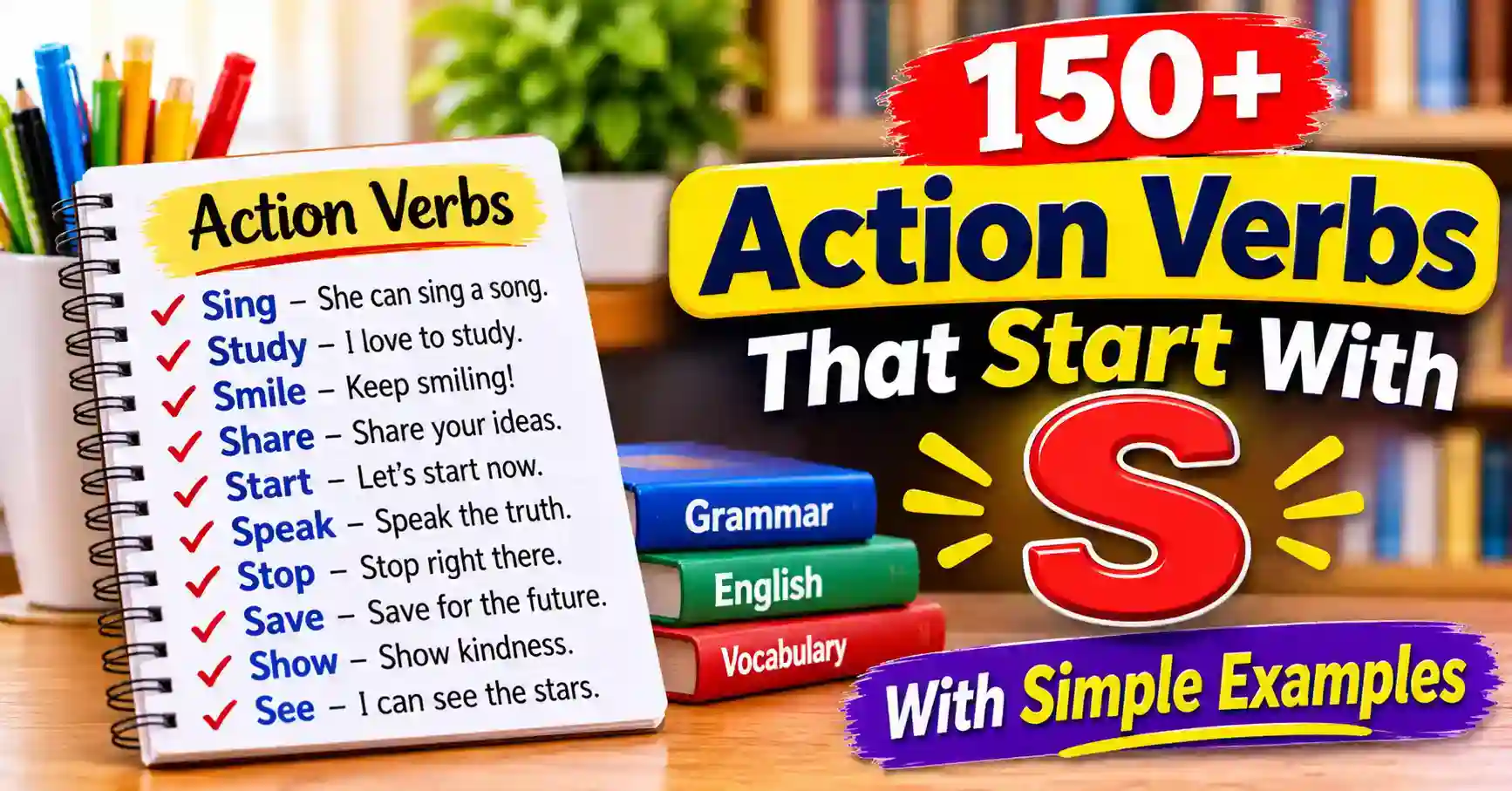
Sing, swim, smile, succeed. Four S verbs make a full story of effort and joy. S is one of the busiest letters in English, and this guide to verbs that start with S gives you 160 real verbs, with clear meanings, forms, and examples.
S gives us everyday words like say, see, and start. It also gives us strong action words like shake, squeeze, and sprint. You will meet them all here, sorted by theme, length, and type.
Here is what you will learn:
- what verbs do in a sentence
- a complete S verbs list, sorted by meaning, length, and type
- how to build every tense and spell each form
- how S verbs with irregular forms work, such as sing and speak
- fun facts, memory tricks, and a short quiz
Strong verbs make your writing clear. They also make your speech confident. Let’s begin.
What Are Verbs?
Verbs are the engine of every sentence. They tell the reader what someone does, what happens, or what something is. Without a verb, a sentence has no motion and no meaning. This section defines verbs in plain words, shows five S examples, and explains why a wide verb vocabulary helps you.
A Simple Definition of a Verb
A verb is a word that shows action, a state, or an event. Look for the word that answers one question: what is the subject doing or being? That word is the verb. Read these five sentences, each with an S verb in bold. Notice how each verb carries the main meaning.
- She sings in the choir.
- The children swim every summer.
- We study after dinner.
- He shared his lunch.
- They started the project early.
Action, State, and Helping Verbs
English verbs do three broad jobs. Action verbs show what someone does. State verbs show what someone knows, feels, or is. Helping verbs support another verb to show time or mood. S verbs fill all three jobs, because two S modals exist.
- Action verbs: shake, swim, and spin show physical action. Example: She spun the wheel.
- State verbs: seem and suppose show a state. Example: You seem tired.
- Helping verbs: shall and should work as modal helpers. Example: You should rest.
Why a Rich Verb Vocabulary Matters
Verbs carry the energy of a sentence. A weak verb needs extra words to do its job. A precise verb does the job alone. Building your list of S verbs gives you sharper choices when you write, speak, and read.
Compare She walked quickly with She sprinted. The second sentence is shorter and clearer. Precise verbs also help you understand what you read. Learn one new verb a day, and your range grows fast.
Complete List of Verbs That Start With S
This is your full guide to verbs that start with S. The lists below group every verb by meaning and use. The first table gives forty common verbs with a meaning and an example. The later lists sort the wider set by theme, so you can find the right word fast.
Common Verbs Starting With S
Start here. This table lists forty of the most useful S verbs in alphabetical order. Each row gives a short meaning and an example sentence. Most words are everyday words, so reading the table once gives you a strong base. Then explore the themed lists that follow.
| Verb | Meaning | Example |
| save | to keep safe, or to store | Save your work. |
| say | to speak words | Say your name. |
| search | to look for | Search the room. |
| see | to notice with the eyes | I see a bird. |
| seem | to appear | You seem happy. |
| select | to choose | Select a seat. |
| sell | to give for money | They sell fruit. |
| send | to cause to go | Send me a message. |
| serve | to give food or help | She serves tea. |
| set | to put in place | Set the table. |
| shake | to move quickly back and forth | Shake the bottle. |
| share | to give a part to others | Share your toys. |
| shop | to buy things | We shop on Sundays. |
| shout | to speak very loudly | Don’t shout. |
| show | to let others see | Show your ticket. |
| sing | to make music with the voice | They sing well. |
| sit | to rest on a seat | Sit here. |
| sleep | to rest with eyes closed | Babies sleep a lot. |
| smile | to show joy with the mouth | She smiled warmly. |
| solve | to find an answer | Solve the puzzle. |
| sort | to put in groups | Sort the mail. |
| sound | to seem when heard | That sounds fun. |
| speak | to talk | Speak clearly. |
| spend | to use money or time | I spend little. |
| stand | to be on your feet | Stand in line. |
| start | to begin | Start the car. |
| stay | to remain | Stay here. |
| step | to move a foot | Step forward. |
| stick | to attach | Stick the label on. |
| stop | to end motion | Stop at the light. |
| strike | to hit | Lightning struck the tree. |
| study | to learn by reading | I study at night. |
| succeed | to reach a goal | She succeeded. |
| suffer | to feel pain | Don’t suffer in silence. |
| suggest | to offer an idea | I suggest a walk. |
| supply | to provide | The farm supplies milk. |
| support | to hold up or help | Friends support each other. |
| survive | to stay alive | Plants survive drought. |
| swim | to move in water | We swim daily. |
| switch | to change | Switch the lights off. |
Learn say, see, start, stop, speak, send, set, share, show, and stay first. These ten cover most daily use.
Action Verbs (Physical Actions)
Action verbs show movement you can see or hear. S has a large set of them. Some involve the hands, the arms, or the whole body, and others involve force, liquid, and speed. This list gathers the physical ones, so you can pick a vivid verb for any scene.
scatter, scrape, scratch, shake, shoot, slide, smash, spill, spin, spray, squeeze, stack, stick, stir, straighten, strike, swing
Use these verbs in stories and instructions. They make each step easy to picture.
Verbs of Communication
People use verbs to speak, write, signal, and suggest. S has a strong group for this job. Some are plain, some are formal, and some add a musical touch. This list shows the words that carry a message, so you can choose the right tone.
say, scream, shout, sign, signal, sing, speak, specify, spell, state, suggest, summarize
Choose say for plain speech and state for formal speech. Both speak, but the tone differs.
Verbs of Thinking and Emotion
Some verbs live inside the mind and heart. They show what we notice, learn, feel, and guess. S offers a rich list here. Each verb below covers a thought or feeling, from quiet study to sudden surprise, and each one works well in everyday sentences.
satisfy, sense, sigh, smile, study, suffer, suppose, surprise
Example: She sensed the change, sighed, and then smiled.
Verbs of Movement
Movement verbs describe how people and things travel, glide, or race. S has many useful ones, from quick sprinting to slow sliding. Each verb below paints a clear picture of motion, so you can match it to the pace and mood of your scene.
sail, scramble, shift, slide, slip, soar, speed, spin, sprint, step, swim, swing
Example: The boat sailed past, and the gulls soared overhead.
Verbs for Work, School, and Daily Life
Daily life runs on verbs. You save a file, schedule a meeting, and submit a form. This list covers S verbs for the office, the classroom, and the home. Each word is practical, and most have simple meanings you can use today.
save, schedule, search, select, sell, send, serve, set, share, shop, sign, sort, store, study, submit, summarize, supply, support, survey
Example: She scheduled the call, shared the notes, and submitted the report.
Positive Verbs
Positive verbs lift a sentence. They show comfort, growth, care, and success. S gives you many warm choices. Use them in cards, speeches, and reviews when you want your tone to feel kind and encouraging. Here are the most uplifting S verbs.
satisfy, save, secure, share, shield, shine, simplify, smile, smooth, solve, spark, stimulate, strengthen, succeed, support, survive, sustain, sweeten
Example: Kind words can strengthen a team, and a small smile can brighten a day.
Negative Verbs
Negative verbs describe fear, damage, and loss. S has several strong ones. They carry heavy meanings, so use them with care and in the right context. Writers often choose them for news reports, history, and dramatic stories. This list names the main ones.
sadden, scare, scatter, shatter, shock, smash, spill, stain, steal, struggle, suffer
Use these words with precision. A clear negative verb is stronger than a long, vague phrase.
Uncommon or Advanced Verbs
Some S verbs are rare. You will meet them in law, science, business, and formal writing. They sharpen your writing, and they please crossword fans. Learn them after you master the common list. Each word below is a real verb found in standard dictionaries.
sanction, saturate, scavenge, scrutinize, simulate, stagnate, stipulate, subdue, subsidize, substantiate, suffice, supersede, supplant, suppress, surmise, synchronize
Pick two or three of these each week and try them in your own sentences.
Simple Verbs for Beginners and Kids
New learners need short, clear words. These S verbs are easy to say, easy to spell, and easy to act out. Kids can mime each one. Start with this list, and build up from there. Say each sentence aloud, and add a motion.
- see: I see a star.
- sing: We sing a song.
- sit: Sit on the mat.
- skip: Skip to the door.
- sleep: The cat will sleep.
- smile: Smile for the photo.
- spin: Spin around.
- stand: Stand up tall.
- stop: Stop at the line.
- swim: I swim in the pool.
Verbs by Word Length
Word length is a handy way to study spelling and play word games. This section sorts verbs that start with S by letter count. Short S verbs are very common, and longer ones often come from Latin. Use these lists for Scrabble, Wordle, and spelling practice.
3-Letter Verbs Starting With S
Three-letter S verbs are short and sharp. English has twelve in standard use, so you can learn them in minutes. Each one is easy to spell, and most have several meanings. Here they are, with a quick example for each.
- sap: Heat can sap your energy.
- saw: Saw the board in half.
- say: Say it again.
- see: See the sights.
- set: Set the clock.
- sew: Sew a button on.
- sit: Sit here.
- sob: Babies sob when tired.
- sow: Sow seeds in spring.
- spy: Spy on the scene.
- sue: Customers may sue the firm.
- sum: Sum the numbers.
4-Letter Verbs Starting With S
Four-letter verbs form a big group, and they include many of the most common S words. They are perfect for beginners and for quick word games. Learn these twenty-nine, and you will cover a large share of everyday S verbs.
sail, save, scan, seal, seek, seem, sell, send, shed, shop, show, shut, sigh, sign, sing, sink, skip, slip, slow, snap, soar, sort, spin, spot, stay, step, stir, stop, swim
5-Letter Verbs Starting With S
Five-letter verbs are popular in word puzzles. S gives you forty-five of them, the biggest group by length. Several are very common, such as share, start, and speak. Study the list below, and say each word aloud to fix the sound and the spelling together.
scale, scare, score, seize, sense, serve, shake, shape, share, shift, shine, shock, shoot, shout, sleep, slide, smash, smell, smile, smoke, solve, sound, spark, speak, speed, spell, spend, spill, split, spray, stack, stain, stand, stare, start, state, steal, steer, stick, sting, store, study, swear, sweep, swing
6-Letter Verbs Starting With S
Six-letter verbs mix everyday words with a few rare ones. You will use search, select, and switch often. Words like subdue and sketch have more specific meanings. Here are twenty-eight six-letter S verbs to practice.
sadden, salute, sample, scrape, scream, screen, search, secure, select, settle, shield, shrink, signal, sketch, smooth, sneeze, soften, spread, spring, sprint, strike, strive, subdue, submit, suffer, supply, survey, switch
7+ Letter Verbs Starting With S
Longer S verbs make up a big group. Many come from Latin and end in -ate, -ize, or -en. They are common in school, business, and formal writing. This list holds forty-six verbs from seven to twelve letters. Learn them in small groups.
salvage, sanction, satisfy, saturate, scatter, scavenge, schedule, scramble, scratch, scrutinize, separate, sharpen, shatter, shelter, shorten, simplify, simulate, specify, squeeze, stagnate, stimulate, stipulate, straighten, strengthen, stretch, struggle, subsidize, substantiate, succeed, suffice, suggest, summarize, supersede, supplant, support, suppose, suppress, surmise, surprise, surround, survive, sustain, swallow, sweeten, symbolize, synchronize
The longest verb here is substantiate, with twelve letters. Next comes synchronize, with eleven.
Verbs by Type
Grammar groups verbs by how they behave. Some verbs take an object, some do not, and some change form in odd ways. This section sorts S verbs into six useful types. Knowing the type helps you build correct sentences and avoid common errors.
Action and Stative Verbs
Action verbs describe things people do. Stative verbs describe conditions, such as seeming or smelling a certain way. Stative verbs rarely appear in the continuous form. This split explains why You seem tired is natural, and You are seeming tired sounds odd in careful writing.
- Action: sail, shake, shoot, sing, stir, swim
- Stative: seem, smell, sound, suppose
Transitive and Intransitive Verbs
A transitive verb needs an object. An intransitive verb does not. Some verbs can do both. Check the word after the verb: if you can ask “what?” or “whom?”, the verb is transitive. This table sorts the S verbs.
| Type | S verbs |
| Transitive | save, sell, send, shape, sharpen, shatter, simplify, steal, submit, supply |
| Intransitive | sail, sigh, sleep, sneeze, soar, stagnate, stay, struggle, swim |
| Both | set, shake, shine, sing, sit, speak, stand |
Example: She sold the car (transitive). The baby slept (intransitive).
Regular and Irregular Verbs
Regular verbs add -ed for the past tense. Irregular verbs change in other ways. Most S verbs are regular. About forty are irregular, which is a large group, and it includes some of the most common verbs in English, such as say, see, and sit. Learn them well.
- Irregular: saw, say, see, seek, sell, send, set, sew, shake, shed, shine, shoot, show, shrink, shut, sing, sink, sit, sleep, slide, sow, speak, speed, spell, spend, spill, spin, split, spread, spring, stand, steal, stick, sting, strike, strive, swear, sweep, swim, swing
- Regular: all other S verbs, such as save, share, and smile
Auxiliary (Helping) and Modal Verbs
Auxiliary verbs help main verbs show tense and mood. Modal verbs, such as can and must, show ability or duty. Two modals begin with S: shall and should. They show duty, advice, or a plan, and they take a plain verb after them.
- shall: We shall begin at noon.
- should: You should rest.
Linking Verbs
Linking verbs connect a subject to a description. They do not show action. The word after them describes the subject. S has four linking verbs that are easy to spot: seem, smell, sound, and stay. Each one links a subject to a quality.
- seem: She seems tired.
- smell: The soup smells good.
- sound: That sounds fun.
- stay: Please stay calm.
Phrasal Verbs With S
A phrasal verb joins a verb with a small word, such as up or out, to make a new meaning. English speakers use them constantly. S has many, built mostly on set, show, sign, stand, and step. Learn each one as a single unit.
| Phrasal verb | Meaning | Example |
| set aside | save for later | Set aside some money. |
| set off | begin a trip | We set off at dawn. |
| set out | begin a journey or task | They set out early. |
| set up | arrange or create | Set up the tent. |
| settle down | become calm | The class settled down. |
| show off | display proudly | He likes to show off. |
| show up | arrive | Please show up on time. |
| shut down | stop working | The system shut down. |
| sign in | enter a password | Sign in to your account. |
| sign out | leave an account | Sign out when you finish. |
| sign up | join | Sign up for the class. |
| sit down | take a seat | Please sit down. |
| sit up | rise to a sitting position | He sat up in bed. |
| slow down | go slower | Slow down near schools. |
| sort out | solve or arrange | We sorted out the problem. |
| speak up | talk louder or voice an opinion | Speak up if you disagree. |
| speed up | go faster | Speed up the process. |
| stand by | wait, be ready, or support | I stand by my words. |
| stand out | be easy to notice | Her work stands out. |
| stand up | rise to your feet | Stand up, please. |
| start over | begin again | Let’s start over. |
| step down | leave a post | The manager stepped down. |
| step in | help in a problem | A teacher stepped in. |
| stick to | follow closely | Stick to the plan. |
| stop by | visit briefly | Stop by anytime. |
| sum up | give a short summary | Sum up the story. |
| switch off | turn off | Switch off the lights. |
| switch on | turn on | Switch on the lamp. |
Treat each phrasal verb as one word. Learn a few at a time, and use them in short sentences.
Verb Forms and Tenses
Every verb has five forms: base, past simple, past participle, present participle, and third-person singular. Once you know them, you can build any tense. This section shows the forms in a table, lists the irregular verbs, explains spelling rules, and gives tense examples.
Verb Forms Table
This table shows the five forms of twenty-two S verbs. Read across each row. Regular verbs follow a clear pattern, so scan for the exceptions. Notice the doubled consonants in words like stopped and shopped. Those changes follow the spelling rules covered below.
| Base | Past simple | Past participle | Present participle | Third-person singular |
| save | saved | saved | saving | saves |
| say | said | said | saying | says |
| see | saw | seen | seeing | sees |
| seem | seemed | seemed | seeming | seems |
| send | sent | sent | sending | sends |
| set | set | set | setting | sets |
| share | shared | shared | sharing | shares |
| shop | shopped | shopped | shopping | shops |
| sing | sang | sung | singing | sings |
| sit | sat | sat | sitting | sits |
| sleep | slept | slept | sleeping | sleeps |
| smile | smiled | smiled | smiling | smiles |
| speak | spoke | spoken | speaking | speaks |
| spend | spent | spent | spending | spends |
| stand | stood | stood | standing | stands |
| start | started | started | starting | starts |
| stay | stayed | stayed | staying | stays |
| step | stepped | stepped | stepping | steps |
| stop | stopped | stopped | stopping | stops |
| study | studied | studied | studying | studies |
| supply | supplied | supplied | supplying | supplies |
| swim | swam | swum | swimming | swims |
For regular verbs, add -ed for both past forms. Check the table whenever a dropped e or a doubled letter confuses you.
Irregular Verbs Starting With S
Irregular verbs break the -ed rule. S has about forty of them, more than most letters, and they appear very often in speech and writing. Many follow patterns, such as sing, sang, sung and swim, swam, swum. Study the table below, and say each row aloud.
| Base | Past simple | Past participle | Present participle | Third-person singular |
| saw | sawed | sawed or sawn | sawing | saws |
| say | said | said | saying | says |
| see | saw | seen | seeing | sees |
| seek | sought | sought | seeking | seeks |
| sell | sold | sold | selling | sells |
| send | sent | sent | sending | sends |
| set | set | set | setting | sets |
| sew | sewed | sewn or sewed | sewing | sews |
| shake | shook | shaken | shaking | shakes |
| shed | shed | shed | shedding | sheds |
| shine | shone (or shined) | shone | shining | shines |
| shoot | shot | shot | shooting | shoots |
| show | showed | shown or showed | showing | shows |
| shrink | shrank (or shrunk) | shrunk | shrinking | shrinks |
| shut | shut | shut | shutting | shuts |
| sing | sang | sung | singing | sings |
| sink | sank | sunk | sinking | sinks |
| sit | sat | sat | sitting | sits |
| sleep | slept | slept | sleeping | sleeps |
| slide | slid | slid | sliding | slides |
| sow | sowed | sown or sowed | sowing | sows |
| speak | spoke | spoken | speaking | speaks |
| speed | sped (or speeded) | sped | speeding | speeds |
| spell | spelled or spelt | spelled or spelt | spelling | spells |
| spend | spent | spent | spending | spends |
| spill | spilled or spilt | spilled or spilt | spilling | spills |
| spin | spun | spun | spinning | spins |
| split | split | split | splitting | splits |
| spread | spread | spread | spreading | spreads |
| spring | sprang (or sprung) | sprung | springing | springs |
| stand | stood | stood | standing | stands |
| steal | stole | stolen | stealing | steals |
| stick | stuck | stuck | sticking | sticks |
| sting | stung | stung | stinging | stings |
| strike | struck | struck | striking | strikes |
| strive | strove (or strived) | striven (or strived) | striving | strives |
| swear | swore | sworn | swearing | swears |
| sweep | swept | swept | sweeping | sweeps |
| swim | swam | swum | swimming | swims |
| swing | swung | swung | swinging | swings |
In American English, spelled and spilled are common. In British English, spelt and spilt are common too.
Spelling Rules for -ing, -ed, and -s
Spelling changes follow a few simple rules. Drop a silent e before -ing and -ed. Double a final consonant after one short vowel when the last syllable is stressed. Change y to ied after a consonant. Add -es after hissing sounds. The table gives each rule with 5 examples.
| Rule | Example | Result |
| Drop the silent e | save, share, shape, smile, solve | saving, sharing, shaping, smiling, solving |
| Keep ee | see | seeing |
| Double the final consonant after one short vowel | stop, step, shop, slip, skip, snap, scan, sob, sum, stir | stopped, stepping, shopped, slipped, skipped, snapped, scanned, sobbing, summed, stirred |
| Double when the last syllable is stressed | submit | submitted |
| Do not double when stress falls earlier | suffer, support, swallow, shelter | suffered, supported, swallowed, sheltered |
| Change y to ied after a consonant | study, supply, satisfy, simplify, specify, spy | studied, supplied, satisfied, simplified, specified, spied |
| Keep y after a vowel | stay, spray, survey | stayed, sprayed, surveyed |
| Add -es after s, sh, ch, x, z | search, scratch, stretch, switch, smash, sketch | searches, scratches, stretches, switches, smashes, sketches |
Note that submit doubles its t because the stress falls on the second syllable. Suffer does not, because the stress falls on the first.
Verb Tenses Explained
Tenses show when an action happens. Each tense has a simple form and a perfect form. The simple forms state facts and habits. The perfect forms link two points in time. Read the two examples for each tense below, and notice how the verb changes.
- Present simple: She sings daily. They swim at dawn.
- Past simple: He sold his car. We stopped early.
- Future simple: I will start tomorrow. She will speak at noon.
- Present perfect: They have saved enough. I have seen the film.
- Past perfect: We had stayed late before the storm hit. She had slept for hours.
- Future perfect: By June, I will have studied all the units. By noon, they will have sent the files.
Spelling Patterns and Prefixes for the Letter S
S has several useful Latin prefixes, and it also opens many tricky consonant clusters, such as str-, spr-, and scr-. This section shows the main patterns, explains the suffixes that build S verbs, and covers tricky spellings and sounds so you can read and say each word with confidence.
Common Prefixes and Letter Combinations
The prefix sub- means under. It changes shape before some letters, giving suc-, suf-, sug-, sup-, and sus-. The prefix sur- means over. Greek syn- and sym- mean together. Study each group below, and notice how the prefix shapes the meaning.
| Prefix | Meaning | Example verbs |
| sub- | under | submit, subdue, subsidize, substantiate |
| suc-, suf-, sug-, sup-, sus- | under (changed form of sub-) | succeed, suffer, suffice, suggest, supplant, supply, support, suppose, suppress, sustain |
| sur- | over | surmise, surprise, surround, survey, survive |
| super- | above | supersede |
| syn-, sym- | together | symbolize, synchronize |
| se- | apart | secure, select, separate |
Note that sub- often means under, as in subdue. Note also that S opens clusters such as str- (stretch, strike, strive, struggle), scr- (scramble, scrape, scratch, scream, screen), and spr- (spray, spread, spring, sprint).
Common Verb Suffixes
Suffixes such as -ize, -ify, -ate, and -en turn other words into verbs. S uses all four, which is why so many S verbs end the same way. Study the groups below, and notice how each ending shapes the meaning of the root word.
- -ize (to make or become): scrutinize, subsidize, summarize, symbolize, synchronize
- -ify (to make or cause): satisfy, simplify, specify
- -ate (to act or cause): saturate, separate, simulate, stagnate, stimulate, stipulate, substantiate
- -en (to make more): sadden, sharpen, shorten, soften, straighten, strengthen, sweeten
The -en suffix is easy to use. It often builds from a plain word. Short becomes shorten, and sweet becomes sweeten.
Tricky Spellings, Silent Letters, and Pronunciation
Some S verbs hide silent letters or odd sounds. The spelling often keeps an old form, even when speech has changed. The notes below show how to say and spell the trickiest words, so you can avoid errors when you speak and write.
- sign: says SYNE. The g is silent.
- sew: says SOH, like go.
- sow: says SOH when it means to plant seeds.
- seize: says SEEZ. It breaks the i before e rule.
- separate: has a rat in the middle. The verb says SEP-uh-rayt.
- succeed: has two c’s and two e’s.
- suffer: has a double f.
- suggest: says suh-JEST. The g sounds like j.
- schedule: says SKEJ-ool in American English and SHED-yool in British English.
- scavenge: says SKAV-inj.
- supersede: is the only common English verb that ends in -sede.
How to Use These Verbs Correctly
Knowing a verb list is only half the skill. You also need to use each verb correctly. This section covers agreement, tense choice, prepositions, common errors, and confusing word pairs. Each part gives clear examples, so you can fix mistakes in your own writing and speak with more confidence.
Subject-Verb Agreement
A verb must match its subject. A singular subject takes a singular verb, and a plural subject takes a plural verb. In the present tense, the third-person singular form adds -s or -es. Check each example below, and notice which word the verb follows.
- She sings in the shower.
- The kids swim after school.
- Each of the students studies hard.
- My brother and sister share a room.
- Neither of them speaks French.
Choosing the Correct Tense
Tense tells the reader when something happens. Choose the tense that matches your time clue. Words like yesterday, now, and tomorrow guide you. Use the simple tense for facts and habits, and use a perfect tense when you link two moments. These five examples show the choice.
- Yesterday, he sold his bike. (past simple, finished time)
- Right now, she seems tired. (present simple, a state)
- Tomorrow, we will start early. (future simple)
- I have saved the file. (present perfect, result now)
- They had stopped before the rain began. (past perfect, earlier event)
Verbs Followed by Prepositions
Many verbs need a specific preposition to complete their meaning. Using the wrong one sounds unnatural. Learn each pair as a unit. This table shows eight S verbs with the prepositions that usually follow them, plus an example for each.
| Verb + preposition | Example |
| search for | I searched for my keys. |
| shout at | Don’t shout at the dog. |
| smile at | She smiled at the baby. |
| speak to | Speak to the manager. |
| spend on | We spend money on food. |
| struggle with | He struggles with math. |
| succeed in | She succeeded in her goal. |
| suffer from | Many people suffer from stress. |
Common Mistakes and Corrections
Even strong writers slip on S verbs. Most errors come from irregular forms and doubled letters. The table below shows seven frequent mistakes beside their fixes. Read each pair aloud. Hearing the correct form helps it stick in your memory.
| Mistake | Correction |
| I seen the movie. | I saw the movie. |
| She singed a song. | She sang a song. |
| He has spoke twice. | He has spoken twice. |
| We swimmed all day. | We swam all day. |
| She sleeped well. | She slept well. |
| I sat the table. | I set the table. |
| They stoped at the light. | They stopped at the light. |
Commonly Confused Words
Several S verbs look or sound like other words. Writers swap them often, and spellcheck rarely catches the error because both words are real. These pairs cause many mistakes. Study the table, and check the meaning before you choose the word.
| Pair | Difference | Example |
| sit / set | Sit means to take a seat. Set means to put something down. | Sit down, and set the cup on the table. |
| sew / sow | Sew means to stitch. Sow means to plant seeds. | She sews a coat, and he sows corn. |
| seize / cease | Seize means to grab. Cease means to stop. | Seize the chance before the offer ceases. |
| say / speak / tell | Say uses words. Speak uses a voice or language. Tell needs a listener. | He said hello, speaks Spanish, and told us a story. |
| sail / sale | Sail means to travel by boat. Sale means selling. | We sail on Sunday, and the sale ends soon. |
| seen / scene | Seen is the past participle of see. Scene is a place or a view. | Have you seen that scene? |
Synonyms and Antonyms
Synonyms give you choices, and antonyms show contrast. Both help you avoid repeating the same word. This table lists eighteen S verbs with common synonyms and antonyms. Use it to pick a word that fits your meaning and to build contrast in your sentences.
| Verb | Synonyms | Antonyms |
| save | rescue, keep | waste, spend |
| say | state, speak | stay silent |
| search | hunt, seek | abandon |
| see | notice, spot | overlook, miss |
| select | choose, pick | reject |
| sell | trade, vend | buy |
| send | mail, dispatch | receive |
| serve | assist, help | ignore |
| shake | shiver, rattle | steady |
| shut | close, seal | open |
| simplify | ease, clarify | complicate |
| sit | rest, perch | stand |
| sleep | rest, doze | wake |
| speak | talk, say | stay silent |
| start | begin, launch | stop, end |
| steal | take, snatch | return, give |
| succeed | win, thrive | fail |
| support | back, assist | oppose |
Choose a verb by tone, strength, and context. Shut is blunt, while close is gentle. Steal is harsh, while take is mild. Select is formal, while pick is casual. This table shows that verbs that start with S offer real range, from gentle to strong.
Practical Use Cases
Verbs earn their keep in real writing. This section shows how S verbs work in six settings, from essays to word games. Each part offers a short note and sample sentences. Copy the patterns, then swap in your own topic. You will see how verbs that start with S can sharpen almost any text.
Essays and Academic Writing
Academic writing needs clear, exact verbs. S verbs help you state claims, support arguments, and summarize findings. Use suggest for careful claims, support for evidence, and summarize for overviews. Keep sentences short, and let the verb carry the claim. These examples show the style.
- The data support the theory.
- The study suggests a link between sleep and memory.
- This section summarizes the main findings.
Storytelling and Creative Writing
Fiction thrives on vivid verbs. A strong verb paints the scene without extra words. It gives you motion, sound, and stillness. Shake adds force, stare adds tension, and slide adds quiet speed. Choose the verb that lets the reader see and feel the moment.
- Thunder shook the walls.
- She stood still and stared at the door.
- Light slid across the floor.
Resumes and Professional Writing
Resumes reward strong, specific verbs. Start each bullet with a past-tense action verb, and follow it with a clear result. S offers many business verbs that stand out. Match each verb to a true achievement. These lines are samples only.
- Scheduled weekly team meetings.
- Secured two new client accounts.
- Simplified the billing process.
- Supported the sales team during a busy season.
- Surveyed customers to improve service.
Social Media Captions
Captions need short, punchy verbs. S verbs fit well because many are brief and bold. Pair a verb with an image or a goal, and keep the line under ten words. These examples work for travel, fitness, study, and daily motivation posts.
- Smile more.
- Start small.
- Stay curious.
Everyday Conversation
Daily talk is full of S verbs. We say hello, see friends, and stop by. Many fixed phrases use them, so learning the verbs also teaches you natural speech. Say these sentences aloud to practice rhythm and tone.
- See you soon.
- Say it again.
- Stop by anytime.
Word Games (Scrabble, Wordle, Crosswords)
Word games reward a good vocabulary. S is worth one point in English Scrabble, but it is one of the most flexible tiles because it makes plurals and verb endings. Many S verbs also fit five-letter puzzles. Learn the common endings, and you will spot answers faster. Here are some quick tips.
- Seven-letter verbs such as support, suggest, succeed, and survive can earn the 50-point bonus for using all seven tiles.
- Try shake, share, shine, shout, sleep, smile, solve, stand, or start when a five-letter puzzle clue points to an S start.
- Short verbs like see, sit, and set are handy crossword fill.
Fun Facts and Learning Tips
Learning sticks when it feels fun. This section shares surprising facts about the letter S and its verbs, gives memory tricks that work, explores where six words came from, and offers daily habits you can start today. It ends with a short quiz and a full answer key. Use these tools to lock in everything you learned about verbs that start with S.
Fun Facts About the Letter S and Its Verbs
S has a rich history for such a curvy letter. It began as a picture, crossed several alphabets, and grew into one of the busiest starting letters in English. Its verbs hide stories about sound, spelling, and shifting meaning. These eight facts show how much a single letter can carry.
- S began as a tooth. The Phoenician letter shin meant tooth. The Greeks turned it into sigma, and Latin borrowed it as S. Our S comes from that line.
- S is a very common starting letter. English dictionaries give it one of the largest sections. That helps explain why S has so many verbs.
- S can lead a triple cluster. English words often start with three consonants only when the first one is S, as in strike, spray, and scratch.
- S also marks the verb ending -s. Nearly every verb takes -s or -es in the third-person singular, as in she sings and he stays.
- Sing, swim, and sink share a pattern. Each changes its vowel from i to a to u, as in sing, sang, sung. Other verbs, such as ring and drink, follow the same pattern.
- Spell has two past forms. American English prefers spelled, while British English also uses spelt. Both are correct.
- Set has a giant dictionary entry. Major dictionaries list hundreds of senses for it. People set tables, set records, and set alarms.
- Supersede is a spelling oddity. It is the only common English verb that ends in -sede. Words like succeed and proceed end in -ceed, and others end in -cede.
Memory Tricks and Mnemonics
Mnemonics turn tricky spellings and forms into easy pictures. Try one or two of these tricks, and invent your own. The best memory tool is a silly image that you can see in your mind. Each trick below uses a real S verb from this guide.
- Sing, sang, sung is i-a-u. Chant it as a rhythm, and use the same pattern for swim, swam, swum.
- Sit yourself, set something. You sit in a chair. You set a cup on a table.
- Separate has a rat in it. Picture a small rat hiding in the middle: sep-a-RAT-e.
- Say becomes said. The y turns into i, and the word still sounds like sed.
- Sleep becomes slept. The double e shrinks to one e, and a t joins the end.
- Succeed has two c’s and two e’s. Think of it as a double success: suc-ceed.
Word Origins and History
Words carry history. Each verb below traveled through languages and time before it reached modern English. Seeing the path helps you remember the meaning and the spelling. These six verbs show how meanings shift, narrow, and grow, based on standard etymology sources.
- save: From Latin salvare, meaning to make safe, from salvus, meaning safe. The meaning grew from rescuing to keeping money or files.
- study: From Latin studium, meaning eagerness or zeal. The meaning moved from eager effort to careful learning.
- salute: From Latin salutare, meaning to greet, from salus, meaning health. It first meant to wish someone good health.
- sanction: From Latin sanctio, meaning a decree. The verb now has two opposite senses: to approve and to penalize.
- stimulate: From Latin stimulus, meaning a goad or pointed stick. It now means to spark action or interest.
- succeed: From Latin succedere, meaning to go under or follow after. The meaning moved from following to achieving a goal.
Daily Practice Tips
Small habits beat long, rare study sessions. Ten minutes a day builds more skill than one long weekend session. Pick two or three habits below and stick with them for a month. Track your progress in a notebook, and celebrate each new verb you use.
- Read a little every day. Read news, stories, or recipes, and circle every S verb. Seeing a word in context teaches you its meaning and use.
- Keep a verb journal. Write one sentence a day that uses an S verb. Short entries add up fast. After a month, you will own thirty fresh sentences.
- Use flashcards. Write the verb on one side and its forms on the other. Review ten cards each morning. Mix in the irregular verbs to master them.
- Speak aloud. Say each example sentence out loud. Your mouth learns tricky words, like sign and seize, faster than your eyes do.
- Group by pattern. Study sing, sink, swim together, then sleep, sweep, send together. Patterns give your memory hooks.
- Play word games. Try Scrabble, crosswords, or Wordle. Games make review feel like play, and they train your spelling.
Mini Practice Quiz
Test yourself with ten short questions. They cover forms, tenses, verb types, and meanings. Write your answers on paper before you check the key. Do not worry about mistakes. Each wrong answer shows you what to review, so reread the matching section afterward.
- Fill in the blank: She ___ (sing) beautifully last night.
- What is the past participle of swim?
- Choose the correct word: Please (sit / set) the vase on the table.
- Which verb is irregular: sail, sleep, or stay?
- Match the meaning: simplify means (to make easier / to make larger / to make louder).
- Add -ing to stop.
- Choose the correct form: He has (spoke / spoken) twice.
- What is the past simple of spend?
- Spell the verb that means to divide, with a rat in the middle.
- Is sleep transitive or intransitive?
Answer key: 1. sang. 2. swum. 3. set. 4. sleep. 5. to make easier. 6. stopping. 7. spoken. 8. spent. 9. separate. 10. intransitive.
FAQs
These questions come from real search habits. Learners, parents, teachers, and writers ask them often. Each answer is short and direct. Use the answers as a quick reference, or return to the earlier sections for more detail on any S verb that interests you.
What are some action verbs that start with S?
Action verbs that start with S include shake, shoot, slide, smash, spin, spray, squeeze, and stack. Each one shows a physical action you can see. You shake a bottle, spin a wheel, and squeeze a lemon. Use these words to make your writing lively and clear.
How many verbs start with S?
This guide lists 160 real verbs that start with S, from common words like say and see to rare words like supplant and substantiate. Dictionaries list more. S is one of the most productive letters for verbs, so you will always find fresh choices.
What are strong verbs that start with S for a resume?
Strong S verbs for a resume include schedule, secure, simplify, solve, strengthen, supply, support, and survey. “Secured new accounts” shows results. “Simplified a process” shows efficiency. “Solved a problem” shows skill. Pair each verb with a clear outcome, such as a goal, a deadline, or a number you can prove.
What is the longest verb that starts with S?
In this guide, substantiate is the longest S verb, with twelve letters. Synchronize follows with eleven. Three verbs have ten letters: scrutinize, straighten, and strengthen. Technical words may be longer, but they are rare. Check your game’s word list before you play a rare verb.
Which S verbs are irregular?
About forty S verbs are irregular. They include say (said), see (saw, seen), sell (sold), send (sent), sing (sang, sung), sit (sat), sleep (slept), speak (spoke, spoken), stand (stood), and swim (swam, swum). All other S verbs take -ed. Learn the common ones by heart, since they appear often.
What are some positive verbs that start with S?
Positive S verbs include satisfy, save, shine, smile, solve, spark, strengthen, succeed, support, survive, and sweeten. You can smile at a stranger, support a friend, or strengthen a team. These words show comfort, growth, and success. Use them in cards, reviews, and speeches to give your message a warm tone.
Conclusion
Verbs that start with S give you power, range, and precision. You now know 160 of them, from everyday words like say, see, and start to rare gems like supplant and substantiate. You also learned their forms, their types, their tricky spellings, and their stories.
Remember the key ideas. About forty S verbs are irregular. Sing, sang, sung and swim, swam, swum follow the same pattern. The prefix sub- means under. Precise verbs make your writing stronger.
Now put this S verbs list to work. Pick three new verbs today. Write one sentence for each, and say each one aloud. Repeat tomorrow. In a month, these words will feel like old friends.
