

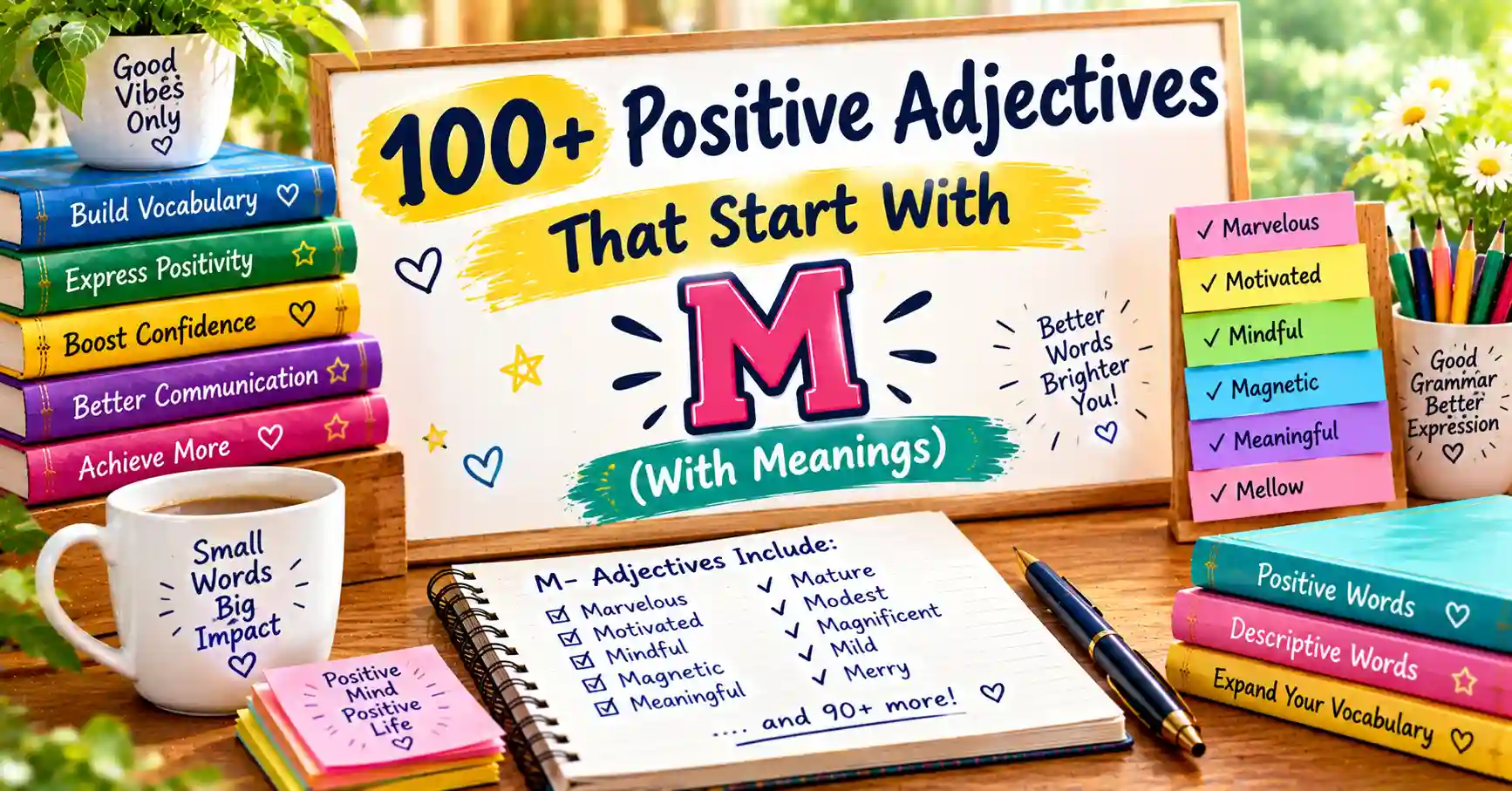
Do you want your words to feel warmer and stronger? Start with better descriptive words. A rich list of adjectives that start with M can lift your writing in seconds. Words like magical, marvelous, meaningful, and mellow turn plain sentences into vivid ones.
This guide gives you more than 100 positive adjectives that start with M. You will see them sorted by meaning and use. The top 40 words come with meanings and example sentences. You will also learn word order, comparisons, and common mistakes.
Why does this matter? Positive adjectives help you praise, encourage, and describe with care. They make your writing clearer and kinder. They also help you speak with more confidence.
You do not need to learn everything at once. Pick a few words. Use them today. Come back to this vocabulary list whenever you need fresh ideas. Small steps build a large vocabulary.
What Are Adjectives?
Before we explore the full list, let us review the basics. An adjective is a word that describes a noun or a pronoun. It tells us what something is like. It can show size, color, feeling, or quality. Adjectives are small words that do big work.
Simple definition: An adjective gives more detail about a noun.
Here are five examples:
- We had a marvelous time at the beach.
- She told a memorable story.
- He has a mild temper.
- The speech was moving.
- It was a magical night.
A strong adjective vocabulary improves your writing and speaking in three ways.
First, it makes your meaning clear. “A good day” is vague. “A memorable day” paints a picture.
Second, it saves words. One exact adjective can replace a long phrase. “Careful about every small detail” can simply become “meticulous.”
Third, it builds confidence. People trust speakers who choose precise words. Learning adjectives by letter is a smart method. It gives you a small, clear target. Today, that target is the letter M.
The Complete List: Adjectives That Start With M
This is the heart of the guide. Below you will find positive adjectives that start with M in clear groups. Each group has its own purpose. You can browse by topic, level, or use. Every word is a real adjective. No word appears twice. Most are positive in everyday use. Start with the group that fits your needs today.
Top 40 Positive Adjectives That Start With M
The top 40 are the most useful positive M adjectives. They appear in daily speech, school texts, and cards. The table gives each word a short meaning and an example sentence. The words are in alphabetical order.
| Word | Meaning | Example Sentence |
| magical | full of wonder and charm | We had a magical evening. |
| magnanimous | generous and forgiving | He was magnanimous in victory. |
| magnetic | strongly attractive | She has a magnetic smile. |
| magnificent | grand and impressive | The palace is magnificent. |
| majestic | dignified and grand | A majestic eagle soared above. |
| mannerly | polite | The mannerly boy held the door. |
| marvelous | wonderful | We had a marvelous time. |
| masterful | showing great skill | She gave a masterful performance. |
| matchless | without an equal | The singer has a matchless voice. |
| mature | fully grown or wise | He is mature for his age. |
| meaningful | full of purpose | We had a meaningful talk. |
| mellow | soft, warm, and relaxed | The mellow light felt calming. |
| melodic | pleasant and tuneful | A melodic song played softly. |
| memorable | worth remembering | It was a memorable trip. |
| merciful | kind and forgiving | The judge was merciful. |
| merry | cheerful and jolly | They sang a merry tune. |
| mesmerized | held spellbound | The kids were mesmerized by the show. |
| mesmerizing | holding your full attention | The dancer was mesmerizing. |
| methodical | careful and orderly | She is a methodical planner. |
| meticulous | very careful about details | He is a meticulous editor. |
| mighty | very strong | A mighty oak stood tall. |
| mild | gentle and soft | The weather is mild today. |
| mindful | aware and attentive | Be mindful of your words. |
| miraculous | like a wonder | It was a miraculous recovery. |
| mirthful | full of laughter | She had a mirthful laugh. |
| modest | humble and not boastful | He is modest about his success. |
| monumental | great and impressive | It was a monumental achievement. |
| moral | right and good | She made a moral choice. |
| moreish | so tasty you want more | These cookies are moreish. |
| motherly | warm and caring | She gave me motherly advice. |
| motivated | eager and driven | A motivated student studies daily. |
| motivating | giving drive | The coach gave a motivating speech. |
| motivational | meant to inspire | I read a motivational book. |
| mouthwatering | looking or smelling delicious | The pizza smelled mouthwatering. |
| moved | touched emotionally | I was deeply moved. |
| moving | touching the emotions | It was a moving story. |
| multifaceted | having many sides or talents | He is a multifaceted artist. |
| multitalented | skilled at many things | She is a multitalented performer. |
| musical | related to or skilled in music | He is a musical child. |
| mutual | shared by two or more | We share a mutual respect. |
Learn these 40 first. Then pick five a week to use in your own writing.
Positive Adjectives That Start With M to Describe People
People are complex, so we need many words to describe them. This group covers personality, appearance, and emotions. Every word below is new to this guide. Use them in character sketches, profiles, recommendation letters, and everyday chat. They help you paint a clear picture of a real person.
Personality: maternal, measured, meditative, mellowed, mentoring, model.
Appearance: manicured, mesmeric, muscular.
Emotions: mellowing, mollified, moonstruck.
Try pairing one personality word with one appearance word. For example: “a measured woman with a manicured garden.” It instantly feels like a real person.
Positive Adjectives That Start With M to Describe Places, Things, and Situations
Not every noun is a person. Places, objects, and events need good adjectives too. This group helps you describe a landscape, a product, or an important moment. These words work well in travel writing, product copy, and reports. Choose the word that fits the noun.
manageable, medicinal, mint, moisturizing, mollifying, momentous, moonlit, multicolored, multicultural, multidimensional, multilingual, mystical, mythical.
You can call a night “moonlit” but not a rule. You can call a day “momentous” but not a cream. Always match the word to the noun.
Positive Compound Adjectives That Start With M
Compound adjectives join two or more words, often with hyphens. They pack a lot of meaning into one phrase. They are very common in reviews, ads, and travel writing. M has many positive ones, and they are real adjectives. The words are in alphabetical order.
maintenance-free, market-leading, master-crafted, medal-winning, mellow-toned, memory-boosting, merry-hearted, mess-free, mild-mannered, mild-natured, mind-blowing, mind-clearing, mind-expanding, mind-refreshing, mind-soothing, mind-stimulating, mint-condition, mint-fresh, mirth-filled, mission-driven, misty-eyed, mobile-friendly, money-saving, mood-boosting, mood-brightening, mood-enhancing, mood-lifting, morale-boosting, much-admired, much-loved, much-needed, multi-purpose, multi-skilled, muscle-building, museum-quality, must-have, must-read, must-see, must-try, must-visit.
Use hyphens when the compound comes before a noun. Write “a must-see view,” but “the view is a must-see” turns the phrase into a noun.
Uncommon or Advanced Positive Adjectives That Start With M
Advanced adjectives make your writing stand out. They are rare, exact, and often elegant. Use them sparingly. One or two in an essay can impress. Too many can confuse your reader. Study the six words below. Always check a rare word twice before you use it.
| Word | Meaning |
| masterly | showing great skill |
| matured | fully developed or aged well |
| mellifluous | sweet and smooth-sounding |
| melodious | pleasant to hear |
| meritorious | deserving praise |
| munificent | very generous |
A quick example: “The munificent donor gave the school a new library.”
Simple Positive Adjectives That Start With M for Beginners
Beginners need friendly words they can use right away. This group has short, easy adjectives from daily speech. Easy words from the top 40, such as magical, merry, mild, mighty, and musical, are also great starting points. The new words below are in alphabetical order.
magic, minty.
Say each word aloud and use it in a short sentence. For example: “We watched a magic show” and “I love the minty smell.”
Neutral M Adjectives for Contrast
This guide focuses on positive words. Still, it helps to see how neutral words compare. Neutral adjectives do not praise or criticize. They state facts such as size, type, or time. They are the plain background of clear writing. The words are in alphabetical order.
main, major, manual, marine, mass, maximum, medical, medium, mental, middle, minimum, minor, mobile, modern, monthly, multiple.
Use neutral words for facts and positive words for feelings. Together, they make your writing balanced.
Negative M Adjectives for Contrast
Negative adjectives show dislike, gloom, or harm. They are not the focus here, but knowing them helps you avoid them. They also help you see the opposite of each positive word. Use them with care, because strong words can hurt. The words are in alphabetical order.
malicious, meager, mean, mediocre, melancholy, menacing, merciless, messy, miserable, monotonous, moody, morbid, mournful, mundane, murky.
Notice the range. Messy is mild. Malicious is very strong. Match the word to the feeling you mean.
Adjectives by Type
Adjectives come in several types. Knowing the types helps you place each word correctly. In this section, we use real examples from the M-list. We also show the types that have only a few M-words. That honesty saves you time when you study.
Descriptive Adjectives
Descriptive adjectives are the largest group. They describe quality, size, shape, color, or condition. Almost every word in the lists above belongs here. Words like mellow, magnificent, moonlit, and multicolored are all descriptive. They answer the question “What is it like?”
Example: “The moonlit garden felt mellow and calm.”
Comparative and Superlative Adjectives
Comparative adjectives compare two things. Superlative adjectives compare three or more. Short words usually add -er and -est. Longer words use more and most. For example, mild becomes milder and mildest. Magnificent becomes more magnificent and most magnificent. A full table appears in the grammar section below.
Possessive and Demonstrative Adjectives
Possessive adjectives show ownership: my, your, his, her, its, our, their. M gives us one: my. Demonstrative adjectives point to things: this, that, these, those. None of them starts with M. You will use my daily beside M-words, as in “my marvelous friend.”
- “My mentor gave me motivating advice.”
- “I love my mellow, moonlit street.”
Quantitative Adjectives
Quantitative adjectives tell us how much or how many. M has several of the most common ones: many, much, more, and most. In modern grammar, some books call them determiners. They work the same way in a sentence.
- “Many friends sent magical messages.”
- “I have much respect for her.”
- “We need more mild days like this.”
- “Most guests found the show memorable.”
Remember that many goes with things you can count, and much goes with things you cannot.
Compound Adjectives
Compound adjectives join words to make one description. The full list of 40 positive compounds appears above, so we will not repeat it. You can use them to make reviews and ads sound lively. Always place the hyphenated compound before the noun it describes.
- “It was a must-see museum.”
- “She shared a mood-boosting playlist.”
- “He is a mild-mannered teacher.”
When in doubt, check a dictionary for the correct hyphens.
How to Use These Adjectives Correctly
Knowing many words is only half the job. You must also place them well and avoid common slips. This section covers the key grammar rules: word order, comparisons, frequent errors, and confusing word pairs. Read each part slowly. A few small habits can make your English sound far more natural.
Adjective Word Order
When you use more than one adjective before a noun, English follows a natural order. Native speakers use it without thinking. Learners must study it. The usual order is: opinion, size, age, shape, color, origin, material, purpose. Break the order, and the phrase sounds odd.
Here are three examples with M-words:
- a marvelous little old wooden cabin (opinion, size, age, material)
- a magnificent young Moroccan singer (opinion, age, origin)
- a magical new silver bracelet (opinion, age, material)
Opinion words, like marvelous and magnificent, almost always come first.
Comparative and Superlative Forms
Comparing things is a daily task. Short adjectives usually take -er and -est. Longer ones take more and most. Words ending in -y change the y to i. Study this table of ten key words. The words are in alphabetical order.
| Adjective | Comparative | Superlative |
| magnificent | more magnificent | most magnificent |
| marvelous | more marvelous | most marvelous |
| mature | more mature | most mature |
| meaningful | more meaningful | most meaningful |
| mellow | mellower | mellowest |
| memorable | more memorable | most memorable |
| merry | merrier | merriest |
| mighty | mightier | mightiest |
| mild | milder | mildest |
| modest | more modest | most modest |
Notice that merry and mighty change the y to i. A few words, such as mature and modest, also allow -er forms, but more and most are safer.
Common Mistakes and How to Avoid Them
Even strong learners repeat the same errors. Spotting them is the first step to fixing them. Below are six common mistakes with simple corrections. Check your own writing against this list.
- Wrong article. ❌ “an magical night” → ✅ “a magical night.” Use a before a consonant sound. But note that letters follow sound: say “an M,” as in “an MBA degree.”
- Double comparison. ❌ “more merrier” → ✅ “merrier.”
- Adjective instead of adverb. ❌ “He spoke meaningful.” → ✅ “He spoke meaningfully.”
- Mixing -ed and -ing. ❌ “The speech was motivated.” → ✅ “The speech was motivating.” Also: ❌ “I am motivating.” → ✅ “I am motivated.”
- Much and many. ❌ “much people” → ✅ “many people.” ❌ “many water” → ✅ “much water.”
- Wrong preposition. ❌ “mesmerized from the view” → ✅ “mesmerized by the view.”
Also remember that adjectives never take a plural s. Say “the magical nights,” not “the magicals nights.”
Commonly Confused Words
Some adjectives look or sound alike but mean different things. Mixing them up can change your message. Learn these six pairs. Each one includes a short explanation to keep them straight.
| Pair | Difference |
| momentary / momentous | Momentary means lasting a short time. Momentous means very important. |
| marital / martial | Marital relates to marriage. Martial relates to war or fighting. |
| medical / medicinal | Medical relates to medicine and doctors. Medicinal means able to heal. |
| masterful / masterly | Masterful often means commanding and confident. Masterly means highly skilled. |
| moral / morale | Moral is an adjective for right and good. Morale is a noun for team spirit. |
| mannerly / mannered | Mannerly means polite. Mannered often means artificial or affected. |
Say the pairs aloud a few times. The sound difference will help the meaning stick.
Synonyms and Antonyms
A single idea can wear many words. Synonyms are words with similar meaning. Antonyms are words with opposite meaning. Knowing both gives you range. It stops you from repeating the same word again and again. The table below shows 18 key adjectives that start with M, with synonyms and antonyms.
| Word | Synonyms | Antonyms |
| magical | enchanting, wondrous | ordinary, dull |
| magnificent | splendid, grand | plain, shabby |
| majestic | stately, regal | humble, ordinary |
| marvelous | wonderful, superb | terrible, dreadful |
| mature | grown-up, wise | childish, immature |
| meaningful | significant, valuable | pointless, trivial |
| mellow | soft, gentle | harsh, sharp |
| memorable | unforgettable, notable | forgettable, ordinary |
| merciful | kind, forgiving | cruel, merciless |
| merry | cheerful, jolly | gloomy, sad |
| meticulous | careful, thorough | careless, sloppy |
| mighty | powerful, strong | weak, feeble |
| mild | gentle, soft | harsh, severe |
| mindful | aware, attentive | careless, heedless |
| modest | humble, unassuming | boastful, arrogant |
| motivated | driven, eager | unmotivated, apathetic |
| moving | touching, stirring | dull, unemotional |
| musical | melodic, tuneful | tuneless, discordant |
Synonyms are not perfect twins. Each one has its own tone, strength, and style. “Big” is plain and friendly. “Grand” is more formal. “Magnificent” is rich and strong.
Choose by asking three questions. How strong is the feeling? How formal is the setting? Who is the reader? A text to a friend can say “marvelous.” A formal report might say “commendable.” A story might say “majestic.” Matching tone to context is the mark of a skilled writer. When two words seem close, put each in a sentence. The one that sounds natural is usually right.
Practical Use Cases
Words are tools, and tools work best in the right setting. Below you will see how adjectives that start with M fit into five real situations. Each part has short examples you can copy, adapt, and make your own. Choose the setting that matches your goal today.
Essays and Academic Writing
Academic writing needs clear, exact, and balanced language. Choose adjectives that show analysis, not just opinion. Words like meaningful, measured, methodical, and momentous fit well. Avoid slang. Keep your tone calm and formal.
- The author draws a meaningful link between the two ideas.
- The report takes a measured and methodical approach.
- This discovery was a momentous step for science.
Storytelling and Creative Writing
Stories live on images. Good adjectives help readers see, hear, and feel the scene. Pick words that set the mood. Moonlit, misty-eyed, and mystical create wonder. Mellow and merry create warmth. Show the scene, do not just tell it.
- A magical mist hung over the moonlit meadow.
- Her mellow voice filled the room.
- The majestic mountains stood tall and still.
Resumes and Professional Writing
Employers scan fast. Use adjectives that prove value, and back them with facts. Words like motivated, meticulous, multitalented, and mission-driven are strong choices. Avoid empty praise. Pair each adjective with a real result.
- Motivated, meticulous analyst with five years of experience.
- Multitalented designer with a mission-driven approach.
- Mature, methodical problem solver who meets every deadline.
Social Media Captions
Captions are short, so every word counts. Cheerful adjectives work best. Keep it light, fun, and real. One bright adjective can make a post feel alive. Match your word to the photo and the mood.
- Magical mornings and mellow moods.
- Moonlit nights and must-see views.
- Mindful moments and mood-boosting meals.
Everyday Conversation
In daily talk, simple words win. Short adjectives sound natural and friendly. You do not need rare words here. Choose ones people understand right away. A few well-placed M-words can make small talk more lively.
- That was a marvelous meal!
- You are so motivating.
- What a memorable day!
Fun Facts and Learning Tips
Learning words should feel fun, not heavy. The best learners are curious. They ask where a word came from, how it changed, and how to remember it. This section gives you stories, tricks, and habits that make adjectives stick. You will find fun facts, memory aids, word histories, daily practice ideas, and a short quiz to test yourself. Take your time and enjoy it.
Fun Facts About These Adjectives
Words have secret lives. Some have surprising origins. Others changed meaning over centuries. Here are seven facts about adjectives that start with M. They show how living and surprising English can be.
- M began as water. The old Phoenician letter mem meant “water.” Its zigzag shape looked like waves. The Greeks turned it into mu.
- M is a first sound for many babies. The “m” sound is easy to make with closed lips. That is one reason words like mama sound alike in many languages.
- Meticulous once meant “fearful.” It comes from a Latin word for fear. Over time, people who feared mistakes became very careful. The word now praises care instead of fear.
- Mesmerizing comes from a person. It honors Franz Mesmer, an 18th-century doctor. He claimed a hidden force could put people in a trance. The word now means holding someone’s full attention.
- Magnetic has a place name inside it. The word magnet comes from Greek words linked to Magnesia, a region where special stones were found. The adjective grew from that stone.
- Marvelous shares a root with mirror and miracle. All three come from Latin roots about wonder and looking. A marvelous thing makes you stare in wonder.
- Mighty is built on might. It comes from Old English miht, meaning “strength” or “power.” The adjective adds -y to show “full of might.”
Memory Tricks and Mnemonics
Memory works best when words connect to pictures, sounds, or stories. Here are six simple techniques. Each one uses real words from the lists. Try the one that suits you, and invent your own versions.
- Use the magn- root. It means “great.” Link magnificent, magnanimous, and magnitude to one idea: greatness.
- Use the wonder root. Miraculous and marvelous both carry the idea of wonder. Picture a rainbow for both.
- Spot the -ful pattern. Meaningful, mindful, and mirthful all mean “full of” something. Say them together.
- Split the confusing pairs. Marital has “marry” inside it. Martial sounds like “Mars,” the god of war.
- Chain with alliteration. Say, “A magical, merry, memorable morning.” The repeated M sounds lock the words in your mind.
- Learn opposite pairs. Study mature/immature, mindful/mindless, and modest/boastful together. Your brain remembers contrast well.
Word Origins and History
Every word has a family tree. Looking at the roots can make meanings clear and memorable. Here are six words with their languages of origin and how their meanings changed. These stories make dry vocabulary feel alive.
- Magnificent comes from Latin magnus, “great,” plus facere, “to make.” It first described someone who did great deeds. It now describes anything grand.
- Magnanimous comes from Latin magnus, “great,” plus animus, “soul.” It means “great-souled.” It describes a person who is generous even toward rivals.
- Modest comes from Latin modestus, from modus, “measure.” It first meant “keeping to proper limits.” Now it means humble and not boastful.
- Merry comes from Old English myrge, meaning “pleasing” or “agreeable.” Over time, the meaning moved toward “cheerful.”
- Mature comes from Latin maturus, meaning “ripe” or “timely.” It first described fruit and good timing. It now describes wise, grown-up people.
- Mild comes from Old English milde, meaning “gentle.” Its meaning has stayed close to its roots for over a thousand years.
Daily Practice Tips
Small habits beat big bursts. Ten minutes a day will do more than one long weekend session. Choose habits you can keep. Here are six that work well for learners at every level.
- Read every day. Pick articles, stories, or blogs you enjoy. Underline any new M-adjective. Seeing a word in context fixes its meaning.
- Keep a word journal. Each night, write three sentences using three new adjectives. Writing makes you think about meaning and spelling.
- Use flashcards. Put the word on one side and the meaning plus a sentence on the other. Review them with spaced repetition. Look at hard cards more often.
- Speak out loud. Say your new words in real conversations. Record yourself and listen back. Speaking turns passive knowledge into active skill.
- Play an “M-day” game. For one day, try to describe everything with an M-word. Your coffee is mellow. Your morning is magical. It is silly, and it works.
- Review weekly. Every Sunday, scan your journal. Circle words you forgot. Reuse them during the next week.
Mini Practice Quiz
Time to test yourself. These ten questions cover meaning, grammar, and usage. Try them without looking back. Then check the answer key to see how you did. Do not worry about mistakes. Each one shows you what to review.
- She gave a ______ speech that touched the whole room. (moving / mundane)
- Choose the correct phrase: (a magical night / an magical night)
- I have ______ friends. (much / many)
- What is the comparative of merry? (merrier / more merry)
- Meticulous means: (a) very careful about details (b) very loud (c) very sleepy
- The class was ______ by the magic show. (mesmerized / mesmerizing)
- Choose the antonym of modest: (boastful / mild)
- Choose the correct word: a ______ art (marital / martial)
- Mindful means: (a) aware and attentive (b) forgetful (c) angry
- Her ______ voice soothed the baby. (mellow / mean)
Answer Key
- moving. It means touching the emotions.
- a magical night. Use a before a consonant sound.
- many. Use many with countable nouns.
- merrier. Change y to i and add -er.
- (a) very careful about details.
- mesmerized. The class feels the effect.
- boastful.
- martial. It relates to fighting.
- (a) aware and attentive.
- mellow. Mean is not positive.
Score 9 or 10? Excellent. Score 6 to 8? Good, review the weak spots. Below 6? Re-read the lists and try again tomorrow.
Frequently Asked Questions
Readers often ask the same questions when they study this topic. This FAQ section answers seven of the most common ones in clear, short replies. Use it as a quick refresher. If your question is not here, check the matching section above for more detail and examples.
What are some positive adjectives that start with M?
Popular positive choices include magical, magnificent, marvelous, meaningful, mellow, memorable, merry, mighty, and mindful. They are great for praise, reviews, and cheerful writing. For a more formal tone, try meritorious, munificent, or magnanimous. Choose the word that fits the strength of your praise.
What are good adjectives that start with M to describe a person?
For personality, try mature, modest, mindful, motivated, merciful, or mild-mannered. For skill, try masterful, meticulous, methodical, or multitalented.Pick words that show a real trait. A specific word is always stronger than a general one.
What are positive adjectives that start with M for a resume?
Strong resume choices include motivated, meticulous, methodical, multitalented, mature, and mission-driven. Use them with proof, such as results or numbers. For example, say “meticulous analyst who cut errors by half.” Avoid empty praise. Specific words backed by evidence are more convincing to employers.
What are easy positive M adjectives for kids?
Easy positive M adjectives for kids include magic, merry, mild, mighty, musical, minty, and marvelous. They are short, common, and easy to picture. Teach them with actions, such as a magic trick or a merry song. Movement and examples make new words stick fast.
What are some uncommon positive adjectives that start with M?
Rare but useful options include mellifluous, munificent, meritorious, masterly, melodious, and matured. They add precision and style to essays and stories. Use one or two at a time. Always check the meaning first, because a rare word used wrongly can confuse your reader.
What adjectives that start with M describe feelings?
Try moved, mesmerized, mirthful, merry, mellowing, mollified, and moonstruck. Notice that many end in -ed. These describe how a person feels. Words ending in -ing, like moving or mesmerizing, describe what causes the feeling. Keep this rule in mind to avoid mix-ups.
How can I learn adjectives that start with M quickly?
Learn in small groups of five words. Write a sentence for each one. Use flashcards and review them daily with spaced repetition. Group words by theme, such as feelings or places. Say them aloud and use them in real talk. Short, steady practice beats long, rare study sessions.
Conclusion
Strong writing starts with strong word choice. Now you have a deep list of adjectives that start with M. You saw positive words for people, places, and moods. You also saw compounds, advanced words, and a few neutral and negative words for contrast.
Here are the key takeaways. Use positive words to praise and encourage. Place opinion adjectives first. Use many with countable nouns and much with uncountable ones. Watch out for confusing pairs like marital and martial. Choose synonyms by tone and context.
Now it is your turn. Pick five new adjectives that start with M today. Write one sentence for each. Say them out loud. Save this guide for later, and share it with a friend who loves words. Small steps build a large vocabulary.
