

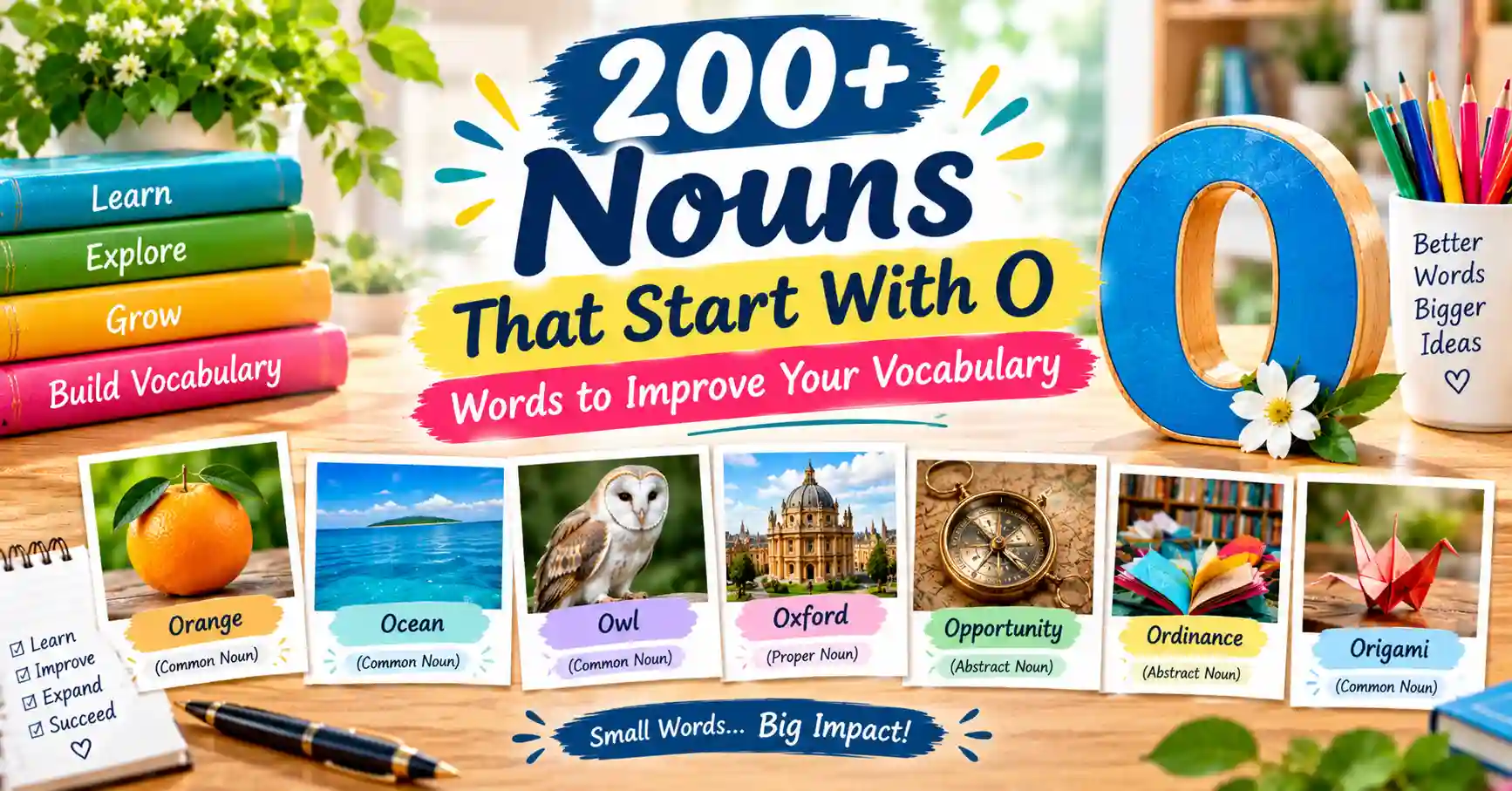
Every sentence needs a noun. Without one, there is nothing to talk about. This guide gives you a full list of nouns that start with O, from oak and ocean to optimism and opportunity. You will find meanings, examples, and clear grammar tips in one place.
O is a round and open letter. It gives us words like officers and opticians.
In this guide, you will learn:
- more than 200 real nouns, sorted by theme, length, and type
- meanings and example sentences for the top 40 words
- plurals, articles, and the simple an rule for O
- common mistakes and confusing word pairs
- origins, memory tricks, and a ten-question quiz
Every word on these lists is a noun. We kept out verbs and adjectives. A richer noun vocabulary helps you name things with care. It makes your writing sharper and your speech clearer. Let’s begin.
What Are Nouns?
Nouns are the naming words of English. They label every person, place, thing, idea, and animal we talk about. This section gives a simple definition and five examples. It also shows how nouns work inside a sentence and why a wide noun vocabulary makes you a stronger writer and speaker.
A noun is a word that names a person, place, thing, idea, or animal. Here are five examples that start with O:
- Person: “The officer helped us cross.”
- Place: “We rested at a green oasis.”
- Thing: “She grabbed an oar and pushed off.”
- Idea: “He faced the test with optimism.”
- Animal: “An owl called from the dark.”
Nouns do many jobs in a sentence. They can be the subject: “The operator answered.”
Why does a rich noun vocabulary matter? Vague nouns give a blurry picture. “A building” could be anything. “An observatory” gives a clear image. Precise nouns make reading easier and writing stronger.
Nouns that start with O follow the same rules as all other nouns. They can be common or proper. Learn the rules once, and every new word becomes easy to use.
Complete List of Nouns That Start With O
This is the heart of the guide. Here you will find O words grouped by theme, from everyday objects to rare gems. Each list is alphabetical. We begin with the top 40 words, which include meanings and examples. Then we explore people, places, nature, food, objects, ideas, names, and advanced words. Some words repeat in the later length and type lists, but no word repeats inside the main theme lists.
Top 40 Common Nouns That Start With O
These forty nouns are the most useful O words for daily life. You will hear them at home, at school, and at work. Each one has a short meaning and an example sentence. Learn these first, because they form the base for every other list in this guide.
| Word | Meaning | Example |
| oak | a large, strong tree | An oak shaded the yard. |
| oar | a pole with a flat end for rowing | He pulled hard on the oar. |
| oasis | a green spot with water in a desert | The oasis was a welcome sight. |
| oath | a solemn promise | She took an oath. |
| object | a thing you can see or touch | The object was small and round. |
| occasion | a special event or time | It was a happy occasion. |
| ocean | a vast body of salt water | We crossed the ocean. |
| octopus | a sea animal with eight arms | An octopus hid in a shell. |
| offer | something put forward for acceptance | I accepted the offer. |
| office | a room or building for work | The office opens at nine. |
| officer | a person with a position of authority | The officer checked the map. |
| oil | a thick, slippery liquid | Add oil to the pan. |
| olive | a small green or black fruit | Put an olive on the pizza. |
| omelet | eggs beaten and cooked flat | She made a cheese omelet. |
| onion | a round vegetable with a sharp smell | Chop the onion. |
| opening | a gap, or a first part | There is an opening in the fence. |
| opera | a play set to music and sung | We saw an opera. |
| operation | a process, or a medical procedure | The operation went well. |
| opinion | a personal view | What is your opinion? |
| opportunity | a good chance | This is a rare opportunity. |
| option | a choice | You have two options. |
| orange | a round citrus fruit | Peel the orange. |
| orchard | a place where fruit trees grow | The orchard was full of apples. |
| orchestra | a large group of musicians | The orchestra tuned up. |
| order | a command, or a clear arrangement | Put the books in order. |
| organ | a body part with a job, or a musical instrument | The heart is an organ. |
| organization | a group set up for a purpose | She runs an organization. |
| origin | the place or cause where something starts | Find the origin of the word. |
| ornament | a decoration | She hung an ornament on the tree. |
| orphan | a child whose parents have died | The orphan found a new home. |
| ostrich | a huge bird that cannot fly | An ostrich ran across the plain. |
| otter | a playful, swimming animal | An otter floated on its back. |
| ounce | a small unit of weight | Add one ounce of butter. |
| outcome | the result of an event | The outcome was a surprise. |
| outfit | a set of clothes | She chose a bright outfit. |
| outline | a short plan or the shape of something | Write an outline first. |
| oven | a closed space for baking | The bread is in the oven. |
| owl | a night bird with big eyes | An owl hooted nearby. |
| owner | a person who owns something | The owner locked the shop. |
| oxygen | the gas we need to breathe | Plants make oxygen. |
Pick five words from this table. Use each one in a sentence today.
Nouns for People
People fill our stories and our days. These nouns name jobs, roles, and community members. Roles such as officer, orphan, and owner already appear in the top 40. The words below add professions and everyday roles. Use them in resumes, news writing, and daily talk.
- oarsman – a person who rows
- oboist – a person who plays the oboe
- observer – a person who watches closely
- obstetrician – a doctor who cares for mothers during birth
- occupant – a person who lives in or uses a place
- official – a person who holds a public role
- oligarch – one of a few people who hold great power
- ombudsman – a person who looks into public complaints
- oncologist – a doctor who treats cancer
- operator – a person who runs a machine or a service
- opponent – a person on the other side of a contest
- optician – a person who makes and sells glasses
- optimist – a person who expects good things
- orator – a skilled public speaker
- orderly – a hospital worker who helps with basic tasks
- organizer – a person who plans and arranges events
- ornithologist – a scientist who studies birds
- orthodontist – a dentist who straightens teeth
- outlaw – a person who lives outside the law
- outsider – a person who is not part of a group
- overseer – a person who watches over workers
Use specific job nouns whenever you can. “Optician” says more than “worker.”
Nouns for Places
Places give every story a setting. These nouns name buildings, landforms, and open spaces. Some are built by people, like observatory and orphanage. Others are wild, like outback. Use them to help readers picture where something happens. Short, exact place nouns paint a clear scene.
- observatory – a building for watching the stars
- oilfield – an area where oil is pumped from the ground
- orangery – a glass building for growing citrus trees
- oratory – a small chapel
- orphanage – a home for children without parents
- outback – remote, wild land, especially in Australia
- outbuilding – a small building apart from the main house
- outhouse – a small shed used as a toilet
- outpost – a small, distant settlement
- outskirts – the outer edge of a town
- overlook – a high spot with a wide view
- overpass – a bridge that carries a road over another road
Try swapping “a place” in your own writing for one of these exact words.
Nouns for Animals and Nature
Nature offers rich nouns. This list covers animals, plants, stones, and space. A few nature words, such as oak, ocean, otter, and owl, are already in the top 40. The words below are new. They suit science lessons, nature writing, and children’s books.
- obsidian – black volcanic glass
- ocelot – a small spotted wild cat
- okapi – a forest animal related to the giraffe
- oleander – a shrub with pink or white flowers
- onyx – a banded stone, often black
- opal – a gem that flashes many colors
- opossum – a small animal that plays dead
- orangutan – a large, red-haired ape
- orbit – the path of one body around another
- orca – a black and white whale
- orchid – a delicate, showy flower
- ore – rock that holds metal
- oriole – an orange and black songbird
- oryx – an antelope with long, straight horns
- osprey – a bird of prey that dives for fish
- outcrop – rock that sticks out of the ground
- ox – a large farm animal used for work
- oxbow – a U-shaped bend in a river
- oyster – a shellfish that can make pearls
- ozone – a gas layer high in the sky
Nature nouns work best with a detail. “A lone osprey above the oxbow” paints a full picture.
Nouns for Food and Drink
Food nouns make our mouths water and our writing tasty. O has a shorter list than most letters, so this one is honest. Common foods, such as olive, omelet, onion, and orange, are already in the top 40. The words below add grains, herbs, and drinks from many kitchens.
- oatcake – a flat, baked cake of oats
- oatmeal – crushed oats cooked as porridge
- oats – a grain used for porridge and baking
- offal – the organs of an animal used as food
- okra – a green pod vegetable
- oolong – a partly fermented tea
- orangeade – a sweet orange drink
- oregano – a herb used in Italian cooking
- orzo – small, rice-shaped pasta
- ouzo – a Greek drink flavored with anise
- oxtail – the tail of an ox, used in stews
Food nouns shine when paired with senses. Try “warm oatmeal” or “sharp oregano.”
Nouns for Objects and Things
Objects are the things we hold, use, and own. These O nouns name tools, instruments, and household items. They help you describe a room, a bag, or a kitchen with accuracy. Choose the exact noun, and the reader can see it. “Oilcloth” is clearer than “cover.”
- obelisk – a tall, four-sided stone pillar
- oboe – a slim wind instrument
- ocarina – a small clay wind instrument
- octagon – a shape with eight sides
- odometer – a gauge that counts distance traveled
- ohm – a unit of electrical resistance
- oilcloth – a waterproof cloth used on tables
- oilskin – waterproof cloth or a coat made of it
- ointment – a soft cream for the skin
- opener – a tool that opens cans or bottles
- orb – a sphere
- oscilloscope – a device that shows electric waves on a screen
- ottoman – a cushioned seat or footstool
- outlet – a socket for plugs
- ovenware – dishes that can go in an oven
- overalls – work trousers with a bib
- overcoat – a heavy coat worn over other clothes
- overhang – a part that sticks out over something
Look around your room. How many of these objects can you spot?
Abstract Nouns: Emotions, Ideas, and Qualities
Abstract nouns name things we cannot touch. They cover feelings, ideas, and qualities. You cannot hold optimism in your hand, but you know it is real. These words are vital for essays, speeches, and personal writing. They let you talk about what matters most.
- obedience – the act of following orders
- objection – a statement of disagreement
- objective – a goal
- obligation – a duty
- oblivion – the state of being forgotten
- obscurity – the state of being unknown
- obsession – a thought that fills the mind
- obstacle – something that blocks the way
- occupation – a job, or the act of taking over a place
- oddity – a strange person or thing
- odor – a smell
- offense – an act that breaks a rule, or hurt feelings
- omen – a sign of what will come
- omission – something left out
- oneness – the state of being united
- onslaught – a fierce attack
- openness – the quality of being frank and willing to listen
- opposition – resistance, or a group that opposes
- oppression – cruel or unfair control
- optimism – hope for good outcomes
- opulence – great wealth and luxury
- ordeal – a hard, painful experience
- orientation – a position, or a first introduction
- originality – the quality of being new and fresh
- orthodoxy – a set of accepted beliefs
- ostracism – the act of shutting someone out
- outbreak – a sudden start of something bad
- outcry – a loud public protest
- outlook – a view of the future
- output – the amount produced
- outrage – strong anger at something unfair
- ovation – loud, long applause
- overconfidence – too much belief in oneself
- overflow – an excess that spills over
- overload – too great a load
- oversight – a mistake of not noticing, or the act of supervising
- overture – a musical opening, or a first offer
- overview – a summary of the whole
- ownership – the state of owning something
Abstract nouns carry the meaning of a piece. Back each one with a real example.
Proper Nouns That Start With O
Proper nouns name specific people, places, and things. They always start with a capital letter. All the words below begin with O, and none is a brand. Notice how the capital makes them stand out. Use proper nouns when you need to be exact about who or where.
Country
- Oman – a country on the Arabian Peninsula
Cities
- Oakland – a city in California
- Odesa – a port city in Ukraine
- Orlando – a city in Florida
- Osaka – a large city in Japan
- Oslo – the capital of Norway
- Ottawa – the capital of Canada
- Oxford – a city in England
States and provinces
- Ohio – a US state
- Oklahoma – a US state
- Ontario – a province of Canada
- Oregon – a US state
Month
- October – the tenth month of the year
Personal names
- Oliver, Olivia, Omar, Oscar, Otto, Owen
Always capitalize these words, even in the middle of a sentence.
Uncommon and Advanced O Nouns
Some O nouns are rare and elegant. They add depth to essays, speeches, and fiction. Most will not appear in casual talk. Use one or two in a piece of writing. Too many can sound showy and slow the reader down.
| Word | Meaning | Example |
| obfuscation | the act of making something unclear | The report was full of obfuscation. |
| oblation | an offering made to a god | The priest placed an oblation on the altar. |
| obloquy | public blame and abuse | He faced obloquy after the scandal. |
| obsolescence | the state of becoming out of date | Old phones suffer quick obsolescence. |
| octogenarian | a person in their eighties | The octogenarian still walks daily. |
| odium | strong public dislike | The law brought odium on the mayor. |
| odyssey | a long, adventurous journey | Their trip became an odyssey. |
| oeuvre | the complete works of an artist | The museum shows her whole oeuvre. |
| oligarchy | rule by a small group | The country became an oligarchy. |
| omnivore | an animal that eats plants and meat | A bear is an omnivore. |
| onomatopoeia | a word that imitates a sound | “Buzz” is an example of onomatopoeia. |
| onus | a burden or duty | The onus is on the buyer. |
| opprobrium | harsh public shame | The remark drew opprobrium. |
| opus | a work of art, especially music | The composer finished his great opus. |
| orthography | the system of spelling in a language | English orthography is tricky. |
| outlier | a value far from the rest | The result was an outlier. |
| overlord | a ruler over other rulers | The overlord demanded tribute. |
| oxymoron | two opposite words used together | “Jumbo shrimp” is an oxymoron. |
Learn one advanced word a week. Say it aloud before you try it in writing.
Simple Nouns for Beginners and Kids
Young learners need short, friendly words. Many simple O nouns, such as owl, otter, orange, and oven, already appear above. Three words are new: ogre, oink, and ooze. The others repeat here because they suit kids best. They are easy to say, spell, and picture. Parents and teachers can use them in games and reading time.
- octopus – “An octopus has eight arms.”
- ogre – “The ogre lived under the bridge.”
- oink – “The pig said, ‘Oink!’”
- ooze – “The mud began to ooze.”
- orange – “I peeled an orange.”
- otter – “The otter likes to swim.”
- oven – “The cookies are in the oven.”
- owl – “The owl has big eyes.”
Ask a child to find or draw each item. Games make new words stick.
Nouns That Start With O by Word Length
Word length changes how a word feels. Short nouns are quick and punchy. Long nouns sound formal and rich. This section sorts O nouns by letter count. It helps you choose words for headlines, poems, puzzles, and word games. Some words repeat from earlier lists, since one word can fit more than one group.
3-Letter Nouns That Start With O
Three-letter nouns are tiny but mighty. They are popular in word games and quick notes. O has only a few, so each one counts. They fit into tight spaces on a puzzle board. Here are all nine to learn.
oaf, oak, oar, ode, ohm, oil, orb, ore, owl
Short words are easy to remember. Try writing one sentence with three of them.
4-Letter Nouns That Start With O
Four-letter nouns strike a nice balance. They are short enough to read fast. They are long enough to carry clear meaning. You will meet them in headlines, signs, and children’s books. These twelve cover objects, nature, and ideas, so they suit many topics.
oath, oboe, odor, ogre, oink, okra, omen, onus, onyx, opal, opus, oven
Notice how many names are concrete things. That makes them easy to picture.
5-Letter Nouns That Start With O
Five-letter nouns are the favorite of puzzle fans. They fit many crossword grids and guessing games. They are also common in daily speech. The twelve words below cover objects, places, and ideas. Say each one aloud to feel its steady rhythm.
oasis, ocean, offer, olive, onion, opera, orbit, order, otter, ounce, oxbow, ozone
Use this list as a warm-up before a word game.
6-Letter Nouns That Start With O
Six-letter nouns often feel complete and friendly. Many name things we meet every day. They are long enough to be specific, yet short enough to stay simple. Try using these twelve words to replace vague nouns such as “thing” or “stuff” in your writing.
object, office, omelet, option, oracle, orange, orphan, osprey, outfit, outing, oxygen, oyster
Pick two of these and write a short, vivid sentence for each.
7+ Letter Nouns That Start With O
Long nouns add weight and detail. They are common in academic writing, reports, and formal speech. They can also name big ideas, like opportunity and originality. Use them with care, because a long word can slow a sentence. One long noun per sentence is usually enough.
obstacle, occasion, octopus, offering, opening, opinion, orchard, ornament, ostrich, outcome, outline, overview
Mix long and short words. A short noun after a long one gives your sentence a nice beat.
Nouns by Type
Nouns can be sorted in several ways. Each type tells you how a noun behaves in a sentence. This section explains six key types with examples that begin with O. Knowing the types helps you pick the right article, verb, and plural form. It also makes grammar rules much easier to remember.
Common and Proper Nouns
Common nouns name general things, such as a city or country. Proper nouns name one specific person, place, or thing, and they start with a capital letter. This simple split is the first rule of noun grammar. Look at how O words fall into both groups.
| Common noun | Proper noun |
| country | Oman |
| capital | Oslo |
| state | Ohio |
| month | October |
| boy | Oliver |
Common nouns need a capital only at the start of a sentence. Proper nouns always need one.
Concrete and Abstract Nouns
Concrete nouns name things you can see, touch, hear, smell, or taste. Abstract nouns name ideas, feelings, and qualities. Both types are vital. Concrete nouns build the scene, and abstract nouns carry the meaning. A quick test: if you can sense it with your five senses, it is concrete.
- Concrete: oak, oar, oven, owl
- Abstract: obedience, oblivion, opportunity, optimism
Strong writing blends both. “A lamp burned in the observatory, and optimism filled the room.”
Countable and Uncountable Nouns
Countable nouns can be counted: one oak, two oaks. Uncountable nouns cannot take a number directly. They are treated as a mass. We say some oil or much optimism, not an optimism. This type matters because it controls articles, plurals, and words like many and much.
- Countable: oak, ocean, office, onion, orange, owl
- Uncountable: obedience, oil, oatmeal, optimism, oxygen, ownership
To count an uncountable noun, add a unit: a drop of oil, a bowl of oatmeal.
Collective Nouns
Collective nouns name a group as a single unit. O has only a few, so this list is short and honest. They name groups of musicians, believers, workers, and relatives. In American English, most take a singular verb. British English often allows either.
- offspring – the young of a person or animal
- opposition – a group that opposes, such as a political party
- orchestra – a large group of musicians
- order – a religious community, such as an order of monks
- organization – a group set up for a purpose
- outfit – an informal word for a group or team
Example: “The orchestra tunes up before the show.”
Compound Nouns
Compound nouns join two words to make a new one. They can be written as one word, with a hyphen, or as two words. Many compound nouns are solid words, such as outlook. Check a dictionary when you are unsure, since spelling can vary.
- oatmeal (oat + meal)
- offspring (off + spring)
- oilcloth (oil + cloth)
- oilfield (oil + field)
- outbreak (out + break)
- outcome (out + come)
- outhouse (out + house)
- outlook (out + look)
- overcoat (over + coat)
- overpass (over + pass)
Spot the two smaller words inside each compound. This trick helps with spelling. Earlier lists also hold compounds such as outpost, outskirts, and overview.
Possessive Nouns
Possessive nouns show ownership. Add an apostrophe and s to a singular noun, as in the owner’s keys. Add only an apostrophe to most plural nouns that end in s, as in the owls’ nests. Irregular plurals that do not end in s take ‘s. Possessive nouns are different from possessive adjectives like my.
- the officer’s badge
- the officers’ meeting
- the otter’s den
- the owl’s nest
- the owls’ calls
- the owner’s keys
- the oxen’s yoke
Ask one question: who owns it? Then place the apostrophe next to the owner.
Spelling Patterns and Prefixes for Nouns That Start With O
Spelling gets easier when you spot patterns. Many O words share beginnings and endings. Others hide double letters or odd vowel groups. This section shows the most useful patterns for nouns that start with O. Learn them once, and you can spell and understand many new words with confidence.
Common Prefixes and Letter Combinations
Prefixes are word parts that come before a root. They change or add meaning. O is rich in them. The prefix ob- changes shape before some letters, and out- and over- build long word families. The table below shows the most helpful patterns, with example nouns for each.
| Beginning | Meaning | Example nouns |
| ob- / oc- / of- / op- | against or in the way | obstacle, objection, occupation, offense, opposition |
| out- | outside or beyond | outbreak, outcome, outline, outlook, output |
| over- | above or too much | overcoat, overflow, overload, oversight, overview |
| omni- | all | omnivore |
| ortho- | straight or correct | orthodontist, orthodoxy, orthography |
| ornith- | bird | ornithologist |
| onco- | tumor | oncologist |
When you meet a new noun, check its beginning. It often hints at the meaning.
Common Suffixes in O Nouns
Suffixes are word endings. Many turn verbs or adjectives into nouns. Knowing them helps you build word families. It also helps you spell long nouns correctly. The table below lists the most common endings in O nouns, with examples.
| Suffix | Meaning | Example nouns |
| -tion | act or result | operation, organization, omission, obligation, orientation, ovation |
| -ness | quality or state | openness, oneness |
| -ity | quality or state | oddity, originality, obscurity, opportunity |
| -ance / -ence | state or quality | obedience, overconfidence, opulence, obsolescence |
| -ship | state or bond | ownership |
| -er / -or | one who does | observer, operator, organizer, owner, overseer, opener |
| -ist | person with a skill | oboist, optimist, orthodontist, ornithologist, oncologist |
| -ism | a belief or practice | optimism, ostracism |
| -ory / -ery | place for an activity | observatory, oratory, orangery |
| -y | various | oligarchy, orthodoxy, orthography |
Add -ness to many adjectives to make a noun. Add -ist to name a person with a skill.
Tricky Spellings, Silent Letters, and Pronunciation Notes
O looks simple, but some words still trip people up. A few have double letters that people forget. Others come from French or Greek and sound different from their spelling. Learn the trouble spots below. A quick check will keep your writing clean and your speech confident.
- occasion: double c, single s. Many people write occassion.
- opportunity: double p. Say “op-er-TOO-nuh-tee.”
- omission: one m, two s. Many people write ommission.
- oasis: say “oh-AY-sis.” The plural is oases.
- oeuvre: say “UH-vruh.” It comes from French.
- onomatopoeia: say “on-uh-mat-uh-PEE-uh.”
- oneness: it starts with a “w” sound. Say “WUN-nis.”
- ocelot: say “OS-uh-lot” or “OH-suh-lot.”
- oregano: American speakers say “uh-REG-uh-no.” British speakers say “or-ih-GAH-no.”
- offense and odor: US spellings. British spellings are offence and odour.
- orangutan: also spelled orang-utan. Say “uh-RANG-uh-tan.”
- ointment: say “OYNT-ment.” The oi sounds like “oy.”
Say each tricky word aloud three times. Then write it once from memory.
How to Use These Nouns Correctly
Knowing words is only half the job. You also need to form them, place them, and match them with verbs. This section covers plurals, articles, agreement, mistakes, and confusing pairs. It also shares the simplest a or an rule for O. Learn these rules once, and you can use any O noun with confidence.
Singular and Plural Forms
Most nouns add -s to become plural. Some follow special rules. A few have two accepted forms. Others come from Latin or Greek and change in unusual ways. The table below shows thirteen O nouns, both regular and irregular. Study the pattern, and then apply it to new words.
| Singular | Plural | Rule |
| oasis | oases | Greek: -is becomes -es |
| oath | oaths | regular: add -s, but the th sound changes |
| oboe | oboes | regular: add -s |
| octopus | octopuses or octopi | octopuses is the safest form |
| offspring | offspring | usually unchanged |
| omelet | omelets | regular: add -s |
| opportunity | opportunities | consonant + y changes to ies |
| opus | opuses or opera | Latin form is opera |
| oratory | oratories | consonant + y changes to ies (for the chapel) |
| orchestra | orchestras | regular: add -s |
| ostrich | ostriches | add -es after ch |
| ox | oxen | irregular: add -en |
| oyster | oysters | regular: add -s |
When unsure, check a dictionary. Irregular plurals must be learned one by one.
Articles With Nouns
Articles are small words that come before nouns. A and an point to any one item. The points to a specific one. The choice of a or an depends on sound, not spelling. The letter O almost always starts with a vowel sound, so an is the usual partner. This is one of the simplest rules of any letter.
- Use an before almost every O noun: an oak, an ocean, an owl, an opportunity.
- The one exception: oneness starts with a “w” sound, so say “a oneness.”
- Check the next word: “a very old oak” uses a because very starts with a consonant sound. “An old oak” uses an.
- Use the for a specific item: “the officer we met.”
- Letter name: say “an O-ring” and “an O-level,” because the letter name “oh” starts with a vowel sound.
The rule is simple. Listen to the first sound of the very next word.
Noun-Verb Agreement
A verb must match its subject. A singular noun takes a singular verb. A plural noun takes a plural verb. Some nouns look tricky, such as collective, uncountable, and plural-in-use ones. These five examples show the right match.
- “The officer waits.” / “The officers wait.”
- “The orchestra plays at eight.” (a singular unit in American English)
- “Oxygen is vital.” (an uncountable noun, singular verb)
- “The oxen pull the cart.” (an irregular plural, plural verb)
- “The outskirts are quiet.” (a plural-in-use noun, plural verb)
Find the real subject first. Then match the verb to it.
Common Mistakes and Corrections
Even strong writers slip on nouns. Most errors are small and easy to fix. The table below shows seven common mistakes. Read each fix once. You will soon spot these errors in your own writing.
| Wrong | Right | Why |
| a octopus | an octopus | Octopus starts with a vowel sound. |
| a ounce | an ounce | Ounce starts with a vowel sound. |
| two oxes | two oxen | Ox has an irregular plural. |
| two oasises | two oases | Use the Greek plural. |
| oportunity | opportunity | It has a double p. |
| occassion | occasion | One s only. |
| ommision | omission | One m, two s. |
Proofread once only for nouns. You will catch more errors than when you read for everything at once.
Commonly Confused Words
Some nouns look or sound alike but mean different things. Mixing them up can change your message. The six pairs below cause trouble for many writers. Keep the table nearby when you edit.
| Pair | Difference | Example |
| oar/ore | a pole for rowing/rock that holds metal | “He pulled the oar. The mine yields iron ore.” |
| ode / owed | a poem of praise/money that is due (a verb form) | “She wrote an ode. He owed her ten dollars.” |
| offal / awful | animal organs used as food / very bad (an adjective) | “The stew held offal. The smell was awful.” |
| omission/emission | something left out / something given off | “The report had an omission. The factory cut its emissions.” |
| optician/optometristt | a person who makes glasses / a person who tests eyes | “The optician fitted my frames. The optometrist checked my sight.” |
| ordinance/ordnance | a local law / military weapons and supplies | “The town passed an ordinance. The army stored ordnance.” |
Awful, owed, and emission are not O nouns, so they sit here only as partner words. If two words confuse you, make a tiny picture for each. Pictures beat rules.
Synonyms and Related Words
Synonyms are words with similar meanings. Related words sit close by in topic or feeling. Knowing both sharpens your choices fast. The table pairs eighteen key O nouns with matches. Use it to avoid repeating yourself and to see each word more clearly.
| Word | Synonyms and related words |
| oath | vow, pledge, promise |
| obsession | fixation, mania, craze |
| obstacle | barrier, hurdle, hindrance |
| ocean | sea, deep, main |
| odor | smell, scent, stench |
| offer | proposal, bid, proposition |
| omen | sign, portent, warning |
| opinion | view, belief, judgment |
| opportunity | chance, opening, break |
| optimism | hope, confidence, positivity |
| ordeal | trial, hardship, test |
| order | command, instruction, sequence |
| origin | source, root, beginning |
| outcome | result, consequence, effect |
| outline | summary, sketch, draft |
| output | production, yield, product |
| overview | summary, survey, preview |
| owner | proprietor, holder, possessor |
Synonyms are close, but they are not twins. Each one has its own tone. Smell is plain, scent is pleasant, and stench is strong and bad. Owner is neutral, while proprietor sounds formal.
Think about intensity too. Opinion is mild. Obsession is strong. Ordeal is heavier than test. A strong word for a small thing can sound false.
Finally, think about context. Outcome fits events and studies. Result fits daily life. When unsure, pick the simpler word. Clear writing always wins.
Practical Use Cases
Words matter most when you use them. This section shows how nouns that start with O work in real writing and speech. You will see samples for school, stories, work, social media, daily talk, and word games. Copy them, change them, and make them your own.
Essays and Academic Writing
Academic writing needs precise, balanced words. Abstract nouns help you name ideas and arguments clearly. Choose nouns that are accurate and measured. Avoid slang. Here are three samples you can adapt for your own topics.
- “The study examines the impact of overconfidence on decisions.”
- “Each objective is linked to a clear outcome.”
- “The author gives a short overview of the debate.”
Storytelling
Stories live on strong, concrete nouns. The right noun sets a scene in a single beat. Use place and nature nouns to build the setting. Use abstract nouns to show feeling. Here are three lines to inspire your next story.
- “An owl watched from the old oak.”
- “Mist hung over the oasis at dawn.”
- “She felt oblivion close in as the outback grew dark.”
Resumes and Professional Writing
Work documents need clear, honest language. Role nouns and quality nouns show your value. Back each claim with a fact. Avoid vague promises. These samples show the style. Replace the details with your own facts.
- “Served as office manager for a team of ten.”
- “Met every objective for two years.”
- “Showed ownership of each project from start to finish.”
Social Media Captions
Captions are short, so every noun counts. A good noun adds mood in one beat. Keep your tone real. Followers can tell when words feel forced. Here are three ideas you can post today.
- “Oceans, olives, and a slow October.”
- “Oatmeal, oranges, and optimism.”
- “Orchards, owls, and open skies.”
Everyday Conversation
Daily talk is quick and relaxed. Simple nouns work best. A clear noun saves time and avoids confusion. Aim for natural, not fancy. Here are three samples you might hear at home, in a shop, or among friends.
- “Can you pass the oil?”
- “The office opens at nine.”
- “I need an onion for the soup.”
Word Games: Scrabble, Wordle, and Crosswords
Word games reward a large vocabulary. O nouns are handy in all of them. In standard English Scrabble, the letter O is worth one point, so it is easy to place. Short words like oaf, ode, ohm, and orb help you use the tile. Five-letter nouns suit guessing games and crossword grids.
- “Try ocean, olive, or opera when you guess five-letter words.”
- “Clue: a green spot in a desert (5 letters). Answer: oasis.”
- “Clue: a sea animal with eight arms (7 letters). Answer: octopus.”
Fun Facts and Learning Tips
Learning is easier when it is fun. Nouns that start with O have surprising stories behind them. Some came from ancient Greece and Rome. This section shares fun facts, memory tricks, word origins, daily habits, and a quiz. Each part helps you remember more O words and use them with joy.
Fun Facts About the Letter O and Its Nouns
Letters and words carry hidden stories. The seven facts below show how O has shifted across time and languages. They also make great conversation starters. Share one with a friend today and watch their surprise.
- O began as an eye. It traces back to the Phoenician letter ayin, which meant “eye.” The round shape looks like an eye. The Greeks later split it into omicron, “small O,” and omega, “big O.”
- O is one of the steadiest shapes. Its round form has changed very little across thousands of years. Few letters have stayed so close to their ancient look.
- “Orange” lost its first letter. It came from a Sanskrit word that began with n, through Persian and Arabic. English speakers heard “a norange” as “an orange,” and the n slipped away. The fruit also gave its name to the color, not the other way around.
- “Octopi” is a false Latin plural. The word octopus comes from Greek, not Latin, and it means “eight-foot.” The safest plural is octopuses. The rare Greek form is octopodes.
- “Ox” keeps an old plural. It adds -en to make oxen, like children. This pattern is older than the common -s rule.
- “Opera” is a plural in Latin. It is the plural of opus, “work.” Italian borrowed the word to name a “work” that mixes music, drama, and song.
- “Oxygen” was named by mistake. The French chemist Antoine Lavoisier coined it from Greek words meaning “acid-forming.” He believed the gas was in all acids. He was wrong, but the name stayed.
Memory Tricks and Mnemonics
Memory tricks make new words stick. The brain loves pictures, sounds, and stories. Try the five methods below. Each one uses real words from this guide. Mix them to find the one that works best for you.
- Octo means eight. Link octopus, octagon, and October, which was once the eighth month. Each word points to the number eight.
- Oar and ore. Say “An oar rows; ore is in the rock.” The a in oar stands for “afloat.”
- Optician and optometrist. Say “An optician makes glasses; an optometrist tests the eyes.” The extra -metrist hints at measuring.
- Ox to oxen. Say “Ox gets en, like children.” It reminds you not to write oxes.
- Story chain. Link words in one silly sentence: “An otter and an owl ate an omelet on an oak.” The shared sound locks them together.
Word Origins and History
Every word has a past. Knowing where a word came from deepens its meaning and helps you remember it. Here are six O nouns with their languages of origin and how their meanings changed.
- Ocean comes from Greek Okeanos, a great river that the Greeks thought circled the world. It came to English through Latin and French. The name moved from a mythic river to the vast sea.
- Orange comes from Sanskrit naranga, through Persian, Arabic, and Old French. It named the fruit first. Later the same word named the color.
- Oxygen comes from Greek oxys, “sharp” or “acid,” and genes, “forming.” Lavoisier coined it in the 1700s. Today it names the gas we breathe.
- Opera comes from Italian, from Latin opera, “works.” It first meant labor or a piece of work. Later it named a sung drama.
- Orphan comes from Greek orphanos, “bereaved,” through Late Latin. It first meant someone deprived of something. Now it names a child without parents.
- Orchestra comes from Greek orkhestra, the part of a theater where the chorus danced. The word moved from a place to the group of musicians who now fill a similar space.
Daily Practice Tips
Habits beat cramming. A few minutes each day can add many words each month. Pick two habits to start. Add more when they feel natural and easy.
- Learn an O noun of the day. Pick one new noun each morning. Use it in a text, a note, or a chat before bed. Using a word three times helps make it yours.
- Label your surroundings. Name ten objects in your home with O nouns, such as outlet, oven, and ottoman. Seeing real things helps words stay.
- Sort by category. Group words into people, places, food, and ideas. Grouping gives your brain a map to follow.
- Write one sentence a day. Use a new O noun in a sentence about your day. Real events make words memorable.
- Play word games. Try crosswords or Wordle for five minutes. Games make practice feel like play.
- Review with flashcards. Write the word on one side and the meaning on the other. Review for five minutes each week. Short, repeated practice works well.
Mini Practice Quiz
Testing yourself locks in what you learned. This quiz has ten questions. It mixes fill-in-the-blank, noun types, plurals, and matching tasks. Try it without peeking. Then check the answer key.
Fill in the blank. Word bank: orchestra, oasis, observatory.
- The ______ tuned up before the concert.
- We rested at the ______ in the desert.
- The astronomer works at an ______.
Identify the noun type.
- Is optimism concrete or abstract?
- Is Oslo a common noun or a proper noun?
Choose the correct plural.
- The plural of ox is: (a) oxes (b) oxen
- The plural of oasis is: (a) oases (b) oasises
- The plural of opportunity is: (a) opportunitys (b) opportunities
Match the meaning.
- Match each word: 1. odium 2. onus 3. opus.
(a) a work of art, especially music (b) a burden or duty (c) strong public dislike
Choose the correct phrase.
- Which is correct? (a) an octopus (b) an octopus
Answer key:
- orchestra
- oasis
- observatory
- abstract
- proper noun
- (b) oxen
- (a) oases
- (b) opportunities
- 1–c, 2–b, 3–a
- (a) an octopus
FAQs
People often ask the same questions about O words. This section gives short, clear answers. Use them for quick study, classroom review, or fast reference. Each answer is brief, but you can find fuller lists and examples earlier in the guide. Skim the questions to find the one you need.
What are some nouns that start with O?
Some common examples are oak, ocean, office, oil, onion, orange, owl, and oven. Others include optimism, opportunity, and originality. O nouns name people, places, animals, food, objects, and ideas. This guide lists more than 200 of them, including proper nouns, with meanings and examples.
What are some animals that start with O?
Popular choices include octopus, otter, owl, ostrich, ox, orca, oryx, okapi, ocelot, oriole, osprey, opossum, orangutan, and oyster. Some live in the sea, some in forests, and some on farms. An okapi is a forest animal related to the giraffe. Use these words in science lessons, stories, and animal games.
What is the longest noun that starts with O?
There is no single answer, because technical terms can be very long. Among everyday words, overconfidence has 14 letters and ornithologist has 13. Organization, obsolescence, and onomatopoeia each have 12. Scientific writing can produce even longer terms. For a word game, check an official word list. Never guess, because rules vary.
What are easy O nouns for kids?
Try owl, oak, oar, oil, orange, otter, oven, octopus, ogre, oink, and ooze. These words are short and easy to say. Each one is easy to picture, so kids can match it to a toy or an animal. Play a game where children point to each item or draw it. Fun practice builds strong word memory.
What are abstract nouns that start with O?
Abstract nouns name ideas and feelings, not physical things. Good O examples are optimism, obedience, opportunity, originality, oblivion, obsession, outrage, and ownership. You cannot touch them, but you can feel them. Use them in essays, speeches, and personal writing. They help you explain what matters and why people act the way they do.
Are there proper nouns that start with O?
Yes. Many countries, cities, and names start with O. Examples include Oman, Oslo, Ottawa, Osaka, Oxford, Ohio, Oregon, October, Oliver, and Olivia. Proper nouns always begin with a capital letter. They name one specific person, place, or thing, so they stand apart from common nouns like city and month.
Do you use “a” or “an” before O nouns?
Use an before almost every O noun, because O starts with a vowel sound: an oak, an ocean, an opportunity. The rare exception is oneness, which starts with a “w” sound, so we say “a oneness.” The letter name “oh” also takes an, as in “an O-ring.” The rule follows sound, not spelling.
Conclusion
Nouns name our world, and O gives us a round and generous share of them. In this guide, you explored a full list of nouns that start with O. You met concrete words like oak and oven, abstract words like optimism, and proper names like Oslo. You also learned plurals, articles, agreement, and fun origins.
Remember the key points. Choose specific nouns over vague ones. Check plural forms, especially irregular ones like oxen and oases. Say an owl, never a owl. Practice a little each day.
Now it is your turn. Pick three O nouns from this guide. Use each one in a sentence today. Save this list, share it with a friend, and keep building your vocabulary one word at a time.
