

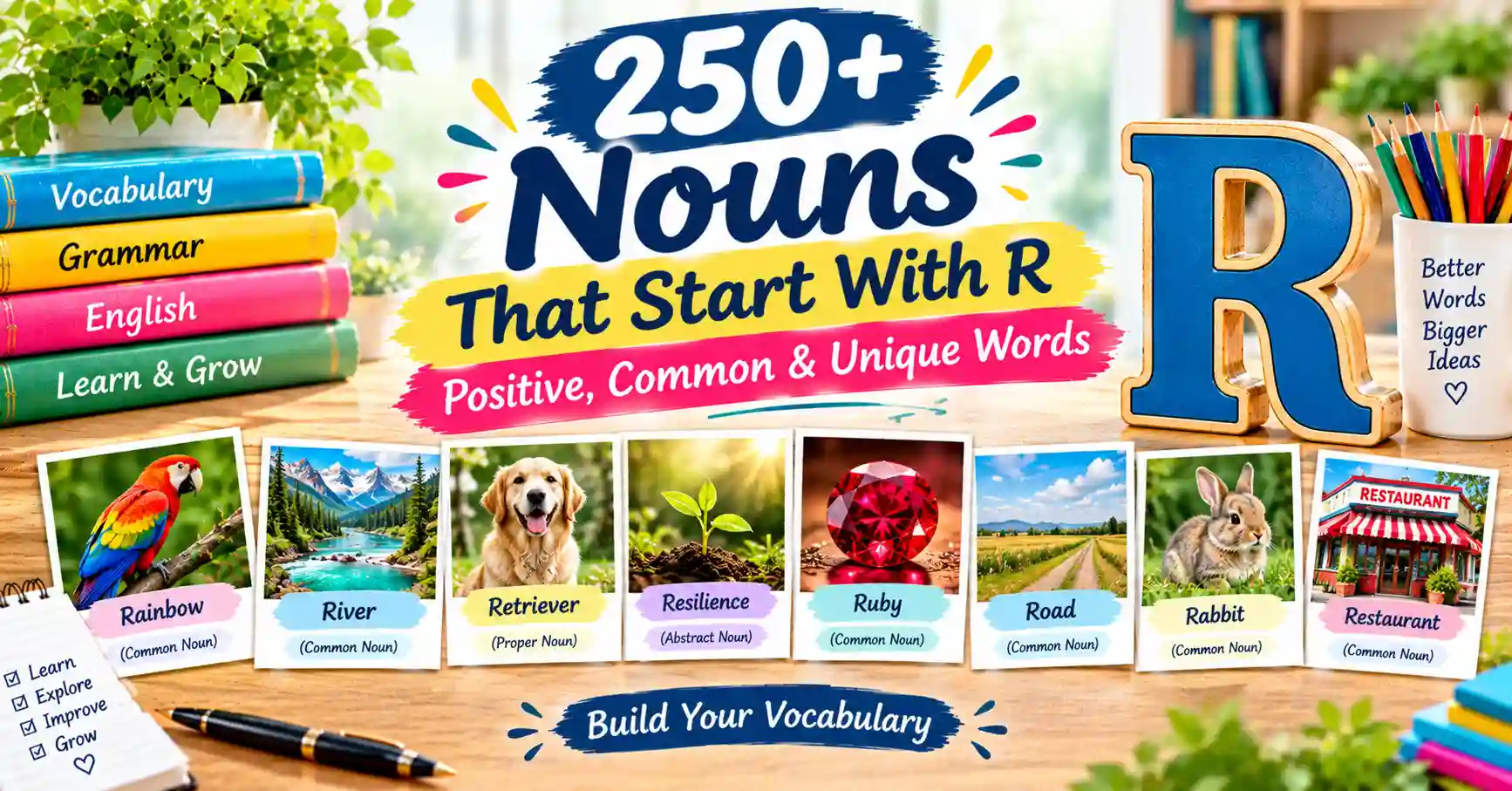
Rain, rivers, rainbows, and robots. Look closely, and the letter R is everywhere. This guide shares more than 250 nouns that start with R, and every one is real. You will find positive words, common words, and unique words in one clear place.
Each group is easy to scan. You will see meanings and example sentences for the most common words. You will learn plurals, articles, and spelling tricks. There are fun facts, memory tips, and a short quiz too.
Why does this matter? Nouns name everything we talk about. A rich noun bank makes your writing clear and your speech sharp. It also helps in school, at work, and in word games.
You will meet everyday words like “road” and “recipe.” You will also meet rare gems like “raconteur” and “rhapsody.” Words for kids, scholars, and Scrabble fans all have a home here.
Read it once. Then come back and practice. Small steps build a large vocabulary. Let’s begin.
What Are Nouns?
Nouns are the naming words of language. They name people, places, things, ideas, and animals. Almost every sentence needs at least one. Without nouns, we could not say who did something or what they did it to. Let’s look at a clear definition, five quick examples, and the job nouns do in a sentence.
A noun is a word that names a person, place, thing, idea, or animal.
Here are five examples that all start with R:
- Person: referee (a person who enforces the rules of a game)
- Place: river (a large flow of water)
- Thing: robot (a machine that does tasks)
- Idea: respect (a feeling of high regard)
- Animal: rabbit (a small, long-eared animal)
In a sentence, a noun can be the subject, the object, or the end of a phrase. In “The referee earned respect,” referee is the subject and respect is the object.
A rich noun vocabulary helps in three ways. First, you name things with more precision. “Rampart” says more than “wall.” Second, you write with more color. Third, you understand books, news, and tests faster.
Now let’s explore nouns that start with R, one group at a time.
Complete List of Nouns That Start With R
This is the full word bank. It holds more than 250 real nouns that begin with R. The words are sorted by theme, so you can browse by topic. Every list runs in alphabetical order. The first table gives meanings and examples. Later groups appear as clean lists you can scan fast.
Common Nouns Starting With R
Common nouns are the everyday words you use all the time. You hear them at home, at school, and at work. The forty words below are the best place to begin. Read each meaning. Then say the example sentence out loud once to lock it in.
| Word | Meaning | Example |
| race | a contest of speed | We watched the race. |
| radio | a device for broadcasts | Turn on the radio. |
| rain | water falling from clouds | Rain fell all day. |
| rainbow | an arc of colors in the sky | A rainbow followed the storm. |
| range | a set of choices or limits | The shop has a wide range of shoes. |
| rate | speed, or price per unit | The rate is ten dollars an hour. |
| reason | a cause or explanation | What is the reason for the delay? |
| receipt | proof of payment | Keep the receipt. |
| recipe | cooking instructions | I love Grandma’s recipe. |
| record | a written or recorded account | She broke the record. |
| report | an account of facts | Read the report. |
| request | a polite ask | I requested help. |
| research | careful study | Research takes time. |
| resource | a useful supply | Water is a vital resource. |
| rest | a time of relaxing | Take a rest. |
| restaurant | a place to eat meals | We ate at a restaurant. |
| result | an outcome | The result was a surprise. |
| review | an evaluation | Write a review of the film. |
| reward | a prize for effort | The reward was a trip. |
| rhythm | a pattern of beats | I love the rhythm of this song. |
| rice | a grain used as food | We ate rice for dinner. |
| ring | a circular band | She wore a gold ring. |
| river | a large flow of water | A river runs through town. |
| road | a paved way for travel | The road was empty. |
| robot | a machine that does tasks | The robot cleaned the floor. |
| rock | a hard natural stone | He sat on a rock. |
| role | a part played | She has a key role. |
| roof | the top covering of a building | The roof leaks. |
| room | a space in a building | Clean your room. |
| root | the underground part of a plant | The root grows deep. |
| rope | a thick cord | Tie the rope tight. |
| rose | a fragrant flower | She gave me a rose. |
| route | a way taken to a place | We took the short route. |
| routine | a regular habit | My morning routine is simple. |
| row | a line of things | We sat in the front row. |
| rug | a floor covering | The rug is soft. |
| rule | an instruction on what to do | Follow the rule. |
| rumor | an unproven story | A rumor spread fast. |
| run | an act of running | He went for a run. |
| rush | a sudden hurry | The morning rush began. |
Start with ten words. Write one sentence for each. Then add ten more.
Nouns for People
Many R nouns name people. Some show a job. Some show a role in a game or a group. These words are useful in stories, resumes, and daily talk. The twenty-six words below cover work, study, sport, and leadership. Notice how many end in “-er.”
rabbi, racer, radiologist, rancher, ranger, reader, rebel, receptionist, recruit, referee, refugee, regent, relative, reporter, representative, researcher, resident, retiree, reverend, rider, rival, robber, roommate, rower, ruler, runner
Endings like “-er” and “-ist” often name a person who does something.
Nouns for Places
Places give a story its setting. They also help us give directions and describe travel. R has places for land, water, towns, and buildings. The twenty-four nouns below range from a quiet riverbank to a busy runway. Use them to make your descriptions feel real.
railroad, railway, rainforest, rampart, ranch, ravine, realm, reef, refuge, region, republic, reservoir, residence, resort, restroom, retreat, rink, riverbank, roadway, rooftop, rotunda, roundabout, ruin, runway
Pick a place word to open your next story. “A hidden ravine” sets a mood fast.
Nouns for Animals and Nature
Nature is full of R words. Birds, beasts, and landscapes all join the list. These nouns are loved by kids and nature writers alike. Many carry strong images and sounds. The seventeen words below include pets, wild animals, and bits of the wild world.
rabbit, raccoon, ram, rapids, rat, rattlesnake, raven, redwood, reed, reindeer, reptile, rhino, rhinoceros, ridge, ripple, robin, rooster
Say them aloud. Many R animals have a rolling, rumbling sound.
Nouns for Food and Drink
Food words make us hungry and make writing tasty. They also appear on menus, in recipes, and at family tables. R gives us sweet fruit, hearty grains, and rich flavors. The fourteen words below cover produce, meals, and drinks. They are perfect for cooking posts and menu writing.
radish, raisin, ramen, raspberry, ravioli, relish, rhubarb, risotto, roast, roll, rosemary, rum, rutabaga, rye
Use specific food nouns in your writing. “A raspberry tart” is tastier than “a dessert.”
Nouns for Objects and Things
Objects fill our homes, bags, and workplaces. We touch them every day. Naming them well makes your writing clear and exact. R has tools, toys, and daily items. The twenty-two nouns below range from a simple rag to a powerful rocket. Learn the ones you do not know yet.
rack, racket, radar, radiator, raft, rag, rake, ramp, rattle, razor, receiver, recorder, refrigerator, remote, ribbon, rocket, rod, roller, rubber, ruby, rucksack, rudder
Look around you. Can you name five of these objects in your room right now?
Abstract Nouns
Abstract nouns name ideas, feelings, and qualities. You cannot touch them or see them. Still, they shape how we think and speak. The twenty-nine words below are split into two groups. The first group holds positive nouns that lift a sentence. The second holds neutral and negative ones. Use both to give your writing depth.
Positive: radiance, rapport, reassurance, recognition, reconciliation, recovery, refinement, relaxation, reliability, relief, resilience, resourcefulness, respect, responsibility, reverence, romance
Neutral and negative: rage, reality, rebellion, regret, rejection, remorse, resentment, resistance, restraint, revenge, ridicule, risk, rivalry
Abstract nouns often end in “-ity,” “-ness,” “-ence,” or “-ion.” Spot those endings to find more.
Proper Nouns
Proper nouns name specific people, cities, countries, and special days. They always start with a capital letter. Here, every one begins with a capital R. These words are useful in geography, history, and travel writing. The twenty-two names below include nations, cities, rivers, and famous figures.
Rabat, Rachel, Raleigh, Ramadan, Raphael, Ravi, Rawalpindi, Rebecca, Reykjavik, Rhine, Rhodes, Richmond, Riga, Riyadh, Robert, Romania, Rome, Rotterdam, Rumi, Russia, Ruth, Rwanda
Always capitalize proper nouns. “Rome” is a city. “rome” is a typo.
Uncommon or Advanced Nouns
Rare nouns make your writing stand out. Use them in small doses. One advanced word per paragraph is plenty. Too many can confuse a reader. The twenty-six words below are strong, precise, and often found in books and speeches. Learn two or three at a time, and check each in a dictionary before you use it.
raconteur, rancor, rapier, rapture, rationale, rebuttal, recluse, redress, regalia, regimen, rejoinder, relic, remnant, renaissance, renown, repose, reprieve, reprisal, reverie, rhapsody, rhetoric, rigor, rostrum, rubric, rudiment, ruse
Try “a rich reverie” instead of “a daydream.” It adds polish.
Simple Nouns for Beginners and Kids
If you are just starting, begin here. These ten words are short, common, and easy to say. Children love them, and so do new English learners. Each one names something you can see, hear, or touch. Draw a small picture for each word to help it stick.
rap, ray, rhyme, rib, riddle, ride, rim, roar, robe, rodent
Read them aloud with a friend. Then make a sentence for each word.
Nouns by Word Length
Sorting words by length helps in spelling, games, and puzzles. Short words are easy to learn. Long words need chunking. This section groups R nouns by how many letters they have. None of the words below repeats an earlier list. Use these groups to build your word-game skills.
3-Letter Nouns
Three-letter words are the building blocks of English. They are quick to spell and easy to remember. They are also gold in Scrabble and crossword grids. These eight nouns each have a clear, simple meaning. Learn them first, then move on to the longer groups.
ref, rep, rev, rig, roe, rot, rub, rut
Short words fit tight spaces. Keep these handy for puzzles.
4-Letter Nouns
Four-letter words are the sweet spot for many games. They give you enough letters to build a plan, but they stay easy to hold in memory. The thirteen nouns below cover objects, events, and everyday life. Say each one and picture it in your mind.
raid, rail, rank, rant, rash, rear, reel, rent, rift, rind, riot, rite, rust
Many 4-letter nouns also work as verbs. Check the sentence to know which one you have.
5-Letter Nouns
Five-letter words are popular in word puzzles. They are long enough to be tricky and short enough to guess. The fourteen nouns below range from “rally” to “rumba.” They are great for Wordle fans and for anyone who loves a quick brain game.
rally, ratio, reach, relay, reply, rifle, right, rodeo, rogue, roost, round, rover, rugby, rumba
Notice the double sounds in words like “rally.” Break them into chunks to remember them.
6-Letter Nouns
Six-letter words begin to show patterns like double letters and clear endings. They are useful in essays and stories. The fourteen nouns below cover money, travel, law, and daily life. Break each one into two small chunks when you learn it. “Re-pair” and “rum-ble” are easy.
radius, ransom, rascal, rebate, reform, refund, regime, remedy, rental, repair, rescue, retail, rubble, rumble
Split long words into chunks. Your memory will thank you.
7+ Letter Nouns
Longer nouns add weight and detail to writing. They often come from Latin or French. Learn them by their parts, such as a prefix, a root, and a suffix. The fourteen words below range from eight to eleven letters. Use them when you want your writing to sound precise.
raincoat, rainfall, reaction, reception, reference, reflection, reminder, reputation, requirement, reservation, resolution, retirement, revenue, revolution
Long words feel hard at first. With practice, they become easy.
Nouns by Type
Nouns come in several types. Each type tells us something about how a word works. Some are specific. Knowing the types helps you use articles, plurals, and verbs the right way. Let’s explore six key types with R examples.
Common and Proper Nouns
Common nouns name general things. Proper nouns name specific ones and use capital letters. The same idea can appear in both forms. For example, “river” is common, but “Rhine” is proper. Knowing the difference helps with capitalization and with clear writing.
- Common: robot, road, rooster, ruler
- Proper: Rome, Romania, Russia, Rwanda
Concrete and Abstract Nouns
Concrete nouns name things you can see, touch, hear, smell, or taste. Abstract nouns name ideas and feelings. Good writing uses both. Concrete nouns paint a picture. Abstract nouns explain meaning. Try to balance them in each paragraph you write.
- Concrete: radio, ribbon, rock, rose
- Abstract: rage, relief, resilience, respect
Countable and Uncountable Nouns
Countable nouns can take a number and a plural form. Uncountable nouns cannot. We do not say “two rices.” We say “some rice.” This rule matters for words like “much” and “many.” It also decides whether a verb is singular or plural.
- Countable: rabbit, recipe, rock, rule
- Uncountable: rain, research, respect, rice
Collective Nouns
Collective nouns name a group as one unit. They are fun and full of character. Many animal groups have special R names. Use them to add flavor to stories, speeches, and quizzes. Remember that some can take a singular or plural verb.
- a rabble of butterflies
- a regiment of soldiers
- a rhumba of rattlesnakes
- a romp of otters
- a rookery of penguins
Compound Nouns
Compound nouns join two words into one idea. They may be written as one word, two words, or with a hyphen. Check a dictionary when you are unsure. Many everyday R words are compounds. Spotting the two parts makes them easy to spell and remember.
racehorse, raindrop, rainstorm, ringtone, roadmap, roadside, rosebud, rowboat
Possessive Nouns
Possessive nouns show who owns something. Add an apostrophe and “s” to most singular nouns. Add just an apostrophe to most plural nouns that end in “s.” This small mark changes meaning, so place it with care. It tells the reader who owns what.
- the rabbit’s ears
- the rancher’s hat
- the referees’ whistles
- the reporters’ notebooks
Spelling Patterns and Prefixes for the Letter R
Spelling gets easier when you see patterns. R begins many words, and each pattern hints at a meaning. This section shows common prefixes, endings, and tricky spots. Use it as a map when you study nouns that start with R. A short list of patterns can unlock hundreds of words.
Common Prefixes and Letter Combinations
Prefixes are small word parts added to the front of a word. They change or shape the meaning. The prefix “re-” is the star of the R family. Learn these patterns once, and you can guess new words with ease. The list below shows each part, its rough meaning, and sample nouns.
- re- (again, back): rebirth, recall, refill, replay, restart
- retro- (backward): retrofit, retrospect
- radio- (rays, radio): radioactivity, radiograph, radiotherapy
- rh- (a silent-H spelling from Greek): rhetoric, rhinoceros, rhyme, rhythm
Spot the prefix first. Then the rest of the word is easier to read.
Common Suffixes Found in These Nouns
Suffixes are word parts added to the end. Many noun endings show what kind of thing a word names. Knowing them helps you spell and sort new words. The examples below all start with R. Practice by adding each ending to a new base word.
- -ance / -ence (a state): radiance, reference, reliance, residence, resistance
- -ism (a belief or practice): racism, rationalism, realism, romanticism
- -ity (a quality): rarity, reality, regularity, reliability
- -ment (a result or action): refinement, reinforcement, replacement, requirement, resentment, retirement
- -ness (a state): readiness, restlessness, rudeness
- -ship (a skill or bond): readership, relationship
- -tion (an action or result): reaction, reception, recognition, reflection, relation, repetition, reputation, resolution, revolution
Suffixes often change a verb or adjective into a noun. “Retire” becomes “retirement.”
Tricky Spellings, Silent Letters, and Pronunciation
R can be sneaky. Sometimes a silent letter hides inside the word. Sometimes a spelling looks very different from how it sounds. These traps catch even skilled readers. Learn the patterns below, and you will avoid many common errors in speech and spelling.
- Silent H after R: rhyme, rhythm, rhubarb, rhetoric. The “h” makes no sound.
- Silent P: raspberry and receipt both hide a silent “p.”
- Silent letters in French words: rendezvous ends with a silent “z” and “s.”
- Often misspelled: restaurant (not “restaraunt”), rhythm (not “rythm”), recommendation (one “c,” two “m”s).
Notice that “rhythm” has no a, e, i, o, or u. The letter “y” does the vowel work.
How to Use These Nouns Correctly
Knowing a noun is not enough. You must use it well. This section covers the rules that matter most: plurals, articles, verb agreement, mistakes, and confusing pairs. Use it as a quick guide before you write or speak. Practice with the nouns that start with R that you like best.
Singular and Plural Forms
Most nouns add “-s” to become plural. Some add “-es.” Some change “y” to “ies.” A few are irregular and must be learned by heart. The table below shows fourteen R nouns and their plural forms. Study the pattern, then cover the middle column and test yourself.
| Singular | Plural | Type |
| rabbit | rabbits | regular (-s) |
| radio | radios | regular (-s) |
| radius | radii (or radiuses) | irregular (Latin) |
| rash | rashes | regular (-es) |
| ratio | ratios | regular (-s) |
| reef | reefs | regular (-s) |
| reindeer | reindeer | irregular (no change) |
| relay | relays | regular (-s) |
| remedy | remedies | regular (y → ies) |
| rhinoceros | rhinoceroses (or rhinoceros) | regular / variant |
| rodeo | rodeos | regular (-s) |
| roof | roofs | regular (-s) |
| rose | roses | regular (-s) |
| ruby | rubies | regular (y → ies) |
Words ending in “s,” “ch,” or “sh” take “-es.” Words ending in a consonant plus “y” take “-ies.” A vowel plus “y” simply adds “-s,” as in “relays.”
Articles With Nouns
Articles are the small words “a,” “an,” and “the.” Use “a” before a consonant sound. Use “an” before a vowel sound. R always makes a consonant sound when it starts a word. So you say “a rabbit,” “a robot,” and “a rhyme.” Use “the” for a specific thing.
Examples:
- a river, a recipe, a rhinoceros
- the river near home, the recipe in this book
- No article for uncountable ideas: “Respect is earned.”
The letter name is the exception. You say “an R” because the name “ar” begins with a vowel sound. You also say “an RV.”
Noun-Verb Agreement
A verb must match its noun. Singular nouns take singular verbs. Plural nouns take plural verbs. A few nouns need extra care, such as uncountable, collective, and always-plural nouns. Read each example below, and notice how the verb changes with the noun.
- The rabbit hops across the lawn. (singular)
- The rabbits hop across the lawn. (plural)
- Rice is cheap here. (uncountable, singular verb)
- A rookery of penguins is noisy. (collective, one unit)
- The rapids are dangerous. (always plural)
Common Mistakes and How to Avoid Them
Everyone makes mistakes. The key is to spot them early. Here are six that learners make often. Each has a quick fix. Read them twice. Then check your next piece of writing for the same slips.
- Wrong: “I bought two rices.” Right: “I bought two bags of rice.” (Rice is uncountable.)
- Wrong: “She did many researches.” Right: “She did a lot of research.”
- Wrong: “The reindeers ran.” Right: “The reindeer ran.” (The plural is the same.)
- Wrong: “An robot walked in.” Right: “A robot walked in.”
- Wrong: “A strong rythm.” Right: “A strong rhythm.”
- Wrong: “Reccomendation.” Right: “Recommendation.”
Commonly Confused Words
Some nouns look or sound alike but mean different things. Mixing them up can change your message. Here are six pairs worth learning. Study the difference. Then try each word in a sentence of your own. Soon the right choice will feel natural.
- rain/reign: Rain is water from the sky. A reign is the time a ruler holds power.
- recipe/receipt: A recipe is cooking instructions. A receipt is proof of payment.
- right / rite: A right is something you are owed. A rite is a ceremony.
- role/roll: A role is a part played. A roll is a small bread or a turning motion.
- root/route: A root is the underground part of a plant. A route is a way to a place.
- reality/realty: Reality is what is real. Realty is real estate.
Synonyms and Related Words
Synonyms are words with similar meaning. Related words share a theme. Learning both helps you avoid repeating yourself. You also gain a feel for shades of meaning. The table below covers sixteen key nouns. It is a handy tool for anyone studying nouns that start with R.
| Noun | Synonyms | Related Words |
| race | contest, competition | sprint, marathon |
| rain | rainfall, shower | drizzle, storm |
| reason | cause, motive | logic, purpose |
| recipe | formula, method | ingredient, dish |
| request | appeal, petition | demand, plea |
| reward | prize, bonus | payment, bounty |
| rhythm | beat, tempo | meter, pulse |
| road | street, highway | lane, avenue |
| role | part, function | duty, character |
| rule | law, regulation | guideline, policy |
| relief | comfort, ease | release, rest |
| respect | esteem, regard | honor, courtesy |
| rival | opponent, competitor | enemy, challenger |
| rumor | gossip, hearsay | tale, whisper |
| refuge | shelter, haven | sanctuary, asylum |
| radiance | glow, brilliance | light, shine |
Choosing between synonyms is about tone and context. “Reward” and “bonus” both mean extra gain. But “reward” feels warm and personal, while “bonus” feels like business. “Rumor” is plain. “Hearsay” sounds legal and formal. Ask yourself two questions. Who is reading? How strong should the feeling be? Then pick the noun that fits.
Practical Use Cases
Words matter most when you use them. This section shows where R nouns fit in real life. You will see ideas for school, stories, work, social media, daily talk, and word games. Each type of writing has its own tone. Match your noun choice to that tone, and your message will land well.
Essays and Academic Writing
Academic writing needs precise, neutral nouns. Choose words that are clear and formal. Avoid slang. Nouns like “research,” “relationship,” and “resolution” work well. They sound professional and exact. Use them to frame ideas and present evidence without sounding emotional.
- The research shows a clear link between sleep and memory.
- The relationship between the two events is complex.
- The council passed a resolution on clean water.
Storytelling
Stories need setting, character, and mood. Strong nouns help readers see and feel the scene. Use place, nature, and object nouns to build a world. A single sharp noun can carry a whole image. Choose words that match the mood you want.
- A lone raven watched from the rampart.
- A rumor crept through the ruins at dawn.
- She traced a ripple across the reservoir.
Resumes and Professional Writing
Resumes need short, strong nouns. Name your skills, tools, and results. Words like “result,” “responsibility,” and “recognition” add weight. Always back them with numbers or proof. Claims without proof feel empty to hiring managers.
- Delivered a result that saved 15% in costs.
- Took responsibility for a team of eight.
- Earned recognition for top customer service.
Social Media Captions
Captions are short and catchy. A single strong noun can make a post pop. Choose fun, light words. Nouns like “rainbow,” “rest,” and “recipe” work well. Keep your tone warm and natural. Short captions often win more attention than long ones.
- A rainbow after the storm 🌈
- Sunday is for rest and good coffee.
- Grandma’s recipe never fails.
Everyday Conversation
In daily talk, simple nouns win. Use common words that sound warm and clear. “Reason,” “request,” and “rest” are perfect. They help you share thoughts fast. You do not need fancy words to sound smart. Clear speech always sounds good.
- “What’s the reason for the delay?”
- “I have a small request.”
- “You need some rest.”
Word Games (Scrabble, Wordle, Crosswords)
Word games reward a big noun bank. R is worth one point in English Scrabble, and it appears often, so it is a handy tile. Short R nouns fit tight crossword grids. Five-letter nouns like “radio” and “river” suit Wordle-style guessing. Practice with the length lists above to build speed.
- Try the Scrabble plays rut or rig to fit a tight spot.
- Guess radio or right as a five-letter starter.
- For a crossword clue “Coral formation,” think reef.
Fun Facts and Learning Tips
Learning words should be fun. Stories stick better than lists. In this section, you will find surprising facts, smart memory tricks, word histories, daily habits, and a quiz. Take your time here. Try one idea at a time. Soon, nouns that start with R will feel like old friends, and your vocabulary will grow with every page you read.
Fun Facts About the Letter R and Its Nouns
The letter R has an old and colorful story. Its words hide odd plurals, silent letters, and famous inventions. These six facts show how alive English can be. Share a few with friends. They make great conversation starters, and they help words stay in your memory.
- R began as a “head.” The Phoenician letter resh meant “head.” Greek turned it into rho (Ρ), and Latin added a small leg to make R.
- Romans called R “the dog letter.” The Latin phrase littera canina describes the growling, rolling sound of R. It sounded like a dog’s snarl.
- “Rhythm” has no standard vowels. It uses the letter “y” instead of a, e, i, o, or u. It is one of the best-known vowel-free-looking words in English.
- R is a busy letter in writing. It ranks among the ten most frequent letters in English text. That is why it is so useful in word games.
- “Reindeer” stays the same. The plural is “reindeer,” not “reindeers.” Only a few animal names behave this way.
- “Robot” comes from a play. The Czech play R.U.R. in 1920 made the word famous. Its author, Karel Čapek, said his brother Josef coined it.
Memory Tricks and Mnemonics
Memory tricks turn hard words into easy ones. Your brain loves pictures, sounds, and stories. Use the five tricks below. Each one has an example from our list. Try making your own too. Personal tricks work best because they connect to things you already know and care about.
- Alliteration: Link words with the same sound. “Rosy rabbits race rainbows.”
- Hip chant for rhythm: “Rhythm Helps Your Two Hips Move.” Each first letter spells R-H-Y-T-H-M.
- Pay clue: A “receipt” has a silent “p,” as in “pay.” A “recipe” has an “i,” as in “ingredients.”
- Prefix clue: “Re-” means again. A “replay” plays again. A “restart” starts again.
- Picture clue: “Rival” and “river” look alike. Rivals once shared the same river.
Word Origins and History
Word origins explain why meanings feel the way they do. Here are five R nouns and where they came from. Notice how far some words have traveled. Seeing the root often unlocks the meaning. It also helps you guess new words you meet later, without opening a dictionary.
- Rival: From Latin rivalis, meaning “one who uses the same stream.” People who shared a river often argued over it. The word later meant any competitor.
- Rhythm: From Greek rhythmos, meaning “flow” or “measured motion.” It first described the flow of movement. Later it described patterns in music and speech.
- Rebel: From Latin rebellis, meaning “waging war again.” It first named a people who fought Rome after defeat. Now it names anyone who resists authority.
- Recipe: From Latin recipe, meaning “take!” Old medical notes began with this command. It later named any set of instructions for mixing things.
- Rhinoceros: From Greek rhinokeros, meaning “nose-horn.” It joins rhis, “nose,” and keras, “horn.” The name describes the animal’s most striking feature.
Daily Practice Tips
Small habits beat big plans. Ten minutes a day can change your vocabulary in a month. Pick two or three of the habits below. Stay steady. Progress will come. Do not worry about speed. Regular practice matters far more than long, rare study sessions.
- Read every day. Pick articles, stories, or recipes. Underline any R noun you meet. Look up the ones you do not know.
- Keep a word journal. Write three new nouns each day. Add a meaning and your own sentence. Review the page each week.
- Use flashcards. Put the word on one side and the meaning on the other. Paper cards or apps both work. Short, frequent reviews are best.
- Label your home. Stick notes on a rug, a radio, and a refrigerator. Seeing the word with the object builds strong links.
- Speak out loud. Say each new noun in a full sentence. Hearing yourself helps memory. Try it while walking or cooking.
- Play word games. Try Scrabble, Wordle, or crosswords with a friend. Games make practice fun and fast.
Mini Practice Quiz
Quizzes show what you know. They also show what to review. Try these ten questions without peeking. Write your answers on paper. Then check the answer key. Be kind to yourself. Every mistake is a step forward, and every correct answer proves your hard work is paying off.
- What is the plural of “reindeer”? (reindeer / reindeers)
- Which letter is silent in “rhyme”? (r / h / y)
- Keep your ___ as proof of payment. (receipt/recipe)
- A ___ of penguins. (rookery/romp/rabble)
- Which noun is abstract? (robot/respect/rope)
- Choose the correct article: ___ robot. (a / an)
- What does “rival” mean? (an opponent / a helper / a friend)
- Which noun is uncountable? (rice/rabbit/ring)
- The king’s ___ lasted forty years. (rain/reign/rein)
- Which noun is proper? (Rome / river/road)
Answer Key
- reindeer – The plural has no change.
- h – The “h” makes no sound.
- receipt – A recipe is for cooking.
- rookery – A group of penguins is a rookery.
- respect – You cannot touch it.
- a – R makes a consonant sound.
- an opponent – It names a competitor.
- rice – We say “some rice,” not “two rices.”
- reign – A reign is a ruler’s time in power.
- Rome – It names a specific city.
Frequently Asked Questions
Learners often ask the same smart questions. This section answers the most common ones. Each answer is short and clear. Use them as quick reminders when you study or write. If you still have a question after reading, test the words in your own sentences and see how they sound.
What are nouns that start with R?
Nouns that start with R are naming words that begin with the letter R. Examples include road, river, rabbit, respect, robot, and recipe. They name people, places, things, ideas, and animals. This guide lists more than 250 of them, with meanings, examples, plurals, and usage tips.
What are some animals that start with R?
Popular choices include rabbit, raccoon, ram, rat, rattlesnake, raven, reindeer, rhinoceros, robin, and rooster. They live in forests, farms, deserts, and backyards. Many have strong sounds and clear images, so kids love them. Use them in stories, school projects, and games.
What is the longest noun that starts with R?
There is no single official answer. In daily English, words like “responsibility,” “representative,” and “rehabilitation” have 14 letters. Technical words are longer. “Radioimmunoassay” has 16 letters and names a lab test. Long words are easier when you split them into small chunks, such as “re-hab-il-i-ta-tion.”
What are easy nouns that start with R for kids?
Good beginner choices are rat, rug, ring, road, rain, rose, rock, rope, ray, and robe. They are short and easy to say. Each name is something a child can see or touch. Pair each word with a picture, and ask kids to make a simple sentence.
What are some positive R nouns?
Warm choices include respect, relief, resilience, rapport, reassurance, recovery, radiance, reverence, and romance. Each one lifts the tone of a sentence. “Resilience” praises strength. “Rapport” praises connection. “Relief” praises comfort. Use them in speeches, cards, and kind messages.
Is “rice” countable or uncountable?
“Rice” is usually uncountable, so you say “some rice” or “a bowl of rice.” You do not say “two rices.” In food writing, “rices” can mean different types, such as “basmati and jasmine rice.” In everyday English, use a unit word like “cup,” “bag,” or “grain.”
What are some proper nouns that start with R?
Examples include Rome, Romania, Russia, Rwanda, Riga, Riyadh, Rotterdam, Rabat, and Reykjavik. Proper nouns name specific people, places, and things, so they always start with a capital letter. Use them in geography, history, and travel writing. Check each spelling, since small errors are easy to miss.
Conclusion
You saw how to sort them by theme and length, spell them, pluralize them, and avoid common mistakes. Here are the key takeaways. Start with the simple words. Add a few rare ones for flavor. Use them in real sentences. Review often.
Vocabulary grows through use, not just reading. So take action today. Pick five R nouns from this page. Write one sentence for each. Save this article for later. Share it with a friend who loves words. Keep practicing, and your writing will shine.
