

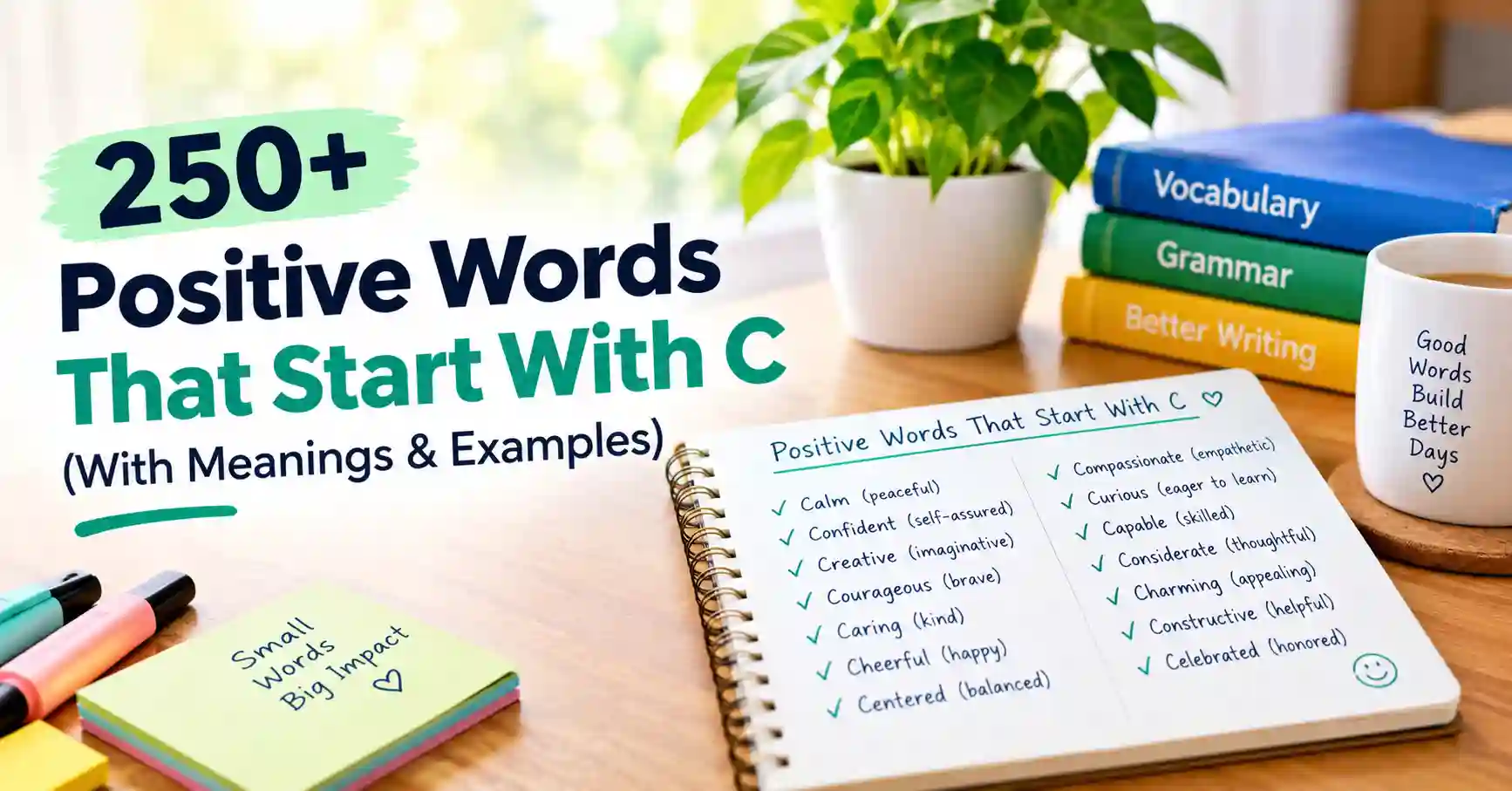
Words can change a day. A kind word can calm a worried mind. A bright word can turn a dull message into a warm one. A strong list of positive words that start with C gives you more choices every time you speak or write.
This guide gives you more than 250 positive words that start with C. You will see adjectives, nouns, verbs, and adverbs. They are grouped by meaning, theme, and length. The top 40 words come with meanings and example sentences.
You will also learn how to use these words well. We cover tone, specific praise, common mistakes, and confusing word pairs. A short quiz at the end checks what you learned.
Why does this matter? Positive vocabulary helps you encourage others, express feelings clearly, and write with warmth. Pick a few words today. Use them in real sentences.
What Are Positive Words?
Let us start with the basics. Positive words carry a good meaning or a good feeling. They praise, comfort, encourage, or celebrate. We use them to show kindness, joy, and respect. A positive word does not hide the truth. It simply chooses a helpful and warm way to say it.
Simple definition: A positive word is a word with a clearly good meaning or a warm emotional tone.
Here are five positive words that start with C, each in a sentence:
- calm: She stayed calm during the storm.
- courage: It takes courage to speak up.
- cherish: I cherish our time together.
- creative: He is a creative thinker.
- compassion: The nurse treated everyone with compassion.
Every word has two layers. The first is its denotation, the plain dictionary meaning. The second is its connotation, the feeling it carries. “Thin” and “slender” both describe a small body, but slender feels warmer. Good writers choose words with both layers in mind.
Positive words improve communication in three ways. They make messages clearer and kinder.
Complete List of Positive Words That Start With C
This is the heart of the guide. Below you will find positive words that start with C in seven groups. Each group has its own purpose. The main lists show the part of speech for every word. No word appears twice in the guide’s main lists. Start with the group that fits your goal today.
Top 40 Positive Words That Start With C
The top 40 are the most useful positive words that begin with C. They appear in daily speech, school texts, and cards. The table gives each word’s part of speech, a short meaning, and an example sentence. The words are in alphabetical order.
| Word | Part of Speech | Meaning | Example Sentence |
| calm | adjective | peaceful and relaxed | She stayed calm during the storm. |
| candid | adjective | honest and open | I appreciate your candid advice. |
| capable | adjective | able to do things well | He is a capable leader. |
| care | noun | kind attention and concern | The nurse showed great care. |
| caring | adjective | kind and thoughtful | She is a caring friend. |
| celebrate | verb | to mark a happy event | We celebrate her success tonight. |
| celebration | noun | a joyful event | The celebration lasted all night. |
| champion | noun | a winner, or a strong supporter | She is a champion for kindness. |
| charity | noun | generosity toward those in need | Her charity changed many lives. |
| charm | noun | a delightful, attractive quality | He won us over with his charm. |
| charming | adjective | very pleasing | What a charming little town! |
| cheer | verb | to encourage with happy shouts | We cheer for our team. |
| cheerful | adjective | happy and bright | The cheerful baker greeted us. |
| cherish | verb | to hold dear | I cherish our time together. |
| clarity | noun | clearness of thought | The teacher spoke with clarity. |
| clever | adjective | quick to learn and solve problems | That was a clever idea. |
| collaborate | verb | to work together | Let us collaborate on this project. |
| comfort | noun | ease and relief | Her words brought comfort. |
| commend | verb | to praise | I commend your hard work. |
| commitment | noun | dedication to a goal | Her commitment inspires us. |
| compassion | noun | deep care for others’ pain | He treated everyone with compassion. |
| compassionate | adjective | showing deep care | A compassionate nurse sat with her. |
| compliment | noun | a kind remark | She gave me a lovely compliment. |
| confidence | noun | belief in yourself | You can speak with confidence. |
| confident | adjective | sure of yourself | He felt confident before the test. |
| congratulate | verb | to share joy for an achievement | I congratulate you on the win. |
| connect | verb | to build a bond | Good stories connect people. |
| considerate | adjective | thoughtful of others | A considerate guest helps clean up. |
| contentment | noun | quiet happiness | She found contentment in simple things. |
| cooperate | verb | to work well together | The kids cooperate during games. |
| cordial | adjective | warm and friendly | They gave us a cordial welcome. |
| courage | noun | the strength to face fear | It takes courage to speak up. |
| courageous | adjective | brave | The courageous girl saved her friend. |
| courtesy | noun | polite, respectful behavior | Thank you for your courtesy. |
| cozy | adjective | warm and comfortable | We sat in a cozy room. |
| create | verb | to make something new | Artists create beauty. |
| creative | adjective | full of new ideas | She is a creative thinker. |
| creativity | noun | the power to imagine and make | Creativity makes work fun. |
| cultivate | verb | to grow and develop | Cultivate kindness every day. |
| curious | adjective | eager to learn | The curious child asked questions. |
Learn these 40 first. Then pick five a week to use in your own writing.
Positive Adjectives That Start With C
Adjectives describe people, places, and things. Positive adjectives add warmth and praise to any description. They work well in reviews, cards, profiles, and stories. This list adds more adjectives to the top 40 above. The words are in alphabetical order.
celebrated, celestial, choice, classic, clearheaded, cohesive, comfortable, committed, competent, confiding, consistent, constructive, content, cool.
Use an adjective right before the noun it praises, such as “a competent teacher” or “a cohesive team.”
Positive Nouns That Start With C
Nouns name people, places, things, and ideas. Positive nouns name good qualities, good feelings, and good relationships. They are strong in speeches, essays, and heartfelt notes. This list adds nouns that are not in the top 40. The words are in alphabetical order.
camaraderie, candor, capability, charisma, cheerfulness, chivalry, clemency, closeness, companion, companionship, competence, composure, concord, confidant, connection, consideration, consistency, constancy, contribution, conviction, cooperation, creator, credibility, curiosity.
A noun can often replace a longer phrase. “She has composure” says the same as “She stays calm under pressure.”
Positive Verbs That Start With C
Verbs show actions. Positive verbs show kind, helpful, and joyful actions. They make writing active and warm. They are also perfect for thank-you notes and encouraging messages. This list adds verbs that are not in the top 40. The words are in alphabetical order.
captivate, caress, clarify, coexist, commit, complement, conciliate, confide, console, contribute, cradle, cuddle, cure.
Choose the verb that fits the moment. Console comforts someone in sorrow, while celebrate shares joy.
Positive Adverbs That Start With C
Adverbs describe how something is done. Positive adverbs show kindness, skill, and joy in action. They add warmth to verbs without extra words. Most end in -ly. All of these are real adverbs, and each one adds a gentle, positive tone. The words are in alphabetical order.
calmly, candidly, capably, caringly, charmingly, cheerfully, cleverly, comfortably, compassionately, competently, confidently, considerately, constructively, contentedly, cooperatively, cordially, courageously, courteously, creatively.
Use adverbs with care. “She spoke calmly” is stronger than “She spoke very quietly and gently.”
Uncommon or Advanced Positive Words That Start With C
Advanced words are rare, exact, and often elegant. They add polish to essays, speeches, and fiction. Use them sparingly. One or two in a piece can impress, but too many can confuse readers. Check the meaning before you use each one. The part of speech is shown in brackets.
cachet (noun), cathartic (adjective), cherubic (adjective), clement (adjective), cogent (adjective), collegial (adjective), comity (noun), conducive (adjective), congenial (adjective), consummate (adjective), convivial (adjective), copacetic (adjective), cornucopia (noun), coruscating (adjective), courtly (adjective), cynosure (noun).
A quick example: “The garden was a cornucopia of color” means it was full of a wide variety.
Simple Positive Words That Start With C for Beginners and Kids
Beginners and kids need friendly words they can use right away. These positive words are short, warm, and easy to picture. They are great for cards, classroom walls, and bedtime talk. Say each word aloud and smile as you do. The part of speech is shown in brackets.
champ (noun), cheerleader (noun), cherub (noun), chum (noun), comfy (adjective), cuteness (noun), cutie (noun).
Kids learn best with action. Ask them to “cheer like a cheerleader” or to “give a comfy hug.”
Positive Words by Theme and Emotion
Sometimes you do not want a list by part of speech. You want words for a feeling or a moment. This section groups new positive C words by theme. Every word here is new to this guide. Use these lists for cards, speeches, journals, and gifts. Pick the theme that matches the moment.
Positive Words for Happiness and Joy
Happiness has many shades. It can be quiet, bubbly, or festive. These words capture the lighter side of joy. They work well for celebrations, travel stories, and cheerful messages. Choose the one that matches the energy of the moment. The words are in alphabetical order.
carnival, celebratory, charmed, cheerily, cheeriness, chirpy, chortle, chuckle, chuffed, contented.
Pair a joy word with a clear cause. “She chuckled at the old joke” shows both the feeling and the reason.
Positive Words for Love and Affection
Love can be loud or very gentle. These words describe warmth, closeness, and care between people. They fit love letters, anniversary cards, wedding speeches, and family notes. Use them to show what words like “nice” cannot. The words are in alphabetical order.
caressing, charmer, compatible, complementary, comrade, connected, cordiality, courtship, coziness.
Choose words that fit the relationship. Comrade suits close teammates, and courtship suits romance.
Positive Words for Success and Achievement
Success deserves strong words. These words honor hard work, victory, and proud moments. They fit awards, graduation cards, reports, and speeches. Use them to celebrate others with clear praise. They also help you describe your own wins with honest pride. The words are in alphabetical order.
capstone, championship, commendation, congratulations, credit, creditable, crowning, culmination.
Use these words with detail. “This capstone project was a crowning achievement” tells readers exactly what you admire.
Positive Words for Kindness and Compassion
Kindness is one of the strongest human values. These words describe gentle acts and caring people. They suit thank-you notes, sympathy cards, and volunteer stories. Use them to praise small acts as well as big ones. The words are in alphabetical order.
caregiver, charitably, civility, comforter, conciliatory, congeniality, consolation, consoling, courtliness.
Notice how consolation and consoling work together. One is a noun, and the other describes a voice or gesture.
Positive Words for Strength and Courage
Strength is not only about muscles. It is about steady character, calm in a storm, and the will to continue. These words describe that inner power. They suit speeches, sports stories, and tributes to people who overcame hard times. The words are in alphabetical order.
cast-iron, collected, commanding, constant, cool-headed, cornerstone, credible, crusader.
For example, “She stayed collected under pressure” praises calm strength, not loud force.
Positive Words for Peace and Calm
Peace is a gift in a noisy world. These words describe stillness, balance, and harmony. They fit wellness writing, journals, meditation notes, and quiet moments. Use them to set a gentle tone. They also help when you want to comfort someone. The words are in alphabetical order.
calming, calmness, centered, chill, coexistence, composedly, conciliation, contemplative.
A calm tone often works better than a strong one. Try “a calming voice” instead of “a quiet voice.”
Positive Words for Gratitude and Appreciation
Gratitude turns small moments into warm ones. These words help you say thank you, honor a person, or remember a good day. They fit thank-you cards, award speeches, and anniversary notes. Choose words that match the size of the gift or deed. The words are in alphabetical order.
cherished, commemorate, commemoration, commendable, commendatory, complimentary, congratulatory, creditably.
For example, “a commendable effort” praises the work, and “a commemoration of her service” honors a person over time.
Positive Words for Hope and Optimism
Hope looks forward. It says that good things can still happen. These words describe encouragement, fresh starts, and bright futures. They fit motivational posts, recovery stories, and graduation speeches. They also help friends who need a lift. The words are in alphabetical order.
calling, can-do, cheering, cheerleading, cloudless, comeback, compelling, curative.
Pair a hope word with a plan. “A can-do attitude and a clear next step” is stronger than hope alone.
Positive Words for Intelligence and Creativity
Bright minds deserve bright words. These words describe sharp thinking, skilled making, and new ideas. They suit school reports, reviews, and praise for artists and thinkers. Use them to be specific about what you admire. The words are in alphabetical order.
canny, coherent, collaborative, concise, craftsmanship, creation, cultured, cutting-edge.
Say exactly what impressed you. “A coherent argument” is clearer than “a smart argument.”
Positive Words to Describe People
People are the best subject for positive words. A good description helps readers see and feel who someone is. This section gives new C words for five common situations. Each list has short example phrases. Use them in letters, reviews, toasts, and introductions. Every word here is new to this guide.
Positive Words to Describe Personality and Character
Character shows in how a person acts when no one is watching. These words describe values, manners, and inner strength. They fit recommendation letters, eulogies, and profiles. Use them with a short example so your praise feels real. The words are in alphabetical order.
- charismatic (a charismatic speaker)
- charitable (a charitable heart)
- chivalrous (a chivalrous gesture)
- composed (a composed leader)
- conscientious (a conscientious student)
- courteous (a courteous neighbor)
- cultivated (a cultivated mind)
Pick two words that fit and add a short story. That makes the praise believable and personal.
Positive Words to Describe a Friend, Partner, or Family Member
Close relationships need warm, personal words. These words describe comfort, loyalty, and affection. They fit birthday cards, toasts, and heartfelt notes. Pick the ones that match the person you love. A small, true detail makes the praise feel real. The words are in alphabetical order.
- cheery (a cheery friend)
- chummy (chummy neighbors)
- close-knit (a close-knit family)
- comforting (a comforting hug)
- companionable (a companionable partner)
- cuddly (a cuddly grandfather)
Use one word and one memory. “Her comforting hug after a hard day” is stronger than a long list.
Positive Words for Describing a Boss, Teacher, or Colleague
Work and school relationships need respectful, clear praise. These words describe skill, support, and teamwork. They fit reviews, thank-you emails, and recommendation letters. Keep your tone professional and specific. Name the behavior you admire, not just the title. The words are in alphabetical order.
- coach (a supportive coach)
- coachable (a coachable teammate)
- collaborator (a trusted collaborator)
- collegiality (a spirit of collegiality)
- contributor (a valued contributor)
- counselor (a wise counselor)
Add a result when you can. “A trusted collaborator who helped us finish early” is clear and credible.
Positive Words for Describing Children
Children grow quickly, so warm and gentle words matter. These words describe joy, curiosity, and sweetness. They fit school notes, birthday messages, and family stories. Choose words that celebrate who the child is, not only what the child does. The words are in alphabetical order.
- captivating (a captivating smile)
- carefree (carefree laughter)
- chipper (a chipper toddler)
- colorful (a colorful imagination)
- cooperative (a cooperative child)
- cute (a cute giggle)
Praise effort and character too. “A cooperative child who shares” teaches kids what you value.
Positive Words for Describing Appearance and Style
Appearance words should be kind and respectful. They should celebrate style, grooming, and presence. They suit fashion writing, event descriptions, and compliments. Focus on choices, like clothes and style, rather than judging bodies. The words are in alphabetical order.
- chic (a chic outfit)
- chiseled (chiseled features)
- classy (a classy look)
- clean-cut (a clean-cut style)
- coiffed (neatly coiffed hair)
- comely (a comely face)
Compliment choices when you can. “A chic outfit” praises the style, which feels more thoughtful than praising looks alone.
Positive Words by Word Length and Intensity
Words can be sorted by size and by strength. Short words are quick and easy. Long words feel formal and detailed. Gentle words soothe, and powerful words inspire. This section shows both. Use these lists to match your word to your reader and your moment.
Short, Medium, and Long Positive Words
Word length affects tone. Short words feel friendly and direct. Medium words feel balanced. Long words feel formal and precise. The lists below group positive C words by letter count. Short positive words are limited, so the first list gathers words from earlier sections. The other two lists are new.
Short (3-4 letters): calm, care, chic, chum, cool, cozy, cure, cute.
Medium (5-7 letters): catchy, clarion, copious, coveted, cozily, crisp, crown, cutely.
Long (8+ letters): cognizant, concentration, connoisseur, conscience, conscientiousness, consensus, convenient, convincing, coordinated, crackerjack, cultivation.
Use short words in casual talk and long words in formal writing. Mix both for a natural rhythm.
Gentle, Strong, and Powerful Positive Words
Not all praise has the same strength. A gentle word is soft and kind. A strong word is clear and bold. A powerful word is rare and weighty. The table below ranks sets of related words. The ranking is a guide, not an exact science. Always check the tone of your own sentence.
| Idea | Gentle | Strong | Powerful |
| Pleasant | cute | charming | captivating |
| Skilled | capable | competent | consummate |
| Praise | commendable | congratulatory | crowning |
| Friendly | cordial | caring | compassionate |
| Smart | clever | canny | crackerjack |
| Mood | content | cheerful | chuffed |
Save powerful words for moments that truly deserve them. If you use them every day, they lose their shine.
Spelling Patterns and Word Roots for the Letter C
Spelling and roots can make long words easier. Many positive C words share endings and Latin roots. Once you spot them, you can guess meanings and spell with confidence. This section covers common endings, common roots, and tricky spellings. Study the patterns, and you unlock dozens of words at once.
Common Prefixes, Suffixes, and Roots
Endings tell you the word’s job. Roots tell you its core idea. Knowing both makes new words easy to understand. Here are the most useful ones among positive C words, with examples.
Endings
- -ful means “full of”: cheerful, colorful
- -ous means “having”: courageous, courteous, copious
- -ive means “tending to”: creative, constructive
- -ness names a state: calmness, closeness, cheeriness
- -ity names a quality: clarity, creativity, credibility
- -ment names an action or result: commitment, contentment
- -tion names an action or result: celebration, cooperation, consolation
- -ship names a bond or skill: companionship, craftsmanship, championship
- -able / -ible means “able to be”: comfortable, compatible, credible
Roots and prefixes
- cor (Latin, “heart”): courage, cordial, cordiality
- com- / con- (“with” or “together”): collaborate, cooperate, companion, connect
- cred (Latin, “believe”): credible, credibility, credit
- cura (Latin, “care”): cure, curious, curative, curiosity
- cre (Latin, “make”): create, creative, creator, creation
- clar (Latin, “clear”): clarity, clarify, clarion
When you meet a long word, look for the ending first. Then look for the root.
Tricky Spellings and Pronunciation Notes
Some positive C words look easy but hide traps. They may have double letters, silent sounds, or odd stress. Knowing these traps saves you from common mistakes. Say each word aloud as you read.
- conscientious has the word science inside it. Remember: con-SCIENCE-tious.
- commitment has a double m but only one t before -ment. Committed has a double t.
- compassionate has a double s.
- courageous keeps the e: courage + -ous = courageous.
- chic sounds like “sheek.”
- chivalrous sounds like SHIV-ul-rus.
- charisma sounds like kuh-RIZ-muh.
- cachet sounds like ka-SHAY.
- cogent sounds like KOH-jent.
- camaraderie sounds like kam-uh-RAH-duh-ree.
- copacetic sounds like koh-puh-SET-ik.
Remember that C has two main sounds. It says /k/ before a, o, u, as in calm and courage. It often says /s/ before e, i, y, as in celebrate and cyclone.
How to Use Positive Words Correctly
Positive words work best when they are true, specific, and well chosen. This section covers tone, cliché, specific praise, common errors, and confusing pairs. A few small habits can make your kindness clearer and your writing stronger. Read each part slowly, and try the examples in your own life.
Choosing the Right Word for the Situation
The same idea can sound very different in a formal letter and in a text. Formal words feel respectful and careful. Casual words feel warm and relaxed. Match your word to the setting and the reader. Here are six pairs.
- Formal: “Your analysis was commendable.” Casual: “Great job on that!”
- Formal: “She is a conscientious employee.” Casual: “She always does a careful job.”
- Formal: “He showed considerable courage.” Casual: “He was really brave.”
- Formal: “The staff were courteous.” Casual: “The staff was so nice.”
- Formal: “The proposal is cogent.” Casual: “The idea makes sense.”
- Formal: “We are delighted to extend a cordial welcome.” Casual: “Welcome! So glad you are here.”
When you are unsure, choose the simpler word. Plain words rarely sound wrong.
Avoiding Overuse, Clichés, and Insincere Praise
Praise loses power when it is vague, repeated, or untrue. Words like cool, caring, and creative appear everywhere. Readers start to ignore them. A fresh, specific phrase works better. Here are five swaps.
- Instead of “a caring person,” say “someone who checks in on neighbors.”
- Instead of “very creative,” say “designed three original logos in a week.”
- Instead of “cool idea,” say “clever idea that saves time.”
- Instead of “committed team,” say “a team that stayed late to meet the deadline.”
- Instead of “charming host,” say “a host who greeted every guest by name.”
Praise only what you truly see. Sincere words carry more weight than loud ones.
Giving Specific Compliments and Constructive Positive Feedback
A specific compliment names the action and its effect. It helps people repeat what works. Constructive positive feedback also points to a next step. Use warm words, then add one clear idea. Here are six examples.
- “Your calm tone kept the meeting on track.”
- “I appreciate how clearly you explained the budget.”
- “Your creativity shows in the way you solved the layout problem.”
- “You were considerate to check with everyone before deciding.”
- “This draft is concise. Adding one example in paragraph two would make it even stronger.”
- “Your commitment to the project is clear. Let us plan time for your ideas next week.”
Say it soon after the moment. Praise works best when it is fresh.
Common Mistakes and Corrections
Even strong learners repeat the same errors. Spotting them is the first step to fixing them. Below are six common mistakes with simple corrections. They cover wrong word forms and misused words. Check your own writing against this list.
- Wrong word form. ❌ “She is very confidence.” → ✅ “She is very confident.”
- Noun instead of adjective. ❌ “He is courage.” → ✅ “He is courageous.”
- Adjective instead of adverb. ❌ “The baby smiled cheerful.” → ✅ “The baby smiled cheerfully.”
- Compliment and complement mix-up. ❌ “She gave me a complement on my work.” → ✅ “She gave me a compliment on my work.”
- Missing -s. ❌ “Congratulation on your promotion!” → ✅ “Congratulations on your promotion!”
- Vague overpraise. ❌ “You are the most capable genius ever.” → ✅ “You solved that problem quickly and clearly.”
Read your message aloud before you send it. Your ear often catches what your eye misses.
Commonly Confused Positive Words
Some words sound alike or look alike but mean different things. Mixing them up can change your message. Learn these six pairs. Each one comes with a short explanation. Say each pair aloud to hear the difference.
| Pair | Difference |
| compliment/complement | A compliment is a kind remark. To complement is to complete or improve something. |
| confident / confidant | Confident means sure of yourself. A confidant is a trusted person you share secrets with. |
| credible/creditable | Credible means believable. Creditable means deserving praise. |
| continual/continuous | Continual means repeated often. Continuous means without a break. |
| courtesy/curtsy | Courtesy is polite behavior. A curtsy is a small bow made by bending the knees. |
| council/counsel | A council is a group that decides things. Counsel means advice. |
Many of these pairs are homophones or near-homophones. A quick check of the meaning saves embarrassing slips.
Synonyms and Antonyms
One idea can wear many words. Synonyms are words with similar meaning. Antonyms are words with opposite meaning. Knowing both gives you range. It helps you avoid repeating the same word and helps you see how far a word’s meaning stretches. The table below shows 18 key positive C words with synonyms and antonyms.
| Word | Synonyms | Antonyms |
| calm | peaceful, serene | agitated, anxious |
| capable | able, competent | incapable, unfit |
| caring | kind, tender | callous, indifferent |
| charming | delightful, engaging | off-putting, unpleasant |
| cheer | gladden, hearten | dishearten, sadden |
| cheerful | happy, upbeat | gloomy, glum |
| cherish | treasure, value | neglect, disdain |
| clever | smart, quick-witted | foolish, dull |
| comfort | ease, solace | distress, discomfort |
| commend | praise, applaud | criticize, condemn |
| compassion | sympathy, empathy | cruelty, indifference |
| confident | assured, self-assured | doubtful, insecure |
| considerate | thoughtful, kind | thoughtless, inconsiderate |
| cooperate | collaborate, help | oppose, resist |
| cordial | warm, friendly | hostile, cold |
| courage | bravery, nerve | cowardice, fear |
| cozy | snug, comfortable | stark, uncomfortable |
| creative | inventive, imaginative | unimaginative, dull |
Synonyms are not perfect twins. Each one has its own tone and strength. “Kind” is plain and friendly. “Compassionate” is deeper and more serious. “Tender” is soft and gentle.
Choose by asking three questions. How strong is the feeling? How formal is the setting? Who is the reader? A text to a friend can say “caring.” A letter of recommendation might say “conscientious.” A tribute might say “compassionate.” Matching tone, intensity, and context is the mark of a skilled writer. When two words seem close, say each one in your sentence. The one that sounds natural is usually right.
Practical Use Cases
Words are tools, and tools work best in the right setting. Below you will see how positive words that start with C fit into seven real situations. Each part has three examples you can copy and adapt. Choose the setting that matches your goal today.
Compliments and Daily Conversation
Daily conversation is the easiest place to practice positive words. A short, honest compliment can brighten a stranger’s day. Keep it simple and sincere. Say what you noticed and why it mattered to you. Small habits like this build warm relationships over time.
- “You have a calm way of explaining things.”
- “That was a clever solution, and it saved us time.”
- “Thank you for being so considerate today.”
Affirmations and Self-Talk
Affirmations are short, positive statements you say to yourself. They work best when they are realistic and kind. Use words that you can believe. They are not magic, but they can help you focus on your strengths and keep a steady mindset in hard moments.
- “I am capable, and I can learn this step by step.”
- “I choose to stay calm and clear.”
- “I meet change with courage and curiosity.”
Essays and Academic Writing
Academic writing needs precise and balanced positive words. They show approval of ideas without sounding casual. Words like coherent, concise, and credible fit well. They help you judge a source or an argument. Support each judgment with evidence.
- The author presents a coherent and cogent argument.
- A consistent method strengthens the findings.
- The study draws on credible sources.
Resumes, Cover Letters, and Performance Reviews
In professional writing, positive words must be specific and backed by results. Employers want proof, not just adjectives. Pair each word with an action or a number. In reviews, praise real behavior and name its effect on the team.
- Collaborative leader who built a cohesive team of eight.
- Consistently delivered projects on time and committed to client success.
- In a review: “Your constructive feedback helped the team improve its process.”
Social Media Captions and Bios
Captions and bios are short, so every word counts. Warm, simple words work best. They show your mood and your style in a few seconds. Keep the tone light and real. One bright word can make a post feel alive.
- Chasing calm, choosing joy.
- Creative soul, coffee lover, collector of cozy moments.
- Cheerful mornings and comfy nights.
Greeting Cards and Messages
Cards carry feelings. Good words make them feel personal. Use warm, sincere phrases, and add a small detail so the message does not feel generic. Choose words that match the occasion, such as joy for birthdays and comfort for hard times.
- “Congratulations on your big day! You earned every bit of it.”
- “I am cheering for you, today and always.”
- “Sending caring thoughts and a big, cozy hug.”
Motivational Speaking and Storytelling
Speakers and storytellers use positive words to lift an audience. The best ones tell a short story and then name the lesson. Use strong, simple words, and let the story carry the feeling. Here is a mini paragraph.
“When the storm hit, the team did not panic. They stayed calm and collaborated. One by one, they connected the lines and cheered each small win. It was courage in action, and it showed that commitment can carry people through the dark.”
The Power of Positive Language
Language shapes how we think and how we treat each other. Positive language does not deny problems. It simply chooses helpful, respectful words to face them. This section draws on well-known ideas from positive psychology and communication. It covers mood, relationships, growth mindset, and how to reframe negative phrases.
How Positive Words Affect Mood and Relationships
Positive words can lift mood in the moment. A kind sentence can calm tension, show respect, and build trust. This idea is supported by well-known work in positive psychology. One widely discussed idea says that positive emotions can widen our attention and help us build lasting resources, like social ties and new skills.
In relationships, specific praise shows that you notice and value the other person. Communication researchers often note that healthy relationships include far more warm interactions than harsh ones. Positive words are not a cure for every problem. They also cannot replace honest talk. But they can make honest talk easier to hear.
Keep it real. Sincere, specific words build trust, while empty flattery can weaken it.
Positive Words for Building a Growth Mindset
A growth mindset is the belief that abilities can improve with effort and learning. This idea comes from the work of psychologist Carol Dweck. Words play a role. They can invite learning or shut it down. Compare “I am not creative” with “I can cultivate my creativity.” The second sentence leaves the door open.
Useful growth words that start with C include capable, curious, cultivate, commit, courage, and challenge. Another helpful word is “yet,” as in “I cannot do this yet.” Use these words when you set goals, review mistakes, or encourage a friend.
How to Turn Negative Phrases Into Positive Ones
Reframing means saying the same truth more helpfully. It does not hide problems. It points toward action. The table shows ten common negative phrases and positive versions that use C words where they fit. Use them as models for your own situations.
| Negative Phrase | Positive Reframe |
| “I’m so stressed.” | “I need a calm moment, and I can create one.” |
| “This is a problem.” | “This is a challenge I can handle.” |
| “I’m not creative.” | “I can cultivate my creativity.” |
| “You are always late.” | “Let us plan a time that works for both of us.” |
| “I failed.” | “I learned something and can try again with more confidence.” |
| “That idea is bad.” | “I see one concern. Can we improve it together?” |
| “I don’t have time.” | “I choose to focus on what matters most.” |
| “Don’t be nervous.” | “You are capable, and you can do this.” |
| “That’s not my job.” | “I can contribute where I am able.” |
| “I hate change.” | “I am curious about what change can bring.” |
Reframe only when it is honest. If something is truly wrong, say so kindly and clearly.
Fun Facts and Learning Tips
Learning words should feel fun, not heavy. The best learners are curious. They ask where a word came from and how to remember it. This section gives you stories, tricks, and habits that make positive words stick. You will find fun facts, memory aids, word histories, daily practice ideas, and a short quiz to test yourself. Take your time and enjoy it.
Fun Facts About the Letter C and Its Positive Words
The letter C has a long history, and its positive words hide many surprises. Some began with very different meanings. Others came from songs, bread, and the human heart. Here are seven facts that show how rich and strange English can be.
- C began as a different sound. The Latin letter C came from the Greek gamma. In early Latin, it stood for both a “k” sound and a “g” sound. Over time, it settled into the two sounds we use today.
- C has two voices. It says “k” in calm and “s” in celebrate. The rule is that it often turns soft before e, i, and y. This is why learners find C tricky.
- Cute began as a short form of acute. In the 1700s, acute meant sharp or clever. People clipped it to cute. Only later did it come to mean “sweet and pretty.”
- A charm was once a song. Charm comes from a Latin word for “song” or “chant.” People believed a spoken verse could cast a spell. Over time, the word came to mean a delightful quality.
- A companion shares your bread. The word comes from Latin com (“with”) and panis (“bread”). A companion was someone you ate with. That is a lovely picture of friendship.
- Comfort once meant strength. It comes from a Latin word meaning “to strengthen greatly.” Later, the meaning softened into “to ease pain.”
- Candid began as a color word. It comes from Latin candidus, meaning “white” or “bright.” The meaning moved to “pure,” then “open,” then “honest.”
Memory Tricks and Mnemonics
Memory works best when words connect to pictures, sounds, or stories. Here are six simple techniques. Each one uses real words from the lists. Try the one that suits you, and invent your own versions.
- Group by theme. Study the care family together: care, caring, caregiver, compassion. A cluster is easier to hold than a single word.
- Use the heart root. The Latin root cor means “heart.” Link courage, cordial, and cordiality to a heart. Say, “Courage comes from the heart.”
- Picture the bread. For companion, see two friends sharing a loaf. Bread equals companion.
- Say alliteration chains. Try “calm, caring, confident, capable.” The repeated sound makes the set easy to recall.
- Find the hidden word. Conscientious has the word science inside it. Think: con-SCIENCE-tious.
- Use an acrostic. For CALM: Choose A Lighter Mood. Say it when you need a breath.
Word Origins and History
Every word has a family tree. Looking at the roots can make meanings clear and memorable. Here are six positive C words with their languages of origin and how their meanings changed. These stories make dry vocabulary feel alive.
- Comfort comes from Late Latin confortare, “to strengthen.” It entered English through Old French. The meaning moved from strength to ease and relief.
- Candid comes from Latin candidus, “white” or “shining.” It first described a bright color. Later it described a clear, honest mind.
- Charm comes from Latin carmen, “song.” It came through Old French. It moved from a magic song to a pleasing quality.
- Companion comes from Late Latin companio, built from com and panis. It first meant “one who shares bread.” It now means a friend or partner.
- Cheer comes from Old French chiere, meaning “face.” It first described a person’s expression. Later it came to mean mood, and then joy.
- Courage comes from Old French corage, from Latin cor, “heart.” It once meant “what is in the heart.” It now means bravery.
Daily Practice Tips
Small habits beat big bursts. Ten minutes a day will do more than one long weekend session. Choose habits you can keep. Here are six that work well for learners at every level.
- Keep a gratitude journal. Each night, write three things you are thankful for. Use at least one new C word, such as cherish or comfort. This builds vocabulary and a thankful mindset.
- Say a daily affirmation. Pick one kind sentence, like “I am capable.” Say it each morning in front of a mirror. Keep it short and believable.
- Learn a word of the day. Each morning, pick one positive C word. Use it in a message or a conversation before bedtime. Using it once fixes it in memory.
- Give one specific compliment a day. Notice what someone did well and say it clearly. Use a C word when it fits. This builds both vocabulary and friendship.
- Use flashcards. Put the word on one side and the meaning plus an example on the other. Review them with spaced repetition. Look at hard cards more often.
- Reframe one negative thought. When you catch a harsh thought, rewrite it in a kind, honest way. Use the table above as a guide.
Mini Practice Quiz
Time to test yourself. These ten questions cover meaning, word choice, and part of speech. Try them without looking back. Then check the answer key to see how you did. Do not worry about mistakes. Each one shows you what to review.
- She gave me a warm ______ on my speech. (compliment/complement)
- He is very ______. (courage / courageous)
- What part of speech is cheerfully? (noun/adverb/verb)
- Candid means: (a) honest and open (b) very loud (c) very tall
- Please ______ the team on their big win. (congratulate / congratulation)
- What part of speech is creativity? (noun/adjective/verb)
- Her ______ voice helped everyone relax. (calming / calmness)
- Cherish means: (a) to hold dear (b) to forget (c) to hide
- Choose the correct spelling: (commitment / comittment)
- The teacher was ______ and always listened carefully. (considerate/careless)
Answer Key
- compliment. A compliment is a kind remark.
- courageous. You need an adjective after is.
- adverb. It describes how someone acts.
- (a) honest and open.
- congratulate. You need a verb after Please.
- noun.
- calming. It describes the voice, so it is an adjective.
- (a) to hold dear.
- commitment. One t before -ment.
- considerate. Careless is not positive.
Score 9 or 10? Excellent. Score 6 to 8? Good, review the weak spots. Below 6? Re-read the lists and try again tomorrow.
Frequently Asked Questions
Readers often ask the same questions when they study this topic. This FAQ section answers seven of the most common ones in clear, short replies. Use it as a quick refresher. If your question is not here, check the matching section above for more detail and examples.
What are some positive words that start with C?
Positive words that start with C include calm, caring, cheerful, clever, courageous, creative, compassionate, and confident. They describe kind, bright, and strong qualities. You can also use nouns like courage and comfort, and verbs like celebrate and cherish. This guide lists more than 250 of them, with meanings and examples.
What are positive adjectives that start with C?
Positive adjectives that start with C include calm, capable, caring, charming, cheerful, clever, compassionate, confident, considerate, cordial, cozy, creative, and curious. Adjectives describe nouns, so use them before a person, place, or thing. For a formal tone, try competent, conscientious, or cohesive.
What are positive words that start with C to describe a person?
Good choices include charismatic, charitable, composed, conscientious, courteous, caring, candid, and confident. For close relationships, try cheery, comforting, or close-knit. For work, try collaborative, competent, or committed. Pick words that match what you truly see, and add a short example to make your praise feel real.
What are positive C words for kids?
Easy positive C words for kids include cute, cozy, cheerful, clever, calm, curious, caring, and champ. Friendly nouns like cheerleader and chum also work well. Teach them with actions, such as a cozy hug or a cheer. Short, warm words are easy to remember and fun to say.
What are strong positive C words for a resume?
Strong choices include collaborative, committed, competent, consistent, constructive, creative, and capable. Use them with proof, such as results or numbers. For example, say “collaborative leader who built a cohesive team of eight.” Avoid empty praise. Specific words backed by evidence are more convincing to employers.
What are positive C words for feelings like love and gratitude?
For love, try cherish, caring, cordiality, closeness, compatible, and comrade. For gratitude, try commend, compliment, commemorate, cherished, and complimentary. These words work well in cards, speeches, and journals. Pick the one that matches the size of the feeling, and add a small detail to make it personal.
How can I use positive words every day?
Start small. Pick one new word each morning and use it once. Give one specific compliment a day. Write three thankful lines at night. Reframe one negative thought into a kind, honest one. Short, steady habits build vocabulary and a warmer mindset. Keep your words sincere, because trust matters more than volume.
Conclusion
Strong words make strong days. Now you have a deep list of positive words that start with C. You saw adjectives, nouns, verbs, and adverbs. You explored words for joy, love, success, kindness, strength, peace, gratitude, hope, and creativity.
Here are the key takeaways. Choose specific words over vague ones. Match your word to your reader and setting. Use C roots like cor and cred to understand long words. Pair praise with a real example. Keep your language honest and warm.
Now it is your turn. Pick five positive words that start with C today. Use each one in a real sentence. Say one kind word out loud to someone. Save this guide for later, and share it with a friend who loves words. Small words can make a big difference.
