

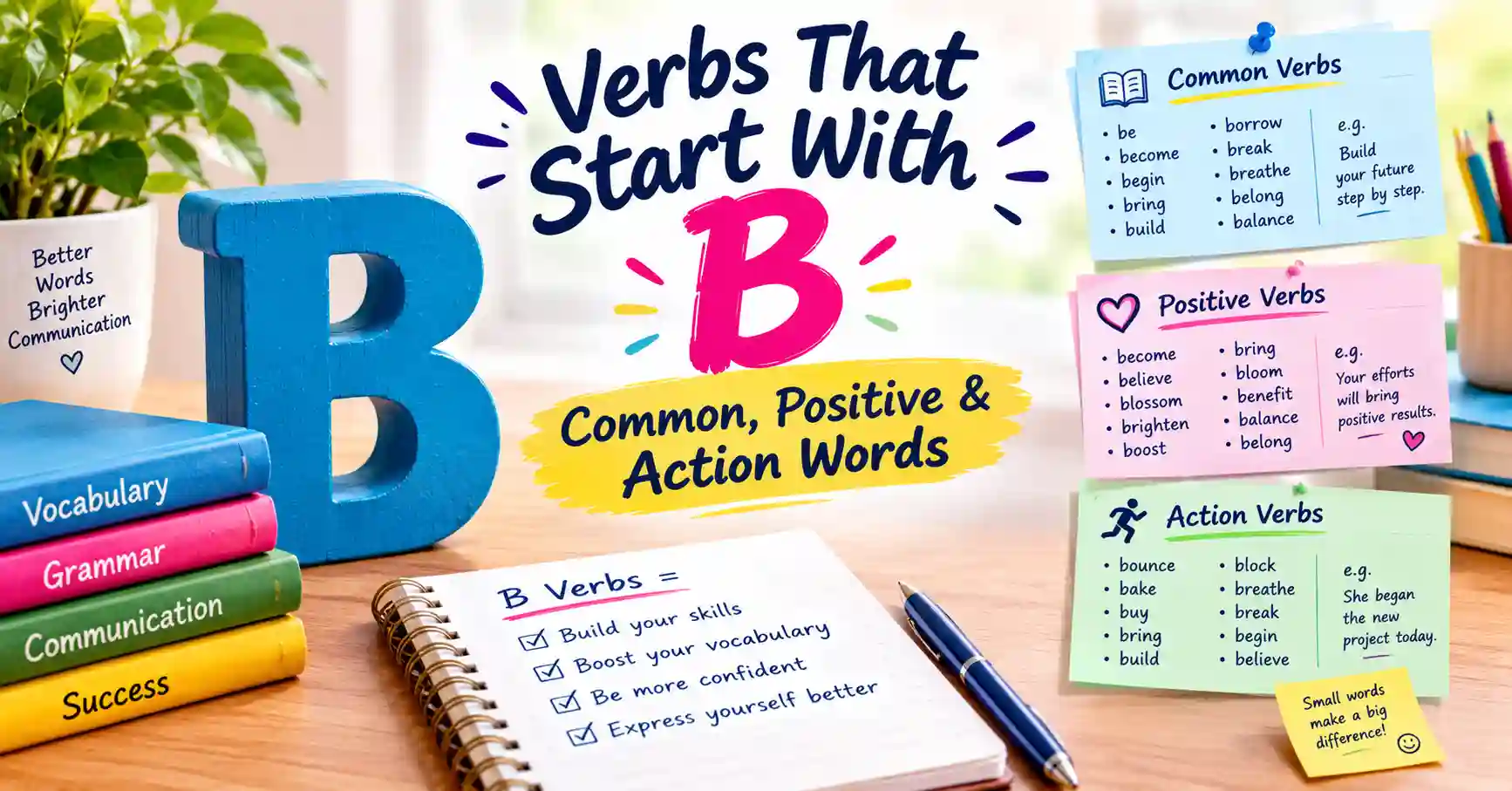
Every sentence needs an engine. That engine is the verb. Without it, nothing happens. A rich list of verbs that start with B gives your writing more power. Think of build, bounce, believe, and break. Each one paints a clear picture in just one word.
This guide gives you more than 200 verbs that start with B. You will see common verbs, positive verbs, and strong action verbs. The top 40 words come with meanings and example sentences.
You will also learn verb forms, tenses, spelling rules, and common mistakes. A short quiz at the end tests what you learned.
Why does this matter? Strong verbs make your writing sharper and your speech clearer. They also help in essays, resumes, stories, and word games. Pick a few verbs today and use them in real sentences.
What Are Verbs?
Let us start with the basics. Verbs are the heart of every sentence. They tell us what someone does, what something is, or what is happening. Once you spot the verb, the rest of the sentence makes sense. Every complete sentence has at least one.
Simple definition: A verb shows an action, a state, or a link between ideas.
Here are five verbs that start with B, each in a sentence:
- bake: She will bake a cake for the party.
- bounce: The ball bounces off the wall.
- believe: I believe in hard work.
- build: They build houses by the river.
- break: Please do not break the glass.
Verbs come in three main roles. Action verbs show something you can do, like bake or bounce. State verbs show a condition or feeling, like belong or believe. Helping verbs support another verb, like be in “She is baking.”
A rich verb vocabulary strengthens writing. “Walk” is fine, but “bustle” or “bolt” adds speed and mood. It also saves words. One exact verb can replace a verb and an adverb.
Complete List of Verbs That Start With B
This is the heart of the guide. Below you will find verbs that start with B in ten clear groups. Each group has its own purpose. You can browse by meaning, tone, or level. Every verb is shown in its base form. No word appears twice in the main lists. Start with the group that fits your goal today.
Common Verbs That Start With B
Common verbs are the ones you hear and use every day. They are the first words most learners need. The table below shows the top 40 common verbs that start with B. Each has a short meaning and an example sentence. The words are in alphabetical order.
| Verb | Meaning | Example Sentence |
| back | to support or move backward | Parents back their children’s dreams. |
| bake | to cook in an oven | I bake bread on Sundays. |
| balance | to keep steady | She can balance a book on her head. |
| bargain | to discuss a price | We bargained for a lower price. |
| bark | to make a dog’s sharp sound | The dog barks at strangers. |
| bathe | to wash the body | He bathes the baby every night. |
| be | to exist or have a quality | Be kind to others. |
| bear | to carry or tolerate | I cannot bear the noise. |
| beat | to hit or defeat | Our team beat the champions. |
| become | to start to be | She wants to become a doctor. |
| beg | to ask in a needy way | The puppy begs for treats. |
| begin | to start | Let us begin the lesson. |
| behave | to act in a certain way | Please behave in class. |
| believe | to accept as true | I believe you. |
| belong | to be owned by or fit in | This book belongs to me. |
| bend | to curve or lean | Bend your knees when you lift. |
| bet | to risk money on a result | I bet it will rain. |
| bind | to tie or join | Ropes bind the logs together. |
| bite | to cut with teeth | Do not bite your nails. |
| blame | to say someone is at fault | Do not blame yourself. |
| bleed | to lose blood | A small cut can bleed a lot. |
| bless | to wish good for someone | Her grandmother blessed the newlyweds. |
| blink | to close and open the eyes quickly | Try not to blink. |
| blow | to send out air | Blow out the candles. |
| boil | to heat until bubbling | Boil the water for tea. |
| boost | to lift or improve | Exercise can boost your mood. |
| borrow | to take and return later | Can I borrow your pen? |
| bother | to annoy or take trouble | Sorry to bother you. |
| bounce | to spring back | The ball bounced twice. |
| bow | to bend forward in respect | The actors bow at the end. |
| break | to split into pieces | Do not break the glass. |
| breathe | to take air in and out | Breathe slowly and relax. |
| bring | to carry to a place | Bring your notebook. |
| brush | to clean with a brush | Brush your teeth twice a day. |
| build | to make by joining parts | They build houses. |
| burn | to be on fire | Paper burns quickly. |
| burst | to break open suddenly | The balloon burst. |
| bury | to put underground | Dogs bury bones. |
| buy | to get by paying | I want to buy a new bag. |
| buzz | to make a humming sound | Bees buzz around flowers. |
Learn these 40 first. They appear in daily speech, school texts, and news stories.
Action Verbs That Start With B
Action verbs show physical movement or effort. They are the most vivid verbs in English. Writers use them to make scenes feel alive. This group covers hitting, tying, polishing, and bundling. Use them when you want your reader to see the action. The words are in alphabetical order.
bandage, bang, bash, batter, belt, bore, braid, brandish, buckle, buff, bundle, bust, butt.
Pick action verbs that match the force of the moment. Bang is loud and quick, while braid is slow and careful.
Verbs of Communication That Start With B
Communication verbs show how people speak, write, and share ideas. They add tone to dialogue and reports. Compare “said” with “bellowed” or “blurted.” The second choice tells us much more. This group covers loud, soft, and written forms of communication. The words are in alphabetical order.
babble, banter, bawl, beckon, bellow, bellyache, berate, bicker, blab, bleep, blog, blurt, bluster, boast, brag, brief, broach, broadcast.
Choose a communication verb that shows the speaker’s mood. It makes dialogue more lively and real.
Verbs of Thinking and Emotion That Start With B
Some verbs show what happens inside us. They describe thoughts, moods, and feelings. These verbs bring depth to characters and personal essays. They help readers feel what a person feels. This group covers joy, doubt, worry, and wonder. The words are in alphabetical order.
bask, beam, begrudge, beguile, bemoan, bemuse, bewilder, bewitch, blush, bond, brainstorm, brood.
Pair an emotion verb with a clear cause. “She beamed at the news” tells us both the feeling and the reason.
Verbs of Movement That Start With B
Movement verbs show how people and things travel. They set speed, direction, and mood. A character can bolt, bustle, or bypass a problem. Each verb gives a different picture. This group is great for stories and travel writing. The words are in alphabetical order.
backpedal, backtrack, bail, barge, board, bolt, bound, breeze, bumble, burrow, bustle, bypass.
Movement verbs also work as images in other topics. For example, you can bypass a rule or backtrack on a promise.
Verbs for Work, School, and Daily Life That Start With B
Daily life needs practical verbs. We bank, book, bake, and budget almost every week. This group covers home tasks, work tasks, and school tasks. Use these verbs in emails, schedules, and lists. They help you describe your routine in clear, simple words. The words are in alphabetical order.
babysit, bank, barbecue, bill, bleach, book, bookmark, boot, bottle, brew, budget, butter, button.
Many of these verbs began as nouns. Bottle, butter, and button all work as both nouns and verbs.
Positive Verbs That Start With B
Positive verbs show kindness, growth, and help. They add warmth to speeches, cards, and reviews. They also make resumes sound strong and hopeful. Use them when you want to praise, encourage, or celebrate. Each word below lifts the mood of a sentence. The words are in alphabetical order.
beautify, befriend, benefit, bestow, bloom, blossom, bolster, bridge, brighten, buoy.
Use these verbs with care. A few well-chosen positive words feel real, while too many can sound forced.
Negative Verbs That Start With B
Negative verbs show harm, failure, or unkindness. Writers use them to build conflict and show danger. They also help in honest reviews and news reports. Use them with care, because strong words can hurt. Match the strength of the verb to the situation. The words are in alphabetical order.
badger, baffle, belittle, betray, blackmail, blight, bludgeon, blunder, bombard, botch, bruise, brutalize, bully, bungle, burden, burgle.
Notice the range of strength. Baffle is mild, but brutalize is very strong.
Uncommon or Advanced Verbs That Start With B
Advanced verbs are rare, exact, and often elegant. They add style to essays, speeches, and fiction. Use them sparingly. One or two in a piece can impress. Too many can confuse readers. Always check the meaning before you use a rare verb. The words are in alphabetical order.
bandy, banish, bedeck, bedevil, befuddle, beget, behead, belabor, belie, bequeath, bereave, beseech, beset, besiege, bespeak, bewail, bilk, blanch, bode, bowdlerize, brook, burgeon, burnish, buttress.
A quick example: “The news did not bode well for the team” means it looked like a bad sign.
Simple Verbs That Start With B for Beginners and Kids
Beginners and kids need friendly verbs they can use right away. These words are short, easy to picture, and fun to act out. They also work well in picture books and classroom games. Say each word aloud and mime the action. The words are in alphabetical order.
beep, bike, blast, brake, bubble, bump, bunk, burp.
Act these out with a friend. Movement makes new words easier to remember.
Verbs by Word Length
Word length is a handy way to study. Short verbs are quick to learn. Long verbs need a bit more care. This section groups new B verbs by their letter count. Every word here is new to this guide. Use these lists for spelling practice, puzzles, and word games.
3-Letter Verbs That Start With B
Three-letter verbs are the shortest verbs in English. Many are common in everyday speech. They are also useful in crosswords and word games. Learn them quickly, but check each meaning. Short words can have more than one job. The words are in alphabetical order.
bag, ban, bar, bat, bay, bed, bid, bin, bob, boo, bop, box, bud, bug, bus.
Many of these words are also nouns. Context tells you which job the word is doing.
4-Letter Verbs That Start With B
Four-letter verbs give you more choice. They cover cooking, noise, motion, and growth. They are common in early reading and word puzzles. Try to picture each action as you read the list. The words are in alphabetical order.
bait, balk, band, bare, base, beef, bide, blip, blot, blur, bomb, boom, boss, bowl, brim, buck, bulk.
Notice the silent l in balk. It sounds like “bawk.”
5-Letter Verbs That Start With B
Five-letter verbs are the sweet spot for many word games. They are long enough to be exact. They are short enough to remember. This group is also popular in spelling bees and puzzles. Read the list slowly and notice the vowel patterns. The words are in alphabetical order.
baste, beach, blank, blare, blaze, bleat, blend, blind, block, blunt, brace, brand, brave, brawl, breed, bribe, bulge, bunch.
Many of these also work as nouns or adjectives. Check the sentence to see the word’s job.
6-Letter Verbs That Start With B
Six-letter verbs often carry more detail. They show up in news stories, school texts, and everyday writing. They also show helpful spelling patterns, such as double letters. Study the list, then try to spot the patterns. The words are in alphabetical order.
barter, battle, behold, better, billow, blister, branch, breach, browse, buffer, buffet.
Watch the double letters in battle, better, buffer, and buffet. They are common spelling traps.
7+ Letter Verbs That Start With B
Longer verbs carry more specific meaning. They often come from Latin, Greek, or French. They show up in school texts and professional writing. Break each word into syllables to learn it faster. This group has fun, strong, and surprising choices. The words are in alphabetical order.
backfire, balloon, bamboozle, baptize, barricade, bifurcate, blaspheme, blindfold, blockade, boomerang, boycott, brainwash, bulldoze.
Many long verbs are built from smaller words. Blindfold is blind plus fold, and bulldoze hints at a bulldozer.
Verbs by Type
Verbs come in several types. Each type follows its own rules. Knowing the types helps you choose the right tense and sentence pattern. This section explains each type with simple examples. The examples use verbs from the lists above. Read them slowly and notice the patterns.
Action and Stative Verbs
Action verbs show something happening, like bake, build, or bounce. Stative verbs show a state, like belong, believe, or be. This difference matters for tenses. Action verbs can use the continuous form. Stative verbs usually cannot.
- Action: “She is baking a cake right now.” ✅
- Stative: “I believe you.” ✅
- Stative: “I am believing you.” ❌
When a verb shows a state of mind or ownership, use the simple form.
Transitive and Intransitive Verbs
Transitive verbs need an object. Intransitive verbs do not. The object answers “what?” or “whom?” after the verb. Some verbs can be both, depending on the sentence. Checking for an object is a quick test.
- Transitive: “She baked a cake.” (what? a cake)
- Transitive: “He bought a ticket.”
- Intransitive: “The flowers bloom.”
- Intransitive: “The baby burped.”
- Both: “The ball bounced.” / “She bounced the ball.”
If you can ask “what?” after the verb and get an answer, it is transitive.
Regular and Irregular Verbs
Regular verbs add -ed for the past: bake becomes baked. Irregular verbs change in other ways: break becomes broke and broken. Many common B verbs are irregular, like begin, bring, build, and buy. You will see full tables in the next section.
Learn irregular verbs as a set. Say each group aloud: “begin, began, begun.”
Auxiliary (Helping) and Modal Verbs
Auxiliary verbs help another verb form a tense or a question. The verb be is the main auxiliary that starts with B. It forms the continuous and passive voices. No modal verb starts with B. Modals like can and will start with other letters.
- Continuous: “They are building a bridge.”
- Passive: “The cake was baked this morning.”
- Perfect: “She has been busy.”
Remember that be has eight forms: be, am, is, are, was, were, been, being.
Linking Verbs
Linking verbs connect a subject to more information. They do not show action. The two main linking verbs that start with B are be and become. They link the subject to a noun or an adjective.
- “She is a baker.”
- “He became brave.”
- “The soup is bland.”
A quick test: swap the verb with “equals.” If it still works, it is probably a linking verb.
Phrasal Verbs That Start With B
Phrasal verbs join a verb with a small word like up, down, or out. The meaning often changes from the original verb. They are very common in spoken English. Learn them as chunks, not as separate words. The table shows 14 common ones in alphabetical order.
| Phrasal Verb | Meaning | Example Sentence |
| back down | retreat from a position | He refused to back down. |
| back up | support, or save a copy | Back up your files. |
| bail out | rescue from trouble | The government bailed out the bank. |
| bank on | rely on | You can bank on her help. |
| bear with | be patient with | Please bear with me. |
| blow up | explode, or inflate | The kids blow up balloons. |
| bounce back | recover | She bounced back quickly. |
| break down | stop working | The car broke down. |
| break up | end a relationship, or split | They broke up last year. |
| bring up | raise a topic or a child | Do not bring up that topic. |
| brush up | improve a skill | I need to brush up on my French. |
| build up | increase gradually | Build up your strength slowly. |
| burn out | become exhausted | Long hours can burn you out. |
| butt in | interrupt | Do not butt in. |
Use these in casual speech and informal writing. In formal writing, a single verb like recover may sound better than bounce back.
Verb Forms and Tenses
Every verb has several forms. These forms help us show time, number, and voice. Learning them well is the key to correct grammar. This section shows the forms of 40 B verbs in tables. It also explains spelling rules and the main tenses. Study the tables, then practice with your own sentences.
Verb Forms Table
The table below shows five forms of 20 regular B verbs. These are the base form, past simple, past participle, present participle, and third-person singular. Notice how the endings follow clear rules. The verbs are in alphabetical order.
| Base | Past Simple | Past Participle | Present Participle | Third-Person Singular |
| back | backed | backed | backing | backs |
| bake | baked | baked | baking | bakes |
| bargain | bargained | bargained | bargaining | bargains |
| bathe | bathed | bathed | bathing | bathes |
| beg | begged | begged | begging | begs |
| belong | belonged | belonged | belonging | belongs |
| blame | blamed | blamed | blaming | blames |
| bless | blessed | blessed | blessing | blesses |
| blink | blinked | blinked | blinking | blinks |
| boast | boasted | boasted | boasting | boasts |
| boil | boiled | boiled | boiling | boils |
| bother | bothered | bothered | bothering | bothers |
| bounce | bounced | bounced | bouncing | bounces |
| brag | bragged | bragged | bragging | brags |
| brush | brushed | brushed | brushing | brushes |
| bubble | bubbled | bubbled | bubbling | bubbles |
| bully | bullied | bullied | bullying | bullies |
| bump | bumped | bumped | bumping | bumps |
| bury | buried | buried | burying | buries |
| buzz | buzzed | buzzed | buzzing | buzzes |
Use this table as a model. Most new regular verbs follow the same patterns.
Irregular Verbs That Start With B
Irregular verbs do not follow the -ed rule. Their forms change in unique ways. Many of the most common English verbs are irregular. This table shows 20 irregular B verbs with all five forms. Study the past forms first, since they are used most often.
| Base | Past Simple | Past Participle | Present Participle | Third-Person Singular |
| be | was/were | been | being | is (am, are) |
| bear | bore | borne (born for birth) | bearing | bears |
| beat | beat | beaten | beating | beats |
| become | became | become | becoming | becomes |
| begin | began | begun | beginning | begins |
| bend | bent | bent | bending | bends |
| bet | bet | bet | betting | bets |
| bid | bid | bid | bidding | bids |
| bind | bound | bound | binding | binds |
| bite | bit | bitten | biting | bites |
| bleed | bled | bled | bleeding | bleeds |
| blow | blew | blown | blowing | blows |
| break | broke | broken | breaking | breaks |
| breed | bred | bred | breeding | breeds |
| bring | brought | brought | bringing | brings |
| broadcast | broadcast | broadcast | broadcasting | broadcasts |
| build | built | built | building | builds |
| burn | burned/burnt | burned/burnt | burning | burns |
| burst | burst | burst | bursting | bursts |
| buy | bought | bought | buying | buys |
A few more irregular B verbs are behold (beheld), beset (beset), and beseech (besought). Both burned and burnt are correct. American English prefers burned.
Spelling Rules for Adding -ing, -ed, and -s
Spelling changes follow a few simple rules. Once you learn them, you can form almost any verb correctly. The rules cover silent e, doubled consonants, and the letter y. Here they are with B examples.
Adding -ing
- Drop the silent e: bake becomes baking, bathe becomes bathing.
- Double the final consonant after one short vowel: beg becomes begging, brag becomes bragging, bat becomes batting.
- For -ie verbs, change ie to y: belie becomes belying.
Adding -ed
- Add -d after silent e: bake becomes baked.
- Change y to i after a consonant: bury becomes buried, bully becomes bullied.
- Keep y after a vowel: bay becomes bayed.
- Double the consonant in short words: ban becomes banned, bug becomes bugged.
Doubling also applies to longer verbs if the stress falls on the last syllable. That is why begin becomes beginning. When the stress falls on the first syllable, do not double: bother becomes bothering.
Verb Tenses Explained
Tenses show when an action happens. English has many, but a few cover most needs. The table below shows six key tenses with two examples each. Notice how the verb changes with the tense. Use the table as a quick reference.
| Tense | When We Use It | Examples |
| Present simple | habits and facts | I bake bread every Sunday. She believes in hard work. |
| Present continuous | actions happening now | He is building a shed. They are bouncing on the bed. |
| Past simple | finished actions | We borrowed two books. She began to sing. |
| Future simple | plans and predictions | I will buy a ticket. They will bring snacks. |
| Present perfect | past actions with present results | I have broken my phone. She has become a teacher. |
| Past perfect | an action before another past action | He had bought the gift before the party. We had begun when she arrived. |
If you are unsure, ask: “Is this happening now, before now, or later?” The answer points to the tense.
Spelling Patterns and Prefixes for the Letter B
Spelling gets easier when you see patterns. Many B verbs share beginnings, endings, and tricky spots. This section covers common prefixes, common suffixes, and tricky spellings. Study the patterns, not just the words. A few rules can unlock dozens of verbs at once.
Common Prefixes and Letter Combinations
Prefixes are word beginnings that add meaning. Many B verbs start with the prefix be-, which can make a verb from a noun or an adjective. Other B beginnings come from small words that join together. Here are the most useful ones, with examples.
- be- means “make” or “all over”: befriend (make a friend), bewitch, bedevil, belittle, behead
- back- means “reverse”: backtrack, backpedal, backfire
- by- means “around” or “past”: bypass
- brain- joins with another word: brainstorm, brainwash
- bi- means “two”: bifurcate (split into two)
Notice how befriend and belittle both use be- to turn a word into an action. That pattern is very productive in English.
Common Verb Suffixes
Suffixes are word endings that change a word’s type. Some endings turn nouns and adjectives into verbs. Spotting them helps you guess meaning. Here are the most common ones in B verbs, with examples from our lists.
- -ize (to make or turn into): baptize, bowdlerize, brutalize
- -ify (to make): beautify
- -ate (to cause or act): bifurcate
- -en (to make or become): brighten
- -le (repeated action): babble, bubble, bumble, bustle, buckle, bundle
- -er (repeated action): batter, bicker, blunder, bluster, bother, banter
- -ish (to make): banish, burnish
Repeated-action endings like -le and -er often suggest small, quick, repeated movements. Think of a babble of small sounds or a bubble of tiny pops.
Tricky Spellings, Silent Letters, and Pronunciation Notes
Some B verbs look easy but hide traps. They may have silent letters, odd sounds, or spelling variants. Knowing these traps saves you from common mistakes. Say each word aloud as you read.
- Believe follows the rule “i before e.” A memory trick: “never believe a lie.” The word lie is inside it.
- bomb and balk each have a silent letter. Bomb sounds like “bom.” Balk sounds like “bawk.”
- bury sounds like BER-ee, not “BYOO-ree.”
- bequeath sounds like bih-KWEETH.
- beguile sounds like bih-GYLE.
- bowdlerize sounds like BOWD-luh-rize.
- breathe (verb) has a final e. The noun breath does not.
- bathe (verb) has a final e. The noun bath does not.
- baptize/baptise, brutalize/brutalise, and bowdlerize/bowdlerise have two spellings. American English uses -ize, and British English often uses -ise.
- boycott has a double t.
When a word seems strange, break it into syllables. Then check a dictionary.
How to Use These Verbs Correctly
Knowing many verbs is only half the job. You must also use them well. This section covers subject-verb agreement, tense choice, prepositions, common mistakes, and confusing pairs. Read each part slowly. A few small habits can make your English sound much more natural and accurate.
Subject-Verb Agreement
A verb must match its subject. A singular subject takes a singular verb. A plural subject takes a plural verb. In the present simple, singular verbs usually end in -s. Here are five clear examples.
- She bakes every morning. (singular)
- They bake together on weekends. (plural)
- The children bounce on the bed. (plural)
- Each bird builds its own nest. (each is singular)
- Neither the boys nor the girl believes the story. (the verb agrees with the nearest subject)
Find the subject first. Then match the verb to it.
Choosing the Correct Tense
The right tense shows the right time. Think about when the action happens and whether it is finished. Here are five examples with bake and buy. Each one uses a different tense for a different purpose.
- Habit (present simple): I buy bread every day.
- Right now (present continuous): I am baking a cake.
- Finished action (past simple): I bought bread yesterday.
- Result now (present perfect): I have baked enough cookies for everyone.
- Plan (future simple): I will buy a cake tomorrow.
When a time word is present, such as yesterday or every day, let it guide your choice.
Verbs Followed by Prepositions
Many verbs need a specific preposition. Using the wrong one sounds unnatural. These pairs work as chunks, so learn them together. Here are eight common ones with B verbs.
- believe in: I believe in you.
- belong to: This bag belongs to my sister.
- benefit from: Students benefit from daily practice.
- blame (someone) for: Do not blame him for the delay.
- boast about: He likes to boast about his grades.
- borrow from: She borrowed a book from the library.
- bump into: I bumped into an old friend.
- bargain for: We did not bargain for so much rain.
Learn the preposition with the verb, not alone. This habit saves you from many small errors.
Common Mistakes and Corrections
Even strong learners repeat the same errors. Spotting them is the first step to fixing them. Below are six common mistakes with simple corrections. Check your own writing against this list.
- Borrow and lend mix-up. ❌ “Can you borrow me your pen?” → ✅ “Can you lend me your pen?” or “Can I borrow your pen?”
- Wrong past form. ❌ “He begun the race.” → ✅ “He began the race.”
- Regular ending on an irregular verb. ❌ “She breaked the glass.” → ✅ “She broke the glass.”
- Continuous with a stative verb. ❌ “I am believing you.” → ✅ “I believe you.”
- Wrong preposition. ❌ “They belong with the club.” → ✅ “They belong to the club.”
- Missing -s. ❌ “The dog bark at night.” → ✅ “The dog barks at night.”
Read your work aloud. Your ear often catches what your eye misses.
Commonly Confused Verbs
Some verbs look or sound alike but mean different things. Mixing them up can change your message. Learn these six pairs. Each one comes with a short explanation. Say each pair aloud to hear the difference.
| Pair | Difference |
| borrow/lend | Borrow means to take something for a time. Lend means to give something for a time. |
| bring/take | Bring moves something toward the speaker. Take moves it away. |
| breath / breathe | Breath is a noun (the air). Breathe is a verb (to take air in and out). |
| bath / bathe | Bath is a noun (a wash). Bathe is a verb (to wash). |
| bought/brought | Bought is the past tense of buy. Brought is the past tense of bring. |
| born/borne | Born is used for birth: “She was born in May.” Borne is the past participle of bear in other senses: “He has borne the cost.” |
The mouth shape for breath and breathe is the same, but the vowel and the ending differ. Practice them with a mirror.
Synonyms and Antonyms
A single action can have many words. Synonyms are words with similar meaning. Antonyms are words with opposite meaning. Knowing both gives you range. It stops you from repeating the same verb again and again. The table below shows 17 key B verbs with synonyms and antonyms.
| Verb | Synonyms | Antonyms |
| banish | exile, expel | welcome, admit |
| begin | start, commence | end, finish |
| believe | trust, accept | doubt, distrust |
| bend | curve, flex | straighten |
| betray | deceive, backstab | defend, support |
| bless | favor, honor | curse |
| boast | brag, show off | downplay, understate |
| boost | lift, raise | lower, reduce |
| borrow | take on loan | lend, return |
| break | smash, shatter | fix, mend |
| brighten | lighten, illuminate | darken, dim |
| bring | carry, fetch | remove |
| build | construct, assemble | demolish, destroy |
| bully | intimidate, torment | protect, help |
| burn | scorch, ignite | extinguish |
| bury | inter, hide | dig up, uncover |
| buy | purchase, acquire | sell |
Synonyms are not perfect twins. Each one has its own tone, strength, and style. “Start” is plain and friendly. “Commence” is formal. “Embark” feels like a journey.
Choose by asking three questions. How strong is the action? How formal is the setting? Who is the reader? A text to a friend can say “begin.” A legal paper might say “commence.” A story might say “embark.” Strength matters too. Bump is gentle, bash is harder, and bludgeon is brutal. Matching tone, strength, and context is the mark of a skilled writer.
Practical Use Cases
Words are tools, and tools work best in the right setting. Below you will see how verbs that start with B fit into six real situations. Each part has short examples you can copy and adapt. Choose the setting that matches your goal today.
Essays and Academic Writing
Academic writing needs precise and balanced verbs. Words like base, benefit, bridge, and bolster fit well. They sound formal and show clear thinking. Avoid slang and very emotional verbs. Let your verbs show logic and evidence.
- The study bases its claims on field data.
- Regular exercise benefits both body and mind.
- This theory bridges two older ideas.
Storytelling and Creative Writing
Stories need vivid verbs. They help readers see, hear, and feel the scene. Pick verbs that show speed, sound, and mood. Bolt, bellow, and brood each paint a clear picture. Replace weak verbs like “walked” or “said” with stronger choices.
- She bolted down the stairs.
- The captain bellowed across the deck.
- He brooded by the window all night.
Resumes and Professional Writing
Employers scan fast. Start each bullet with a strong action verb. Use past tense for past jobs. Pair each verb with a real result. These B verbs work well on a resume: boosted, built, balanced, briefed, budgeted, bridged, bolstered, and brainstormed.
- Boosted monthly sales by 20 percent.
- Built a team of eight support agents.
- Balanced budgets across three departments.
Social Media Captions
Captions are short, so every word counts. Strong verbs make a post feel active. Imperative verbs, which give a command, work especially well. They invite the reader to join in. Keep the tone upbeat and real.
- Break the routine. Build the dream.
- Bake it. Share it. Repeat.
- Breathe in. Bounce back.
Everyday Conversation
In daily talk, simple verbs win. Short, common verbs sound natural and friendly. You do not need rare words here. Choose ones people understand right away. A few well-placed B verbs can keep a conversation moving.
- Can I borrow your charger?
- Please bring a jacket.
- Do not bother with the dishes.
Word Games: Scrabble, Wordle, and Crosswords
Word games reward a large vocabulary. B verbs are useful in all three games. In standard English Scrabble, the letter B is worth three points. Short B verbs like bop, bud, and bay help you place awkward tiles. In crosswords, short verbs like bid, beg, and bet are common fillers.
For Wordle-style games, practice five-letter verbs. Good ones to know are begin, blame, bleed, blink, boast, boost, brush, build, and burst. Not every word is a possible answer in every game. Still, they train your eye for letter patterns.
Fun Facts and Learning Tips
Learning words should feel fun, not heavy. The best learners are curious. They ask where a word came from and how to remember it. This section gives you stories, tricks, and habits that make verbs stick. You will find fun facts, memory aids, word histories, daily practice ideas, and a short quiz to test yourself. Take your time and enjoy it.
Fun Facts About the Letter B and Its Verbs
The letter B has a long history, and its verbs hide many surprises. Some words changed shape over time. Others come from famous people. Here are seven facts that show how rich and strange English can be.
- B began as a house. The old Phoenician letter beth meant “house.” The Greeks turned it into beta. Our word alphabet comes from the first two Greek letters.
- The verb be has eight forms. They are be, am, is, are, was, were, been, and being. They come from several different old word families that merged over time.
- Bully once meant “sweetheart.” In the 1500s, the noun bully was a friendly term for a dear person. Its meaning slowly turned harsh, and the verb followed.
- Boycott comes from a person. It honors Captain Charles Boycott, an Irish land agent who was shunned by his community in 1880. People refused to work for him or serve him.
- Bowdlerize comes from a name too. Thomas Bowdler published an edited “family” version of Shakespeare in 1807. His name became a verb for removing parts of a text.
- Bamboozle has a mystery origin. It appeared in English in the early 1700s as slang. Scholars do not agree on where it came from.
- Some verbs never change. Bet, bid, and burst look the same in the base form, past simple, and past participle. That makes them easy to spell and tricky to time.
Memory Tricks and Mnemonics
Memory works best when words connect to pictures, sounds, or stories. Here are six simple techniques. Each one uses real words from the lists. Try the one that suits you, and invent your own versions.
- Rhyme the pairs. Buy becomes bought, and bring becomes brought. Both end in -ought. Say them together to stop mixing them up.
- Learn the vowel pattern. Begin, began, begun follows the same pattern as sing, sang, sung. The vowels go i, a, u.
- Use a sentence trick. Spell believe with this line: “Never believe a lie.” The word lie sits inside it.
- Act it out. Mime bounce, bake, blink, and bow. Movement locks meaning into memory.
- Use the be- clue. Befriend means “make a friend.” Belittle means “make little.” The prefix tells the story.
- Add an e for air. The verb breathe ends in e, like the air you let out. The noun breath does not.
Word Origins and History
Every word has a family tree. Looking at the roots can make meanings clear and memorable. Here are six B verbs with their languages of origin and how their meanings changed. These stories make dry vocabulary feel alive.
- Bake comes from Old English bacan. It is related to the German word backen. The meaning has stayed the same for over a thousand years.
- Borrow comes from Old English borgian, from a word for “pledge.” Long ago, borrowing meant giving a pledge to guarantee the return of something.
- Bless comes from Old English blētsian. Many scholars link it to a word for blood, because early rituals used blood to make something holy. Later the meaning softened to “wish happiness.”
- Bargain comes from Old French bargaigner, meaning “to haggle.” It first meant arguing over a price. Later it also described the deal itself.
- Betray comes from Old French and Latin roots meaning “to hand over.” It first meant giving someone up to an enemy. Today it means breaking trust of any kind.
- Banish comes from Old French banir, from a Germanic word meaning “to proclaim.” A ruler would announce that someone must leave. The meaning grew from public announcement to forced exile.
Daily Practice Tips
Small habits beat big bursts. Ten minutes a day will do more than one long weekend session. Choose habits you can keep. Here are six that work well for learners at every level.
- Read every day. Pick articles, stories, or blogs you enjoy. Underline any new B verb. Seeing a word in context fixes its meaning.
- Keep a verb journal. Each night, write three sentences using three new verbs. Try different tenses. Writing makes you think about form and meaning.
- Use flashcards. Put the base form on one side. On the other, write the past, the past participle, and an example. Review them with spaced repetition.
- Speak out loud. Say your new verbs in real conversations. Record yourself and listen back. Speaking turns passive knowledge into active skill.
- Play a “B-day” game. For one day, describe your actions with B verbs. You brush, bake, bring, and buy. It is silly, and it works.
- Review weekly. Every Sunday, scan your journal. Circle verbs you forgot. Reuse them during the next week.
Mini Practice Quiz
Time to test yourself. These ten questions cover verb forms, tenses, types, and meaning. Try them without looking back. Then check the answer key to see how you did. Do not worry about mistakes. Each one shows you what to review.
- Yesterday, she ______ a cake. (bake)
- I have ______ my phone. (break)
- What is the past simple of begin? (began/begun)
- In “She became a doctor,” the verb became is a: (action verb / linking verb / modal verb)
- Please ______ me your pen. (borrow/lend)
- Bewilder means: (a) to confuse (b) to clean (c) to shout
- What is the present participle of begin? (beginning/beginning)
- The car broke ______ on the highway. (down / up)
- She ______ her hair every morning. (brush)
- I believe ______ you. (in/to)
Answer Key
- baked. Add -ed to bake, and the silent e needs only -d.
- broken. The past participle of break.
- began. Begun is the past participle.
- linking verb. Became links she to doctor.
- lend. You give the pen, so use lend.
- (a) to confuse.
- beginning. Double the n because the stress is on the last syllable.
- down. Break down means stop working.
- brushes. Add -es after sh.
- in. Believe in means to trust.
Score 9 or 10? Excellent. Score 6 to 8? Good, review the weak spots. Below 6? Re-read the tables and try again tomorrow.
Frequently Asked Questions
Readers often ask the same questions when they study this topic. This FAQ section answers seven of the most common ones in clear, short replies. Use it as a quick refresher. If your question is not here, check the matching section above for more detail and examples.
What are some action verbs that start with B?
Action verbs that start with B include bake, bounce, build, bump, bolt, brush, bash, bang, bend, and buckle. They show clear physical movement. Writers use them to make scenes lively. In this guide, you will find many more action verbs, sorted by group, with examples for each.
What are strong verbs that start with B for a resume?
Strong resume verbs that start with B include boosted, built, balanced, briefed, budgeted, bridged, bolstered, and brainstormed. Use past tense for past jobs. Start each bullet with the verb and add a clear result. For example: “Boosted monthly sales by 20 percent.” Strong verbs show action and impact.
What are positive verbs that start with B?
Positive verbs that start with B include bless, benefit, boost, bloom, blossom, brighten, befriend, bestow, bolster, and buoy. They show kindness, growth, and support. Use them in speeches, cards, reviews, and cover letters. A few well-chosen positive verbs make your writing warm and hopeful without sounding forced.
What is the longest verb that starts with B?
There is no official longest B verb. In this guide, brainstorm and bowdlerize are the longest, at ten letters each. Other long ones include bamboozle and bifurcate with nine letters. Technical and scientific verbs can be longer. For everyday use, shorter and clearer verbs usually work better.
What are easy verbs that start with B for kids?
Easy B verbs for kids include bake, bounce, bark, brush, bump, bike, blow, build, buy, and bite. They are short, common, and easy to act out. Teach them with simple actions, such as bouncing a ball. Movement makes new words stick fast and makes learning fun.
What are irregular verbs that start with B?
Common irregular B verbs include be, bear, beat, become, begin, bend, bet, bid, bind, bite, bleed, blow, break, breed, bring, build, burn, burst, and buy. They do not follow the -ed rule for the past. Study them as a group. Say each set aloud, such as “begin, began, begun.”
Do any modal verbs start with B?
No. Modal verbs like can, could, may, might, must, shall, should, will, and would start with other letters. The only main helping verb that starts with B is be. It forms the continuous and passive voices, as in “She is baking” and “The cake was baked.”
Conclusion
Strong writing starts with strong verbs. Now you have a deep list of verbs that start with B. You saw common verbs, positive verbs, negative verbs, and advanced verbs. You learned how to sort them by meaning, length, and type.
Here are the key takeaways. Use action verbs to show movement. Use stative verbs for states, and avoid the continuous form with them. Learn irregular verbs as sets. Add the right preposition to each verb. Check spelling rules before you add -ing or -ed.
Now it is your turn. Pick five new verbs that start with B today. Write one sentence for each in a different tense. Say them out loud. Save this guide for later, and share it with a friend who loves words. Small steps build a large vocabulary.
