

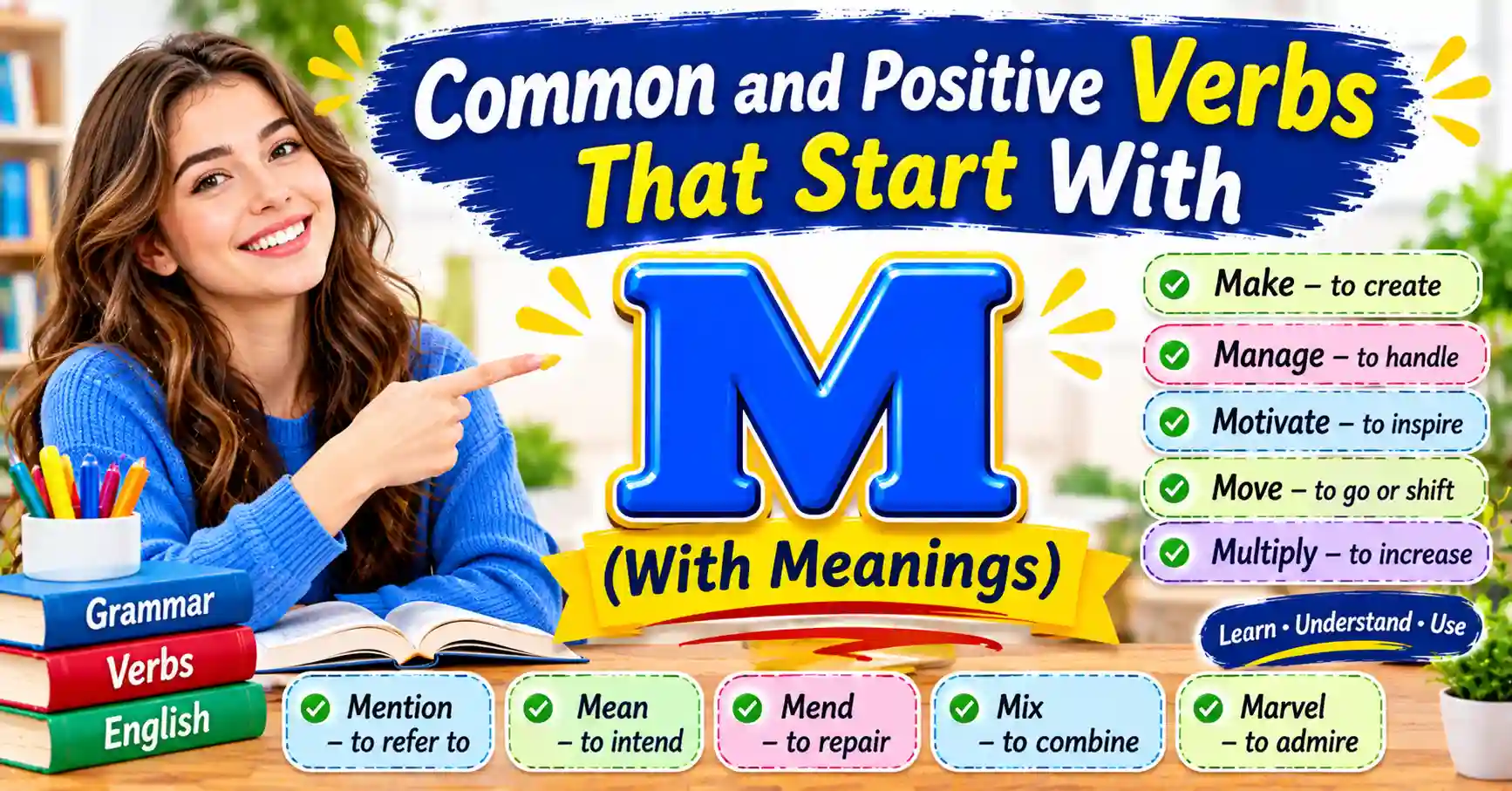
Make, move, master, and motivate. The letter M opens some of the busiest verbs in English. This guide covers verbs that start with M, and there are many: more than 150 real ones, each checked for spelling and form. You will find common words, positive words, action words, and a few rare gems.
Each group is easy to scan. You will see meanings and example sentences for the most common verbs. You will also see verb forms, tenses, spelling rules, and the prepositions that follow each verb. There are fun facts, memory tricks, and a short quiz too.
Why does this matter? Verbs drive every sentence. A strong verb makes writing clear and lively. It makes speech sharper. It also helps in school, at work, and in word games.
Read it once. Then come back and practice. Small steps build a large vocabulary. Let’s begin.
What Are Verbs?
Verbs are the action and state words of language. They tell us what someone does, what happens, or what something is. Almost every sentence needs one. Let’s look at a simple definition, five quick examples, and the three jobs verbs do in a sentence.
A verb is a word that shows an action, an event, or a state of being.
Here are five examples that all start with M:
- She manages a busy bakery.
- The children march to the music.
- We mourn the loss of our friend.
- Heat melts the ice.
- He mastered the guitar in a year.
Verbs do three main jobs:
- Action verbs show what someone does: mix, mop, move.
- State verbs show a condition: matter, mean, mind.
- Helping verbs work with other verbs. Three of them start with M: may, might, must.
A rich verb vocabulary makes writing stronger. “Meander” is more vivid than “walk slowly.” “Maximize” is more exact than “make bigger.” Strong verbs also let you drop extra adverbs.
Now let’s explore verbs that start with M, one group at a time.
Complete List of Verbs That Start With M
This is the full word bank. It holds more than 150 real verbs that begin with M, all in their base form. The words are sorted by use, so you can browse by topic. Every list runs in alphabetical order. The first table gives meanings and examples. Later groups appear as clean lists you can scan fast.
Common Verbs Starting With M
Common verbs are the everyday words you use all the time. You hear them at home, at school, and at work. The forty words below are the best place to begin. Read each meaning. Then say the example sentence out loud once to lock it in.
| Verb | Meaning | Example |
| to send by post or email | She mailed the letter. | |
| maintain | to keep in good condition | We maintain the garden. |
| make | to create or build | They make bread daily. |
| manage | to run or handle | She manages a small team. |
| manufacture | to produce in a factory | The plant manufactures cars. |
| map | to show on a map, or to plan out | Scientists map the ocean floor. |
| march | to walk in step | The band marched down the street. |
| mark | to put a sign on | Mark the date on the calendar. |
| market | to promote for sale | They market their products online. |
| marry | to join as spouses | They married in June. |
| mash | to crush into a soft mass | Mash the potatoes. |
| master | to learn completely | She mastered the piano. |
| match | to go well with | The scarf matches your coat. |
| matter | to be important | Your opinion matters. |
| mean | to intend or express | I mean what I say. |
| measure | to find the size of | Measure the table. |
| meet | to come together with | We meet at noon. |
| melt | to turn from solid to liquid | Ice melts in the sun. |
| memorize | to learn by heart | He memorized the poem. |
| mend | to repair | She mended the torn sleeve. |
| mention | to speak of briefly | Please mention my name. |
| merge | to combine | The two roads merge ahead. |
| migrate | to move to another region | Birds migrate south. |
| mind | to care about, or to look after | Mind the step. |
| minimize | to make as small as possible | Minimize waste. |
| miss | to fail to catch, or to feel the absence of | I miss my friends. |
| mix | to blend | Mix the paint well. |
| model | to show as an example | She models good manners. |
| modify | to change slightly | We modified the plan. |
| monitor | to watch and check | Nurses monitor each patient. |
| motivate | to give a reason to act | Praise motivates students. |
| mount | to climb onto, or to put in place | He mounted the horse. |
| mourn | to feel deep sorrow after a loss | They mourn their friend. |
| move | to change place | Move the chair. |
| mow | to cut grass | He mows the lawn. |
| multiply | to increase in number | Rabbits multiply fast. |
| mumble | to speak unclearly | Do not mumble. |
| murmur | to speak softly | She murmured a reply. |
| muse | to think deeply | He mused about his future. |
| mutter | to speak in a low, unclear voice | He muttered under his breath. |
Start with ten verbs. Write one sentence for each. Then add ten more.
Action Verbs (Physical Actions)
Action verbs show things you can see someone do. They describe cutting, cooking, cleaning, and shaping. These verbs make stories and instructions clear and lively. The fifteen verbs below are not in the top list. Notice how many describe working with the hands.
- maim – to injure badly
- mangle – to crush or twist
- marinate – to soak in a seasoned liquid
- massage – to rub the muscles
- maul – to attack roughly
- milk – to draw milk from
- mill – to grind
- mince – to cut into tiny pieces
- mine – to dig for minerals
- moisten – to make slightly wet
- mold – to shape (also mould in British English)
- mop – to clean with a mop
- muffle – to soften a sound
- mulch – to cover soil to protect it
- muzzle – to cover an animal’s mouth
Pick an action verb when you want the reader to see the movement.
Verbs of Communication
Communication verbs show speaking, writing, asking, and explaining. They help you say exactly how someone shares ideas. A precise verb can replace a weak phrase like “said in a bad way.” The fifteen verbs below are not in the top list. Use them in essays, speeches, and reports.
- malign – to speak ill of
- mediate – to help two sides agree
- mime – to act without words
- misinform – to give wrong facts
- mislead – to give the wrong idea
- mispronounce – to say a word wrongly
- misquote – to repeat words wrongly
- misrepresent – to describe unfairly
- misspell – to spell wrongly
- moan – to complain or groan
- mock – to make fun of
- moderate – to lead a discussion
- moralize – to lecture about right and wrong
- motion – to signal with a gesture
- mouth – to form words silently
Choose “mediate” for peacemaking and “mock” for unkind humor.
Verbs of Thinking and Emotion
These verbs show what happens inside the mind and heart. They describe wonder, doubt, anger, and calm. They make characters feel real. The fifteen verbs below are not in the top list. Many are strong, so pick the one that fits the size of the feeling.
- madden – to make very angry
- marvel – to feel wonder
- meditate – to think quietly
- mesmerize – to hold spellbound
- miscalculate – to judge wrongly
- misconstrue – to misunderstand on purpose or by error
- misjudge – to judge wrongly
- mistake – to confuse one thing with another
- mistrust – to doubt
- misunderstand – to get the wrong meaning
- mollify – to calm
- mope – to feel sad and listless
- mortify – to embarrass deeply
- mull – to think over
- mystify – to puzzle
Match the strength of the verb to the feeling. “Mope” is mild, and “madden” is fierce.
Verbs of Movement
Movement verbs show going, wandering, and pushing forward. They give a story speed, direction, and mood. Some describe strolls, and others describe sudden action. The eight verbs below are not in the top list. English has fewer M verbs of movement than some other languages, so we list all of them.
- maneuver – to move skillfully (also manoeuvre in British English)
- meander – to wander along a winding path
- mingle – to move among people
- mobilize – to prepare and move into action
- mosey – to stroll lazily
- motor – to travel by car
- muscle – to push through by force
- mush – to travel by dog sled
Use “meander” for slow, curving movement and “muscle” for forceful movement.
Verbs for Work, School, and Daily Life
These verbs appear in offices, classrooms, and homes. They describe planning, earning, studying, and caring for things. They are useful in emails, reports, and resumes. The sixteen verbs below are not in the top list. Learn the ones you meet most often first.
- mandate – to order officially
- manicure – to trim and polish nails
- matriculate – to enroll at a university
- maximize – to make as large as possible
- medicate – to treat with medicine
- memorialize – to honor with a memorial
- mentor – to guide a less experienced person
- merit – to deserve
- minister – to serve or care for
- mint – to produce coins
- minute – to record in meeting notes
- modernize – to update
- monetize – to turn into money
- moonlight – to work a second job
- mortgage – to pledge property for a loan
- multitask – to do several tasks at once
Pick “maximize” for results and “mentor” for guidance.
Positive Verbs
Positive verbs lift, grow, and bring people together. They describe skill, calm, and care. They are perfect for speeches, goals, and thank-you notes. Some words below repeat from earlier lists on purpose, because they fit more than one group. Use them to give your writing warmth and energy.
- marvel – to feel wonder
- master – to learn completely
- mature – to grow wiser
- maximize – to make the most of
- mediate – to help two sides agree
- meld – to blend smoothly
- mellow – to become gentle
- mend – to repair
- mentor – to guide
- merit – to deserve
- mesh – to fit together well
- mesmerize – to hold spellbound
- motivate – to give a reason to act
- multiply – to increase
Choose “mentor” for guiding others and “mend” for fixing what is broken.
Negative Verbs
Negative verbs show harm, mistakes, and trouble. They describe breaking things, treating people badly, and failing. Use them with care, because they carry a strong tone. They are useful in news writing and stories with conflict. Three words below also appear in earlier lists.
- malfunction – to fail to work
- malign – to speak ill of
- maltreat – to treat cruelly
- mar – to spoil
- menace – to threaten
- mislead – to give the wrong idea
- misbehave – to act badly
- misguide – to lead the wrong way
- mishandle – to treat badly
- mismanage – to run badly
- mistreat – to treat unfairly
- misuse – to use wrongly
- mock – to make fun of
- muddle – to confuse
- mutilate – to damage badly
Match the strength of the verb to the situation. “Mar” is mild, and “maltreat” is severe.
Uncommon or Advanced Verbs
Rare verbs make your writing stand out. Use them in small doses. One advanced verb per paragraph is plenty. Too many can confuse a reader. The fifteen verbs below are strong, precise, and often found in books and speeches. Check each in a dictionary before you use it.
- macerate – to soften by soaking
- malinger – to fake illness to avoid work
- masquerade – to pretend to be someone else
- masticate – to chew
- maunder – to talk aimlessly
- meliorate – to improve
- mete – to give out, as a punishment
- militate – to work against
- mitigate – to lessen the harm of
- mollycoddle – to pamper too much
- moot – to raise for discussion
- mottle – to mark with spots
- mulct – to fine or cheat
- muster – to gather
- mythologize – to turn into a myth
Try “mitigate” for a formal way to say “make less severe.”
Simple Verbs for Beginners and Kids
If you are just starting, begin here. These ten verbs are short, common, and easy to say. Children love them, and so do new English learners. They repeat from the top list on purpose, because the simplest verbs are often the most useful. Make a sentence for each.
- make, march, mark, meet, melt
- mend, mix, mop, move, mow
Act each verb out with a friend. Then say a sentence for each one.
Verbs by Word Length
Sorting verbs by length helps in spelling, games, and puzzles. Short verbs are easy to learn. Long verbs need chunking. This section groups M verbs by how many letters they have. Some words repeat from earlier lists, and some are new. Use these groups to build your word-game skills.
3-Letter Verbs
Three-letter verbs are the building blocks of English. They are quick to spell and easy to remember. They are also gold in Scrabble and crossword grids. English has nine common verbs of this length that start with M, so we list them all. Learn them first.
man, map, mar, mew, mix, mob, mop, mow, mug
“Man” means to staff a post, “mew” is a cat’s soft cry, and “mob” means to crowd around someone.
4-Letter Verbs
Four-letter verbs are the sweet spot for many games. They give you enough letters to build a plan, but they stay easy to hold in memory. The fourteen verbs below cover making, fixing, and thinking. Say each one and picture it in your mind.
mail, make, mark, mash, mate, mean, meet, meld, mend, mime, mind, moor, muck, muse
“Moor” means to tie up a boat, and “muck” appears in the phrase “muck out a stable.”
5-Letter Verbs
Five-letter verbs are popular in word puzzles. They are long enough to be tricky and short enough to guess. The fourteen verbs below range from “march” to “mulch.” They are great for Wordle fans and for anyone who loves a quick brain game.
march, marry, match, merge, merit, mimic, mince, model, motor, mound, mount, mourn, mouth, mulch
Notice how many start with “ma” or “mo.” That pattern helps in Wordle.
6-Letter Verbs
Six-letter verbs begin to show patterns like double letters and clear endings. They are useful in essays and stories. The fourteen verbs below cover change, care, and trouble. Break each one into two small chunks when you learn it. “Man-age” and “mut-ter” are easy.
manage, mangle, marvel, master, mature, meddle, mellow, mingle, mirror, modify, mutate, mutiny, mutter, muzzle
Split long verbs into chunks. Your memory will thank you.
7+ Letter Verbs
Longer verbs add weight and detail to writing. They often come from Latin and Greek. Learn them by their parts, such as a prefix, a root, and an ending. The fourteen verbs below range from seven to eleven letters. Use them when you want your writing to sound precise.
magnetize, magnify, manifest, manipulate, marginalize, materialize, militarize, mobilize, modernize, monopolize, mortgage, multitask, mutilate, mystify
Long verbs feel hard at first. With practice, they become easy.
Verbs by Type
Verbs come in several types. Each type tells us something about how a verb works in a sentence. Some show actions, and some show states. Some need an object, and some do not. Knowing the types helps you build correct sentences. Let’s explore six key types with M examples.
Action and Stative Verbs
Action verbs show things someone does. Stative verbs show a state, such as a feeling, a belief, or a condition. Stative verbs are rarely used in continuous tenses. Some verbs, like “mind,” can act as both. The lists below show the difference.
- Action: march, mix, mop, move, mow
- Stative: matter, mean, merit, mind, miss
We say “She is mowing,” but we do not usually say “It is mattering.”
Transitive and Intransitive Verbs
Transitive verbs need an object to complete their meaning. Intransitive verbs do not. Many verbs can be both, depending on the sentence. Checking for an object helps you choose the right structure and the right preposition.
- Transitive: maintain, manage, master, measure, mend
- Intransitive: matter, meander, migrate, mope, mourn (when used alone)
- Both: march, melt, mix, move, multiply
“She mended the fence” needs an object. “The birds migrated” does not.
Regular and Irregular Verbs
Regular verbs add “-ed” for the past tense and past participle. Irregular verbs change in other ways. Most M verbs are regular. A small group is irregular, and the most common are “make,” “mean,” and “meet.” Learn these three well, because they are used every day.
- Regular: manage, march, measure, mention, move, multiply
- Irregular: make (made), mean (meant), meet (met), mistake (mistook, mistaken)
The full irregular list, with all forms, appears in the next section.
Auxiliary (Helping) and Modal Verbs
Auxiliary verbs help other verbs form tenses, questions, and negatives. Modal verbs show ability, permission, possibility, or necessity. Three modal verbs start with M: “may,” “might,” and “must.” They never take “-s” in the third person, and the main verb that follows them stays in the base form.
- may – permission or possibility: “You may leave now.” “It may rain.”
- might – a weaker possibility: “We might go to the lake.”
- must – strong necessity or a firm conclusion: “You must wear a helmet.”
Say “She must go,” not “She must to go.”
Linking Verbs
Linking verbs connect a subject to a description, as in “She is tired” or “He seems happy.” The most common ones are “be,” “seem,” “become,” and “feel.” No common linking verb starts with M. Some grammars treat “make” as linking in sentences like “She will make a fine leader,” but this is a special use.
Use linking verbs from other letters with M words. For example: “The soup smells marvelous.”
Phrasal Verbs With M
Phrasal verbs combine a verb with a small word like “up,” “out,” or “on.” They often have meanings that are different from the verb alone. Many are informal and very common in speech. The table below lists sixteen phrasal verbs that start with M.
| Phrasal verb | Meaning | Example |
| make do | to manage with what you have | We made do with a small tent. |
| make out | to see or understand with effort | I cannot make out the sign. |
| make up | to invent, or to settle after a fight | They made up after the argument. |
| mark down | to reduce a price | The shop marked down the coats. |
| mark up | to raise a price, or to write notes on | The store marks up toys. |
| mess around | to waste time or play | The kids messed around outside. |
| mess up | to make a mistake | I messed up the recipe. |
| miss out | to lose a chance | Do not miss out on the sale. |
| mix up | to confuse | I mixed up the dates. |
| mop up | to clean a spill | He mopped up the water. |
| mouth off | to speak rudely | Do not mouth off to your boss. |
| move in | to start living in a home | We move in on Monday. |
| move on | to go forward or leave behind | It is time to move on. |
| move out | to leave a home | She moved out last year. |
| mull over | to think about carefully | I will mull over your offer. |
| muscle in | to force a way in | Rivals muscled in on the deal. |
Learn phrasal verbs as whole units. Their meanings are often not clear from the parts.
Verb Forms and Tenses
Every verb has several forms. Knowing them lets you build all the tenses. This section shows how verbs that start with M change in the past, the participle, and the third person. You will also see the spelling rules, the irregular verbs, and a full tense guide with examples.
Verb Forms Table
This table shows the five forms of twenty-two M verbs. The base form is the dictionary form. The past simple and past participle are usually the same for regular verbs. Study the pattern, then cover the other columns and test yourself.
| Base | Past simple | Past participle | Present participle | Third-person singular |
| mailed | mailed | mailing | mails | |
| manage | managed | managed | managing | manages |
| map | mapped | mapped | mapping | maps |
| march | marched | marched | marching | marches |
| mark | marked | marked | marking | marks |
| marry | married | married | marrying | marries |
| master | mastered | mastered | mastering | masters |
| match | matched | matched | matching | matches |
| measure | measured | measured | measuring | measures |
| mention | mentioned | mentioned | mentioning | mentions |
| merge | merged | merged | merging | merges |
| migrate | migrated | migrated | migrating | migrates |
| mind | minded | minded | minding | minds |
| miss | missed | missed | missing | misses |
| mix | mixed | mixed | mixing | mixes |
| model | modeled (US) or modelled (UK) | modeled or modelled | modeling or modelling | models |
| modify | modified | modified | modifying | modifies |
| monitor | monitored | monitored | monitoring | monitors |
| mop | mopped | mopped | mopping | mops |
| move | moved | moved | moving | moves |
| multiply | multiplied | multiplied | multiplying | multiplies |
| murmur | murmured | murmured | murmuring | murmurs |
Notice that “map” and “mop” double their last letter, while “murmur” does not. The rules below explain why.
Irregular Verbs Starting With M
Irregular verbs do not follow the “-ed” pattern. M has more of them than many letters. The most common are “make,” “mean,” and “meet.” Many others begin with “mis-.” Learn the table below, and you will avoid the most common verb errors.
| Base | Past simple | Past participle | Present participle | Third-person singular |
| make | made | made | making | makes |
| mean | meant | meant | meaning | means |
| meet | met | met | meeting | meets |
| miscast | miscast | miscast | miscasting | miscasts |
| mislay | mislaid | mislaid | mislaying | mislays |
| mislead | misled | misled | misleading | misleads |
| mishear | misheard | misheard | mishearing | mishears |
| misread | misread | misread | misreading | misreads |
| misspell | misspelled or misspelt | misspelled or misspelt | misspelling | misspells |
| misspend | misspent | misspent | misspending | misspends |
| mistake | mistook | mistaken | mistaking | mistakes |
| misunderstand | misunderstood | misunderstood | misunderstanding | misunderstands |
| mow | mowed | mown or mowed | mowing | mows |
Say “I made a cake” and “I have made a cake.” Never say “maked.”
Spelling Rules for -ing, -ed, and -s
Adding endings follows a few simple rules. Drop a silent “e” before “-ing.” Double a final consonant when the last syllable is short and stressed. Change “y” to “i” after a consonant. Add “-es” after certain sounds. The table shows each rule with M examples.
| Rule | Example |
| Drop the silent “e” before -ing and keep it before -s | move → moving, moves |
| Just add -d when the verb ends in “e” | migrate → migrated |
| Double a final consonant after a short, stressed vowel | map → mapping; mop → mopping; mug → mugging; mob → mobbing |
| Do not double if the last syllable is unstressed | murmur → murmured; monitor → monitored |
| Change “y” to “ied” after a consonant | marry → married; multiply → multiplied; modify → modified |
| Add “k” to verbs ending in “c” | mimic → mimicked, mimicking |
| Add “-es” after s, x, z, ch, sh | miss → misses; mix → mixes; match → matches; mash → mashes |
Check the stress of the last syllable before you double a letter. This one rule prevents most errors.
Verb Tenses Explained
Tenses show when an action happens. Simple tenses show habits and facts. Continuous tenses show actions in progress. Perfect tenses link two times. The table below gives the form and two examples for each of eight common tenses, using M verbs.
| Tense | Form | Example 1 | Example 2 |
| Present simple | base / base + s | She manages the shop. | They move often. |
| Present continuous | am/is/are + -ing | He is mowing the lawn. | We are making dinner. |
| Past simple | -ed / irregular | We met at noon. | She mended the fence. |
| Past continuous | was/were + -ing | I was mopping when you called. | They were marching in the rain. |
| Future simple | will + base | I will mail it tomorrow. | They will meet us here. |
| Present perfect | has/have + past participle | She has mastered French. | We have moved twice. |
| Past perfect | had + past participle | He had missed the bus. | They had merged before the sale. |
| Future perfect | will have + past participle | By May, she will have married. | By noon, we will have measured the room. |
Use present simple for habits, past simple for finished events, and perfect tenses to link time periods.
Spelling Patterns and Prefixes for the Letter M
Spelling gets easier when you see patterns. M begins many verbs, and each pattern hints at a meaning. This section shows common prefixes, endings, and tricky spots. Use it as a map when you study verbs that start with M. A short list of patterns can unlock dozens of words.
Common Prefixes and Letter Combinations
Prefixes are small word parts added to the front of a word. They change or shape the meaning. The biggest M prefix is “mis-,” which means “wrongly” or “badly.” Other useful ones include “mal-,” “multi-,” and “micro-.” The list below shows each pattern with examples.
- mis- (wrongly, badly): misbehave, mislead, misread, misspell, mistreat
- mal- (badly): malfunction, malign, maltreat
- multi- (many): multiply, multitask
- micro- (very small): microwave
- mono- (one): monopolize
Spot the prefix first. Then the rest of the word is easier to read.
Common Verb Suffixes
Suffixes are word parts added to the end. Some endings turn nouns and adjectives into verbs. The most common are “-ize,” “-ify,” “-ate,” and “-en.” Knowing them helps you spot verbs and build new ones. The examples below all start with M.
- -ize (to make or do): magnetize, marginalize, materialize, memorize, mobilize, modernize, monopolize
- -ify (to make): magnify, modify, mollify, mortify, mummify, mystify
- -ate (to act on): manipulate, marinate, mediate, migrate, mitigate, motivate, mutilate
- -en (to make or become): madden, moisten
Spelling can vary. “Memorize” is “memorise” in British English.
Tricky Spellings, Silent Letters, and Pronunciation
M verbs hide a few traps. Some have silent letters. Some have two accepted spellings. Learn the patterns below, and you will avoid many common errors in speech and writing.
- Silent “t”: moisten says “MOY-sun,” and mortgage says “MOR-gij.”
- Silent “c”: muscle says “MUS-ul.”
- Silent “g”: malign says “muh-LINE.”
- Double letters: misspell has “ss,” and mispronounce has “mis-pro-.” Say each part slowly as you spell.
- Spelling variants: maneuver (US) is manoeuvre in British English. Mold (US) is mould in British English. Misspelled is also misspelt.
- Often misspelled: mischievous is an adjective, but its verb cousin “misbehave” often loses the “h.”
Notice that “mislead” and “misled” look alike. The base form has “ea,” and the past form has just “e.”
How to Use These Verbs Correctly
Knowing a verb is not enough. You must use it with the right subject, tense, and preposition. This section covers the rules that matter most. You will see agreement, tense choice, verb and preposition pairs, common mistakes, and confusing pairs. Practice with the verbs that start with M that you like best.
Subject-Verb Agreement
A verb must match its subject. Singular subjects take a verb with “-s” in the present tense. Plural subjects take the base form. A few subjects need extra care, such as “everyone,” “neither,” and group nouns. Read each example, and notice how the verb changes.
- The manager manages the team. (singular)
- The managers manage the team. (plural)
- Everyone minds the rules. (“Everyone” is singular.)
- Neither of them mentions the cost. (“Neither” is singular.)
- The team meets every Monday. (a group acting as one)
Choosing the Correct Tense
The right tense depends on when the action happens and how it connects to now. Use present simple for habits, past simple for finished events, continuous for actions in progress, and perfect for links between times. Here are five examples with the verb “move.”
- We move boxes every spring. (habit)
- We moved the boxes yesterday. (finished past)
- We are moving the boxes now. (in progress)
- We have moved all the boxes. (a past action with a present result)
- We will move the boxes tomorrow. (future)
Verbs Followed by Prepositions
Many verbs need a specific preposition. Using the wrong one is a common error. Learn each verb and its preposition as a pair. The eight examples below all use M verbs. Say each sentence aloud once.
- marvel at: We marveled at the view.
- mourn for: They mourn for the lost sailors.
- mix with: Mix the flour with water.
- meddle in: Do not meddle in my affairs.
- mistake for: I mistook him for his brother.
- migrate to: Whales migrate to warm seas.
- major in: She majored in biology.
- mention to: I mentioned the idea to my boss.
Common Mistakes and How to Avoid Them
Everyone makes mistakes. The key is to spot them early. Most errors with M verbs come from irregular forms, modal verbs, and agreement. Here are six that learners make often. Each has a quick fix. Read them twice, then check your next piece of writing.
- Wrong: “She marry him last year.” Right: “She married him last year.”
- Wrong: “He maked a cake.” Right: “He made a cake.”
- Wrong: “I meaned to call you.” Right: “I meant to call you.”
- Wrong: “They has met before.” Right: “They have met before.”
- Wrong: “I must to go now.” Right: “I must go now.” (Modal verbs take the base form without “to.”)
- Wrong: “He mistaked me for someone else.” Right: “He mistook me for someone else.”
Commonly Confused Verbs
Some verbs look or sound alike but mean different things. Mixing them up can change your message. Here are six pairs worth learning. Study the difference, then try each verb in a sentence of your own. Soon the right choice will feel natural.
- may / can: May asks permission or shows possibility. Can shows ability.
- meet / mete: Meet means to come together. Mete means to give out, as in “mete out justice.”
- mediate/meditate: Mediate means to help two sides agree. Meditate means to think quietly.
- mitigate/militate: Mitigate means to lessen. Militate means to work against.
- mend/amend: Mend means to repair. Amend means to change a text or law.
- melt/smelt: Melt means to turn into a liquid. Smelt means to heat ore to get metal.
Synonyms and Antonyms
Synonyms are verbs with similar meaning. Antonyms are verbs with opposite meaning. Learning both doubles your word power. You avoid repeating yourself, and you gain a feel for shades of meaning. The table below covers eighteen key M verbs. It is a handy tool for any learner.
| Verb | Synonyms | Antonyms |
| magnify | enlarge, amplify | shrink, reduce |
| make | create, build | destroy, break |
| manage | run, handle | neglect, mismanage |
| master | learn, conquer | fail, flounder |
| maximize | increase, boost | minimize, reduce |
| mend | repair, fix | break, damage |
| mention | note, cite | omit, ignore |
| merge | combine, join | split, divide |
| migrate | relocate, travel | stay, settle |
| minimize | reduce, lessen | maximize, increase |
| mislead | deceive, fool | inform, guide |
| miss | skip, overlook | catch, hit |
| mix | blend, combine | separate, sort |
| modify | change, adjust | keep, preserve |
| motivate | inspire, drive | discourage, deter |
| mourn | grieve, lament | celebrate, rejoice |
| move | shift, relocate | stay, stop |
| multiply | increase, grow | divide, shrink |
Choosing between synonyms is about tone, strength, and context. “Make” and “build” both create things. But “make” is general and everyday, while “build” suggests parts put together. “Mend” is gentle, while “repair” is formal. “Mislead” is neutral, while “deceive” is stronger. Think about who is reading and how strong the action should be. A formal report may need “maintain,” while a chat may only need “keep.” Match the verb to the person, and your meaning will land well. When in doubt, choose the simpler verb and add one detail.
Practical Use Cases
Verbs matter most when you use them. This section shows where M verbs fit in real life. You will see ideas for school, stories, work, social media, daily talk, and word games. Each setting has its own tone. Match your verb choice to that tone, and your message will land well.
Essays and Academic Writing
Academic writing needs precise, formal verbs. Choose verbs that are clear and measured. Avoid slang and phrasal verbs where a single verb will do. Verbs like “measure,” “monitor,” and “modify” suit essays and reports.
- The study measures changes in sleep.
- Researchers monitor the results each week.
- The authors modify their earlier claim.
Storytelling and Creative Writing
Stories need vivid action and mood. Strong verbs let you show events instead of telling them. Verbs like “meander,” “mutter,” and “mesmerize” paint pictures. Pick the verb that matches the mood you want.
- The river meandered through the valley.
- He muttered a curse and walked away.
- The firelight mesmerized the children.
Resumes and Professional Writing
Resumes need strong action verbs in the past tense. Start each bullet with a verb, and follow it with a number or result. Verbs like “managed,” “mentored,” and “maximized” add weight. Claims without proof feel empty to hiring managers.
- Managed a team of twelve and cut errors by 20%.
- Mentored five new hires to full productivity.
- Maximized ad spend and raised sales by 30%.
- Modernized the filing system and saved two hours a day.
- Mobilized volunteers for a citywide event.
Social Media Captions
Captions are short and catchy. A single strong verb can make a post pop. Choose fun, light verbs, often in the command form. Keep your tone warm and natural. Short captions often win more attention than long ones.
- Make memories, not excuses ✨
- Move with purpose.
- Mix, match, and mingle.
Everyday Conversation
In daily talk, simple verbs win. Use common verbs that sound warm and clear. “Meet,” “mail,” and “mind” are perfect. They help you share plans fast. You do not need fancy words to sound smart. Clear speech always sounds good.
- “Let’s meet at six.”
- “Please mail this letter.”
- “Mind the step.”
Word Games (Scrabble, Wordle, Crosswords)
Word games reward a big verb bank. M is worth three points in English Scrabble. Short M verbs fit tight crossword grids. Five-letter verbs like “march” and “merge” suit Wordle-style guessing. Practice with the length lists above to build speed.
- Try the Scrabble plays mow, mar, or mew to use a tight spot.
- Guess merge, mince, or mourn as a five-letter starter.
- For a crossword clue “Cut the grass,” think mow.
Fun Facts and Learning Tips
Learning words should be fun. Stories stick better than lists. In this section, you will find surprising facts, memory tricks, word histories, daily habits, and a quiz. Take your time here. Try one idea at a time. Soon, verbs that start with M will feel like old friends, and your vocabulary will grow with every page you read.
Fun Facts About the Letter M and Its Verbs
The letter M has an old, colorful story. Its verbs hide ancient roots, odd histories, and famous names. These six facts show how alive English can be. Share a few with friends. They make great conversation starters, and they help words stay in your memory.
- M began as water. The Phoenician letter mem meant “water.” Its wavy shape looked like ripples. The Greeks turned it into mu (Μ), and Latin into M.
- “Meander” comes from a river. The Maeander was a winding river in what is now Turkey. Its curves gave English a verb for wandering along a twisting path.
- “Mesmerize” comes from a doctor’s name. Franz Mesmer was an 18th-century physician who claimed he could put people in a trance. His name gave us “mesmerism” and then “mesmerize.”
- “Muscle” means “little mouse.” It came from a Latin word for a small mouse. A rippling muscle under the skin looked like a mouse running.
- “Mortgage” means “dead pledge.” It came from Old French words for “dead” and “pledge.” The debt “dies” when you pay it off or when the lender takes the property.
- “Mosey” is an American original. It appeared in the early 1800s. Some word experts think it came from “vamoose,” which came from a Spanish word meaning “let us go.”
Memory Tricks and Mnemonics
Memory tricks turn hard words into easy ones. Your brain loves pictures, sounds, and stories. Use the five tricks below. Each one has an example from our list. Try making your own too. Personal tricks work best because they connect to things you already know.
- May and mother: Picture a child asking, “Mother, may I?” That reminds you that “may” asks permission.
- Meet has two e’s: Two e’s look like two people meeting. “Mete” has one e at each end, like a judge giving out a sentence.
- Mediate means middle: “Mediate” shares a root with “middle.” A mediator stands between two sides.
- Misled is a past form: “Mis-LED” sounds like the past tense of “lead.” Say it aloud to remember the spelling.
- Mortgage hides “mort”: “Mort” means death, like in “mortal.” Picture a debt that dies when you pay it.
Word Origins and History
Word origins explain why meanings feel the way they do. Here are five M verbs and where they came from. Notice how many started with a simple, physical idea. Seeing the root often unlocks the meaning. It also helps you guess new verbs.
- Manage: From Italian maneggiare, “to handle or train a horse,” which came from mano, “hand.” It moved from “handling a horse” to “handling anything.”
- Maneuver: From Old French manoeuvre, and from Latin words meaning “to work by hand.” It moved from “hand work” to “skillful movement.”
- Mitigate: From Latin mitigare, “to soften.” It moved from “making soft” to “making less severe.”
- Mention: From Latin mentio, “a calling to mind.” It moved from “remembrance” to “speaking of briefly.”
- Motivate: From Latin movere, “to move.” It moved from “setting in motion” to “giving a reason to act.”
Daily Practice Tips
Small habits beat big plans. Ten minutes a day can change your vocabulary in a month. Pick two or three of the habits below. Stay steady, and progress will come. Regular practice matters far more than long, rare study sessions.
- Read and underline. Pick articles, stories, or recipes. Underline any M verb you meet. Look up the ones you do not know.
- Write three tenses a day. Choose one new M verb. Write one sentence each in the past, present, and future. This builds form and tense skills together.
- Use flashcards. Put the base form on one side and the past and past participle forms on the other. Short, frequent reviews are best.
- Speak in patterns. Say “I make it, I made it, I will make it.” Repeat with a new verb each day. Hearing yourself helps memory.
- Build a resume verb list. Collect strong M verbs like “managed,” “mentored,” and “maximized.” Use one in each job bullet.
- Play word games. Try Scrabble, Wordle, or crosswords with a friend. Games make practice fun and fast.
Mini Practice Quiz
Quizzes show what you know. They also show what to review. Try these ten questions without peeking. Write your answers on paper. Then check the answer key. Be kind to yourself. Every mistake is a step forward, and every correct answer proves your hard work is paying off.
- What is the past simple of “make”? (made / maked)
- What is the past simple of “mean”? (meant/meaned)
- Fill in the blank: “I ___ the bus yesterday.” (miss / missed)
- What is the -ing form of “map”? (maping / mapping)
- What is the third-person singular of “marry”? (marrys / marries)
- What type of verb is “may”? (modal / linking)
- Choose the best verb: “Good planning will ___ the risk.” (mitigate/militate)
- What is the past participle of “mistake”? (mistook / mistaken)
- Which verb is irregular? (mend/meet)
- Fix it: “She marry him in June.” (married / marrying)
Answer Key
- made – “Make” is irregular.
- meant – “Mean” is irregular.
- missed – It is past simple.
- mapping – Double the “p” after a short, stressed vowel.
- marries – Change “y” to “ies” after a consonant.
- modal – It shows permission or possibility.
- mitigate – It means “make less severe.”
- mistaken – The past simple is “mistook.”
- meet – Its past form is “met.”
- married – Use the past simple for a finished event.
Frequently Asked Questions
Learners often ask the same smart questions. This section answers the most common ones. Each answer is short and clear. Use them as quick reminders when you study or write. If you still have a question after reading, test the verbs in your own sentences and see how they sound.
What are verbs that start with M?
Verbs that start with M include make, move, manage, measure, meet, mix, master, and motivate. They show actions, states, and events. English has many of them, because prefixes like “mis-” and endings like “-ize” build so many verbs. This guide lists more than 150, with meanings, forms, tenses, and examples.
What are some action verbs that start with M?
Popular action verbs include march, mix, mop, mow, mash, mince, mold, and massage. They describe things you can see someone do. “Marinate,” “mangle,” and “mulch” are good for hands-on tasks. Choose an action verb when you want the reader to picture the movement clearly.
What are strong verbs that start with M for a resume?
Strong resume verbs include managed, mentored, motivated, modernized, maximized, mobilized, monitored, and measured. Use the past tense for past jobs. Pair each verb with a number or result, such as “Managed a team of twelve.” A strong verb plus proof shows impact better than a general claim.
What is the longest verb that starts with M?
Common long M verbs include “misunderstand,” with 13 letters, and “miscalculate,” “mispronounce,” “misrepresent,” and “misinterpret,” each with 12. Most of them start with the prefix “mis-.” Long verbs are easier if you split them into chunks, such as “mis-un-der-stand.” Rare technical verbs may be longer.
What are easy verbs that start with M for kids?
Good beginner choices are make, march, mark, meet, melt, mend, mix, mop, move, and mow. They are short and easy to say. Each one names something a child can act out. Pair each verb with a gesture, and ask the child to make a simple sentence in the present and past tense.
What are the irregular verbs that start with M?
The most common are make (made), mean (meant), and meet (met). Others include mislay (mislaid), mislead (misled), mishear (misheard), misread (misread), mistake (mistook, mistaken), misunderstand (misunderstood), misspend (misspent), and mow (mowed, mown or mowed). Most other M verbs are regular and simply add “-ed.”
What modal verbs start with M?
Three modal verbs start with M: may, might, and must. “May” shows permission or possibility. “Might” shows a weaker possibility. “Must” shows strong need or a firm conclusion. They never take “-s,” and the verb after them stays in the base form, as in “She must go” and “It might rain.”
Conclusion
You learned what verbs are and how they work. You also tried memory tricks and a short quiz.
Here are the key takeaways. Start with the simple verbs. Learn the past forms as you go. Watch for the irregular verbs, especially make, mean, and meet. Use strong verbs to make writing clear and lively.
Vocabulary grows through use, not just reading. So take action today. Pick five M verbs from this page. Write one sentence for each in two tenses. Save this article for later. Share it with a friend who loves words. Keep practicing, and your writing will shine.
