

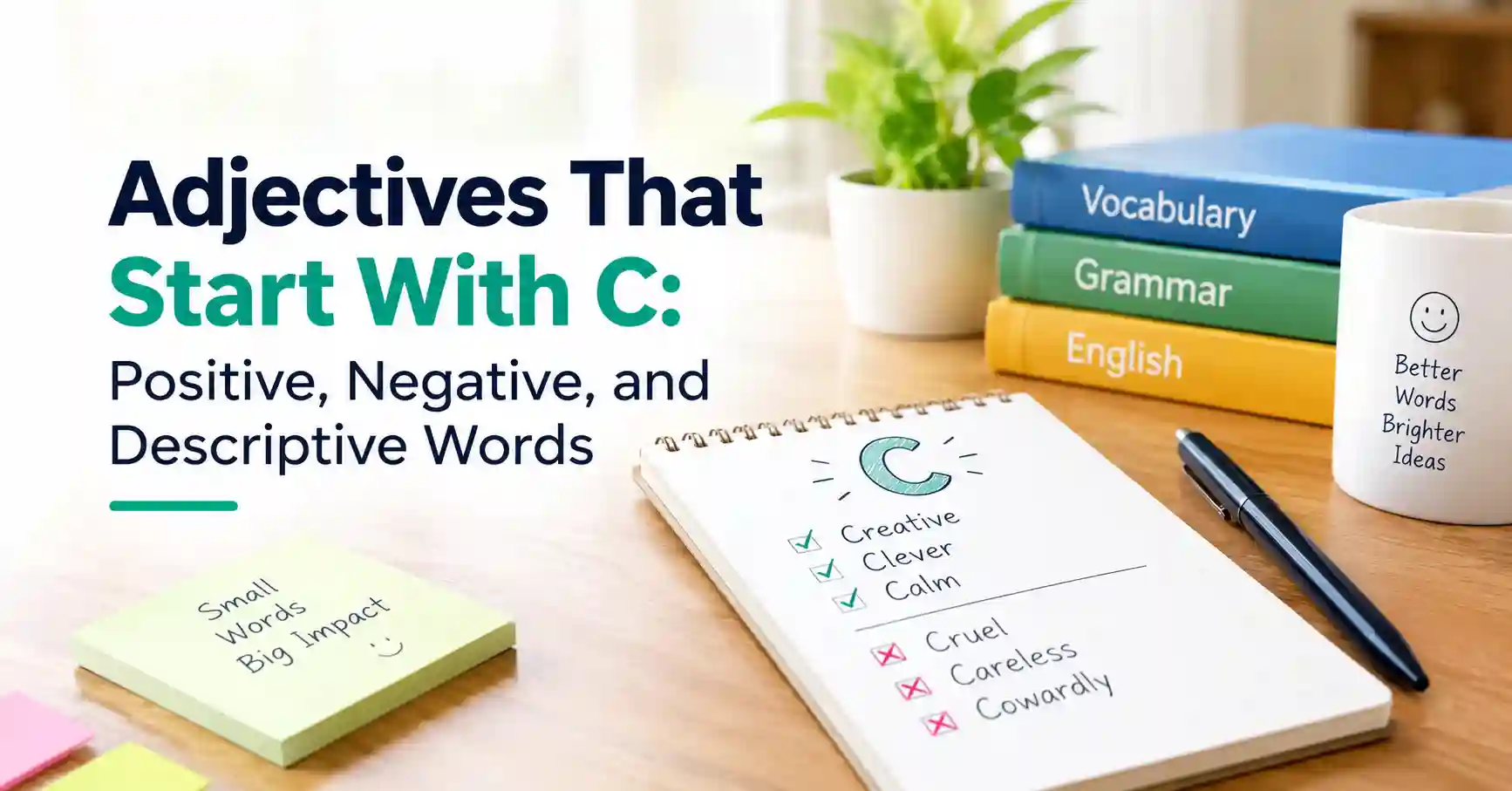
One word can turn a plain sentence into a picture. A chilly morning feels different from a cheerful one. The weather may be the same, but the mood is not. This guide gives you a full list of adjectives that start with C, with positive, negative, and descriptive words in one place.
C is a rich letter for describing the world. It gives us charming, courageous, and creative. It also gives us cruel, cluttered, and cynical. That range lets you describe people, places, feelings, and ideas with care.
In this guide, you will learn:
- more than 150 C adjectives, sorted by tone and theme
- meanings and examples for the top 40 words
- the types of adjectives and how each one works
- word order, comparisons, and common mistakes
- word origins, memory tricks, and a ten-question quiz
Every word here is a real adjective. We did not mix in nouns or verbs. A strong vocabulary makes your writing clearer and your speech more vivid. Let’s begin.
What Are Adjectives?
Adjectives are words that describe nouns. They tell us what a person, place, or thing is like. This section gives a simple definition and clear examples. It also shows why a rich adjective vocabulary helps you write and speak with more power and precision.
An adjective answers questions like these: What kind? Which one? How many? How does it look, feel, or sound?
Here are five examples:
- “The calm river moved slowly.”
- “She asked a curious question.”
- “He wore a colorful scarf.”
- “The soup is cold.”
- “That was a clever plan.”
Adjectives usually come before a noun, as in “a clever plan.” They can also follow linking verbs like be, seem, and feel, as in “The plan is clever.”
Why does this matter? Nouns give facts. Adjectives give color and feeling. A “house” is just a house. A “cozy house” feels warm. A “crumbling house” feels sad.
A strong adjective vocabulary helps in three ways. It also helps you avoid tired words like nice and good. Adjectives That Start With C give you many sharper choices.
Discover Positive Adjectives: Adjectives That Start With Q: 55+ Positive & Descriptive Words
The Complete List of Adjectives That Start With C
This is the heart of the guide. Here you will find C adjectives grouped by meaning and use. Each list is alphabetical. We begin with the top 40 words, with meanings and examples. Then we move through positive, negative, neutral, people, places, advanced, and simple words.
Top 40 Adjectives That Start With C
These are the most useful C adjectives for daily life. You will meet them in books, news, school, and conversation. Each word has a short meaning and an example sentence. Learn these first. They build a strong base for everything else in this guide.
| Word | Meaning | Example |
| calm | peaceful and relaxed | The sea was calm today. |
| candid | honest and direct | She gave a candid reply. |
| capable | able to do things well | He is a capable nurse. |
| careful | taking care to avoid mistakes | Be careful with the glass. |
| caring | showing kindness to others | A caring neighbor helped us. |
| casual | relaxed and informal | We wore casual clothes. |
| cautious | avoiding risk | A cautious driver slows down. |
| charming | pleasant and attractive | The village is small and charming. |
| cheap | low in price | The cheap pen broke fast. |
| cheeky | playfully rude | He gave a cheeky wink. |
| cheerful | happy and bright | A cheerful song filled the room. |
| chilly | uncomfortably cool | It is chilly tonight. |
| civil | polite and respectful | They kept the talk civil. |
| clean | free from dirt | The kitchen is clean. |
| clear | easy to see or understand | The rules are clear. |
| clever | quick to learn or plan | What a clever idea! |
| clumsy | awkward in movement | I was clumsy and spilled the milk. |
| cold | low in temperature | The water is cold. |
| colorful | full of bright colors | A colorful kite flew above. |
| colossal | extremely large | A colossal rock blocked the path. |
| comfortable | giving ease and rest | This chair is comfortable. |
| common | seen often | Sparrows are a common bird. |
| compassionate | feeling sympathy for others | A compassionate doctor listens. |
| complete | whole, with nothing missing | The set is complete. |
| complex | made of many parts | The story is complex. |
| confident | sure of yourself | She felt confident before the talk. |
| considerate | thoughtful of others | A considerate guest helps clean. |
| content | quietly satisfied | The cat looked content. |
| cool | pleasantly cold, or stylish | The breeze felt cool. |
| courageous | brave | A courageous boy spoke up. |
| cozy | warm and snug | We sat in a cozy corner. |
| cranky | easily annoyed | The baby is cranky. |
| creative | full of fresh ideas | He is a creative painter. |
| crisp | firm, fresh, and clean | Crisp apples taste best. |
| critical | very important, or fault-finding | This step is critical. |
| crowded | too full of people | The bus was crowded. |
| cruel | causing pain without care | Cruel words hurt. |
| cunning | clever in a sly way | The fox was cunning. |
| curious | eager to learn | A curious child asks why. |
| cute | sweet and attractive | What a cute puppy! |
Some words have two senses, like cool and critical. Check the sentence to see which sense is meant.
Positive Adjectives That Start With C
Positive adjectives praise people, ideas, and things. They make readers feel good and trust your tone. The words below are warm, kind, or admiring. None of them are in the top 40 table. Use them in compliments, thank-you notes, reviews, and cover letters.
- calming – soothing
- captivating – holding your attention
- celebrated – widely praised
- charismatic – naturally attractive and persuasive
- charitable – generous to people in need
- cheery – bright and happy
- cherished – held dear
- chic – stylish
- chivalrous – polite and brave toward others
- classy – elegant
- committed – dedicated
- compelling – strongly interesting or convincing
- competent – skilled enough to do a job well
- composed – calm and in control
- conscientious – careful and hardworking
- constructive – helpful and useful
- convivial – friendly and lively
- cooperative – willing to work together
- cordial – warm and polite
- courteous – polite and respectful
- credible – believable
- cultured – refined and well-educated
Pick words that match what you truly see. Specific praise always sounds more honest than general praise.
Negative Adjectives That Start With C
Negative adjectives describe flaws, problems, or unpleasant feelings. They are useful in honest writing, reviews, and stories with conflict. Use them with care when describing real people. Choose words that fit a behavior, not a whole person. All these words are new to the lists above.
- callous – cold and unfeeling
- cantankerous – bad-tempered
- careless – not paying attention
- catty – spiteful
- chaotic – completely disordered
- cheerless – gloomy
- childish – silly in a bad way
- clingy – too dependent on others
- clueless – having no idea
- coarse – rough or rude
- cocky – too proud
- conceited – too pleased with oneself
- condescending – acting as if you are better than others
- confused – unable to think clearly
- contemptuous – showing scorn
- controlling – needing power over others
- corrupt – dishonest
- cowardly – lacking courage
- crabby – grumpy
- crass – insensitive and crude
- crooked – dishonest, or not straight
- cynical – distrusting other people’s motives
Describe actions when you can. “His remark was callous” is fairer than “He is a callous man.”
Neutral and Descriptive Adjectives That Start With C
Neutral adjectives simply describe. They do not praise or blame. They tell us about shape, time, place, and kind. These words are the quiet workhorses of clear writing. They are common in science, news, and everyday explanations.
- central – in the middle
- circular – shaped like a circle
- classic – of lasting quality or style
- cloudy – full of clouds
- coastal – near the sea
- collective – shared by a group
- compact – small and tightly packed
- concrete – real and specific
- constant – not changing
- contemporary – belonging to the present time
- conventional – following common custom
- cubic – shaped like a cube
- cultural – about customs and arts
- curved – bending in a smooth line
- customary – usual by habit or tradition
- cylindrical – shaped like a tube
Neutral words keep your tone balanced. They are ideal when you want facts without feelings.
Read More Noun Guides: Useful Nouns That Start With C to Improve Your Vocabulary
Adjectives to Describe People
People are many-sided, so we need many kinds of words. This list covers personality, appearance, and emotions. All the words are new, so they add to what you saw earlier. Use them in stories, speeches, references, and everyday talk.
Personality
- chatty – fond of talking
- competitive – eager to win
- congenial – pleasant and easy to get along with
- conservative – careful about change
- cosmopolitan – at ease in many cultures
- coy – shy in a playful way
Appearance
- chiseled – with sharp, clear features
- chubby – soft and round
- comely – pleasant to look at
- curly – with curls
- curvy – with a rounded shape
Emotions
- comforted – eased from worry
- concerned – worried
- conflicted – pulled in two directions
- cross – mildly angry
- crushed – deeply disappointed
Mix the three groups for a full portrait. “A chatty, comely woman” tells us more than either word alone.
Adjectives to Describe Places, Things, and Situations
Places and events deserve vivid words too. The right adjective helps readers see a room or feel a moment. This group covers spaces and objects first, then situations. Use these words in travel writing, reviews, reports, and stories.
Places and things
- cavernous – huge and hollow
- civic – about a city or town
- clammy – damp and sticky
- cloudless – with no clouds
- cluttered – full of messy things
- congested – too full or blocked
- cramped – too small and tight
- creaky – making squeaking sounds
- creepy – causing an uneasy feeling
- crumbling – falling apart
Situations
- challenging – difficult in a testing way
- complicated – hard to understand
- controversial – causing disagreement
- convenient – easy and useful
- costly – expensive
- crucial – extremely important
“Challenging” and “complicated” are not the same. A challenge tests you. A complication confuses you.
Uncommon and Advanced C Adjectives
Some C adjectives are rare and elegant. They add depth to essays, speeches, and fiction. Most are not used in casual talk. Use one or two in a piece of writing. Too many can sound showy and slow the reader down.
| Word | Meaning | Example |
| cacophonous | harsh and noisy | The cacophonous market never slept. |
| callow | young and inexperienced | A callow clerk made the error. |
| capricious | changing mood without reason | The capricious wind shifted again. |
| cathartic | giving emotional relief | Writing was cathartic for her. |
| celestial | of the sky or heavens | The celestial map showed every star. |
| cerebral | intellectual and thoughtful | He wrote cerebral essays. |
| chary | cautious and unwilling | She was chary of new offers. |
| churlish | rude and unfriendly | It would be churlish to refuse. |
| circumspect | careful about risks | Be circumspect in your reply. |
| clandestine | secret | They held a clandestine meeting. |
| clement | mild, as in weather | We enjoyed clement weather. |
| cloying | too sweet or sentimental | The perfume was cloying. |
| cogent | clear and convincing | She made a cogent argument. |
| cognizant | aware | He was cognizant of the risks. |
| copious | plentiful | She took copious notes. |
| cryptic | mysterious and hard to read | He left a cryptic note. |
Learn one advanced word a week. Say it aloud before you try it in writing.
Simple Adjectives for Beginners and Kids
Young learners need short, friendly words. These C adjectives are easy to say and easy to picture. Parents and teachers can use them with food, pets, and play. Simple words build confidence, and confidence builds a larger vocabulary.
- chewy – “The candy is chewy.”
- close – “The park is close.”
- crazy – “That was a crazy dance!”
- creamy – “I like creamy soup.”
- crunchy – “Crunchy chips are loud.”
- cuddly – “My bear is cuddly.”
Ask a child to name something chewy, creamy, and crunchy. It is a fun and easy game.
Adjectives by Type
Not all adjectives work the same way. Some compare. Knowing the types helps you use C adjectives with confidence and avoid grammar slips. This section explains each type with examples from the lists above. Some types, like possessive and demonstrative, have no C words at all, and we say so honestly.
Descriptive Adjectives
Descriptive adjectives tell us about quality, size, color, feeling, or shape. They are the largest group. Nearly every word in this guide belongs here. They make nouns come alive and help readers picture what you mean.
Examples: a cheerful neighbor, a cloudy sky, a curved road, a crisp morning.
Comparative Adjectives
Comparative adjectives compare two things. Short words usually add -er. Longer words use more. Use than after them. They help you show how one thing differs from another.
Examples: “This room is cleaner than that one.” “She is more confident than before.”
Superlative Adjectives
Superlative adjectives name the highest degree among three or more things. Short words add -est. Longer words use most. They almost always take the word ” the ” before them.
Examples: “That was the coldest night of the year.” “He is the most creative student in class.”
Possessive Adjectives
Possessive adjectives show who owns something. The common ones are my, your, his, her, its, our, and their. None of them start with C. That is why we cannot list C words here. You can still pair them with C adjectives, as in “my cozy room.”
Demonstrative Adjectives
Demonstrative adjectives point to specific things. They are this, that, these, and those. None start with C. Still, they work well with our list, as in “those colorful kites” or “this clear rule.”
Quantitative Adjectives
Quantitative adjectives tell us how much or how many. Common ones are some, many, and few. Two that start with C are considerable and countless. Use them to show amount without giving exact numbers.
Examples: “She showed considerable skill.” “Countless stars lit the sky.”
Compound Adjectives
Compound adjectives join two or more words, often with hyphens. They work as one adjective before a noun. The hyphen keeps the meaning clear. Several compound adjectives start with C.
Examples: clear-headed, close-knit, cold-hearted, cutting-edge, custom-made.
Sentences: “We live in a close-knit town.” “The lab uses cutting-edge tools.”
Explore Everyday Verbs: Verbs That Start With C: Common, Positive & Action Words
How to Use These Adjectives Correctly
Knowing the words is only half the job. You also need to place them well and form them correctly. This section covers word order, comparisons, common mistakes, and confusing pairs. Learn these rules once. They will help you every time you write with C adjectives.
Adjective Word Order
English has a natural order for adjectives. When you use more than one, they usually follow this pattern: opinion, size, age, shape, color, origin, material, and purpose. Native speakers follow this order without thinking, so it sounds natural when you do too.
Three examples:
- “a cozy little wooden cabin” (opinion, size, material)
- “a cheap round plastic container” (opinion, shape, material)
- “a charming old stone bridge” (opinion, age, material)
Say the sentence aloud. If it sounds odd, check the order. “A wooden little cozy cabin” sounds wrong because the order is broken.
Comparative and Superlative Forms
Most short adjectives add -er and -est. Longer adjectives use more and most. Some change spelling. The table below shows ten key C adjectives. Study the pattern, and then apply it to new words.
| Adjective | Comparative | Superlative |
| calm | calmer | calmest |
| cheap | cheaper | cheapest |
| clean | cleaner | cleanest |
| clever | cleverer or more clever | cleverest or most clever |
| cold | colder | coldest |
| comfortable | more comfortable | most comfortable |
| cozy | cozier | coziest |
| crazy | crazier | craziest |
| curious | more curious | most curious |
| cute | cuter | cutest |
Cozy and crazy change y to i. Cute drops its final e before -er. Words with three or more syllables nearly always use more and most.
Common Mistakes and How to Avoid Them
Even strong writers slip on adjectives. Most errors are small and easy to fix. The table below shows six common mistakes. Read each fix once. You will soon spot these errors in your own writing.
| Wrong | Right | Why |
| “more cleaner” | “cleaner” | Do not use more with -er. |
| “the most coldest” | “the coldest” | Use one form only. |
| “He drove careful.” | “He drove carefully.” | Use an adverb to describe a verb. |
| “a car red” | “a red car” | Adjectives come before the noun. |
| “curious of the answer” | “curious about the answer” | Use about with curious. |
| “She is very creativity.” | “She is very creative.” | Use the adjective, not the noun. |
Proofread once only for adjectives. You will catch more errors than when you read for everything at once.
Commonly Confused Words
Some adjectives look or sound alike but mean different things. Mixing them up can change your message. These six pairs cause trouble for many writers. Keep the table nearby when you edit.
| Pair | Difference | Example |
| complementary/complimentary | going well together / free, or praising | “Blue and orange are complementary. The tea was complimentary.” |
| continual/continuous | repeating with breaks / never stopping | “Continual calls annoyed us. The hum was continuous.” |
| credible/credulous | believable / too ready to believe | “A credible source helps a credulous reader.” |
| classic/classical | of lasting quality / of ancient or formal tradition | “A classic film. Classical music.” |
| comprehensive/comprehensible | covering everything / easy to understand | “A comprehensive guide must be comprehensible.” |
| childish/childlike | silly and immature/innocent and joyful | “A childish tantrum. A childlike wonder.” |
Childish is a criticism. Childlike is often a compliment. Choose carefully.
Learn Adverb Meanings: 120+ Adverbs That Start With B (Easy Words for Students)
Synonyms and Antonyms
Synonyms are words with similar meanings. Antonyms are words with opposite meanings. Knowing both sharpens your choices fast. The table pairs 18 key C adjectives with matches and opposites. Use it to avoid repeating yourself and to see each word more clearly.
| Word | Synonyms | Antonyms |
| calm | peaceful, serene | agitated |
| candid | frank, open | evasive |
| capable | able, skilled | incapable |
| careful | cautious, watchful | careless |
| cheerful | happy, sunny | gloomy |
| clean | spotless, tidy | dirty |
| clear | obvious, plain | vague |
| clever | smart, bright | foolish |
| cold | chilly, icy | hot |
| comfortable | cozy, snug | uncomfortable |
| common | usual, frequent | rare |
| complex | complicated, intricate | simple |
| confident | assured, certain | insecure |
| courageous | brave, fearless | cowardly |
| creative | inventive, original | unimaginative |
| cruel | harsh, heartless | kind |
| curious | inquisitive, eager | indifferent |
| cute | adorable, sweet | plain |
Synonyms are close, but they are not twins. Each one has its own tone. “Frank” can sound blunt, while “candid” sounds honest and kind. “Cheap” can sound insulting, while “affordable” sounds fair.
Think about intensity too. “Cool” is mild. “Freezing” is strong. A strong word for a small thing can sound false.
Finally, think about context. “Cordial” fits a meeting. “Cozy” fits a home. When unsure, pick the simpler word. Clear writing always wins.
Practical Use Cases
Adjectives matter most when you use them. This section shows how Adjectives That Start With C work in real writing and speech. You will see samples for school, stories, work, social media, and daily talk. Copy them, change them, and make them your own.
Essays and Academic Writing
Academic writing needs precise, balanced words. Adjectives help you describe evidence, ideas, and arguments without exaggerating. Choose words that are accurate and measured. Avoid slang. Here are three samples.
- “The author makes a cogent argument for reform.”
- “The results were consistent across trials.”
- “This is a controversial but important theory.”
Storytelling and Creative Writing
Stories live on sensory detail. The right adjective sets a mood in a few words. Use cavernous for awe and creepy for fear. Pick words that match the feeling of the scene. Here are three samples.
- “The cavernous hall echoed with every step.”
- “A clammy fog crept over the harbor.”
- “Her cheerful voice filled the cozy kitchen.”
Resumes and Professional Writing
Work documents need confident but honest language. Adjectives show your strengths. Back each one with a fact. Avoid vague claims. Here are three samples.
- “Competent project manager with a collaborative style.”
- “Conscientious analyst who checks every detail.”
- “Creative problem-solver who cut costs by streamlining reports.”
Social Media Captions
Captions are short, so every word counts. A good adjective adds mood in one beat. Keep your tone real. Readers can tell when words are forced. Here are three ideas.
- “Cozy nights and cold coffee.”
- “Chasing colorful sunsets.”
- “Calm mind, cheerful heart.”
Everyday Conversation
Daily talk is relaxed and quick. Simple adjectives work best. A warm word can brighten someone’s day. Aim for natural, not fancy. Here are three samples.
- “That was a clever fix. Thank you!”
- “You look so comfortable in that chair.”
- “What a crowded market today!”
Fun Facts and Learning Tips
Learning is easier when it is fun. Adjectives That Start With C have surprising histories. Some changed meaning over time. Some began as names for ideas or colors. This section shares fun facts, memory tricks, word origins, daily habits, and a quiz. Each part helps you remember more words and use them with confidence.
Explore Positive Words: 250+ Positive Words That Start With C (With Meanings & Examples)
Fun Facts About Adjectives That Start With C
Words carry hidden stories. The six facts below show how letters and meanings shift over time. They also make great conversation starters. Share one with a friend today and watch their surprise.
- The letter C once did two jobs. The Latin C came from the Greek letter gamma, through the Etruscans. Early Latin used it for both the “g” sound and the “k” sound. Later, Romans created a separate letter G.
- “Cute” is a short form of “acute.” Acute once meant sharp or clever. People dropped the first letter in speech. Over time, the meaning softened to “sweet and attractive.”
- “Cunning” once meant “knowing.” It comes from an Old English verb that meant “to know.” At first, it praised skill and learning. Later, it took on a sly tone.
- “Candid” meant “white.” It comes from a Latin word for bright white. The idea was a clear, clean, open mind. The word candidate shares this root, since Roman office seekers wore white togas.
- “Cynical” comes from a Greek word meaning “dog-like.” It links to an ancient school of philosophers called the Cynics. They mocked social customs. Today the word means distrusting people’s motives.
- “Crazy” began with cracks. It comes from craze, an old word meaning to crack or shatter. A “crazy” wall was a cracked wall. The meaning then moved from broken things to unsteady minds, and later to casual slang.
Memory Tricks and Mnemonics
Memory tricks help new words stick. The brain loves pictures, sounds, and stories. Try the five methods below. Each uses real words from this guide. Mix them to find the one that works best for you.
- Picture links. Imagine a snug cabin with a warm fire for cozy. Imagine a giant statue for colossal.
- Sound chains. Say “calm, clear, clean” three times. The shared start locks the words together.
- Root clues. Cor means “heart” in Latin. It sits inside cordial and courageous.
- Pairs with opposites. Link careful with careless. Linking a word to its opposite doubles your memory.
- Mini rhymes. Say “Cautious drivers cross with care.” It is silly, and it works.
Word Origins and History
Every word has a past. Knowing where a word came from deepens its meaning and helps you remember it. Here are six C adjectives with their roots and how their meanings changed.
- Calm comes from Greek kauma, “heat,” through Latin and Italian. It first described the still, hot part of the day. Later it meant any peaceful quiet.
- Cordial comes from Medieval Latin cordialis, from Latin cor, “heart.” It first meant “of the heart.” Now it means warm and polite.
- Courageous comes from Old French corage, from Latin cor. Courage was once a matter of the heart. Today it means brave.
- Crucial comes from French, from Latin crux, “cross.” It grew from the image of a signpost at a crossroads, a point of choice. It now means extremely important.
- Curious comes from Latin curiosus, “full of care.” It once meant careful or fussy. Today it means eager to know.
- Celestial comes from Latin caelestis, from caelum, “sky.” It has always pointed to the heavens.
Daily Practice Tips
Habits beat cramming. A few minutes each day can add many words each month. Pick two habits to start. Add more when they feel natural and easy.
- Read widely. Read news, novels, and essays. Underline every C adjective you meet. Notice how writers use them.
- Keep an adjective journal. Each night, write one sentence about your day. Use one new C adjective. Real events make words stick.
- Use flashcards. Write the word on one side and the meaning on the other. Review for five minutes. Short, repeated practice works well.
- Describe your surroundings. Look around the room. Name three things with three new adjectives. This trains your eye and your tongue.
- Speak it aloud. Use one new word in a chat or call. Saying a word three times helps it stay.
- Replace weak words. Find nice, good, or bad in your writing. Swap each one with a precise C adjective.
Explore More Synonyms: 30+ Furthermore Synonyms: Formal, Academic & Professional Alternatives
Mini Practice Quiz
Testing yourself locks in what you learned. This quiz has ten questions. It mixes fill-in-the-blank, choose-the-word, and matching tasks. Try it without peeking. Then check the answer key.
Fill in the blank. Word bank: candid, cluttered, courageous, cautious, cozy.
- The firefighter was ______ and ran into the building.
- We sat by the fire in the ______ cabin.
- Be ______ on the icy road.
- Her ______ review was honest but kind.
- The ______ desk made it hard to find my pen.
Choose the correct answer.
- Which word means “harsh and noisy”? (a) cacophonous (b) cordial (c) cheerful
- Which is the correct comparative of cozy? (a) more cozy (b) cozier (c) cozyer
- Which order is correct? (a) a red cozy cabin (b) a cozy red cabin
Match the meaning.
- Match each word: 1. callow 2. clement 3. cryptic.
(a) mild, as in weather (b) mysterious (c) young and inexperienced
Identify the meaning.
- In “The tea was complimentary,” what does complimentary mean? (a) free of charge (b) matching well
Answer key:
- courageous
- cozy
- cautious
- candid
- cluttered
- (a) cacophonous
- (b) cozier
- (b) a cozy red cabin
- 1–c, 2–a, 3–b
- (a) free of charge
FAQs
People often ask the same questions about C adjectives. This section gives short, clear answers. Use them for quick study, classroom use, or fast reference. Each answer points you back to the lists above for more detail.
What are adjectives that start with C?
They are describing words such as calm, clever, colorful, cold, cozy, creative, and curious. They cover positive, negative, and neutral meanings. You can use them for people, places, things, and feelings. This guide lists more than 150 of them, with meanings and examples.
What are positive adjectives that start with C?
Positive C adjectives include cheerful, caring, charming, confident, courageous, creative, compassionate, and cordial. Others are captivating, competent, and conscientious. They praise people, ideas, and things. Pair them with specific details for honest, believable praise, such as “a conscientious editor who checks every line.”
What are negative adjectives that start with C?
Negative C adjectives include cruel, careless, callous, cocky, cowardly, cynical, and chaotic. Others are conceited, clingy, and condescending. Use them carefully when describing real people. Describe the action, not the whole person, to keep your tone fair and clear.
Which C adjectives describe a person?
To describe a person, try caring, confident, curious, creative, courteous, chatty, or considerate. For looks, try comely, chiseled, or curly. For feelings, try concerned, conflicted, or comforted. Choose the word that matches what you truly observe.
What are descriptive adjectives that start with C?
Descriptive adjectives tell us about quality, size, shape, or feeling. C examples include colorful, cloudy, curved, crisp, circular, compact, and colossal. They help readers picture what you mean. They are the largest and most useful group of adjectives.
What are simple C adjectives for kids?
Kids do well with short, familiar words. Try cute, cool, clean, close, crazy, creamy, crunchy, chewy, and cuddly. These are easy to say and spell. Link each one to a picture or a snack to make learning fun.
Do possessive adjectives start with C?
No. The standard possessive adjectives are my, your, his, her, its, our, and their. None start with C. Demonstrative adjectives like this, that, these, and those do not start with C either. You can still pair them with C adjectives in a sentence.
Conclusion
Adjectives shape how we see the world. In this guide, you explored a full list of Adjectives That Start With C. You met positive words like courageous, negative words like cruel, and neutral words like circular. You also learned word order, comparisons, common mistakes, and fun origins.
Remember the key points. Choose specific words over vague ones. Match tone to context. Use rare words sparingly. Check your comparatives. Practice a little each day.
Now it is your turn. Pick three C adjectives from this guide. Use each one in a sentence today. Save this list, share it with a friend, and keep building your vocabulary. Every new word makes your writing a little more clear, colorful, and confident.
