

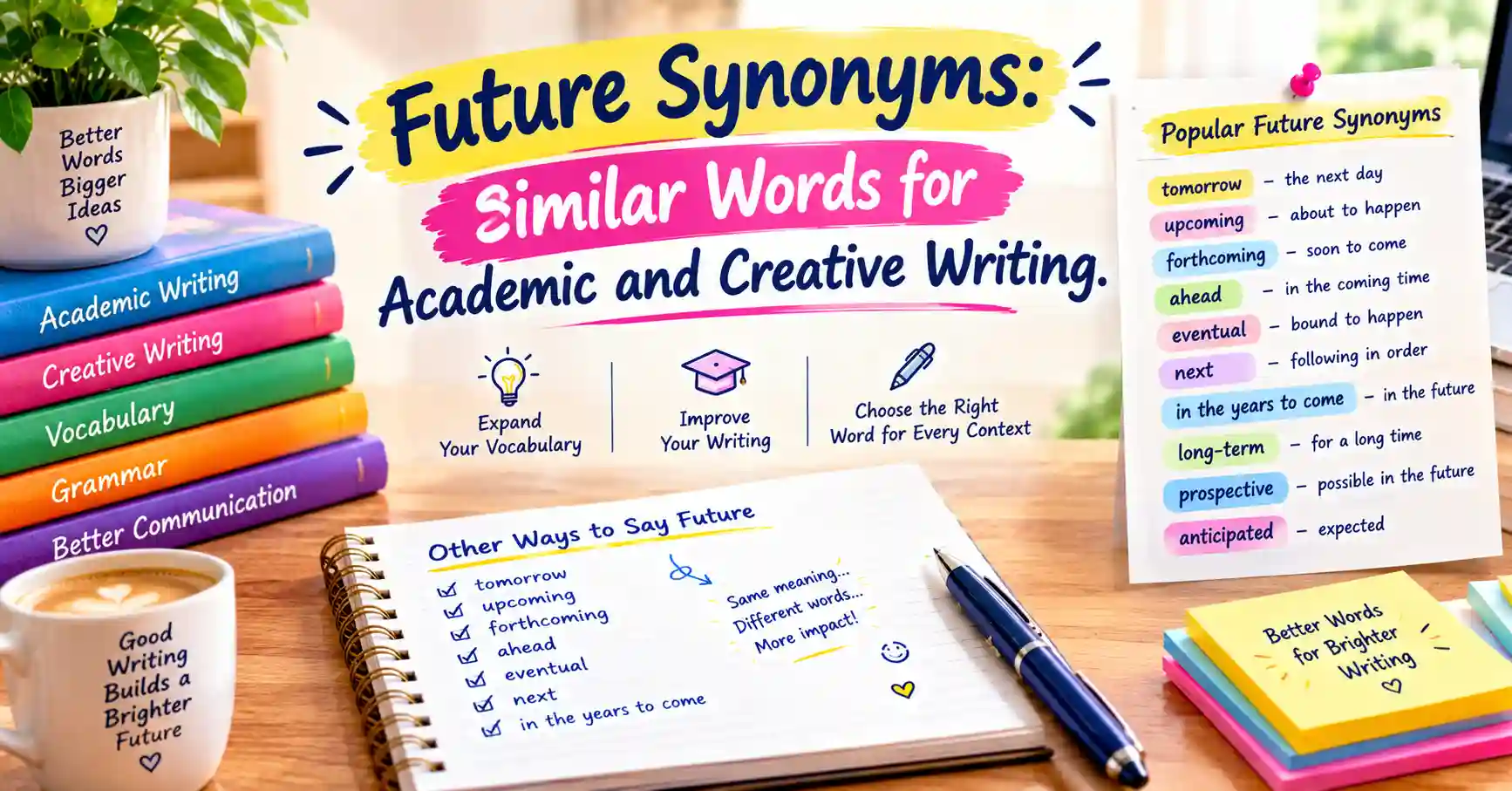
Tomorrow is always on its way. Yet the word we use for it can feel flat when we repeat it. This guide gives you a full list of future synonyms. You will find words, phrases, and clear examples.
The word future is common. It appears in essays, emails, stories, and speeches. Using it too often makes writing dull. A fresh choice adds color and precision.
Here is what you will learn:
- what future means and how to say it
- about 100 synonyms, related words, and phrases
- how each future synonym differs in tone and strength
- grammar, punctuation, and common mistakes
- examples for school, work, and creative writing
One honest note first. Future is a broad word. It works as a noun and as an adjective. Few words match it perfectly. So we label near matches clearly. We do not pad the list with wrong words.
Choosing the right synonym matters. It changes tone. It changes meaning. Let’s find the best word for your next sentence.
What Does Future Mean?
This section explains the word itself. You need a clear base before you swap it for another word. Here you will see the definition, the part of speech, the pronunciation, and five examples. You will also learn when futures is the right choice and when it is not.
Part of speech: noun and adjective. In finance, futures is a plural noun for a type of contract.
Pronunciation: FYOO-chur.
Main meanings:
- Noun: the time that comes after now.
- Noun: what will happen to a person, place, or thing.
- Noun: hope or promise, as in “a future in music.”
- Adjective: existing or happening after now.
Five examples:
- “Nobody can predict the future.”
- “She has a bright future in science.”
- “We should plan for the future.”
- “The future king was only ten years old.”
- “Future generations will thank us.”
Future is neutral in tone. It fits school, work, and daily talk. It is rarely too formal.
But it can be overused. In a long essay, you may write it ten times on one page. That is when a synonym helps. Use tomorrow for warmth.
Complete List of Future Synonyms
Here is the heart of the guide. This complete list of future synonyms is sorted by formality and by type. Each list is alphabetical. Some entries are nouns. Some are phrases. We label each one so you never have to guess.
Top 38 Future Synonyms
These are the most useful words and phrases. They cover nouns, adjectives, and common phrases. Each has a short meaning, a formality label, and an example. Learn these first. They solve most writing problems. (n. = noun, adj. = adjective, adv. = adverb.)
| Word | Meaning | Formality | Example |
| anticipated (adj.) | expected and awaited | neutral | The anticipated results arrive Friday. |
| approaching (adj.) | getting closer in time | neutral | The approaching exam made her nervous. |
| coming (adj.) | about to happen | neutral | Plan for the coming year. |
| days ahead (n.) | the time just ahead | neutral | The days ahead look busy. |
| destiny (n.) | a future seen as meant to be | neutral | He believed in his destiny. |
| down the road (adv.) | at a later time | informal | We can add more rooms down the road. |
| eventual (adj.) | happening in the end | neutral | The eventual winner was a newcomer. |
| expected (adj.) | thought likely to happen | neutral | The expected rise in prices worried us. |
| fate (n.) | what will happen to someone | neutral | The town’s fate was uncertain. |
| forthcoming (adj.) | about to appear or happen | formal | Her forthcoming novel is a mystery. |
| fortunes (n.) | luck and success ahead | neutral | The club’s fortunes are improving. |
| futurity (n.) | future time | formal | The poem looks toward futurity. |
| generations to come (n.) | people not yet born | formal | We protect the forest for generations to come. |
| going forward (adv.) | from this point on | neutral | Going forward, we will meet weekly. |
| henceforth (adv.) | from now on | formal | Henceforth, all reports are due Monday. |
| hereafter (adv.) | from this time on | formal | The rules apply hereafter. |
| horizon (n.) | the edge of what we can foresee | neutral | New jobs are on the horizon. |
| imminent (adj.) | about to happen very soon | formal | A decision is imminent. |
| incoming (adj.) | about to arrive or take a role | neutral | The incoming manager met the team. |
| later (adj.) | after the present time | neutral | We can discuss it at a later date. |
| long-term (adj.) | lasting far into the future | neutral | They made a long-term plan. |
| the morrow (n.) | the next day | literary | They would leave on the morrow. |
| next (adj.) | coming right after this | neutral | See you next week. |
| the offing (n.) | the near future, as in “in the offing” | formal | A raise may be in the offing. |
| outlook (n.) | what seems likely ahead | neutral | The job outlook is strong. |
| planned (adj.) | arranged for later | neutral | The planned trip starts in May. |
| posterity (n.) | all future generations | formal | The letters were saved for posterity. |
| prospective (adj.) | likely to become | formal | We met a prospective buyer. |
| prospects (n.) | chances for success ahead | neutral | Her career prospects are bright. |
| scheduled (adj.) | set for a certain time | neutral | The scheduled meeting is at noon. |
| someday (adv.) | at some unknown future time | informal | Someday I will visit Japan. |
| subsequent (adj.) | coming after | formal | Subsequent chapters explain the plan. |
| time to come (n.) | the time ahead | neutral | In time to come, the town will grow. |
| to-be (adj.) | soon to hold a role | informal | The bride-to-be smiled. |
| tomorrow (n.) | the time ahead, with a hopeful tone | neutral | We are building a better tomorrow. |
| upcoming (adj.) | happening soon | neutral | The upcoming concert sold out. |
| what lies ahead (n.) | the unknown time to come | neutral | Nobody knows what lies ahead. |
| years to come (n.) | many years from now | neutral | This will matter for years to come. |
Pick two or three from this table. Use them in place of future today.
Formal Future Synonyms
Formal words suit reports, essays, and speeches. They sound polished and serious. They are not for casual chat. Use them sparingly, because too many can sound stiff.
- forthcoming – formal and often used for books and events
- futurity – rare, almost poetic
- generations to come – grand, used in speeches
- henceforth – strict and official
- hereafter – legal and formal
- imminent – urgent, and means “very soon”
- posterity – serious and historical
- prospective – used for buyers, students, and employers
- subsequent – used in academic writing for “later”
- the offing – elegant and slightly old-fashioned
Use forthcoming and subsequent in essays. Save posterity for big ideas.
Neutral Future Synonyms
Neutral words work almost anywhere. They are safe in emails, essays, and stories. They never sound too stiff or too casual. When in doubt, choose from this group.
- anticipated – awaited with interest
- approaching – coming closer
- coming – simple and clear
- destiny – a path that feels meant to be
- expected – thought to be likely
- horizon – a figurative edge of the future
- long-term – focused on many years
- next – the very next one
- outlook – a view of what is likely
- planned – arranged on purpose
- prospects – chances ahead
- scheduled – given a set time
- tomorrow – friendly and hopeful
- upcoming – common in news and email
Neutral words are your daily tools. Upcoming and coming cover most needs.
Informal and Conversational Future Synonyms
Casual talk needs relaxed words. These phrases sound natural in speech, texts, and blogs. They would feel odd in a legal paper. Match your word to your reader, and your writing will feel warm.
- down the line – “We’ll fix that down the line.”
- down the road – “Down the road, we may move.”
- later on – “I’ll call you later on.”
- one day – “One day, I’ll write a book.”
- someday – “Someday we’ll travel.”
- soon-to-be – “my soon-to-be neighbor”
- sooner or later – “Sooner or later, it will rain.”
- to-be – “a mom-to-be”
Informal words feel friendly. Use them with friends, not in formal reports.
Simple Future Synonyms for Beginners and Kids
Young learners need short, clear words. These choices are easy to say and spell. They help kids talk about time without stress. Teachers can use them in class. Parents can use them at home.
- ahead – “Good things are ahead.”
- later – “We will play later.”
- next – “Who is next?”
- one day – “One day, I will be a pilot.”
- soon – “Lunch is soon.”
- someday – “Someday you will be tall.”
- tomorrow – “See you tomorrow.”
- what comes next – “I wonder what comes next.”
Teach tomorrow, next, and later first. They build a strong base.
Advanced and Uncommon Future Synonyms
Some words are rare and rich. They add depth to a speech, a poem, or a novel. Most readers will know them, but few use them. Use one per page. Too many can feel showy.
| Word | Meaning | Example |
| by and by (adv., dated) | after a while | By and by, the storm passed. |
| eventuality (n.) | a possible future event | We planned for every eventuality. |
| contingency (n.) | a future event that may happen | The budget covers any contingency. |
| ensuing (adj.) | coming right after | The ensuing years were peaceful. |
| futurity (n.) | future time | Futurity felt full of promise. |
| in the fullness of time (phrase) | when the right time arrives | In the fullness of time, truth emerges. |
| the morrow (n.) | the next day | She would decide on the morrow. |
| prognosis (n.) | a forecast of what will happen | The prognosis for the economy is good. |
| the offing (n.) | the near future | Big news is in the offing. |
Notice that eventuality and contingency name a possible event. They do not name time itself.
Phrases and Multi-Word Alternatives
Phrases often sound more natural than single words. They can set a tone with just a few extra words. Many work as adverbs, so they add time to a verb. Use them at the start or end of a sentence.
| Phrase | Tone | Example |
| as time goes on | neutral | As time goes on, the pain fades. |
| at a later date | formal | We will review it at a later date. |
| at some point | neutral | At some point, we must decide. |
| before long | neutral | Before long, spring will arrive. |
| from here on | neutral | From here on, I will be early. |
| from now on | neutral | From now on, we will recycle. |
| in days to come | literary | In days to come, we will remember. |
| in due course | formal | The results will arrive in due course. |
| in later years | neutral | In later years, she moved abroad. |
| in the coming years | neutral | Sales will grow in the coming years. |
| in the distant future | neutral | Cars may fly in the distant future. |
| in the foreseeable future | neutral | Prices will stay high in the foreseeable future. |
| in the long run | neutral | Honesty pays in the long run. |
| in the near future | neutral | We hope to expand in the near future. |
| in the years ahead | neutral | In the years ahead, we will grow. |
| in years to come | neutral | In years to come, you will smile. |
| years down the road | informal | Years down the road, we laughed about it. |
Pick phrases that fit your rhythm. Short phrases suit speech. Longer ones suit essays.
Future Synonyms by Meaning and Context
Future has more than one meaning. So no single list fits every case. This section sorts synonyms for future by sense. Pick the sense first. Then pick the word. This step prevents most mistakes and keeps your meaning precise.
Sense 1: The Time That Comes After Now
This is the main meaning. It refers to time itself. The words below are mostly nouns. They answer the question: “What comes later?” Use them when you mean time, not a person’s fate.
| Synonym | Nuance | Example |
| days ahead | near and personal | The days ahead will be busy. |
| hereafter | formal; can also mean afterlife | What lies in the hereafter is unknown. |
| the road ahead | figurative, journey feel | The road ahead is long. |
| time to come | neutral and clear | Time to come will judge us. |
| tomorrow | warm and simple | Tomorrow belongs to the bold. |
| what lies ahead | hints at mystery | We fear what lies ahead. |
| years to come | stresses long span | The effects will last for years to come. |
Use tomorrow for hope. Use what lies ahead for mystery.
Sense 2: What Will Happen to Someone or Something
Here, future means a person’s path or chances. The words below carry more emotion. Some imply luck. Some imply fate. Choose with care, because they change how the reader feels.
| Synonym | Nuance | Example |
| destiny | feels meant to be | She followed her destiny. |
| fate | often outside our control | Fate brought them together. |
| fortunes | luck and money | The firm’s fortunes have risen. |
| horizon | what we can see coming | Change is on the horizon. |
| outlook | likely trend | The outlook for farmers is poor. |
| prospects | chances of success | His prospects are excellent. |
Destiny and fate suggest the path is set. Prospects suggest it is open.
Sense 3: Future Generations
Sometimes future means the people who come later. These words are formal and weighty. They suit speeches, history, and ethics. They carry a sense of duty to those who follow us.
| Synonym | Nuance | Example |
| coming generations | warm and clear | We teach coming generations to care. |
| generations to come | common in speeches | We build for generations to come. |
| posterity | formal and historic | The diary was kept for posterity. |
Sense 4: Describing Something That Will Happen Later
Future is also an adjective. It describes things that have not happened yet. The words below fit before a noun. They differ in how soon, how sure, and how formal the event is.
| Synonym | Nuance | Example |
| approaching | getting closer now | The approaching storm worried us. |
| coming | simple and neutral | The coming week is full. |
| eventual | at the end of a process | Their eventual success was clear. |
| forthcoming | formal; about to appear | The forthcoming report is detailed. |
| imminent | very soon | A storm is imminent. |
| incoming | about to arrive or start | The incoming class is large. |
| later | after now | A later chapter explains it. |
| next | right after this | Our next step is testing. |
| prospective | likely to become | A prospective tenant called. |
| subsequent | after something else | Subsequent studies agreed. |
| upcoming | soon, in the calendar | The upcoming election is close. |
Ask three questions. How formal? Your answers point to the right word.
Sense 5: Words About Predicting the Future
These words are related, not exact. They name statements about the future, not the future itself. A forecast is a prediction. The future is what it predicts. Use these only when you mean the prediction.
| Word | Meaning | Example |
| forecast (n.) | a prediction | The forecast calls for rain. |
| prognosis (n.) | an expert prediction | The prognosis is hopeful. |
| projection (n.) | an estimate from data | The projection shows growth. |
| prospect (n.) | something expected | The prospect of rain worried us. |
| vision (n.) | a clear picture of what could be | She shared her vision for the town. |
Future Synonyms by Word Length
Word length changes rhythm. Short words are quick. Long words feel formal. Pick by length when you write headlines, captions, or poems. This section sorts synonyms for future by length.
Short Synonyms (Up to 5 Letters)
Short words are punchy and clear. Only a few real synonyms fit this size. We list the genuine ones and add no filler. They suit posters, texts, and fast speech.
- ahead (adv.) – “Better days are ahead.”
- fate (n.) – “Fate decides.”
- later (adj.) – “A later date works.”
- next (adj.) – “The next step is yours.”
- soon (adv.) – “Results come soon.”
Medium Synonyms (6 to 9 Letters)
Medium words balance clarity and style. This group is the largest. These words work in almost any setting. They are the safest choices for everyday writing and school essays.
- coming – “The coming year looks bright.”
- destiny – “Destiny called her.”
- expected – “The expected rise did not happen.”
- hereafter – “Hereafter, rules apply.”
- imminent – “Rain is imminent.”
- outlook – “The outlook is good.”
- prospect – “The prospect excited us.”
- tomorrow – “Tomorrow looks bright.”
- upcoming – “The upcoming test is hard.”
Long Synonyms (10 or More Letters)
Long words sound formal and exact. They suit reports, papers, and speeches. They can slow a sentence, so use them with care. One long word per sentence is plenty.
- anticipated – “The anticipated launch was delayed.”
- approaching – “The approaching deadline is Friday.”
- contingency – “Prepare for any contingency.”
- eventuality – “We expect every eventuality.”
- forthcoming – “The forthcoming issue is out.”
- foreseeable – “No change is foreseeable.”
- next-generation – “Next-generation cars are electric.”
- projection – “The projection looks strong.”
- prospective – “A prospective client called.”
- subsequent – “Subsequent tests confirmed it.”
Synonym Comparison and Nuance
Synonyms are close, but they are not twins. Each has its own tone, strength, and use. This section helps you compare them side by side. You will see a ranking, a situation guide, and a list of words that cannot always replace future.
Intensity and Formality Ranking
Some words are casual. Others are formal. Ranking them shows the full range. Use the table to move up or down in tone. The words are ranked from most casual to most formal.
| Level | Adjectives | Nouns and phrases |
| 1 – Very casual | next, to-be | someday, down the road |
| 2 – Casual | coming | tomorrow, days ahead |
| 3 – Neutral | upcoming, approaching | time to come, years to come |
| 4 – Formal | forthcoming, prospective | generations to come, the offing |
| 5 – Very formal | subsequent, imminent | posterity, futurity, hereafter |
Read down each column. Pick the level that fits your reader.
Best Future Synonym for Each Situation
The best future synonym depends on your goal. Essays need precision. Texts need speed. This table gives ten common situations. Each has a top choice and a short reason. Use it as a quick guide.
| Situation | Best choice | Reason |
| School essay | prospective, subsequent | formal and precise |
| Business email | upcoming | clear and polite |
| Company plan | long-term, going forward | shows planning |
| Speech | generations to come | rich and moving |
| Text message | later, soon | short and casual |
| Resume | prospective employer | standard and formal |
| Novel | what lies ahead | adds mystery |
| Poem | the morrow, tomorrow | lyrical |
| Science report | projected | based on data |
| Kids’ story | tomorrow, next | simple and clear |
Synonyms That Cannot Always Replace Future
Not every synonym fits every sentence. Some carry extra meaning. Swapping them blindly can change your message. Watch for these six traps.
- Destiny and fate imply the path is set. “The future is open” is not the same as “The destiny is open.”
- Eventual means “at the end.” “Her eventual career” is odd. “Her future career” is correct.
- Imminent means “very soon.” You cannot write “the imminent future of the planet” to mean far ahead.
- Posterity means people, not time. “Plan for posterity” works. “Posterity looks bright” is odd.
- Hereafter can also mean the afterlife. Check your context.
- Forecast is a statement. “The forecast is rain” is not “The future is rain.”
When in doubt, keep future. It is clear and never wrong.
Antonyms and Opposites
Future has no single perfect antonym. The closest opposite is past. The present sits in between. This section lists contrasting words with examples. Knowing the opposite helps you see the exact edge of each future synonym.
| Word | Type | Example |
| antiquity | noun | Ruins from antiquity still stand. |
| bygone days | noun phrase | We remember the bygone days. |
| earlier | adjective | An earlier draft was longer. |
| erstwhile | adjective | Her erstwhile rival is now a friend. |
| former | adjective | The former mayor spoke. |
| history | noun | History teaches us. |
| now | adverb | Act now. |
| past | noun | The past is behind us. |
| present | noun | Live in the present. |
| previous | adjective | The previous owner left a note. |
| prior | adjective | Prior notice is required. |
| the here and now | noun phrase | Focus on the here and now. |
| the old days | noun phrase | In the old days, we wrote letters. |
| today | noun | Today is a gift. |
| yesterday | noun | Yesterday was rainy. |
| yore | noun | In days of yore, knights rode. |
Use past as the main opposite. Use present when you want a middle point.
How to Use Future and Its Synonyms Correctly
Great words need correct grammar. This section covers articles, punctuation, placement, mistakes, and confusing pairs. A good future synonym still fails in a broken sentence. Read each part, then try the examples.
Grammar and Word Order for Future
Future is a noun and an adjective. As a noun, it usually follows the or a. As an adjective, it comes before the noun. It never changes form. The financial plural, futures, is a separate use.
- With “the”: “We worry about the future.”
- With “a”: “She has a bright future.”
- As an adjective: “Plans are exciting.”
- In the plural (finance only): “He trades oil futures.”
Many British writers say “in future” to mean “from now on.” They say “in the future” to mean “at some later time.” Both are correct.
Punctuation Rules
Punctuation helps phrases flow. A phrase at the start of a sentence usually needs a comma. A phrase at the end does not. Hyphens join some words before nouns. Here are six clear examples.
- Comma after an opening phrase: “Going forward, we will check in weekly.”
- Comma after a formal word: “Henceforth, all forms are online.”
- No comma at the end: “We will fix it down the road.”
- Hyphen before a noun: “She made a long-term plan.”
- No hyphen after the noun: “The plan is for the long term.”
- Semicolon between two full ideas: “The launch is imminent; the team is ready.”
Placement in a Sentence
Where you place a word changes its feel. At the start, it sets the scene. In the middle, it feels natural. At the end, it adds a gentle close. Try each spot and listen to the rhythm.
- Beginning: “In the years ahead, we will grow.”
- Middle: “We will, in time, repay the loan.”
- End: “We will visit again someday.”
Adjectives always sit before the noun. Write “the upcoming test,” not “the test upcoming.”
Common Mistakes and Corrections
Even strong writers slip. The table below shows seven common errors. Each has a quick fix. Study it once, and you will avoid these slips for good.
| Wrong | Right | Why |
| “a bright futures” | “a bright future” | Use the singular. |
| “in the futur” | “in the future” | Check the spelling. |
| “The upcoming of the event” | “The upcoming event” | Upcoming is an adjective. |
| “Next generation phones” | “Next-generation phones” | Add a hyphen before a noun. |
| “Going forward we meet weekly.” | “Going forward, we meet weekly.” | Add a comma. |
| “Eventually, we may cancel (meaning maybe).” | “Possibly, we will cancel.” | Eventually means “in the end.” |
| “Hey, henceforth I’m late!” | “Hey, from now on I’m late!” | Henceforth is too formal for casual talk. |
Commonly Confused Words
Some words look or sound alike. Mixing them up changes your meaning. These six pairs are worth learning. Keep the table close when you write about time and plans.
| Pair | Difference | Example |
| prospective / perspective | likely to become / a point of view | “A prospective student shared her perspective.” |
| imminent/eminent | about to happen / famous | “An eminent doctor said the storm is imminent.” |
| later / latter | after now / the second of two | “Later, I chose the latter option.” |
| future/futuristic | after now / like science fiction | “Future cars may look futuristic.” |
| forward / foreword | ahead / a book’s intro | “Look forward. Read the foreword.” |
| prophecy / prophesy | a prediction (noun) / to predict (verb) | “She would prophesy; the prophecy came true.” |
Overuse and Repetition
Repeating one word tires the reader. Natural variety keeps writing fresh. Do not swap blindly, though. Follow three simple habits and your text will flow.
- Vary by sense. Use tomorrow, prospects, and time to come for different ideas.
- Vary by place. Use a phrase at the start and an adjective in the middle.
- Keep one clear word. If a synonym feels forced, use future again.
Readers forgive repetition more than awkward words.
Practical Use Cases
Words matter most when you use them. This section shows each future synonym at work. You will see examples for school, work, stories, and talks. Each has three samples. Copy them, change them, and make them your own.
Essays and Academic Writing
Academic writing needs precise, formal words. Good synonyms show range without losing clarity. They also help you avoid repeating future in every paragraph. Keep claims honest and well supported.
- “Subsequent studies confirmed the early findings.”
- “The forthcoming policy will affect rural schools.”
- “These choices shape the world for generations to come.”
Business Emails and Reports
Work writing should be clear and brief. Neutral words keep the tone polite. Use phrases that signal planning. Avoid slang. Here are three samples.
- “Going forward, please send updates by Friday.”
- “The upcoming audit starts Monday.”
- “The long-term outlook remains strong.”
Resumes and Cover Letters
Job documents need confident, honest language. Future-focused words show ambition. Back each claim with facts. Avoid vague promises. These samples show the style.
- “I am eager to grow with a prospective employer like yours.”
- “My long-term goal is to lead a design team.”
- “I look forward to the coming opportunities.”
Storytelling and Creative Writing
Stories thrive on mood. Future words can add mystery, hope, or dread. Pick a word that matches your tone. Poetic choices work well here. Here are three lines.
- “No one knew what lay ahead.”
- “On the morrow, the village would wake to change.”
- “Her destiny waited beyond the hills.”
Speeches and Presentations
Speakers need rhythm and weight. Formal phrases sound grand when spoken slowly. Short phrases hit the heart. Use pauses. Here are three lines to try.
- “We build today for generations to come.”
- “The road ahead is long, but we will walk it together.”
- “Tomorrow belongs to those who prepare.”
Social Media and Everyday Conversation
Casual posts need short, warm words. Informal phrases feel natural and friendly. Keep it light. Here are three ideas.
- “Big things are coming. Stay tuned.”
- “Can’t wait for what’s next.”
- “Someday soon, we’ll all meet again.”
IELTS, TOEFL, and Exam Writing
Exam writing rewards range and accuracy. Varied vocabulary can help your score. Use words you know well. A wrong fancy word costs more than a simple right one. Here are three samples.
- “In the foreseeable future, cities will use less water.”
- “Subsequent generations may face greater risks.”
- “The projected rise in sea levels is worrying.”
Rewrite Examples: Before and After
Seeing a change is the best teacher. This section shows eight weak sentences and better versions. Each rewrite uses a different future synonym. Each change is explained in one line. Try rewriting your own sentences the same way.
| Before | After | Why it works |
| “The future is future bright.” | “The future is bright.” | Removes a repeated word. |
| “In the future, we will, in the future, grow.” | “In the years ahead, we will grow.” | Cuts repetition with a phrase. |
| “Our plans are plans.” | “Our upcoming plans are clear.” | Swaps in an adjective. |
| “He has a good future.” | “He has bright prospects.” | Adds a specific, richer noun. |
| “We will do it in the future.” | “We will do it down the road.” | Gives a casual tone. |
| “Think about the future of children.” | “Think about generations to come.” | Adds weight and emotion. |
| “The future meeting is on Friday.” | “The scheduled meeting is on Friday.” | Fits the business setting. |
| “The future is unknown.” | “What lies ahead is unknown.” | Adds mystery. |
Fun Facts and Learning Tips
Learning is easier when it is fun. The word future has a rich story. Many of its synonyms have surprising pasts. This section shares fun facts, memory tricks, word origins, daily habits, and a quiz. Each part helps you remember more words and use any future synonym with confidence and joy.
Fun Facts About Future and Its Synonyms
Words have wild histories. Some changed meaning over time. Some hide old images. These six facts show how language moves. Share one with a friend today.
- Future means “about to be.” It comes from the Latin futurus, linked to the verb “to be.” So the word literally means “what is going to be.”
- English has no true future tense. We use helper words like will. Many languages, such as French and Latin, change the verb itself.
- “Eventually” is a false friend. In Spanish, French, and German, similar words mean “possibly.” In English, it means “in the end.” This trips up many learners.
- “Imminent” once meant “overhanging.” It comes from a Latin word for hanging over. That is why it often feels like a threat.
- “Tomorrow” hides “morning.” In Old English, it meant “on the morrow,” and morrow comes from morgen, meaning morning. The word looked ahead to the next sunrise.
- “Soon” once meant “at once.” In Old English, it meant “immediately.” Over time, it softened to “in a short while.”
Memory Tricks and Mnemonics
Memory tricks make new words stick. The brain loves pictures, sounds, and stories. Try these five methods. Each uses real words from this guide. Mix them to find your favorite.
- Picture links. See a bright sunrise for tomorrow and a distant shore for horizon.
- Root clues. Remember fore- means “before.” Then forecast, foresee, and foreseeable all point to the future.
- Sound tricks. Imminent sounds like “in a minute.” It means very soon.
- Spelling tricks. Prospective has “spect,” like looking ahead. Perspective has “per,” like personal view.
- Mini rhymes. Say “Later is greater when you wait.” It is silly, and it works.
Word Origins and History
Every word has a past. Knowing it deepens meaning and aids memory. Here are six synonyms with their roots and how their meanings grew.
- Future comes from Latin futurus, via Old French. It meant “about to be.”
- Destiny comes from Latin destinare, “to make firm.” It began as something fixed in place and became a fixed path in life.
- Fate comes from Latin fatum, “that which has been spoken.” It first meant a decree, then a person’s lot.
- Prospect comes from Latin prospicere, “to look ahead.” It first meant a view, then something expected.
- Posterity comes from Latin posterus, “coming after.” It came to mean all who come later.
- Horizon comes from Greek horizein, “to limit.” It named the line that limits our sight, then our foresight.
Daily Practice Tips
Habits beat cramming. A few minutes a day can add many words each month. Pick two habits to start. Add more when they feel natural.
- Read widely. Read news, novels, and essays. Notice how writers say future in different ways. Jot down good phrases.
- Keep a word journal. Each night, write one sentence using a new future synonym. Tie it to your real day.
- Make flashcards. Put the word on one side and a meaning on the other. Review for five minutes. Spaced review works well.
- Rewrite old sentences. Take a paragraph you wrote. Replace each future with a better choice. Compare the two versions.
- Speak it aloud. Use one new word in a call or chat. Saying a word three times helps it stick.
- Do a word of the day. Pick one synonym each morning. Use it in a text, a note, or a talk before bed.
Mini Practice Quiz
Testing yourself locks in what you learned. This quiz has ten questions. It mixes fill-in-the-blank, best synonym, formality, and matching tasks. Try it without peeking. Then check the answer key.
Fill in the blank. Word bank: later, incoming, eventual, prospective, forthcoming.
- The ______ president will take office in January.
- Please text me ______; I’m busy now.
- The ______ winner was clear after round three.
- She is a ______ student visiting the campus.
- The author’s ______ book comes out in May.
Choose the best answer.
- Which is the most formal? (a) someday (b) down the road (c) henceforth
- Which word is a false friend, meaning “in the end” in English? (a) eventually (b) imminent (c) later
- Which word clashes with “distant” in “the distant future”? (a) far-off (b) imminent (c) long-term
Match the meaning.
- Match: 1. posterity 2. prospects 3. hereafter
(a) from this time on (b) future generations (c) chances of success
Identify the type.
- What part of speech is “going forward” in “Going forward, we will meet weekly”?
Answer key:
- incoming
- later
- eventual
- prospective
- forthcoming
- (c) henceforth
- (a) eventually
- (b) imminent
- 1–b, 2–c, 3–a
- adverbial phrase (it tells when)
FAQs
People often ask the same questions about this word. This section gives short, clear answers. Use them for quick study, classroom use, or fast reference. Each answer points back to the lists above.
What is another word for future?
Common choices are tomorrow, outlook, prospects, time to come, and what lies ahead. As an adjective, try upcoming, coming, or forthcoming. The best choice depends on meaning. Use tomorrow for hope. Use prospects for chances.
What is a formal synonym for future?
Formal options include forthcoming, prospective, subsequent, posterity, and futurity. For a formal phrase, try at a later date or generations to come. Choose carefully. Each word has a narrow meaning. Posterity, for example, means future people, not future time.
What is a simple word for future?
The simplest words are tomorrow, next, and later. For young learners, someday and soon also work. These words are short and easy to say. They are perfect for kids, new English learners, and quick messages.
Can I start a sentence with future?
Yes. As an adjective, it can open a sentence: “Plans are still being made.” You can also use phrases: “In the future, we will expand.” Add a comma after longer openers. For a smooth tone, try “Going forward,” or “In the years ahead,”.
Is future formal or informal?
Future is neutral. It fits essays, emails, speeches, and daily talk. It is rarely too stiff or too casual. If you want a formal tone, try forthcoming or prospective. If you want a casual tone, try down the road or someday.
What is the best future synonym for an essay?
For essays, try prospective, subsequent, forthcoming, or generations to come. Each fits a different purpose. Use subsequent for “later in time.” Use prospective for “likely to become.” Keep your claims clear. A simple word beats a fancy one used wrongly.
What is the difference between future and upcoming?
Future is broad. It can mean any time after now. Upcoming is narrower. It usually means soon, and often means scheduled. So “plans” can be years away, while an “upcoming event” is close. Use upcoming when a date is near.
Conclusion
Words about time shape how we dream and plan. In this guide, you explored about 100 synonyms, related words, and phrases. You saw meanings, tone, grammar, and real examples. You also learned why each future synonym has its own job.
Remember the key points. Pick the sense first, then the word. Match tone to your reader. Use formal words for essays and casual phrases for chats. When unsure, keep the simple word future.
Now it is your turn. Choose one future synonym today. Use it in a sentence, an email, or a story. Keep practicing. Your best tomorrow starts with one better word.
