

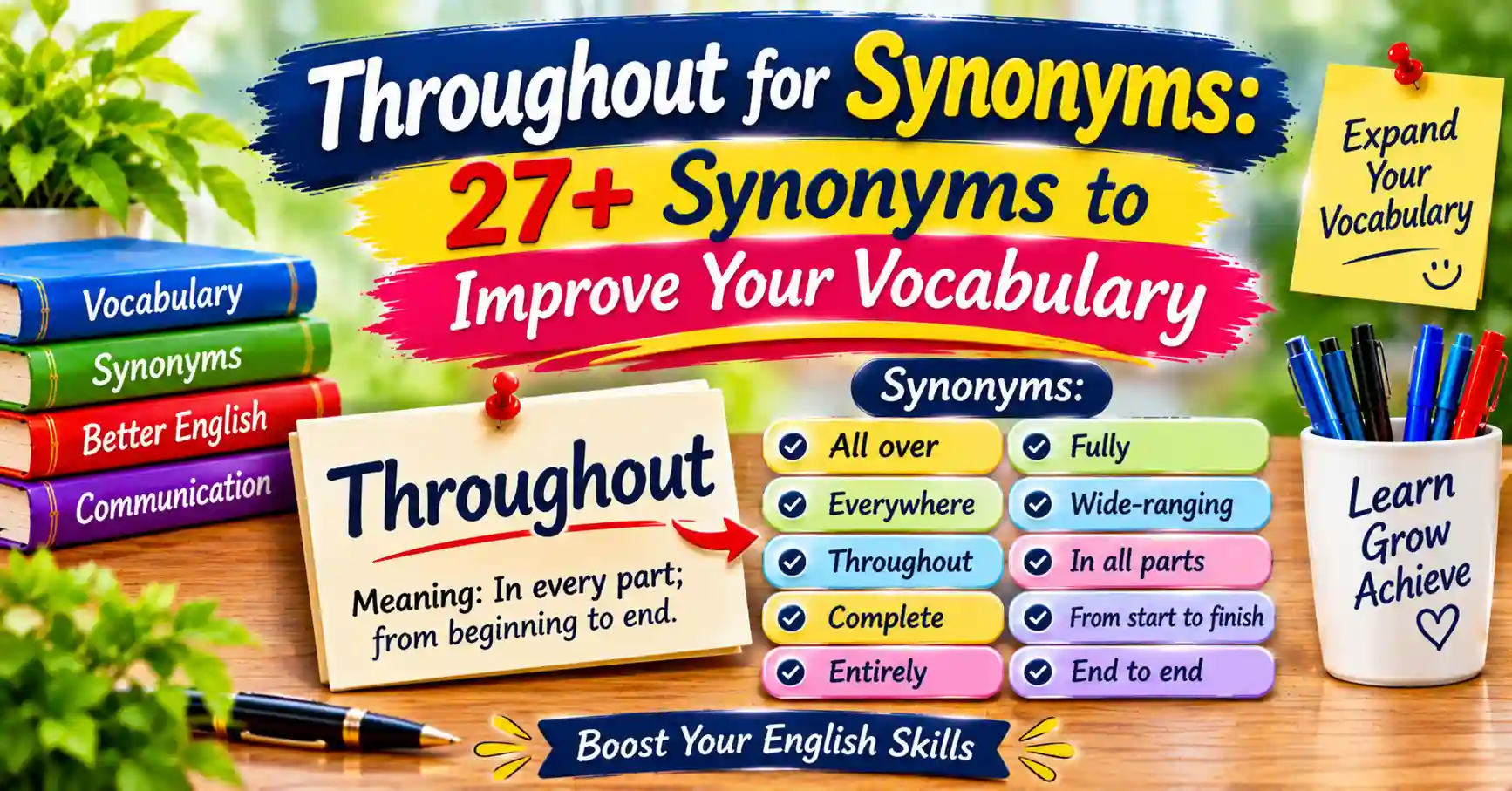
“Throughout” is a useful little word. But use it four times in one page, and it starts to echo. This guide gives you a full list of synonyms for throughout, with clear meanings, tone notes, and easy examples.
Every item here fits one real sense of throughout. Some are formal, like for the entire duration of.
One honest note first. Throughout has few single-word synonyms. Most good matches are short phrases. We found 40, counting single words and phrases. We did not pad the list with loosely related words.
In this guide, you will learn:
- 40 synonyms and phrases for throughout
- how each one differs in tone, strength, and formality
- the best choice for essays, emails, speeches, and texts
- grammar, punctuation, and common mistakes
- origins, memory tricks, and a ten-question quiz
Choosing the right word makes your meaning exact. Let’s begin.
What Does Throughout Mean?
Throughout tells us that something covers a whole time or a whole place. It has no gaps. This section gives the definition, the pronunciation, and five examples. It also shows when the word works well and when another word fits better.
Part of speech: preposition and adverb. Pronunciation: thruh-OWT.
Throughout has three main uses:
- Preposition of time: during the whole of a period. “She stayed calm throughout the meeting.”
- Preposition of place: in every part of a place. “Shops opened throughout the city.”
- Adverb: in every part, or from start to finish. “The house was repainted throughout.”
Here are five examples:
- “It rained throughout the night.”
- “The festival is famous throughout the country.”
- “He kept smiling throughout.”
- “We taught kindness throughout the year.”
- “The walls were checked throughout.”
Throughout is neutral and clear. It suits essays, news, and daily talk. But it is a common word, so that it can feel repetitive. It can also feel a little stiff in a casual chat. A good synonym adds variety or a more exact meaning.
Note one point of grammar. As a preposition, throughout needs a noun after it. We say “throughout the day,” not “throughout of the day.”
Complete List of Synonyms for Throughout
This is the heart of the guide. Here you will find every synonym for throughout we trust, sorted by tone. We start with a table of the twenty most useful options. Then we cover formal, neutral, informal, simple, advanced, and extra phrase options. Each list is alphabetical. No item appears twice in the new-word lists.
Top 20 Synonyms for Throughout
These twenty options are the most useful. You will meet them in news, books, guides, and speech. Each one has a meaning, a formality label, a note on how it differs from throughout, and an example. Learn these first. They form the base for every other list. Labels: prep. means preposition, and adv. means adverb.
| Word or phrase | Meaning | Formality | How it differs from “throughout” | Example |
| across | (prep.) over a whole area | neutral | places only; stresses spread | Snow fell across the country. |
| all along | (adv.) from the very start to now | neutral | stresses a long, hidden truth | She had doubts all along. |
| all over | (prep./adv.) in every part | neutral | place only; a bit casual | Toys lay all over the floor. |
| all the way through | (adv./prep.) from start to end | neutral | stresses a full path | We laughed all the way through the film. |
| all through | (prep.) during the whole of | neutral | plain; time or place | She stayed quiet all through the talk. |
| all year round | (adv.) during every season | neutral | time only; fixed phrase | The cafe is open all year round. |
| around | (prep.) in many parts of | neutral | place; looser than throughout | Fans around the world cheered. |
| everywhere | (adv.) in every place | neutral | place only; no time sense | Dust lay everywhere. |
| far and wide | (adv.) over a great distance | neutral | stresses reach and spread | The news spread far and wide. |
| for the duration of | (prep.) for as long as something lasts | neutral | exact and clear; time only | Stay seated for the duration of the flight. |
| for the whole of | (prep.) the full length of | neutral | time only; slightly formal | It rained for the whole of May. |
| from beginning to end | (adv.) from start to finish | neutral | stresses a full story or process | The book is gripping from beginning to end. |
| from start to finish | (adv.) the full length of | neutral | common for races and tasks | She led the race from start to finish. |
| from top to bottom | (adv.) in all parts, up and down | neutral | place; stresses thoroughness | They cleaned the house from top to bottom. |
| in every part of | (prep.) in all areas of | neutral | place; clear and plain | Shops opened in every part of the city. |
| right through | (adv./prep.) all the way, with no break | informal | stresses no interruption | He slept right through the storm. |
| the length and breadth of | (prep.) over the whole of an area | neutral | stresses full coverage of a land | She travelled the length and breadth of India. |
| the whole time | (adv.) from start to end of a period | neutral | time only; cannot take a noun | I smiled the whole time. |
| through | (prep.) during the whole of | neutral | shorter; also means “by means of” | It rained through the night. |
| up and down | (prep.) in all parts of a place | informal | casual; stresses coverage | Posters hung up and down the street. |
Pick three items from this table. Use one each day this week.
Formal Synonyms
Formal options suit essays, reports, and official notices. They sound precise and serious. Most are longer than throughout. Use them with care, because too many can feel stiff. These seven are new to the table above.
- at every stage of (prep.) – at each step of a process. Stresses steps, not time alone. Support was offered at every stage of the project.
- during the whole of (prep.) – for the full length of. Stresses completeness. He lived abroad during the whole of the war.
- for the entire duration of (prep.) – for as long as something lasts. Stronger than for the duration of. Phones must stay off for the entire duration of the exam.
- from end to end (adv.) – across the full length. Place only. A crack ran from end to end of the wall.
- from first to last (adv.) – from the first part to the final part. Formal and a little literary. The play held our attention from first to last.
- in all parts of (prep.) – in every region of. Formal and plain. Rain fell in all parts of the region.
- over the whole of (prep.) – across all of. Often used with periods of time. Showers continued over the whole of the weekend.
Use one formal phrase per paragraph. It keeps your tone steady and clear.
Neutral Synonyms
Neutral options fit almost any setting. They sound natural in an email, a guide, or a chat. These four are new to the lists above. They are a safe choice when you are unsure. Each one is a prepositional phrase.
- all across (prep.) – over a whole area. Warmer than across. Cafes opened all across the city.
- everywhere in (prep.) – in every part of. Place only. Prices rose everywhere in the region.
- for the entire time (prep./adv.) – for the full period. Plain and clear. She smiled for the entire time.
- in every corner of (prep.) – in all parts of a place. Warm and vivid. Fans cheered in every corner of the stadium.
Neutral phrases are the workhorses of good writing. Pick them when clarity matters most.
Informal and Conversational Synonyms
Informal options suit texts, chats, and social posts. They sound friendly and fresh. But they can feel out of place in a report. These three are new to the lists above. All three are about time.
- all day long (adv.) – during the whole day. Warm and common. Birds sang all day long.
- all night long (adv.) – during the whole night. Warm and common. The dog barked all night long.
- the whole way through (adv.) – from start to end. Casual. I laughed the whole way through.
Match your phrase to your audience. Check the tone before you send.
Simple Synonyms for Beginners and Kids
Young learners need short, friendly words. These are easy to say and easy to spell. They also build a happy habit of clear speech. Parents and teachers can use them every day. All six are re-listed above.
- all over – “Leaves fell all over the yard.”
- all through – “I read all through the night.”
- all year round – “We swim all year round.”
- everywhere – “I looked everywhere for my hat.”
- the whole time – “I smiled the whole time.”
- through – “It snowed through the night.”
Say one of these to a child today. Ask them to make their own sentence.
Advanced and Uncommon Synonyms
A few synonyms for throughout are rare or poetic. They are not used in daily talk. But they add flavor to stories, speeches, and essays. Use one or two per page. Too many can sound showy. All three are new to the lists above.
- all the livelong day (adv.) – during the whole day. Literary and old-fashioned. She sang all the livelong day.
- from dawn to dusk (adv.) – during the whole day. Poetic, and it suggests hard work. They worked from dawn to dusk.
- from pole to pole (adv.) – across the whole world. Poetic; place only. Cold winds blew from pole to pole.
Say these aloud before you write them. Rare phrases need a sure hand.
Phrases and Multi-Word Alternatives
Phrases give your writing rhythm. These three are extra options that fit special situations. They are new to the lists above. Each one fits time more than place. Note that right the way through is mostly British.
- around the clock (adv.) – during all hours, day and night. Often used for services. Nurses work around the clock.
- at all times (adv.) – without any break or exception. Stresses a rule or habit. Stay calm at all times.
- right the way through (adv.) – all the way, to the very end. British and informal. I enjoyed the film right the way through.
Phrases work best in speech and stories. In a formal report, pick a plain option.
Synonyms by Meaning and Context
Throughout has three main uses, and the best synonym depends on the use. A phrase that fits a period of time may not fit a country. An adverb phrase may not take a noun at all. This section sorts each synonym for throughout by use, so you can choose with care.
Synonyms for “During the Whole of a Period” (Time)
Use these when something lasts from the start to the end of a time. They suit news, reports, and stories. Pick for the duration of rules and notices. Pick all through for a plain tone.
| Synonym | Formality | Example |
| all through | neutral | She stayed calm all through the storm. |
| around the clock | neutral | The clinic runs around the clock. |
| at every stage of | formal | We checked quality at every stage of the build. |
| during the whole of | It snowed during the whole of January. | |
| for the duration of | neutral | Keep the sign up for the duration of the sale. |
| for the entire duration of | formal | Silence is required for the entire duration of the test. |
| for the whole of | neutral | He worked abroad for the whole of 2020. |
| over the whole of | formal | Heat continued over the whole of the week. |
| through | neutral | We talked through the night. |
Pair the phrase with a clear period. “For the duration of the flight” is more exact than “for a while.”
Synonyms for “In Every Part of a Place” (Place)
Use these when something covers a whole area. They suit travel, news, and weather writing. Words like everywhere work well for places only. Phrases like the length and breadth of add a sense of size.
| Synonym | Formality | Example |
| across | neutral | Rain fell across the south. |
| all across | neutral | Banners hung all across the square. |
| all over | neutral | Stars shone all over the sky. |
| around | neutral | People around the globe watched. |
| everywhere in | neutral | Birds nest everywhere in the park. |
| from end to end | formal | A rope ran from end to end of the hall. |
| in all parts of | formal | Floods hit in all parts of the valley. |
| in every corner of | neutral | Laughter rang in every corner of the house. |
| in every part of | neutral | Help arrived in every part of town. |
| the length and breadth of | neutral | They toured the length and breadth of Spain. |
| up and down | informal | We walked up and down the beach. |
Notice that up and down can also mean “back and forth.” Check the sense before you use it.
Synonyms for the Adverb Use (“From Start to Finish”)
Throughout can stand alone at the end of a sentence. It then means “all the way” or “in every part.” These options also stand alone. They do not take a noun. Use them when the time or place is already clear.
| Synonym | Formality | Example |
| all along | neutral | I trusted her all along. |
| all the way through | neutral | The story is funny all the way through. |
| everywhere | neutral | Snow lay everywhere. |
| from beginning to end | neutral | The plot is clever from beginning to end. |
| from first to last | formal | The team played well from first to last. |
| from start to finish | neutral | He ran the race from start to finish. |
| from top to bottom | neutral | They checked the ship from top to bottom. |
| right through | informal | I stayed awake right through. |
| the whole time | neutral | We smiled the whole time. |
Test the swap: “He kept smiling throughout” becomes “He kept smiling the whole time.” It works.
Synonyms for Throughout by Word Length
Word length changes how a word feels. Short words are quick and punchy. Long words sound formal and rich. This section sorts each synonym for throughout by letter count, ignoring spaces. Most good matches are phrases, so the short group is empty, and we say so.
Short Synonyms (Up to 5 Letters)
Short options fit headlines, texts, and captions. They are easy to read at a glance. An honest note: no synonym for throughout has five letters or fewer. Even all over has seven. If you need a short option, through is the closest.
none
When space is tight, choose through or all over. They are the briefest real matches.
Medium Synonyms (6–9 Letters)
Medium options fit nearly every setting. They are long enough to be exact, yet short enough to stay clear. Most are neutral, so they suit emails and essays. These seven are a strong everyday set.
across, around, through, all over, all along, all through, up and down
Medium options are the sweet spot for most writers. Start here when unsure.
Long Synonyms (10+ Letters)
Long options add weight and formality. They suit reports, notices, and speeches. But a long phrase can slow a sentence. Use one per sentence at most. Here are eight.
everywhere, far and wide, all day long, all year round, the whole time, in every part of, from start to finish, around the clock
Mix long and short options. A short word after a long phrase gives a nice beat.
Synonym Comparison and Nuance
Synonyms are close, but they are never twins. Each synonym for throughout has its own tone, reach, and best use. Some fit time, and some fit place. Some are casual, and some are formal. This section helps you compare them and pick with care.
Intensity and Formality Ranking Table
Options differ in strength and tone. Through is plain and short. From pole to pole is grand and rare. This table ranks synonyms for throughout from plain to formal or poetic. Use it to match the tone of your phrase to your audience.
| Level | Options | Tone |
| 1 – Plain | through, across, around | short, everyday |
| 2 – Clear | all through, all over, the whole time | friendly, common |
| 3 – Full | from start to finish, for the duration of, all the way through | exact, strong |
| 4 – Emphatic | from top to bottom, far and wide, the length and breadth of | bold, vivid |
| 5 – Formal or poetic | from first to last, at every stage of, from pole to pole, all the livelong day | polished, rare |
Read down the table. Notice how the tone grows more formal. A poetic phrase in a casual chat can sound odd.
Best Synonym for Each Situation
The right phrase depends on the setting. A text message and a thesis need different choices. This table gives ten common situations, with a best choice and a reason. Use it as a quick guide when you write.
| Situation | Best choice | Reason |
| Academic essay | at every stage of | formal and precise |
| Business email | for the duration of | professional and clear |
| Speech | from start to finish | easy to say aloud |
| Text message | the whole time | casual and friendly |
| Resume | at every stage of | shows full involvement |
| Cover letter | from start to finish | shows ownership |
| Weather report | across | short and exact for areas |
| Travel writing | the length and breadth of | vivid sense of size |
| Fiction | all the livelong day | adds old-world flavor |
| Public notice | around the clock | plain and practical |
Always back the phrase with a fact. “At every stage of the launch, with weekly checks” proves your point.
Synonyms That Cannot Always Replace “Throughout”
Not every option fits every sentence. Some change the meaning. Some cannot take a noun. Check each swap before you commit. Here are the common traps.
- during: it can mean “at some point in.” “It rained during the night” may mean for a short time. Throughout means the whole night.
- over: “over the weekend” can mean “across it,” but “over a drink” does not. It is not always a safe swap.
- within: it means “inside a limit.” “Within the year” is not “throughout the year.”
- everywhere: it is place only. “Everywhere the year” is wrong.
- the whole time and from start to finish: these do not take a noun. “From start to finish the year” is wrong.
- through: it can mean “by means of.” “Through hard work” is not the same as “throughout hard work.”
- around: it can mean “about.” “Around noon” means “near noon.”
- all over: it can mean “finished” or “messy.” “It’s all over” does not mean “throughout.”
When in doubt, read the sentence aloud. If it sounds off, return to throughout.
Antonyms and Opposites
Antonyms are words with opposite meanings. Throughout has no single true antonym, because it describes full coverage. Its opposite is partial coverage, with gaps in time or place. So the words below are contrasts, not exact opposites. They help you see what throughout really means.
| Contrast | Meaning | Example |
| at intervals | with gaps between | Rain fell at intervals. |
| at times | on some occasions | She was nervous at times. |
| briefly | for a short time | He spoke briefly. |
| here and there | in a few places | Flowers grew here and there. |
| in parts | in some sections | The film dragged in parts. |
| in places | in some spots | The road was icy in places. |
| intermittently | stopping and starting | The lights flickered intermittently. |
| locally | in one area | Storms hit locally. |
| now and then | from time to time | We visit now and then. |
| occasionally | once in a while | He cooks occasionally. |
| off and on | with breaks | It rained off and on. |
| only in part | not fully | The plan worked only in part. |
| partially | to some degree | The road was partially closed. |
| partly | not completely | The sky was partly cloudy. |
| patchily | unevenly | The snow fell patchily. |
| sporadically | at random times | Gunfire was heard sporadically. |
Use these contrasts with care. They tell the reader that something was not complete.
How to Use Throughout and Its Synonyms Correctly
Great words need great grammar. Throughout is a preposition and an adverb, so it follows those rules. Most of its synonyms do too. This section covers word order, punctuation, placement, mistakes, and confusing words. Learn these rules once, and you can use any synonym for throughout with confidence.
Grammar and Word Order
As a preposition, throughout comes before a noun or noun phrase. We say “throughout the day,” “throughout the house,” and “throughout her career.” We do not add of.
As an adverb, throughout stands alone. We say “The room was cleaned throughout.” It usually comes at the end of a clause.
Throughout is one word. Do not split it into “through out.”
Compare the forms. Throughout the book is a prepositional use. Throughout alone, as in “He stayed calm throughout,” is an adverb use. Many synonyms work in only one of the two uses, as the tables above show.
Punctuation Rules
Punctuation makes your meaning clear. These six examples show the main rules.
- A comma after an opening phrase: “Throughout the year, she kept a journal.”
- No comma before the phrase at the end: “She kept a journal throughout the year.”
- A comma for an adverb at the end: “He stayed calm, throughout.”
- A comma around extra detail: “The team, throughout the season, never gave up.”
- A semicolon between linked clauses: “Rain fell throughout the week; the river rose.”
- A colon to introduce a list: “Throughout the trip, we saw three things: mountains, lakes, and farms.”
The same rules apply to synonyms. Put a comma after a long opening phrase such as “From start to finish, she led.”
Placement in a Sentence
A phrase can sit in different spots. Each spot changes the rhythm. Here are the three common ones.
- Beginning: “Throughout the night, the wind howled.” This sets the scene first.
- Middle: “The wind howled throughout the night.” This is the most common form.
- End: “The wind howled throughout.” This puts the idea last, for emphasis.
Try all three, and pick the one that sounds best.
Common Mistakes and Corrections
Even strong writers slip on small words. The table below shows seven common errors with simple fixes. Study it once. You will avoid the same slips for good.
| Wrong | Right | Why |
| “through out the day” | “throughout the day” | It is one word. |
| “throughtout” | “throughout” | The spelling is through-out. |
| “throughout of the book” | “throughout the book” | Do not add of. |
| “thruout” | “throughout” | Thruout is not standard. |
| “throughout the year” | “throughout the year” | All throughout is redundant in formal writing. |
| “throught the night” | “throughout the night” | Throught is a spelling error. |
| “throughout in the house” | “throughout the house” | Do not add in. |
Commonly Confused Words
Some words look or sound alike but mean different things. Mixing them up can change your message. The pairs below are worth learning. Keep this table nearby when you edit.
| Pair | Difference | Example |
| through / threw | by way of, or finished / past tense of throw | “She walked through the door. He threw the ball.” |
| through / thorough | passing from end to end / complete and careful | “We went through the file. It was a thorough check.” |
| through / though | by way of / however, or even if | “We drove through town, though it was late.” |
| throughout/through out | one word, all of / two words, rarely correct | “It rained throughout. Pass the ball through out the window.” |
| throughout / thoroughly | in every part or all the time / completely | “Rain fell throughout. We cleaned thoroughly.” |
| through/thru | standard spelling / informal drive-through spelling | “Walk through the park. Use the drive-thru.” |
Through and thorough come from the same old word. Check the spelling before you send.
Overuse and Repetition
Even a good word loses power when repeated. Readers notice when one word fills a page. Here are easy ways to vary your choice.
- Use one strong option per paragraph. Then switch to another.
- Be exact. “Every day of May” can say more than “throughout May.”
- Swap in a phrase. “From start to finish” adds rhythm.
- Match the phrase to the thing. Across fits regions. Around the clock fits services. All year round fits seasons.
- Cut the word. Sometimes “She stayed calm” says enough.
Aim for variety, not a thesaurus dump. A plain word is often the best word.
Practical Use Cases
Words matter most when you use them. This section shows how a synonym for throughout works in real writing and speech. You will see samples for school, work, stories, and exams. Each use has three examples with different options. Copy them, change them, and make them your own.
Essays and Academic Writing
Academic writing needs precise, measured words. Formal options fit best. Avoid slang. Pair each phrase with evidence. Here are three samples.
- “The author tests the theory at every stage of the study.”
- “Rainfall rose in all parts of the region.”
- “The treaty held for the whole of the decade.”
Business Emails and Reports
Work writing needs a clear, professional tone. Neutral and formal options work well. Keep it short and specific. Here are three samples.
- “Please keep your camera on for the duration of the call.”
- “Support is open around the clock.”
- “We tracked costs from start to finish.”
Resumes and Cover Letters
Job documents need honest, confident language. Back each phrase with a fact. Avoid vague claims. Here are three samples.
- “Managed budgets across five regional offices.”
- “Led the product from start to finish.”
- “Reviewed quality at every stage of production.”
Storytelling and Creative Writing
Stories use color and rhythm. Fresh phrases keep readers hooked. Poetic options add flavor. Here are three lines to inspire your next story.
- “She sang all the livelong day.”
- “They worked from dawn to dusk.”
- “Rumors spread far and wide.”
Speeches and Presentations
Speeches are heard, not read. Choose phrases that are easy to say and easy to follow. Short, clear options land well. Here are three samples.
- “You stood by us from start to finish.”
- “Your kindness reached the length and breadth of the town.”
- “We will be here for you at all times.”
Social Media and Everyday Conversation
Daily talk is quick and relaxed. Informal options sound natural. Aim for warm and real, not fancy. Here are three samples.
- “I laughed the whole way through!”
- “Glitter was all over the floor.”
- “It rained all day long.”
IELTS, TOEFL, and Exam Writing
Exams reward range and accuracy. A varied vocabulary can help, but only if each phrase is correct. Use neutral or formal options. Avoid slang. Here are three samples.
- “Students need support throughout their studies.”
- “Pollution has risen across many cities.”
- “The project was monitored from beginning to end.”
Do not force rare phrases. A clear, correct word beats a fancy, wrong one.
Rewrite Examples: Before and After
Seeing a change is the best way to learn. This section shows eight weak or repetitive sentences, each with an improved version. Each pair ends with a one-line note on the change. Try rewriting your own sentences in the same way.
- Before: “It rained throughout the day, and the wind blew throughout the day.”
After: “It rained all day long, and the wind blew from dawn to dusk.”
Varied phrases remove the echo. - Before: “Prices rose throughout the country.”
After: “Prices rose across the country.”
A shorter word fits a region. - Before: “She was calm throughout.”
After: “She was calm the whole time.”
A plain phrase suits a casual tone. - Before: “The staff checked the work throughout the project.”
After: “The staff checked the work at every stage of the project.”
The new phrase names the steps. - Before: “Please be quiet throughout the exam.”
After: “Please be quiet for the entire duration of the exam.”
A formal phrase suits a notice. - Before: “The news spread throughout the land.”
After: “The news spread far and wide.”
A vivid phrase adds rhythm. - Before: “The clinic is open throughout the day and night.”
After: “The clinic is open around the clock.”
A common idiom is shorter and clearer. - Before: “He slept throughout the storm.”
After: “He slept right through the storm.”
A casual phrase fits a casual story.
Fun Facts and Learning Tips
Learning is easier when it is fun. Words for “all the way” have odd stories behind them. Some are built from smaller words. This section shares fun facts, memory tricks, word origins, daily habits, and a quiz. Each part helps you remember more synonyms for throughout and use them with joy.
Fun Facts About “Throughout” and Its Synonyms
Words carry hidden stories. The six facts below show how these words came to be. They also make great conversation starters. Share one with a friend today.
- “Throughout” is “through” plus “out.” The two small words joined long ago. The old sense was “all the way through and out the other side.” That picture explains the full-coverage meaning.
- “Through” and “thorough” are twins. They come from the same Old English word. Over time, the spellings split. Thorough took on the sense of “complete.”
- The letters “ough” can sound in many ways. Think of through, though, tough, cough, and bough. Each has a different sound. That is why it trips up learners.
- “Thru” is a modern shortcut. It appears in signs like “drive-thru.” It is common in informal American writing. In formal writing, use through.
- “All along” first sounded spatial. It first described a line, as in “all along the road.” Later it also came to describe time, as in “I knew all along.”
- “Around the clock” is a clock picture. It treats the day as one full turn of the hands. The phrase is fairly modern, and some details of its history are uncertain.
Memory Tricks and Mnemonics
Memory tricks make new words stick. The brain loves patterns, pictures, and sounds. Try the five methods below. Each uses real phrases from this guide. Mix and match to find your favorite.
- Split it, then join it. Say “through + out = throughout.” Picture a thread going through cloth and out the other side.
- Time or place. Say “Duration for time; across for place.” It helps you pick the right phrase fast.
- The coverage ladder. Picture a ladder: through, all over, from start to finish, the length and breadth of. Climb one rung at a time.
- Noun or no noun. Say “The whole time stands alone; through needs a noun.” It stops the “from start to finish the year” slip.
- Story chain. Link phrases in one silly sentence: “Rain fell all day long, across the town, from dawn to dusk.” The rhythm locks them together.
Word Origins and History
Every word has a past. Knowing where a word came from deepens its meaning and helps you remember it. Here are six items with their languages of origin and how their meanings changed.
- Through comes from Old English þurh. It first described passing from one side to the other. Later it also described the whole length of a period.
- Across comes from Anglo-French, with the sense “in the shape of a cross.” It first meant crossing from side to side. Now it also means over a whole area.
- Around joins a- with round, which came from French rond. It first meant in a circle. Now it also means in many parts of a place.
- Everywhere comes from Old English ǣfre hwǣr, “ever where.” It has long meant in every place.
- Duration comes from Latin durare, “to last.” It first meant a lasting. Now it names the length of time something lasts.
- Livelong is likely from an old word lief, meaning “dear.” It first meant a dear, long day. Later spelling made it look like live plus long. This origin is debated.
Daily Practice Tips
Habits beat cramming. A few minutes a day can add many phrases each month. These six habits are simple and joyful. Pick two to start. Add more as they feel natural.
- Read with a pen. When you meet a word, circle it. Note whether it means time or place. You will see how writers choose.
- Keep a phrase journal. Each night, write one sentence with a new option. Real events make phrases memorable.
- Use flashcards. Write the phrase on one side and the meaning and tone on the other. Review for five minutes. Short, spaced practice works well.
- Rewrite your own sentences. Take an old email and swap each throughout for a better fit. Compare the two versions.
- Speak it aloud. Use one new phrase in a call or a chat. Saying it makes it yours.
- Sort by use. Make three columns: time, place, and adverb. Add new phrases to the right one as you learn them.
Mini Practice Quiz
Testing yourself locks in what you learned. This quiz has ten questions. It mixes fill-in-the-blank, best-synonym, formality, and matching tasks. Try it without peeking. Then check the answer key.
Fill in the blank. Word bank: for the duration of, all along, from dawn to dusk.
- Please keep your phone off ______ the exam.
- She felt sure she would win. She knew it ______.
- The farmers worked ______ in the harvest.
Choose the best synonym.
- Which fits a formal essay best? “Checks were made ______ the process.” (a) all over (b) at every stage of
- Which is the most formal? (a) all day long (b) the whole time (c) from first to last
Choose the correct form.
- Which is correct? (a) throughout the day (b) throughout the day
- Which cannot be followed by a noun? (a) everywhere (b) through
Match the meaning.
- Match each phrase: 1. far and wide 2. around the clock 3. the length and breadth of
(a) at all hours (b) over the whole of an area (c) over a great distance - Match each phrase: 1. all the livelong day 2. from pole to pole 3. right the way through
(a) British, to the very end (b) literary, the whole day (c) across the whole world
Choose the correct phrase.
- Which is correct? (a) throughout the year (b) throughout the year
Answer key:
- for the duration of
- all along
- from dawn to dusk
- (b) at every stage of
- (c) from first to last
- (b) throughout the day
- (a) everywhere
- 1–c, 2–a, 3–b
- 1–b, 2–c, 3–a
- (b) throughout the year
FAQs
People often ask the same questions about this word. This section answers the most common ones in short, clear replies. Use them for quick study, classroom use, or fast reference. Each answer points you back to the lists above for more detail.
What is another word for throughout?
Common choices include all through, across, all over, everywhere, and the whole time. Each has its own use. Across fits places. The whole time fits time. This guide lists 40 options, so you can pick the best synonym for throughout in any sentence.
What is a formal synonym for throughout?
Good formal choices include at every stage of, for the entire duration of, during the whole of, and from first to last. They suit essays, reports, and notices. Pick one that matches both your meaning and your setting.
Can I start a sentence with throughout?
Yes. “Throughout the week, the team worked hard” is a clear opening. Place a comma after the opening phrase. This style is common in reports and stories. Use it with variety, so your sentences do not all start the same way.
What is a simple word for throughout?
Simple choices include through, all over, all through, and everywhere. These are easy to say and spell, so they suit kids and new learners. They also work in daily talk. Add a clear example, such as “It rained through the night,” for clarity.
Is throughout formal or informal?
Throughout is neutral. It fits both formal and casual settings. You can use it in an essay, a report, or a chat. For a more formal tone, try at every stage. For a casual one, try the whole time.
Is “throughout” one word or two?
It is one word. Write “throughout the day,” not “through out the day.” The two-word form is rarely correct. It appears only when through is followed by a separate out, as in “pass it through out the window.”
Is “throughout” correct?
People say it in speech, but it is redundant. Throughout already means “all the way.” In formal writing, use throughout alone, or use all through. Drop the extra all to keep your sentence clean.
Conclusion
Small words carry big weight. In this guide, you explored a full list of synonyms for throughout, from plain options like through to poetic ones like from pole to pole. You saw how time, place, and tone shape each choice.
Remember the key points. Match the phrase to the setting. Check whether it fits time, place, or both. Some options cannot take a noun, so test each swap. Write throughout as one word, and never add of after it. Vary your phrases, but keep them natural.
Now it is your turn. Pick three options from this list. Use each one in a sentence today. Save this guide, share it with a friend, and let your writing flow from start to finish.
